What do a bank account, a basketball score difference, ocean depth, and winter temperature all have in common? They can all be represented using numbers less than zero. Once negative numbers enter the picture, addition becomes more than just "making bigger." Sometimes adding moves you forward, and sometimes it moves you back. That is exactly why rational numbers are so useful: they describe change, direction, and position in the real world.
Positive and negative numbers help us describe opposites. A temperature of \(8\) degrees above zero is different from \(-8\) degrees. A balance of \(\$25\) means you have money in your account, while \(-\$25\) might represent debt. An elevation of \(300\) meters is above sea level, while \(-300\) meters is below sea level.
When we add signed numbers, we are often combining a starting position with a change. If you begin at \(p\) and then change by \(q\), your new position is \(p + q\). This way of thinking helps make sense of both positive and negative sums.
On a horizontal number line, numbers increase as you move to the right and decrease as you move to the left. On a vertical number line, numbers increase as you move up and decrease as you move down.
A rational number is any number that can be written as a fraction of integers, such as \(\dfrac{3}{4}\), \(-2\), or \(0.125\).
Rational numbers include integers, fractions, and terminating or repeating decimals. Examples are \(-3\), \(\dfrac{2}{5}\), \(-1.75\), and \(0\).
Opposites are numbers the same distance from \(0\) on a number line but on opposite sides, such as \(5\) and \(-5\).
Additive inverses are two numbers whose sum is \(0\). A number and its opposite are additive inverses.
For this topic, the most important idea is that addition can be seen on a number line. Instead of treating signed-number rules as something to memorize without meaning, we connect every sum to movement.
A number line is a picture of numbers arranged in order. Each point represents a value. If you start at one number and move, your final location represents the result of an operation.
Suppose you start at \(p\). Then the second number, \(q\), tells you what to do next. The distance you move is \(|q|\), which is the absolute value of \(q\). Absolute value means distance from \(0\), so it is always nonnegative.
If \(q\) is positive, move in the positive direction: right on a horizontal number line or up on a vertical number line. If \(q\) is negative, move in the negative direction: left on a horizontal number line or down on a vertical number line.
The meaning of \(p + q\)
The expression \(p + q\) means: start at \(p\), then move a distance of \(|q|\). The direction depends on the sign of \(q\). If \(q > 0\), move in the positive direction. If \(q < 0\), move in the negative direction. This interpretation works for integers, fractions, and decimals.
This idea is powerful because it works the same way every time. Whether \(q = 4\), \(q = -4\), \(q = \dfrac{3}{2}\), or \(q = -0.6\), you still move a distance of \(|q|\), and the sign of \(q\) tells the direction.
Addition on the number line is movement from a starting point, as [Figure 1] shows. The first number, \(p\), is where you begin. The second number, \(q\), tells both how far and which way to move.
For example, in \(2 + 3\), start at \(2\) and move \(3\) units to the right. You land on \(5\). In \(2 + (-3)\), start at \(2\) and move \(3\) units to the left. You land on \(-1\).
Notice that the distance in both cases is \(|3| = 3\). The only difference is direction. Positive \(3\) means move right. Negative \(3\) means move left.
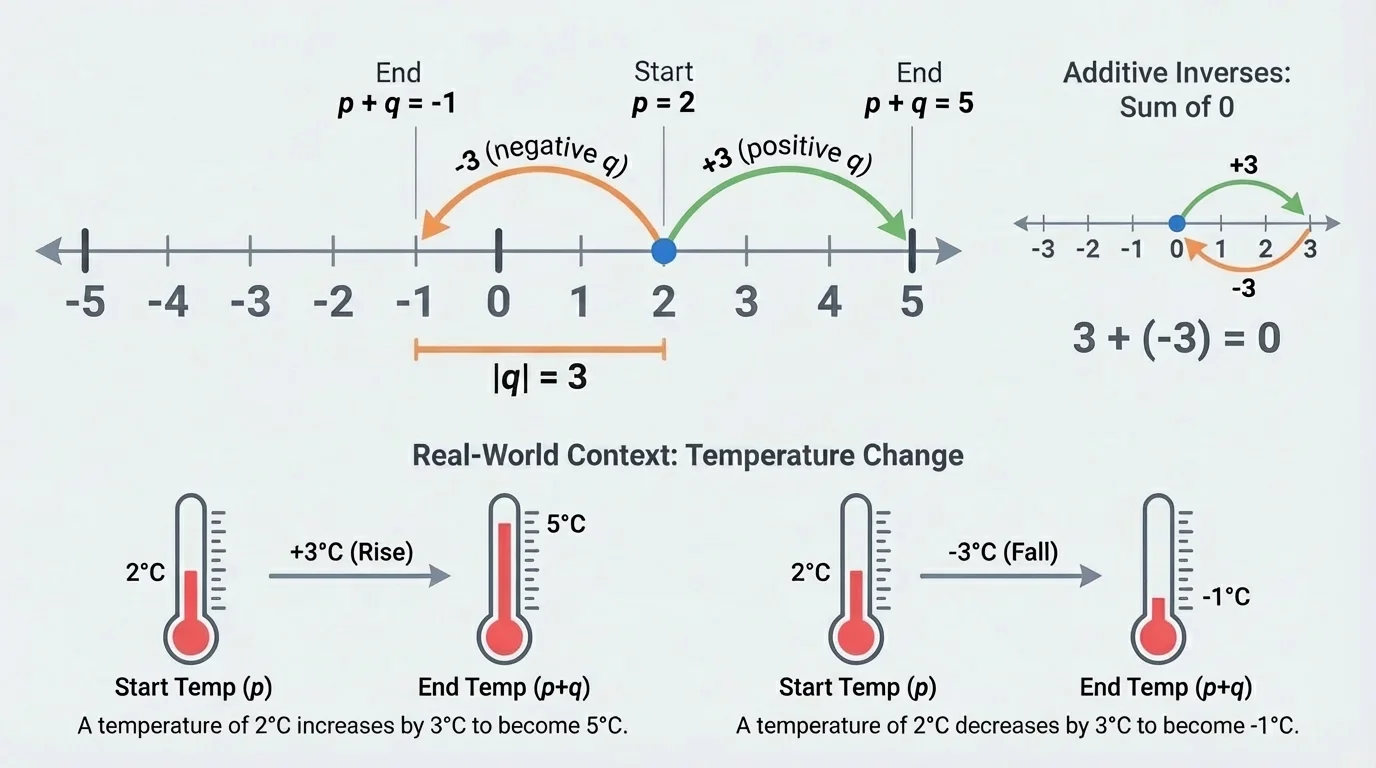
This is why writing \(p + q\) does not always mean the result is larger than \(p\). If \(q\) is negative, then adding \(q\) actually moves in the negative direction. For instance, \(7 + (-10) = -3\), which is less than \(7\).
The same reasoning works with fractions and decimals. In \(-\dfrac{1}{2} + \dfrac{3}{4}\), start at \(-\dfrac{1}{2}\) and move \(\dfrac{3}{4}\) units to the right. You end at \(\dfrac{1}{4}\). In \(1.2 + (-0.7)\), start at \(1.2\) and move \(0.7\) units left to reach \(0.5\).
Some pairs of numbers are especially important. Opposite numbers lie the same distance from \(0\) but on opposite sides, as [Figure 2] illustrates. Examples include \(6\) and \(-6\), \(\dfrac{2}{3}\) and \(-\dfrac{2}{3}\), and \(0.4\) and \(-0.4\).
When you add a number and its opposite, the moves cancel each other. Starting at \(6\) and moving \(6\) units left gives \(0\). Starting at \(-6\) and moving \(6\) units right also gives \(0\).
This leads to an important fact:
\[a + (-a) = 0\]
Any number \(a\) and its opposite \(-a\) are additive inverses.
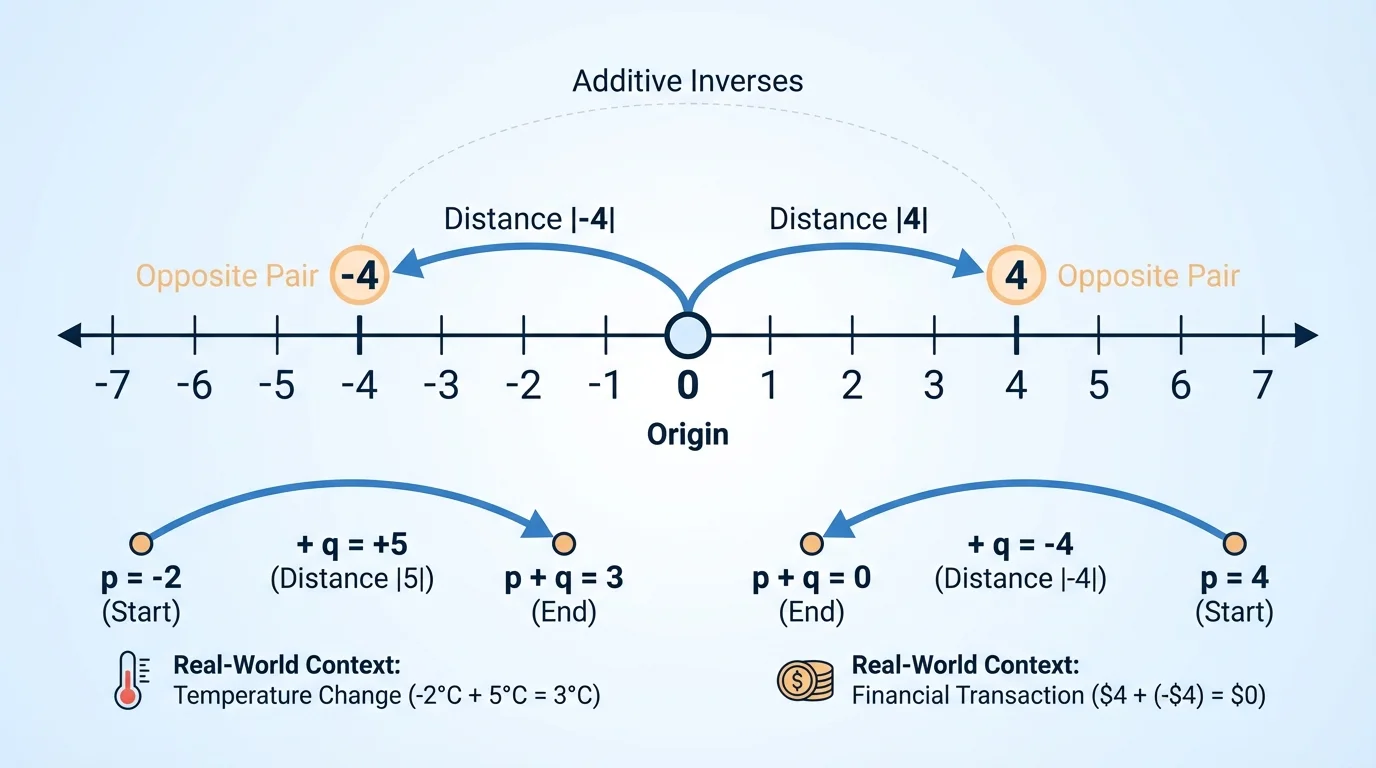
Zero is its own opposite because \(0 + 0 = 0\). This may seem simple, but it matters: it shows that every rational number has an additive inverse.
Understanding additive inverses also helps with subtraction. Subtracting a number is the same as adding its opposite. For example, \(5 - 8\) can be rewritten as \(5 + (-8)\), and that means start at \(5\) and move \(8\) units left.
Financial software, navigation systems, and temperature sensors all rely on the same signed-number ideas. A negative value is not "wrong"; it usually means a quantity is measured in the opposite direction or below a reference point.
Later, when equations become more complex, additive inverses will help you "undo" addition. For example, if \(x + 7 = 2\), adding \(-7\) to both sides works because \(7 + (-7) = 0\).
Now let's connect the ideas to complete solutions. In each example, think about the starting point, the distance \(|q|\), and the direction.
Example 1: Find \(4 + (-7)\)
Step 1: Identify the starting point and the change.
Start at \(p = 4\). The second number is \(q = -7\).
Step 2: Use absolute value to find the distance.
The distance is \(|-7| = 7\).
Step 3: Decide the direction.
Because \(-7\) is negative, move \(7\) units to the left.
Step 4: Find the endpoint.
Starting at \(4\) and moving left \(7\) units lands at \(-3\).
\[4 + (-7) = -3\]
This result makes sense because adding a negative number moves left on the number line.
Example 2: Find \(-\dfrac{3}{4} + \dfrac{5}{4}\)
Step 1: Identify the starting point and change.
Start at \(-\dfrac{3}{4}\). Then add \(\dfrac{5}{4}\).
Step 2: Interpret on the number line.
Since \(\dfrac{5}{4}\) is positive, move right \(\dfrac{5}{4}\) units.
Step 3: Compute using common denominators.
Because the denominators are already the same, add the numerators: \(-3 + 5 = 2\).
Step 4: Write the result.
\(\dfrac{2}{4} = \dfrac{1}{2}\).
\[-\frac{3}{4} + \frac{5}{4} = \frac{1}{2}\]
The number-line meaning and the fraction calculation agree. You start left of zero, move right farther than that, and end at a positive number.
Example 3: Find \(-2.6 + (-1.4)\)
Step 1: Identify the numbers.
Start at \(-2.6\) and add \(-1.4\).
Step 2: Determine distance and direction.
The distance is \(|-1.4| = 1.4\). Because the number is negative, move left.
Step 3: Add the negative values.
Moving left from \(-2.6\) by \(1.4\) lands at \(-4.0\).
Step 4: State the result clearly.
\(-4.0\) is the same as \(-4\).
\[-2.6 + (-1.4) = -4\]
When both addends are negative, you keep moving in the negative direction, so the result is farther left.
Example 4: Show that \(\dfrac{7}{8}\) and \(-\dfrac{7}{8}\) are additive inverses
Step 1: Write the sum.
\(\dfrac{7}{8} + \left(-\dfrac{7}{8}\right)\)
Step 2: Combine the numbers.
The numerators are opposites: \(7 + (-7) = 0\).
Step 3: Simplify.
\(\dfrac{0}{8} = 0\).
\[\frac{7}{8} + \left(-\frac{7}{8}\right) = 0\]
This confirms that a number and its opposite always sum to zero.
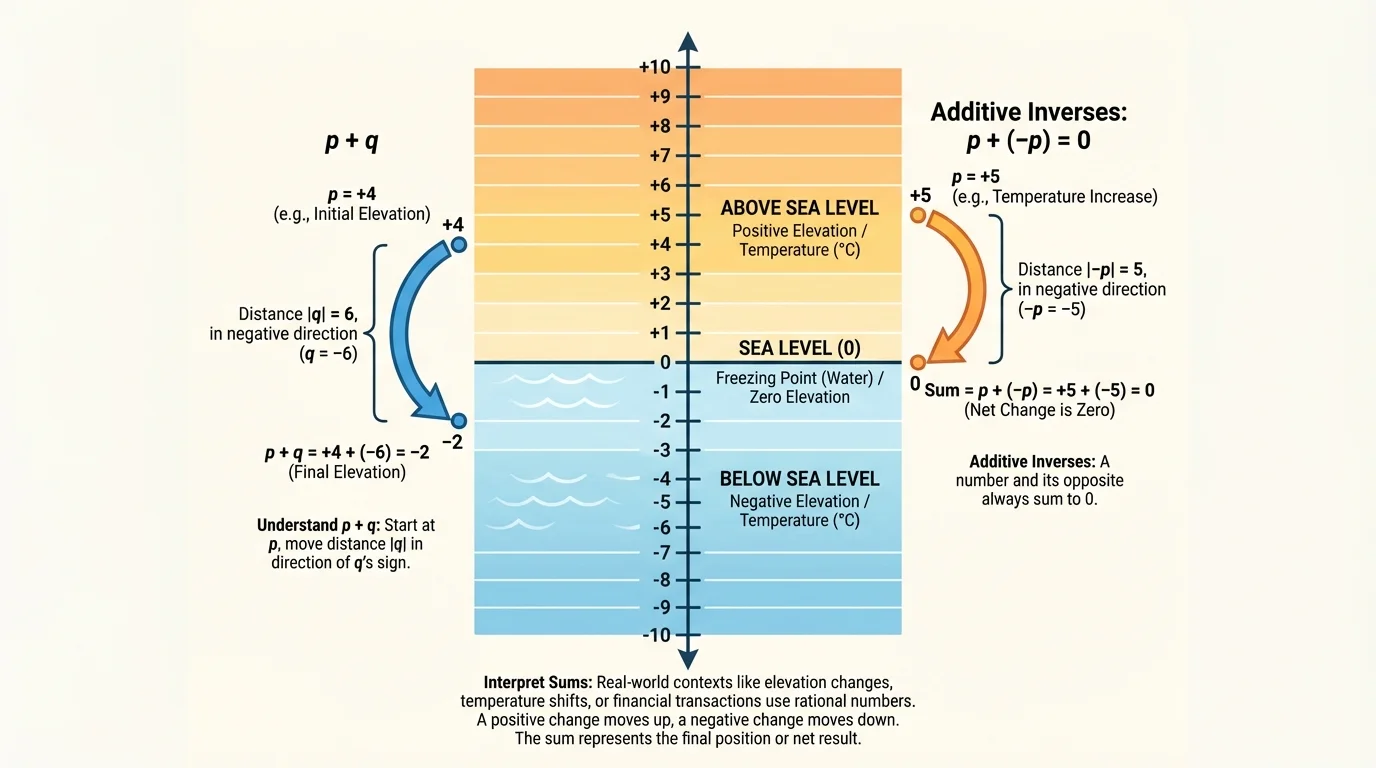
Some sums are easiest to picture vertically, especially in situations involving height, depth, or temperature, as [Figure 3] shows. A vertical number line still follows the same rule: positive means move up, and negative means move down.
Absolute value still tells the size of the change, while the sign tells the direction. That makes signed-number addition useful for many everyday situations.
Temperature: If the temperature is \(-3\) degrees in the morning and rises by \(5\) degrees, the new temperature is \(-3 + 5 = 2\). If it drops by \(4\) degrees instead, the new temperature is \(-3 + (-4) = -7\).
Elevation: A diver starts at sea level, which we call \(0\), and descends \(12.5\) meters. That position is \(-12.5\). If the diver then rises \(4.2\) meters, the new position is \(-12.5 + 4.2 = -8.3\).
Money: Suppose your account balance is \(-15\) dollars, meaning you owe money, and you deposit \(\$22\). Your new balance is \(-15 + 22 = 7\). You are now above zero, so you have \(\$7\).
Sports: A team's point differential is \(-6\), meaning it has been outscored by \(6\) points overall. If the team improves its differential by \(9\), the new differential is \(-6 + 9 = 3\). Now the team is ahead by \(3\).
Elevation above and below sea level: A hiker is at \(150\) meters above sea level and then walks down \(230\) meters. The new elevation is \(150 + (-230) = -80\), which is \(80\) meters below sea level. This matches the vertical movement described earlier.
Context tells what the sign means
The same sum can represent different real situations. In money, negative may mean debt. In temperature, it means below zero. In elevation, it means below sea level. The arithmetic stays the same, but the interpretation depends on the context.
This is one reason rational numbers matter beyond the classroom. They let us track both position and change in a precise way.
Students sometimes think addition always makes numbers bigger. That is not true with signed numbers. For example, \(3 + (-8) = -5\), which is less than \(3\).
Another common mistake is forgetting that the sign of \(q\) determines direction. In \(p + q\), the distance is \(|q|\), but the sign of \(q\) tells whether to move positive or negative.
Here are some useful patterns:
| Situation | Meaning on the number line | Example |
|---|---|---|
| Add a positive number | Move right or up | \(-2 + 5 = 3\) |
| Add a negative number | Move left or down | \(4 + (-6) = -2\) |
| Add opposites | Moves cancel | \(\dfrac{3}{5} + \left(-\dfrac{3}{5}\right) = 0\) |
| Add zero | No movement | \(-7 + 0 = -7\) |
Table 1. Patterns for interpreting sums of rational numbers on a number line.
Adding zero changes nothing because the distance is \(|0| = 0\). No movement means the point stays where it started.
Subtracting can also be rewritten as addition:
\[p - q = p + (-q)\]
This is helpful because it lets us use one main idea: start at \(p\), then move according to the second number.
A horizontal number line is common in math class, but a vertical number line is just as valid. In fact, it is often better for situations like floors in a building, scuba depth, and temperatures above and below zero.
If an elevator starts on floor \(-2\) and goes up \(5\) floors, its new position is \(-2 + 5 = 3\). If it then goes down \(7\) floors, the new position is \(3 + (-7) = -4\).
The same rule is always true: in \(p + q\), begin at \(p\), move a distance \(|q|\), and use the sign of \(q\) to decide the direction. Whether the diagram is horizontal or vertical does not change the meaning.
When you think of addition as movement, rational numbers become much easier to understand. You do not have to rely only on memorized sign rules, because the number line explains why the rules work.
That explanation also makes additive inverses feel natural. If one move goes one way and the opposite move goes the same distance the other way, the result returns to \(0\). That is exactly why \(a + (-a) = 0\), as seen earlier with the opposite-number model in [Figure 2].
Whether you are working with integers, fractions, or decimals, the idea stays consistent. Rational number addition is really about location, distance, direction, and meaning.
