A pilot tracks altitude changes, a video game player gains and loses points, a shopper compares discounts, and a builder measures spaces to the nearest fraction of an inch. These situations may look different, but they all depend on the same skill: solving problems with rational numbers. When numbers can be positive or negative, and when they may appear as whole numbers, fractions, or decimals, careful thinking matters just as much as calculation.
Many real problems are not solved in one step. You may need to read the situation, decide what each number means, choose operations, convert numbers into a more useful form, and then check whether the result makes sense. A single problem might involve a decimal such as \(2.5\), a fraction such as \(\dfrac{3}{4}\), and a negative number such as \(-6\).
In mathematics, these numbers are called rational numbers. A rational number is any number that can be written as a fraction of two integers, with a nonzero denominator. That means whole numbers, fractions, terminating decimals, and repeating decimals all belong to the same family.
A rational number is any positive or negative whole number, fraction, or terminating or repeating decimal. Examples are \(5\), \(-3\), \(\dfrac{2}{7}\), \(-\dfrac{5}{2}\), \(0.6\), and \(-1.25\).
A multi-step problem is a problem that takes more than one operation or more than one decision to solve.
Being good at these problems is not just about getting the right answer. It is also about choosing an efficient path, keeping track of signs, and checking your work in a smart way.
Rational numbers can appear in several forms, and sometimes one form is easier to use than another. For example, \(0.5\), \(\dfrac{1}{2}\), and \(50\%\) all represent the same amount. If you are finding half of a number, the fraction \(\dfrac{1}{2}\) may feel natural. If you are working with money, the decimal \(0.5\) may be easier. If the problem describes a discount or raise, a percent might be best at first.
You should be able to move between forms when needed:
Negative numbers work the same way. For example, \(-0.5 = -\dfrac{1}{2}\). The negative sign tells direction, loss, decrease, or being below a reference point, such as below zero or below sea level.
Remember that adding a negative number is the same as moving left on a number line, and subtracting a negative number is the same as adding its opposite. For example, \(7 + (-3) = 4\) and \(7 - (-3) = 10\).
Mixed numbers also appear in real-world measurements. For instance, \(9\dfrac{3}{4}\) inches means \(9 + \dfrac{3}{4}\) inches. In calculations, it is often easier to convert a mixed number to an improper fraction first: \(9\dfrac{3}{4} = \dfrac{39}{4}\).
Good problem solvers do not use the same method every time. They choose tools strategically. If the problem uses money, decimals may be best. If it uses measurement, fractions may be better. If you only need a quick check, estimation may be enough.
Useful tools include a number line, a calculator, scratch paper, a table, and a labeled drawing. A calculator can help with long decimal work, but it does not replace thinking. You still need to decide what operation to use and whether the answer is reasonable.
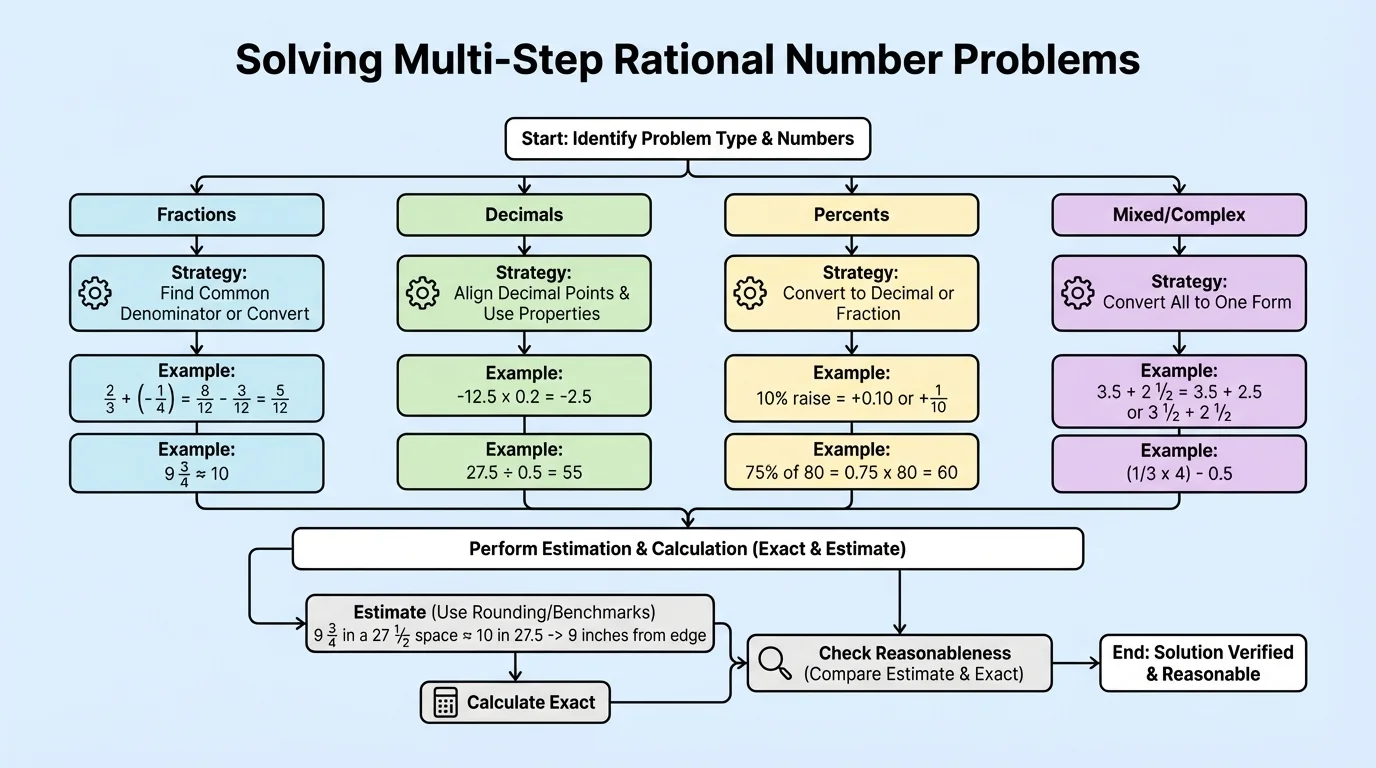
As [Figure 1] suggests, a strong strategy often follows these steps: understand the situation, identify what is known and unknown, choose operations, calculate carefully, and check the result. In algebra, this may also mean writing an expression or equation before solving.
A useful problem-solving habit is to ask, "What does each number represent?" A negative number may mean a loss, a drop, or a direction. A fraction may represent part of a whole. A decimal may represent money or a measured amount. Understanding the meaning prevents many mistakes.
Later, when you estimate with benchmark numbers, the same strategic choices from [Figure 1] still matter. You may decide to round decimals, replace a fraction with a nearby familiar fraction, or convert everything to one form before combining numbers.
Properties of operations help you calculate efficiently and write equivalent expressions. The commutative property says you can change the order in addition or multiplication: \(a + b = b + a\) and \(ab = ba\).
The associative property says you can change the grouping in addition or multiplication: \((a + b) + c = a + (b + c)\) and \((ab)c = a(bc)\). This is useful when some numbers combine easily, such as \((-2.5) + 2.5 + 4 = 4\).
The distributive property connects multiplication and addition: \(a(b + c) = ab + ac\). For example, \(3\left(\dfrac{1}{2} + 2\right) = 3\cdot\dfrac{1}{2} + 3\cdot 2 = \dfrac{3}{2} + 6\).
These properties are helpful in both arithmetic and algebra. They can reduce the amount of computation and make patterns easier to see.
| Property | General Form | Example |
|---|---|---|
| Commutative | \(a+b=b+a\) | \(-1.2+3=3+(-1.2)\) |
| Associative | \((a+b)+c=a+(b+c)\) | \((\dfrac{1}{4}+\dfrac{3}{4})+2=\dfrac{1}{4}+(\dfrac{3}{4}+2)\) |
| Distributive | \(a(b+c)=ab+ac\) | \(5(0.2+1)=5(0.2)+5(1)\) |
Table 1. Three important properties of operations used to simplify calculations.
A woman earns \(\$25\) per hour and receives a \(10\%\) raise. What is her new hourly wage?
Worked example
Step 1: Find the amount of the raise.
A \(10\%\) raise means \(\dfrac{10}{100} = 0.10\) of the original wage.
Compute \(0.10 \times 25 = 2.5\), so the raise is \(\$2.50\).
Step 2: Add the raise to the original wage.
\(25 + 2.5 = 27.5\)
The new hourly wage is \(\$27.50\).
You can also reason mentally: \(10\%\) is one-tenth, and one-tenth of \(\$25\) is \(\$2.50\). That quick check confirms the answer.
As [Figure 2] shows, a towel bar is \(9 \dfrac{3}{4}\) inches long and a door is \(27 \dfrac{1}{2}\) inches wide. To center the bar, the empty space on both sides must be equal.
We want the distance from each edge of the door to the towel bar.
Worked example
Step 1: Convert mixed numbers to improper fractions.
\(27\dfrac{1}{2} = \dfrac{55}{2}\)
\(9\dfrac{3}{4} = \dfrac{39}{4}\)
Step 2: Find the total empty space.
Use a common denominator of \(4\): \(\dfrac{55}{2} = \dfrac{110}{4}\)
Then \(\dfrac{110}{4} - \dfrac{39}{4} = \dfrac{71}{4}\)
So the empty space is \(\dfrac{71}{4} = 17\dfrac{3}{4}\) inches.
Step 3: Split the empty space equally on both sides.
\(\dfrac{71}{4} \div 2 = \dfrac{71}{4} \cdot \dfrac{1}{2} = \dfrac{71}{8} = 8\dfrac{7}{8}\)
The towel bar should be placed \(8\dfrac{7}{8}\) inches from each edge.
An estimate is a great check. Round \(27\dfrac{1}{2}\) to about \(28\) and \(9\dfrac{3}{4}\) to about \(10\). Then \(28 - 10 = 18\), and \(18 \div 2 = 9\). Since \(8\dfrac{7}{8}\) is close to \(9\), the answer is reasonable.
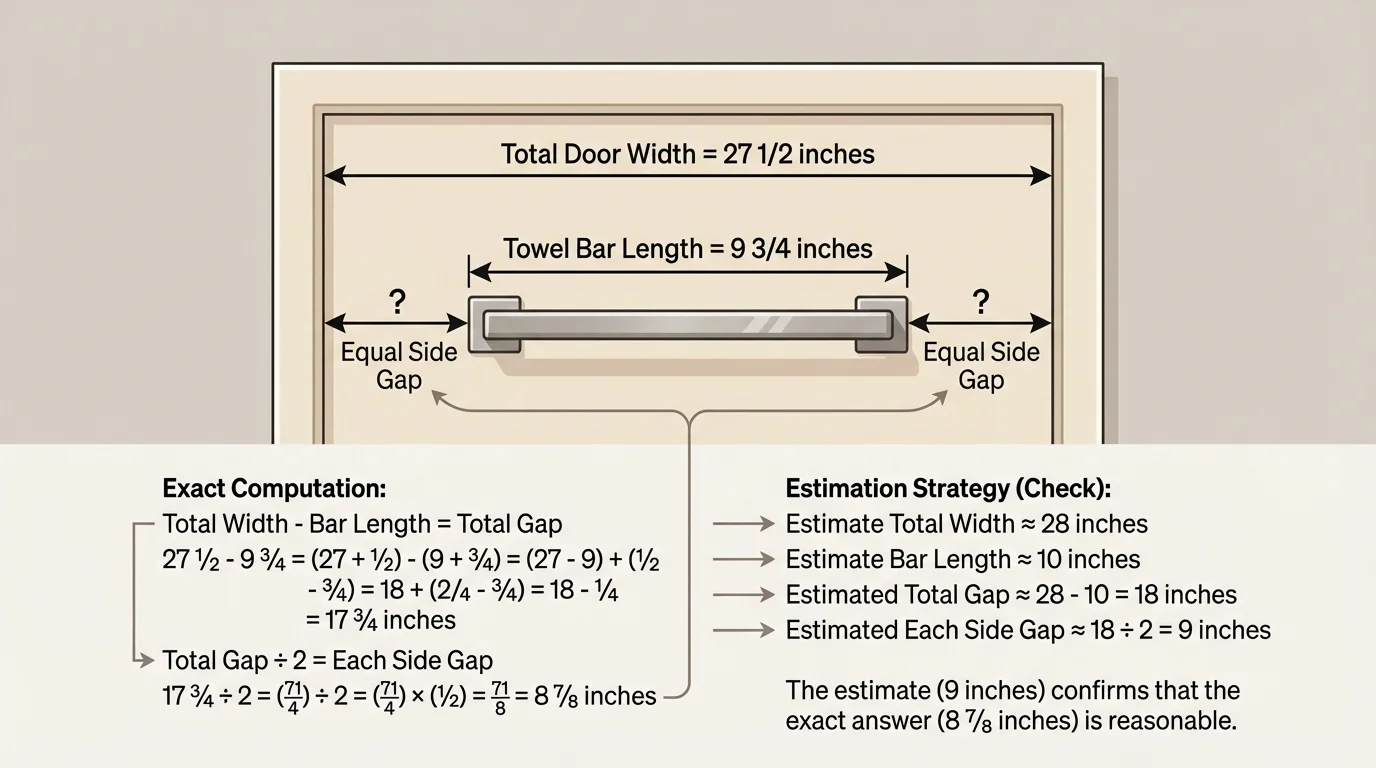
When measurements involve fractions, keeping them as fractions often avoids rounding too early. That is one reason builders and designers frequently work with fractional lengths.
A scuba diver starts at sea level, descends \(18.5\) meters, then rises \(6.75\) meters, and finally descends another \(2\dfrac{1}{4}\) meters. What is the diver's final position relative to sea level?
Worked example
Step 1: Represent movements with signs.
Descending is negative, so the changes are \(-18.5\), \(+6.75\), and \(-2\dfrac{1}{4}\).
Step 2: Convert to a common useful form.
\(2\dfrac{1}{4} = 2.25\), so the expression is \(-18.5 + 6.75 - 2.25\).
Step 3: Compute step by step.
\(-18.5 + 6.75 = -11.75\)
\(-11.75 - 2.25 = -14\)
The diver ends at \(-14\) meters, which means \(14\) meters below sea level.
The sign is important. A result of \(-14\) does not mean the calculation is wrong. It tells the diver's position is below the reference point of \(0\).
A recipe uses \(\dfrac{3}{4}\) cup of yogurt for one batch. A cook makes \(2.5\) batches. How many cups of yogurt are needed?
Worked example
Step 1: Decide which form is easier to use.
We can convert \(2.5\) to \(\dfrac{5}{2}\), so the multiplication becomes \(\dfrac{3}{4} \times \dfrac{5}{2}\).
Step 2: Multiply fractions.
\(\dfrac{3}{4} \times \dfrac{5}{2} = \dfrac{15}{8}\)
Step 3: Write the answer in a useful form.
\(\dfrac{15}{8} = 1\dfrac{7}{8} = 1.875\)
The cook needs \(1\dfrac{7}{8}\) cups of yogurt.
In cooking, a fraction such as \(1\dfrac{7}{8}\) cups may be more practical than \(1.875\) cups. Choosing the best form depends on the context.
Professional cooks, carpenters, and engineers often switch between decimals and fractions depending on the tools they use. A calculator may display a decimal, but a measuring tape may be marked in fractions.
This is why converting between forms is not just a school skill. It helps people communicate quantities in the form that makes the most sense.
Sometimes a problem gives all the numbers, and you write a numerical expression. Other times, one quantity is unknown, and you use a variable to write an equation.
Suppose a student has \(\$12\) in lunch money and spends \(\$2.75\) each day for \(d\) days. The amount left is \(12 - 2.75d\). This expression shows repeated subtraction through multiplication.
If the student has \(\$1\) left, then the equation is \(12 - 2.75d = 1\). Subtract \(12\) from both sides to get \(-2.75d = -11\), and then divide by \(-2.75\) to find \(d = 4\). This means the money covers \(4\) days of lunches, with \(\$1\) remaining.
Expressions and equations are useful because they organize information clearly. They also help you see which operations belong together.
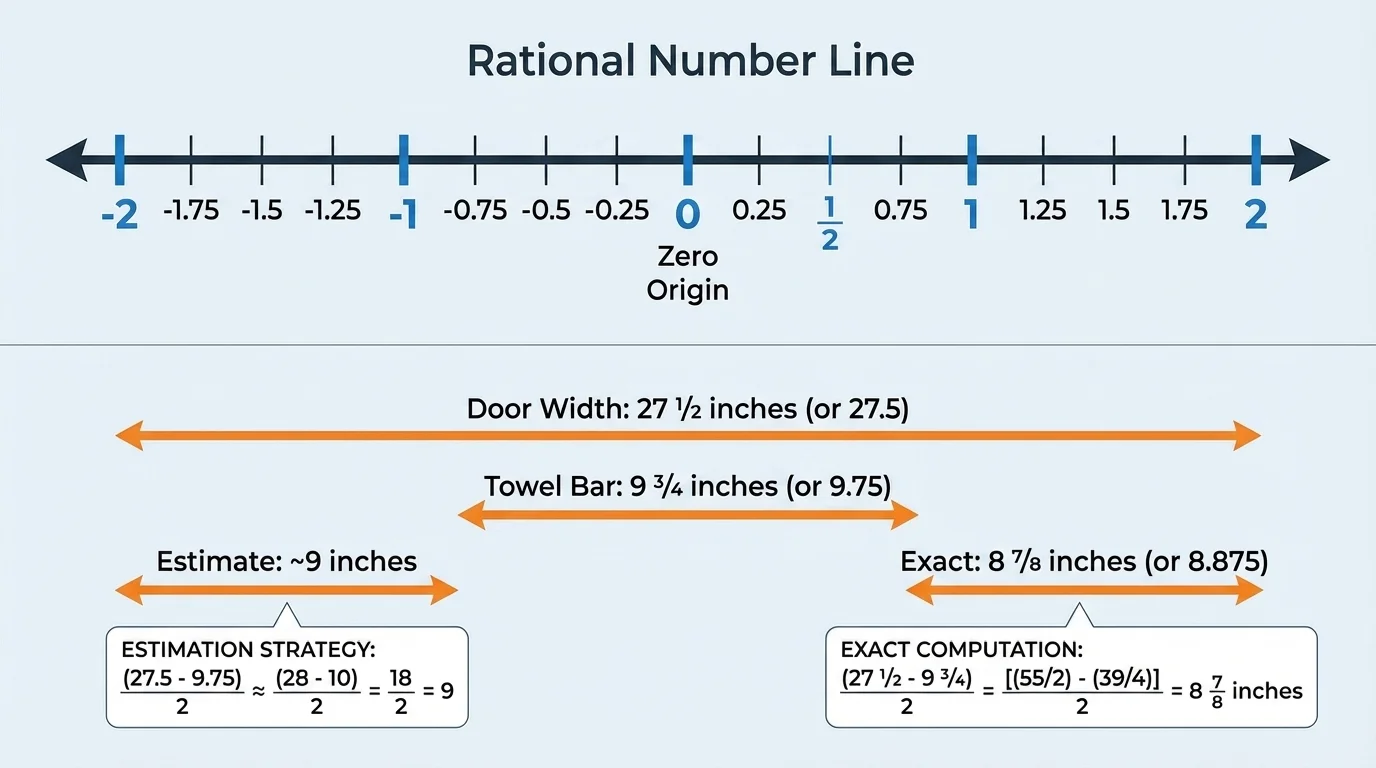
As [Figure 3] shows, before trusting a final answer, ask whether it makes sense. One effective method is to use estimation. Benchmark numbers on a number line help you compare the size and sign of rational numbers quickly.
For example, \(0.49\) is close to \(0.5\), \(\dfrac{49}{100}\). Also, \(-1.98\) is close to \(-2\). These nearby values make mental calculations easier.
Here are several ways to check reasonableness:
Suppose you calculate \(-3.2 + 1.1 = 4.3\). Estimation shows a problem immediately. Since \(-3.2\) and \(+1.1\) combine to a number a little above \(-2\), a positive answer cannot be correct. The likely correct answer is \(-2.1\).
Later, when solving more complex expressions, the benchmark view from [Figure 3] helps you decide whether values are near \(0\), near \(1\), or far into the negative or positive side.
One common error is losing track of negative signs. For example, \(5 - 8\) is \(-3\), not \(3\). Another common error is mixing forms carelessly, such as adding \(\dfrac{1}{2}\) and \(0.3\) without realizing that \(\dfrac{1}{2} = 0.5\).
A second error is rounding too early. If you round in the middle of a problem, your final answer may drift away from the exact value. Estimate to check, but keep exact numbers during the main calculation when possible.
A third error is using the wrong operation. Words like decrease, shared equally, per, increase by, and of often signal subtraction, division, multiplication, addition, and multiplication.
Signs and context go together. In a bank account problem, a deposit is positive and a withdrawal is negative. In a temperature problem, warming is positive and cooling is negative. The same number can mean different things in different situations, so always connect the sign to the story.
Careful labels can help. Write units, mention whether a number is above or below a reference point, and state what the final answer means in words.
Rational-number problem solving appears in many fields. In finance, people calculate tips, discounts, taxes, and percent changes. In sports, players track gains and losses in points, times, and averages. In construction, workers use fractions and mixed numbers to measure lengths accurately. In science, temperature changes and elevations often involve negative values.
Travel also uses these ideas. If a hiker climbs \(450.5\) meters, then descends \(275.75\) meters, the net change is \(450.5 - 275.75 = 174.75\) meters. That answer should be positive, because the hiker ended higher than the starting point.
Technology depends on this thinking too. Computer programs often process decimal values, negative coordinates, and repeated calculations. Whether a person is designing a bridge, managing a budget, or tracking a spacecraft, organized work with rational numbers matters.
"An answer is not finished until you know it makes sense."
That idea is powerful in mathematics. A correct method, a clear calculation, and a reasonable final answer all work together.
