A phone screen rotates, a map is flipped, and a company logo is slid across a page. In each case, the picture changes where it is or how it faces, but something important stays the same: the corners do not suddenly become wider or narrower. That idea is one of the most powerful facts in geometry. When a figure is moved by certain transformations, every angle in the figure is taken to an angle of the same measure.
Geometry is not only about drawing shapes. It is also about understanding which properties stay unchanged when shapes move. If a triangle is turned, flipped, or slid, we still think of it as the same triangle shape. One reason is that its sides keep the same lengths. Another reason is that its angles keep the same measures.
When we say that angles are taken to angles of the same measure, we mean this: if an angle in the original figure measures, for example, \(52^\circ\), then the corresponding angle in the image after the transformation also measures \(52^\circ\). The angle may point in a different direction, but its size stays the same.
Angle measure is the amount of turn between two rays that form an angle, usually measured in degrees.
Transformation is a rule that moves a figure in a plane.
Rigid motion is a transformation that preserves distances and angle measures. The main rigid motions are translation, rotation, and reflection.
This idea is part of what makes rigid motions so useful. They let us move figures without stretching, shrinking, or bending them. Because of that, rigid motions help explain why two figures can be congruent: one can be matched exactly onto the other by a sequence of moves.
A rigid motion preserves the size of every angle. No matter whether the figure slides, turns, or flips, the angle markings still match. If \(\angle A = 40^\circ\) in the original figure, then the corresponding image angle also measures \(40^\circ\).
[Figure 1] The three basic rigid motions are a translation, a rotation, and a reflection. Each one changes position in a different way, but all three keep angle measure unchanged. In symbols, if point \(A\) goes to \(A'\), point \(B\) goes to \(B'\), and point \(C\) goes to \(C'\), then angle \(\angle ABC\) is taken to angle \(\angle A'B'C'\), and their measures are equal:
\[m\angle ABC = m\angle A'B'C'\]
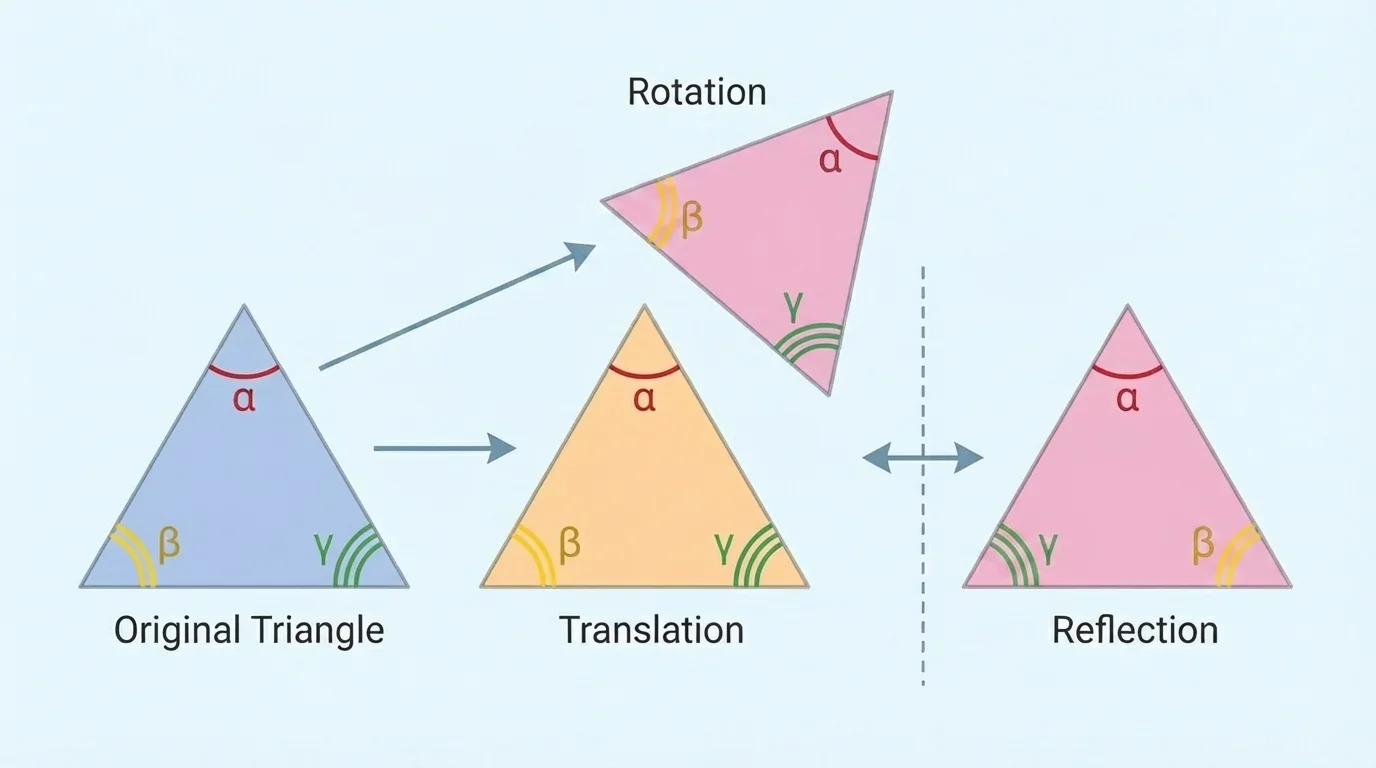
This matters because angle measure describes shape. A triangle with angles \(50^\circ\), \(60^\circ\), and \(70^\circ\) has a different shape from one with angles \(30^\circ\), \(60^\circ\), and \(90^\circ\). If a transformation changed angle measures, it would change the shape itself. Rigid motions do not do that.
You can think of a rigid motion as moving a cardboard cutout across a desk. You can slide it, turn it, or flip it over, but the corners remain the same size. That physical idea is one way to understand why the image angle always matches the original angle.
A translation moves every point of a figure the same distance in the same direction. It is often called a slide. Because the figure is not turned or stretched, each angle lands on a new location with exactly the same opening. If \(\angle P = 95^\circ\) before the translation, then its image angle is still \(95^\circ\).
A rotation turns a figure around a fixed point called the center of rotation. The figure may face a new direction after the turn, but each angle keeps its measure. For example, rotating a rectangle \(90^\circ\) changes its orientation, yet every right angle remains \(90^\circ\).
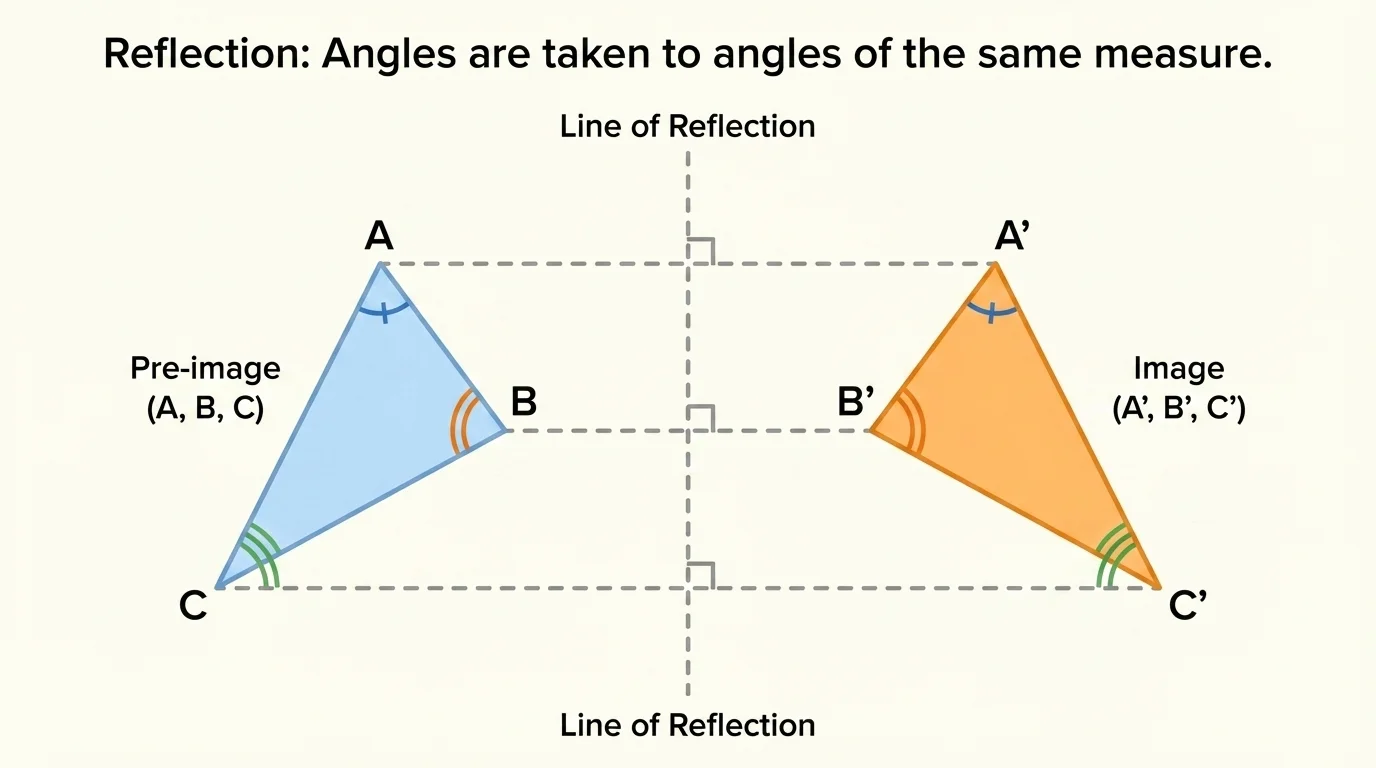
A reflection flips a figure across a line called the line of reflection. This can make the figure look reversed, but the angle sizes still do not change. A reflected \(35^\circ\) angle is still \(35^\circ\), even though it opens in the opposite direction.
[Figure 2] One subtle point is important here: the orientation of an angle may change, especially under reflection, but the corresponding angles remain equal in measure. Geometry cares about the amount of turning between the sides of the angle, not whether it leans left or right.
Later, when students study congruence more deeply, this property becomes one of the reasons transformations are used to define congruent figures. If every side length and every angle measure stays the same under a rigid motion, then the image fits exactly on the original figure.
You already know that an angle is named with three points, and the middle point is the vertex. For example, in \(\angle ABC\), the vertex is \(B\). That naming rule still matters after a transformation because the image angle must be named using the corresponding image points in the same order.
Suppose a triangle \(ABC\) is rotated to triangle \(A'B'C'\). Angle \(\angle ABC\) matches angle \(\angle A'B'C'\), not some random angle in the image. Keeping track of the vertex correspondence is a big part of reading transformations correctly.
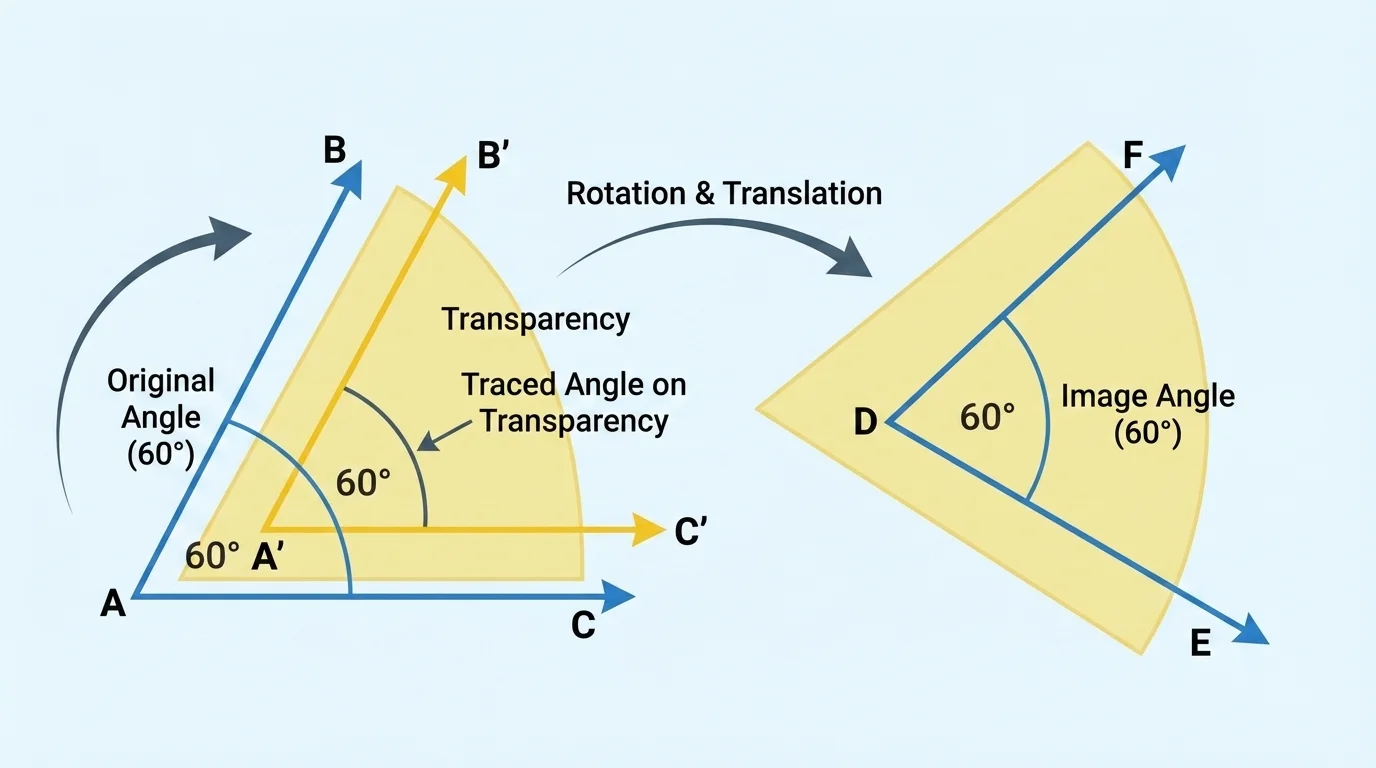
Geometry is not only proved with symbols; it can also be tested by careful observation. Using tracing paper, a transparency, or geometry software, students can verify that angle measure is preserved. This means you can actually move a copy of a figure and check whether its angles still line up exactly with the image.
[Figure 3] Here is the basic idea. First, draw a figure with a marked angle, such as \(\angle XYZ = 68^\circ\). Then trace the figure. Next, slide, rotate, or reflect the tracing so that it matches the image of the figure. If the transformation is a rigid motion, the traced angle overlaps the image angle exactly. Since they coincide perfectly, they have the same measure.
On grid paper or in geometry software, you can also compare numerical angle measures before and after the move. For instance, if software reports that the original angle has measure \(112^\circ\), then after a translation, rotation, or reflection, the corresponding image angle still reads \(112^\circ\). This is an experimental way to confirm the property.
Experimental verification is valuable because it connects abstract geometry to physical actions. It helps students see that the rule is not just a sentence to memorize. It is something visible and testable.
When a figure is transformed, points usually receive prime marks. So \(A\) becomes \(A'\), \(B\) becomes \(B'\), and so on. That notation helps us match each original angle with its image angle. If \(\angle DEF\) is an angle in the original figure, then the image angle is \(\angle D'E'F'\).
Notice that the middle letter stays the vertex. If \(E\) is the vertex of the original angle, then \(E'\) is the vertex of the image angle. This is why naming angles carefully matters. The statement
\[m\angle DEF = m\angle D'E'F'\]
is meaningful because the matching points have been correctly paired.
[Figure 4] If the figure is a polygon, every interior angle has a corresponding image angle. For example, if quadrilateral \(ABCD\) is reflected to \(A'B'C'D'\), then \(\angle A\) corresponds to \(\angle A'\), \(\angle B\) corresponds to \(\angle B'\), and so on. Even if the order looks reversed in a reflection, the corresponding angle measures remain equal.
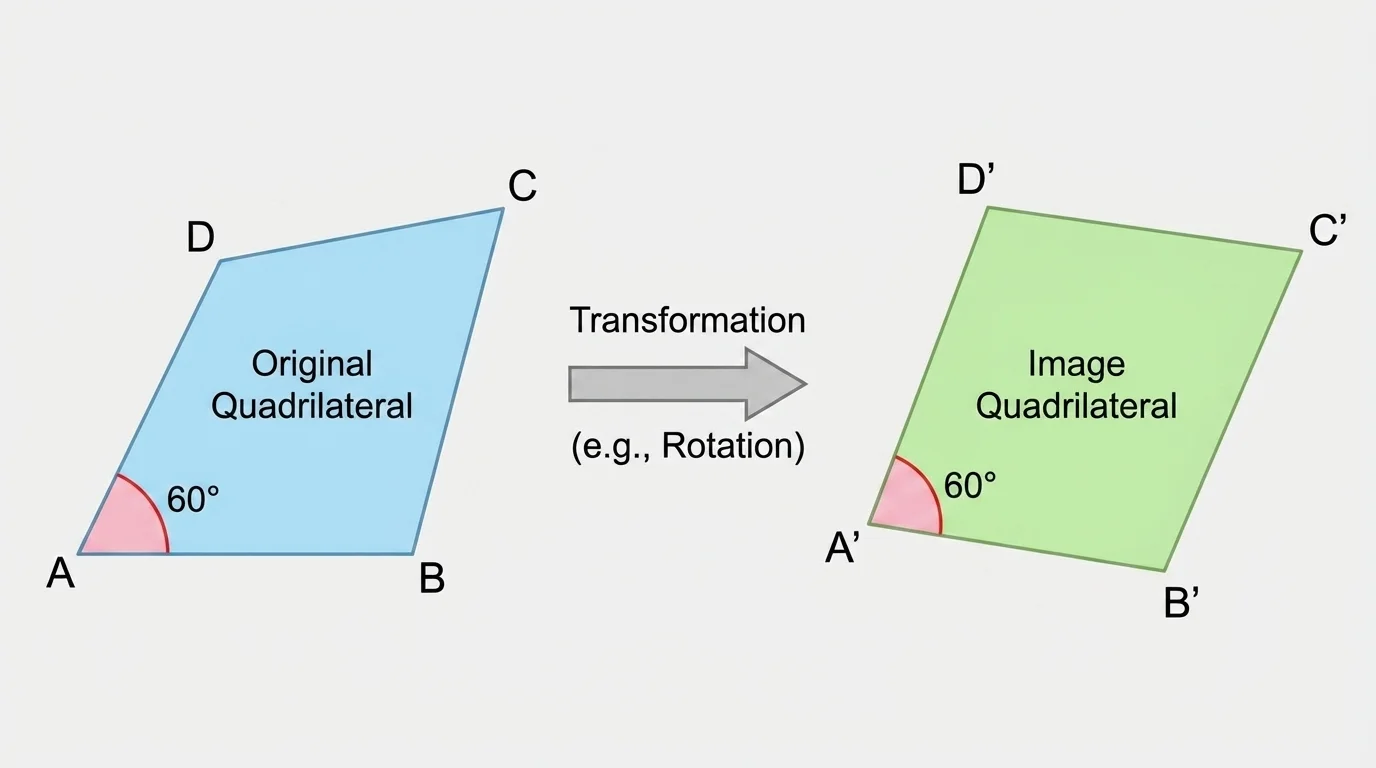
This matching process becomes especially important in proofs and problem solving. If a diagram tells you that \(m\angle C = 47^\circ\) and the figure is translated, rotated, or reflected, then you immediately know that the corresponding image angle also measures \(47^\circ\).
Worked example 1
Triangle \(ABC\) is translated to triangle \(A'B'C'\). If \(m\angle ABC = 63^\circ\), find \(m\angle A'B'C'\).
Step 1: Identify the transformation.
A translation is a rigid motion, so it preserves angle measure.
Step 2: Match the corresponding angles.
Angle \(\angle ABC\) corresponds to angle \(\angle A'B'C'\).
Step 3: Use the preservation rule.
Since corresponding angles have equal measure, \(m\angle A'B'C' = 63^\circ\).
Therefore,
\[m\angle A'B'C' = 63^\circ\]
That example is simple, but it shows the main idea clearly: moving a figure does not change the angle size.
Worked example 2
A pentagon is reflected across a line. One angle in the original pentagon measures \(118^\circ\). A student says the image angle is different because the figure is reversed. Is the student correct?
Step 1: Identify what reflection changes.
A reflection changes orientation, meaning the figure looks like a mirror image.
Step 2: Identify what reflection preserves.
A reflection is still a rigid motion, so it preserves distances and angle measures.
Step 3: State the conclusion.
Even though the figure is reversed, the corresponding image angle still measures \(118^\circ\).
The student is not correct. The image angle has the same measure:
\(118^\circ\)
This is exactly the kind of situation where students mix up direction with measure. Reflection can reverse left and right, but it does not make an angle wider or narrower.
Worked example 3
Triangle \(PQR\) is rotated to triangle \(P'Q'R'\). Suppose \(m\angle P = 2x + 15^\circ\) and \(m\angle P' = 5x - 24^\circ\). Find \(x\).
Step 1: Use the fact that rotation preserves angle measure.
Since \(\angle P\) corresponds to \(\angle P'\), set their measures equal:
\(2x + 15 = 5x - 24\)
Step 2: Solve the equation.
Subtract \(2x\) from both sides: \(15 = 3x - 24\).
Add \(24\) to both sides: \(39 = 3x\).
Divide by \(3\): \(x = 13\).
Step 3: Check the angle measure.
Substitute \(x = 13\):
\(2(13) + 15 = 26 + 15 = 41\)
and
\(5(13) - 24 = 65 - 24 = 41\)
So the value of \(x\) is
\(x = 13\)
This example shows that transformation facts can also help solve algebra problems.
Worked example 4
Quadrilateral \(JKLM\) is translated to \(J'K'L'M'\). If the original quadrilateral has angle measures \(90^\circ\), \(110^\circ\), \(70^\circ\), and \(90^\circ\), what are the image angle measures?
Step 1: Recall the property of translations.
A translation preserves angle measure.
Step 2: Match each angle with its image.
\(\angle J \leftrightarrow \angle J'\), \(\angle K \leftrightarrow \angle K'\), \(\angle L \leftrightarrow \angle L'\), and \(\angle M \leftrightarrow \angle M'\).
Step 3: Copy the measures to the image.
The image angles are \(90^\circ\), \(110^\circ\), \(70^\circ\), and \(90^\circ\).
Therefore, the transformed quadrilateral keeps exactly the same set of angle measures:
\[90^\circ,\ 110^\circ,\ 70^\circ,\ 90^\circ\]
As we saw earlier in [Figure 1], the image may be in a different place or facing a different direction, but the matching angle measures stay the same.
One common mistake is thinking that a rotated angle changes size because it points somewhere new. But direction and measure are different ideas. An angle of \(45^\circ\) remains \(45^\circ\) whether it points up, down, left, or right.
Another common mistake is with reflections. Because the image looks reversed, students sometimes think the angle has changed. The reflection picture in [Figure 2] helps show why that is false: the angle opens the same amount even though the figure is mirrored.
A third mistake is matching the wrong vertices. If \(\angle ABC\) is the original angle, the corresponding image angle must use the corresponding image points in order: \(\angle A'B'C'\). A naming error can make a true statement look false.
| Transformation | What changes | What stays the same |
|---|---|---|
| Translation | Location | Side lengths, angle measures |
| Rotation | Location and orientation | Side lengths, angle measures |
| Reflection | Location and orientation | Side lengths, angle measures |
Table 1. Comparison of what translations, rotations, and reflections change and preserve.
Engineers and architects depend on angle-preserving moves when they copy or reposition parts of a design. If a support beam is shown at a certain angle in one part of a plan, rotating or translating the drawing must not change that angle. Otherwise, the design would no longer represent the same object.
Computer graphics use the same principle. When a video game rotates a character or reflects a shape across a line of symmetry, the image must keep its original form. If the software changed the angle measures during the motion, the object would appear distorted.
Robotics also relies on transformations. A robot arm may rotate tools or move objects from one position to another. The shape of a part does not change just because it is turned. That means the angles in the part remain the same during the movement.
Modern animation software constantly applies transformations to images. When a figure is rotated on a screen, the computer recalculates point locations while preserving geometric properties such as distance and angle measure.
Mapmaking and navigation give another example. A symbol on a map may be moved or rotated for clarity, but its shape must stay consistent. Preserving angle measure helps the symbol remain recognizable.
Experimental tools matter in these settings too. Designers often test movements using models, digital overlays, or software, much like the verification process described with [Figure 3]. The geometry idea stays the same whether the tool is a sheet of tracing paper or an advanced design program.
When two figures can be matched by translations, rotations, reflections, or a combination of these, they are congruent. The reason this works is that rigid motions preserve the key parts of shape: side lengths and angle measures.
So whenever you read that a figure has been translated, rotated, or reflected, you should immediately know something important. Every angle in the original figure is taken to a corresponding angle in the image, and the measures are equal.
That simple fact is one of the foundations of transformation geometry.
