A photo on your phone can shrink to fit a screen, a logo can grow to fit a billboard, and a map can represent an entire city on a small piece of paper. In each case, the picture changes size, but its shape stays the same. That idea is at the heart of geometry: two figures are similar when one can be obtained from the other by a sequence of rotations, translations, reflections, and dilations.
Similarity is about the same shape, not necessarily the same size. If you draw a small triangle and then make an enlarged copy where every side is multiplied by the same number, the new triangle is similar to the original. The two triangles are not congruent unless the scale factor is exactly \(1\), but they still match in shape.
This matters in real life because many objects are made as scaled copies. Architects use scale drawings. Engineers use models. Phones and computers resize images. When the resizing keeps the shape unchanged, similarity is being used.
Remember: Congruent figures have the same shape and the same size. They can be matched by rigid transformations only: translations, rotations, and reflections. Similar figures have the same shape, but the size may change, so a dilation may also be needed.
To understand similarity well, you need to know the four transformations that appear in this topic.
The four transformations are translation, rotation, reflection, and dilation. As [Figure 1] shows, the first three move a figure without changing its size, while dilation changes the size in a controlled way.
A translation slides a figure. Every point moves the same distance in the same direction. A rotation turns a figure around a center point. A reflection flips a figure across a line, like a mirror image. A dilation enlarges or shrinks a figure from a center by a scale factor.
Translations, rotations, and reflections preserve lengths and angle measures exactly. That is why they are called rigid motions. Dilation is different: it changes side lengths, but it keeps angle measures the same and multiplies all lengths by the same factor.
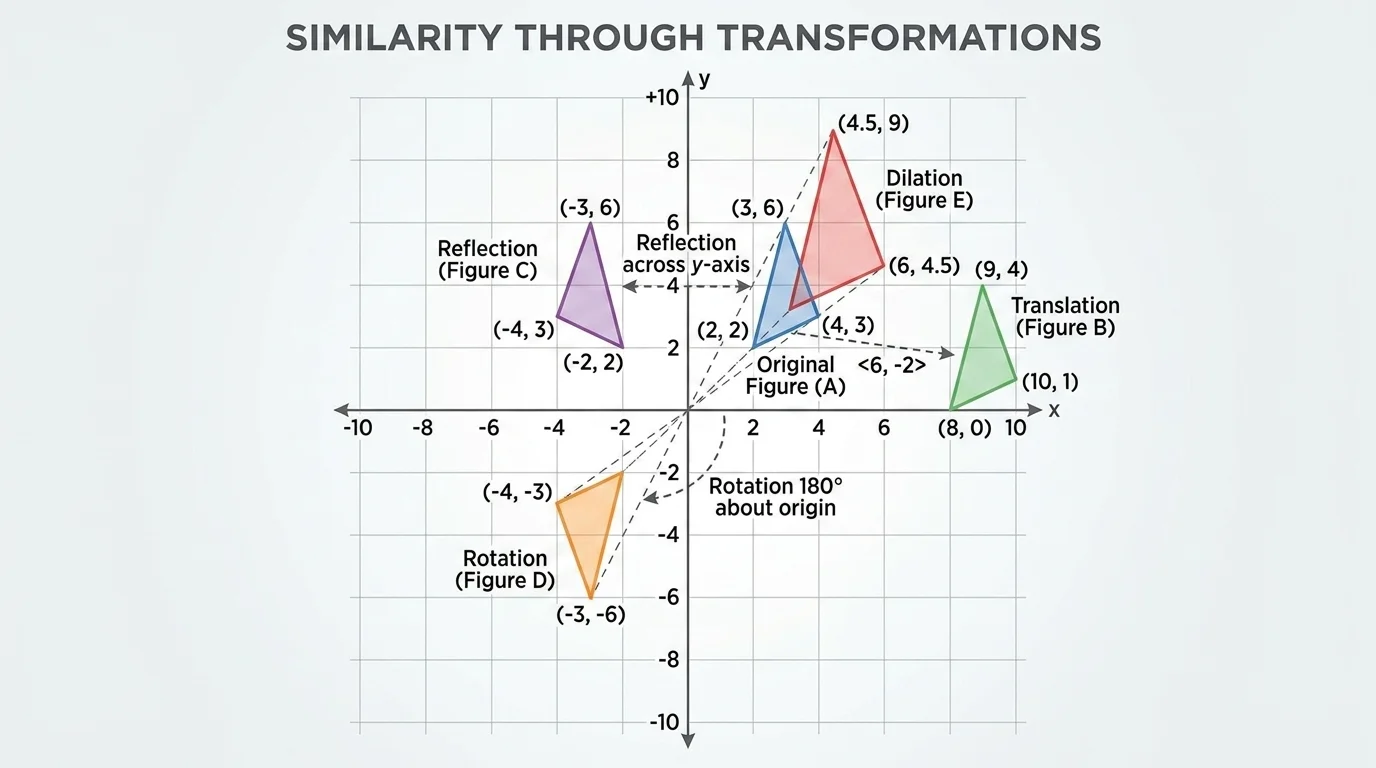
If the scale factor is greater than \(1\), the image gets larger. If the scale factor is between \(0\) and \(1\), the image gets smaller. For example, a dilation with scale factor \(2\) doubles every distance from the center, while a dilation with scale factor \(\dfrac{1}{2}\) cuts every distance in half.
Similar figures are two-dimensional figures for which one can be obtained from the other by a sequence of rotations, reflections, translations, and dilations.
Scale factor is the number that tells how much a dilation enlarges or shrinks a figure.
Corresponding parts are matching sides and matching angles in two figures being compared.
Because a dilation changes all lengths by the same multiplier, it keeps the figure's shape. That is the key reason it belongs in the definition of similarity.
Two figures are similar if one can be mapped onto the other using a sequence of transformations. This transformation idea matches an important shape rule: as [Figure 2] illustrates, corresponding angles are equal and corresponding side lengths are proportional.
Suppose triangle \(ABC\) is similar to triangle \(DEF\). Then the matching angles satisfy \(\angle A = \angle D\), \(\angle B = \angle E\), and \(\angle C = \angle F\). The matching side lengths satisfy one common ratio, such as
\[\frac{DE}{AB} = \frac{EF}{BC} = \frac{DF}{AC}\]
If all those ratios are equal to the same number \(k\), then \(k\) is the scale factor from the first figure to the second.
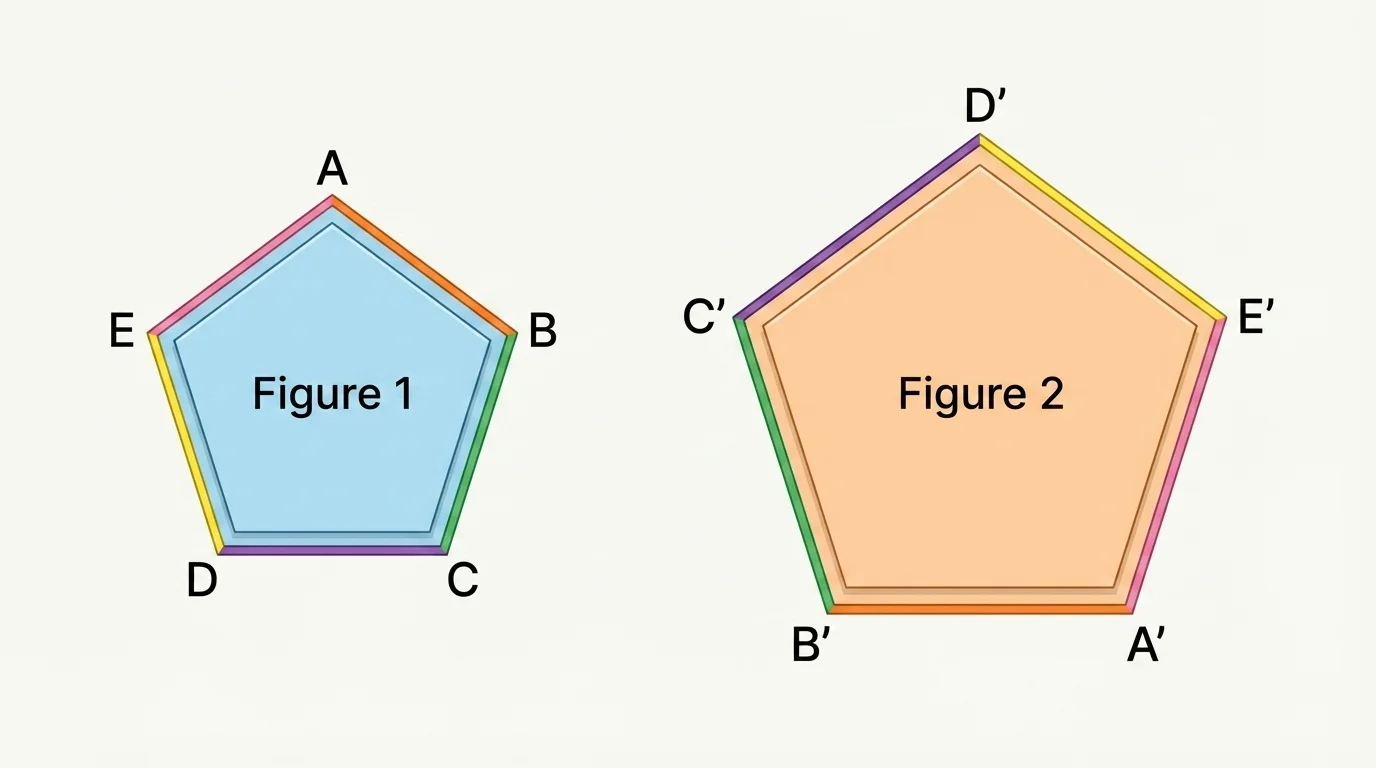
Notice the difference between similar and congruent. Congruent figures have scale factor \(1\). Similar figures can have scale factor \(1\), but they can also have any positive scale factor, such as \(2\), \(\dfrac{3}{4}\), or \(5\).
Later, when you check your answers, use both ideas: ask whether the shape is preserved and whether a sequence of allowed transformations exists. The side ratios and angle matches help confirm what [Figure 2] displays visually.
When two figures are similar, your job is often to describe a sequence of transformations that maps one figure to the other. As [Figure 4] and [Figure 3] show, a good strategy is to think of the sequence as a path: first deal with size, then with orientation, then with position.
One valid path can include a reflection before the final translation into place.
Here is a helpful method:
Step 1: Compare corresponding side lengths to find the scale factor.
Step 2: Use a dilation to make the sizes match.
Step 3: If necessary, use a reflection to fix a mirror-image situation.
Step 4: Use a rotation to turn the figure into the correct direction.
Step 5: Use a translation to slide the figure into the exact place.
The order can vary. Sometimes you translate first so that the center of dilation is more convenient. Sometimes a reflection is not needed. Sometimes a rotation is unnecessary. What matters is that the sequence actually maps every point of one figure to the corresponding point of the other.
On a coordinate plane, this is often easier because you can compare coordinates. If one triangle has side lengths \(2\), \(3\), and \(4\), and the other has side lengths \(4\), \(6\), and \(8\), then the scale factor is \(2\). After dilating by \(2\), you only need to check turning, flipping, or sliding.
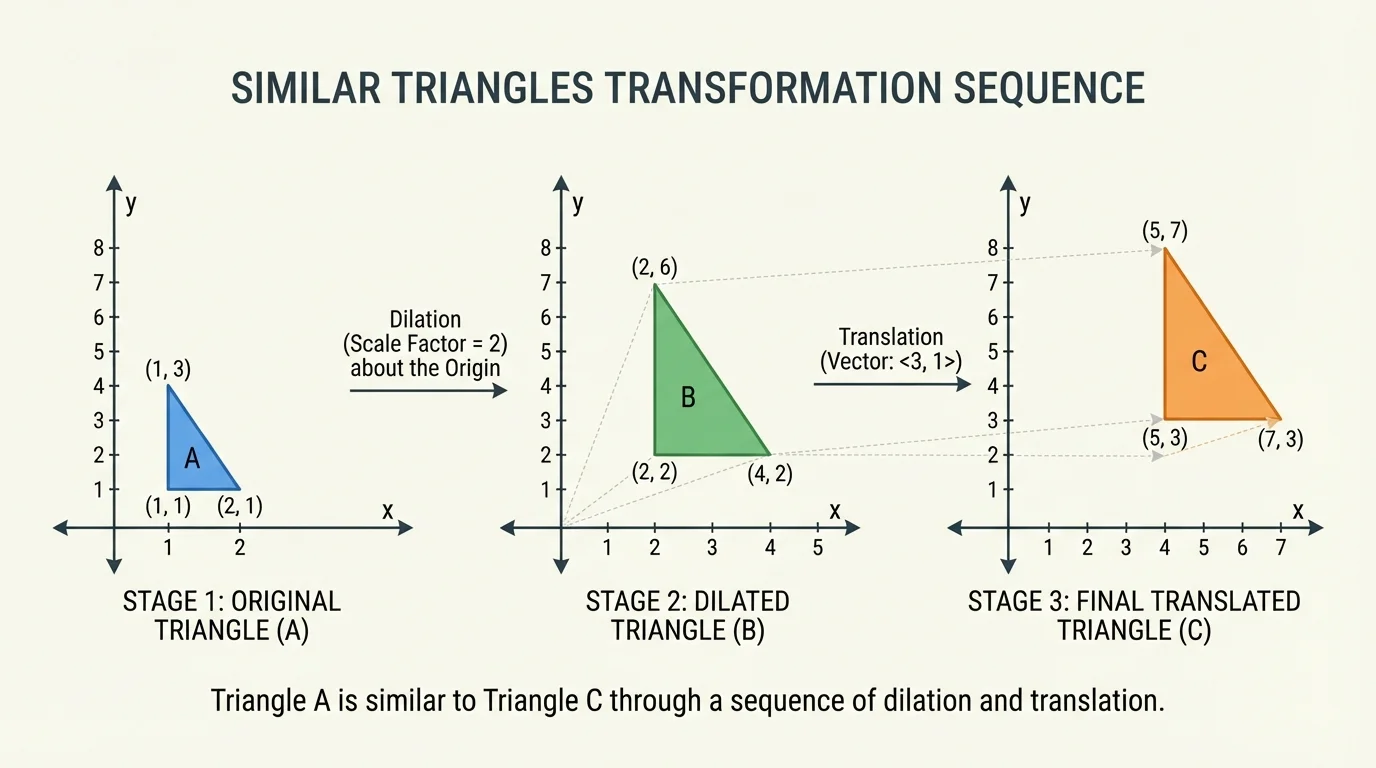
Describing the sequence clearly is important. A strong answer sounds like this: "Dilate triangle \(ABC\) by a scale factor of \(2\) about the origin, then rotate it \(90^\circ\) clockwise about the origin, and then translate it \(3\) units right and \(1\) unit up."
Let triangles \(ABC\) and \(DEF\) have vertices \(A(1,1), B(3,1), C(1,2)\) and \(D(2,2), E(6,2), F(2,4)\), respectively. Describe a sequence that maps triangle \(ABC\) onto triangle \(DEF\).
Worked example 1
Step 1: Compare side lengths.
In triangle \(ABC\), \(AB = 2\) and \(AC = 1\). In triangle \(DEF\), \(DE = 4\) and \(DF = 2\). Each corresponding side is multiplied by \(2\).
So the scale factor is \(2\).
Step 2: Test a dilation about the origin.
Dilating point \(A(1,1)\) by \(2\) gives \(A'(2,2)\).
Dilating point \(B(3,1)\) by \(2\) gives \(B'(6,2)\).
Dilating point \(C(1,2)\) by \(2\) gives \(C'(2,4)\).
Step 3: Compare with the target triangle.
The image points are exactly \(D(2,2), E(6,2), F(2,4)\).
The sequence is simply: dilate triangle \(ABC\) by a scale factor of \(2\) about the origin.
This example is short because the image already lands in the correct location and orientation after the dilation. Many problems require more than one transformation, but this one shows that a single dilation can be enough.
Sometimes the second figure has the opposite orientation. In that case, a reflection may be necessary before the final translation into place.
Suppose triangle \(P(1,1), Q(3,1), R(1,3)\) maps to triangle \(S(-2,1), T(-6,1), U(-2,5)\). Describe one possible sequence.
Worked example 2
Step 1: Find the scale factor.
Side \(PQ = 2\) and side \(ST = 4\), so the scale factor is \(2\). Also, \(PR = 2\) and \(SU = 4\), which confirms the same ratio.
Step 2: Dilate triangle \(PQR\) by \(2\) about the origin.
\(P(1,1) \to P'(2,2)\), \(Q(3,1) \to Q'(6,2)\), and \(R(1,3) \to R'(2,6)\).
Step 3: Reflect across the \(y\)-axis.
\(P'(2,2) \to P''(-2,2)\), \(Q'(6,2) \to Q''(-6,2)\), and \(R'(2,6) \to R''(-2,6)\).
Step 4: Translate the reflected triangle down \(1\) unit.
\(P''(-2,2) \to (-2,1)\), \(Q''(-6,2) \to (-6,1)\), and \(R''(-2,6) \to (-2,5)\).
One correct sequence is: dilate by \(2\) about the origin, reflect across the \(y\)-axis, then translate \(1\) unit down.
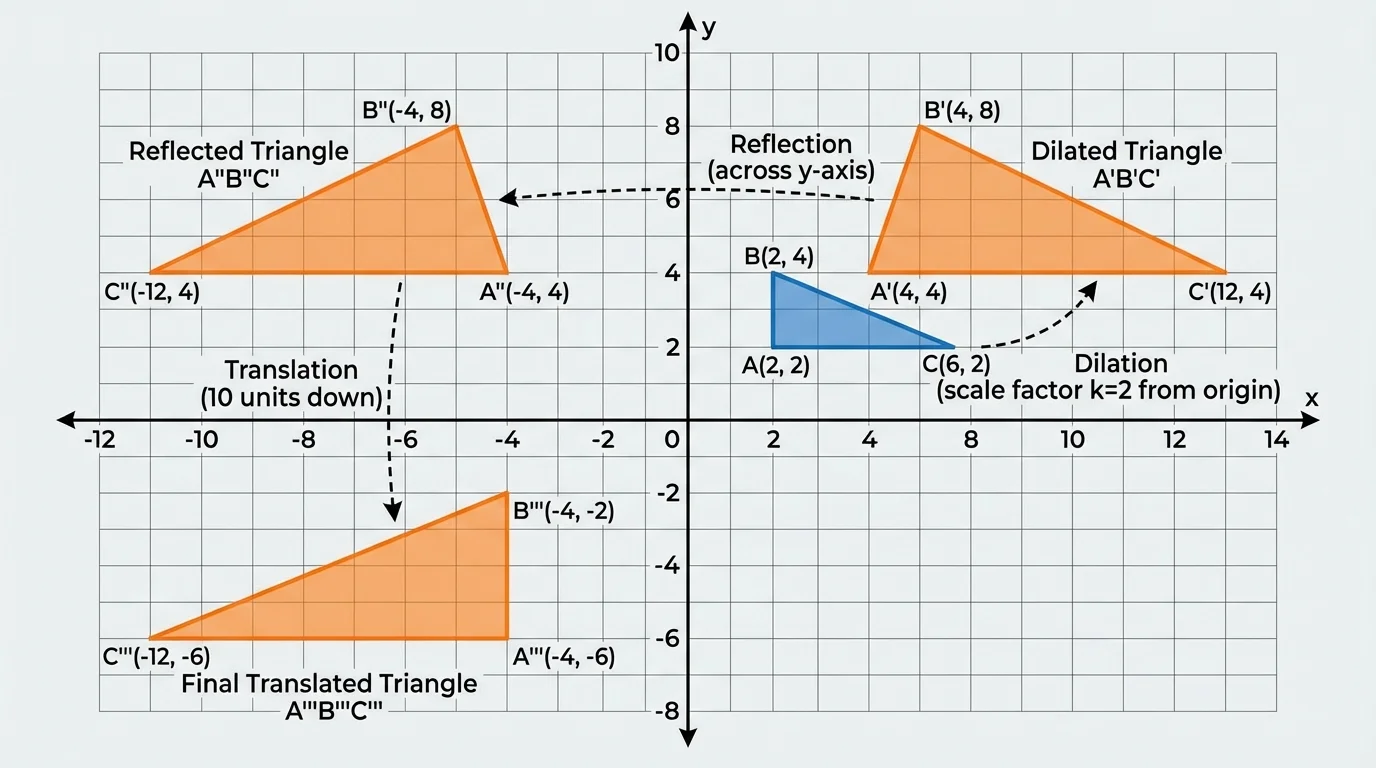
There can be more than one correct sequence. For instance, you might reflect first and then dilate, depending on the center and the coordinates. Geometry often allows different valid routes to the same final image.
Consider quadrilateral \(JKLM\) with side lengths \(3, 5, 3, 5\), and quadrilateral \(NOPQ\) with side lengths \(6, 10, 6, 10\). Suppose corresponding angles are equal. Are the figures similar?
Worked example 3
Step 1: Compare side ratios.
\(\dfrac{6}{3} = 2\), \(\dfrac{10}{5} = 2\), \(\dfrac{6}{3} = 2\), and \(\dfrac{10}{5} = 2\).
All corresponding side lengths have the same ratio, \(2\).
Step 2: Check angles.
The problem states that corresponding angles are equal.
Step 3: Decide.
Because corresponding angles are equal and corresponding sides are proportional, the quadrilaterals are similar.
A possible transformation description is: dilate quadrilateral \(JKLM\) by scale factor \(2\), followed by any needed translation, rotation, or reflection to line it up with quadrilateral \(NOPQ\).
This example shows that similarity is not only about coordinates. You can also decide similarity by comparing angle measures and side-length ratios, then describe a transformation sequence that would make the match happen.
The ideas of congruence and similarity are closely related, but they are not the same. The table below highlights the difference.
| Feature | Congruent Figures | Similar Figures |
|---|---|---|
| Shape | Same | Same |
| Size | Same | May be different |
| Angle measures | Equal | Equal |
| Side lengths | Equal | Proportional |
| Allowed transformations | Translation, rotation, reflection | Translation, rotation, reflection, dilation |
| Scale factor | \(1\) | Any positive number |
Table 1. A comparison of congruent figures and similar figures.
If you ever wonder whether two figures are only congruent or also similar, remember this: every pair of congruent figures is also similar, because a scale factor of \(1\) is allowed. But not every pair of similar figures is congruent, because similar figures may have different sizes.
One common mistake is using the wrong correspondence. If side \(AB\) matches side \(DE\), then the endpoints should match in the same order. Incorrect matching can produce the wrong scale factor.
Another mistake is forgetting orientation. If one figure is a mirror image of the other, a reflection is needed. The visual comparison we saw earlier in [Figure 1] helps remind you that sliding or turning alone cannot create a mirror image.
A third mistake is assuming that proportional sides are enough in every case. For many grade-level problems involving standard polygons with known corresponding angles, side ratios and angle matches are used together. If angle measures do not match, the figures are not similar.
To check your work, ask these questions:
1. Are the corresponding angles equal?
2. Do the corresponding side lengths all have the same ratio?
3. Does your transformation sequence use only allowed moves?
4. After the sequence, does every vertex land on the matching vertex?
Map scales are based on similarity. If a map scale says \(1:100{,}000\), then every length on the map is \(\dfrac{1}{100{,}000}\) of the actual distance, but the shapes of roads, lakes, and boundaries stay in proportion.
Those checks are especially useful on coordinate-plane questions, where one small sign mistake can move a point into the wrong quadrant.
Similarity appears whenever a shape is resized without being distorted. In photography, stretching a picture more in one direction than the other creates distortion, so the image is no longer similar to the original. But enlarging both length and width by the same factor keeps the image similar.
Architects use blueprints where a wall that is \(8\) meters long in real life might be drawn as \(8\) centimeters on paper. The scale factor from the drawing to the real object is \(100\). The blueprint works because the rooms and walls remain similar to the actual building.
Engineers and designers also use similarity in models. A model bridge, a car prototype, or a digital design can be scaled up or down while preserving shape. The step-by-step resizing idea from [Figure 3] is the same idea used when software enlarges a design and then repositions it on a screen.
In science and medicine, images from microscopes and scans are often magnified. Magnification is a kind of dilation. The doctor or scientist wants the enlarged image to stay similar to the original so that measurements and shapes are trustworthy.
When writing your answer, be precise. State the transformation, the amount, and the location when needed. For example, say "rotate \(90^\circ\) clockwise about the origin," not just "rotate it." Say "translate \(4\) units left and \(2\) units up," not just "move it." Say "dilate by scale factor \(\dfrac{3}{2}\) about point \(A\)" if a center is specified.
Clear geometry writing is part of clear geometry thinking. A complete sequence tells exactly how one figure becomes the other.
"Same shape can survive a change in size."
— A useful way to think about similarity
That idea is why similarity is such a powerful concept. It allows figures to change size while preserving the relationships that define their shape.
