A triangle can be tiny on a phone screen or huge in a bridge support, but one fact never changes: its angles always fit together in a very precise way. That is one of the most surprising ideas in geometry. Even better, the same angle patterns appear when roads cross, ladders lean against walls, and designers use scale drawings. Once you understand these patterns, many geometry problems stop looking random and start looking connected.
Geometry is full of facts that can be explained informally. That means we use careful reasoning, drawings, physical models, and known angle relationships to see why something must be true. In this lesson, you will use informal arguments to understand three major ideas: the angle sum of a triangle, the exterior angle of a triangle, and the angle patterns formed when parallel lines are cut by a line called a transversal. Then you will connect all of that to one of the most useful ideas in geometry: when two triangles are similar because they share two equal angles.
Before working with triangles, it helps to remember a few angle facts. A straight angle measures \(180^\circ\). A full turn measures \(360^\circ\). When two lines cross, they create vertical angles, and vertical angles are equal. Also, when two angles form a straight line, they are supplementary, which means their measures add to \(180^\circ\).
A straight line always gives a total angle measure of \(180^\circ\). This idea is the backbone of almost every angle argument in this lesson.
Another important idea is that a line can cut across two other lines. That cutting line is called a transversal. If the two lines it crosses are parallel, very special angle relationships appear. Those patterns will help explain why triangle angle facts work.
Any triangle has three interior angles, and their measures always add to \(180^\circ\). [Figure 1] One informal way to see this is to make three copies of the same triangle and arrange them so that one angle from each copy meets at a point and the three selected angles lie along a straight line. Because a straight line measures \(180^\circ\), the three angles together must also measure \(180^\circ\).
You can also reason using parallel lines. Suppose triangle \(ABC\) has interior angles \(\angle A\), \(\angle B\), and \(\angle C\). Draw a line through vertex \(C\) that is parallel to side \(AB\). Then sides \(AC\) and \(BC\) act like transversals. Because of parallel-line angle relationships, the angle formed by the new line and \(AC\) matches \(\angle A\), and the angle formed by the new line and \(BC\) matches \(\angle B\). Those two angles and \(\angle C\) sit on a straight line, so their total is \(180^\circ\). Therefore, \(m\angle A + m\angle B + m\angle C = 180^\circ\).
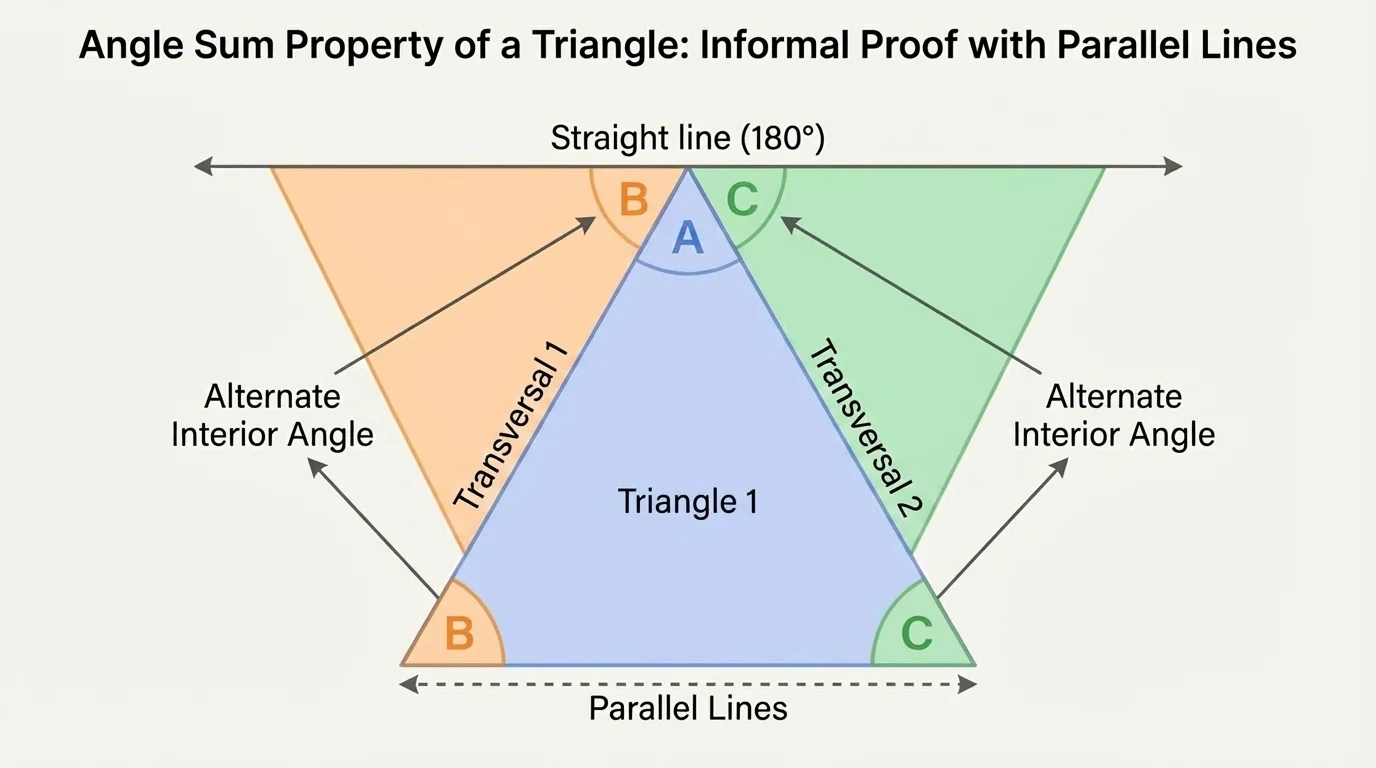
This is a great example of an informal argument. You do not need a long formal proof to understand the idea. Whether you cut out paper triangles, use transparencies, or draw a parallel line, the result is the same:
\[m\angle A + m\angle B + m\angle C = 180^\circ\]
Interior angles of a triangle are the three angles inside the triangle. Their measures always add to \(180^\circ\).
Exterior angle is an angle formed when one side of a triangle is extended past a vertex.
Remote interior angles are the two interior angles of the triangle that are not next to a chosen exterior angle.
A useful consequence appears immediately: if you know any two interior angles of a triangle, you can find the third. For example, if two angles measure \(65^\circ\) and \(45^\circ\), then the third angle is \(180^\circ - 65^\circ - 45^\circ = 70^\circ\). This idea will return when we study similar triangles, because if two angles match, the third one is forced to match too.
Solved example 1
Find the missing angle in a triangle with angles \(52^\circ\) and \(81^\circ\).
Step 1: Use the triangle angle sum.
The three interior angles add to \(180^\circ\).
Step 2: Add the known angles.
\(52^\circ + 81^\circ = 133^\circ\)
Step 3: Subtract from \(180^\circ\).
\(180^\circ - 133^\circ = 47^\circ\)
The missing angle is \(47^\circ\).
Now extend one side of a triangle. The angle outside the triangle is called an exterior angle. The key fact is that an exterior angle has the same measure as the sum of the two remote interior angles.
Why does this work? Suppose an exterior angle is next to interior angle \(\angle C\). Those two angles form a straight line, so they add to \(180^\circ\). But the three interior angles of the triangle also add to \(180^\circ\). If \(m\angle A + m\angle B + m\angle C = 180^\circ\), then \(m\angle A + m\angle B = 180^\circ - m\angle C\). The exterior angle also equals \(180^\circ - m\angle C\). So the exterior angle must equal \(m\angle A + m\angle B\).
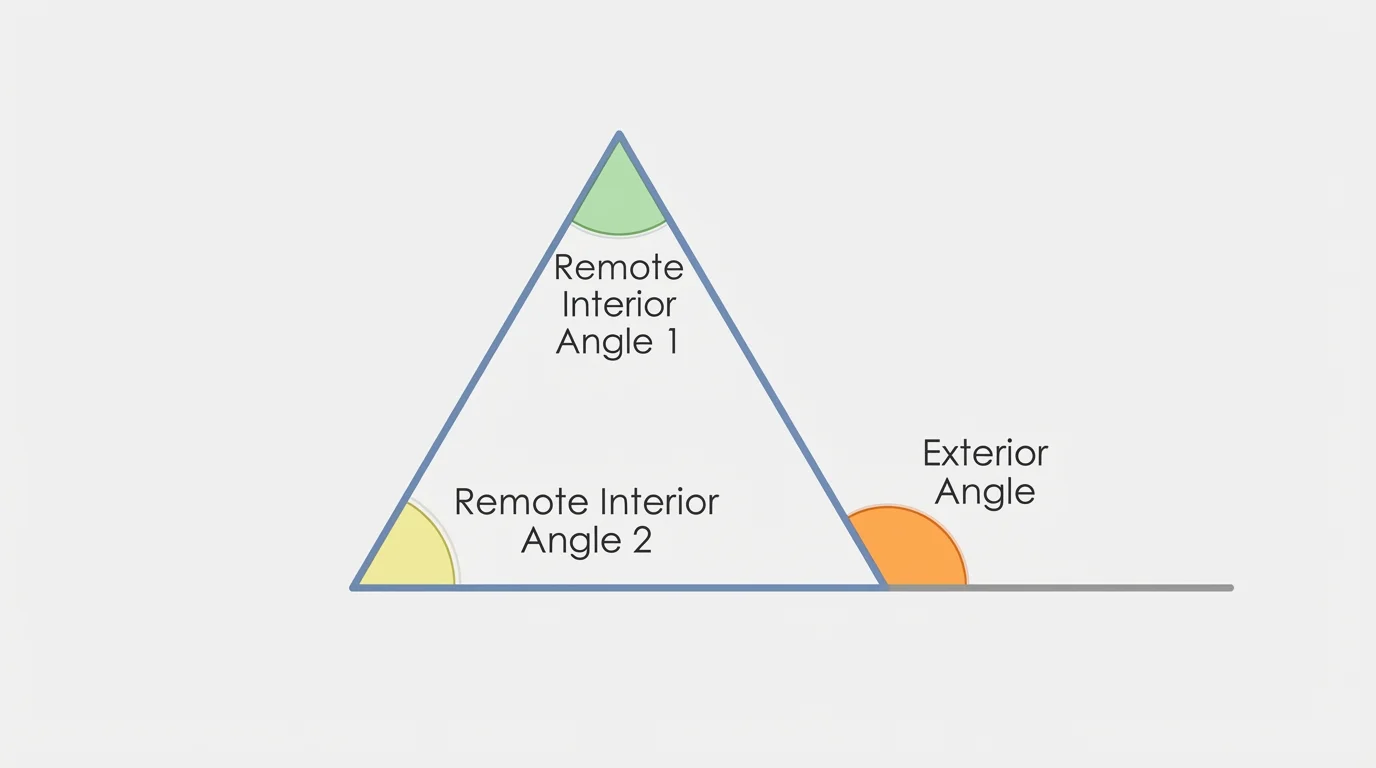
This gives the exterior angle theorem in an informal but convincing way:
\[m\angle \textrm{exterior} = m\angle \textrm{remote 1} + m\angle \textrm{remote 2}\]
This fact is especially helpful because sometimes the outside angle is easier to see than the inside ones. In road signs, roof frames, and support beams, extended lines often appear naturally, so exterior angles become a practical tool.
Solved example 2
An exterior angle of a triangle measures \(124^\circ\). One remote interior angle measures \(57^\circ\). Find the other remote interior angle.
Step 1: Write the exterior angle relationship.
Exterior angle \(=\) sum of the two remote interior angles.
Step 2: Set up the equation.
If the unknown angle is \(x\), then \(57^\circ + x = 124^\circ\).
Step 3: Solve.
\(x = 124^\circ - 57^\circ = 67^\circ\)
The missing remote interior angle is \(67^\circ\).
[Figure 3] When two parallel lines are crossed by a transversal, several angle pairs are created, and these pairs follow reliable patterns. The layout helps organize the names and locations of these angle pairs. These relationships are not just separate facts to memorize; they are the reason many triangle angle arguments work.
The most important angle pairs are these:
If the two lines are parallel, these relationships must happen. You can think of the transversal as copying angle positions from one intersection to the other. That is why drawing a line parallel to one side of a triangle is so powerful: it creates matching angles that let us connect the triangle to a straight line.
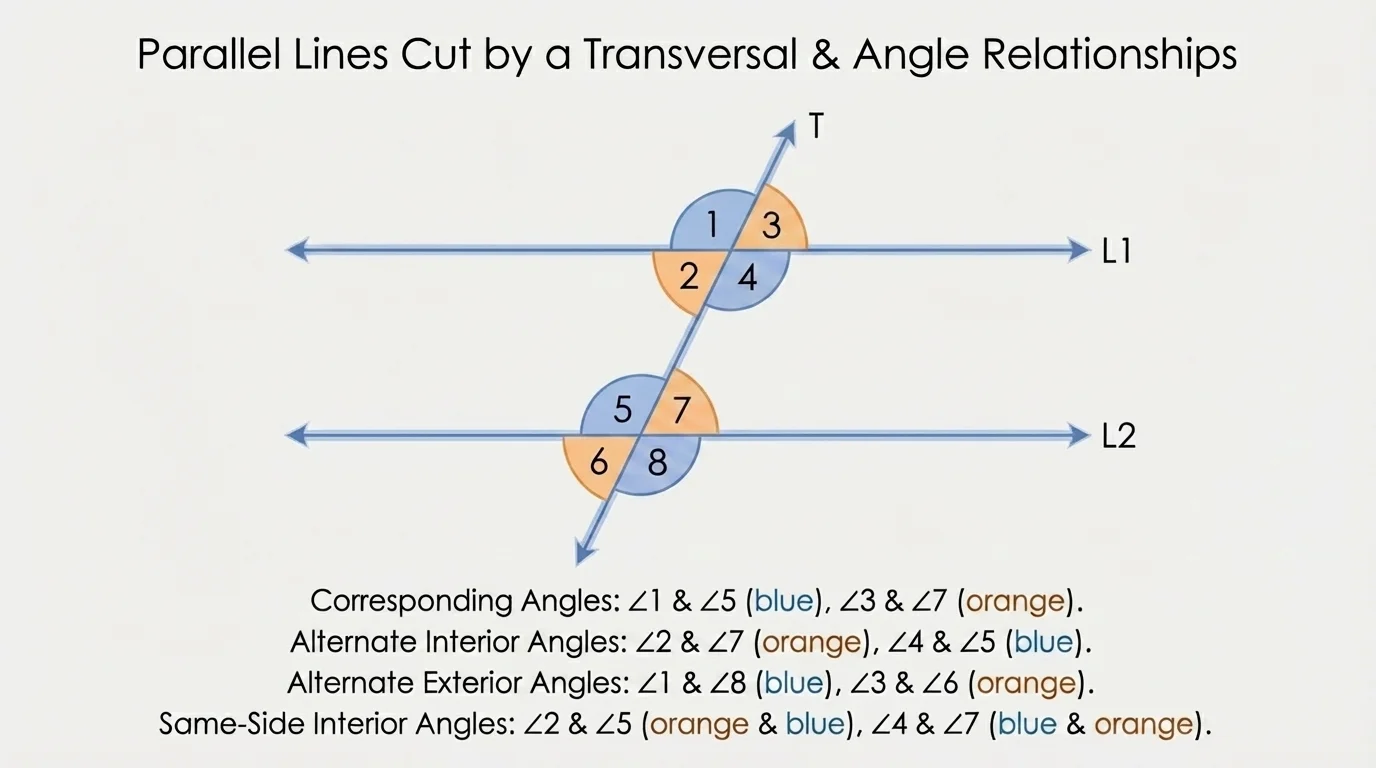
For example, in the triangle-angle-sum argument from earlier, the line drawn through one vertex parallel to the opposite side creates corresponding or alternate interior angles equal to two of the triangle's angles. Then all three angles line up to form a straight line. That connection to [Figure 1] shows how triangle facts and parallel-line facts are really part of the same idea.
Why parallel lines matter
Parallel lines keep the same direction and never meet. Because of that, a transversal crosses them in matching ways, creating repeated angle patterns. Geometry uses these repeated patterns to transfer angle information from one place to another.
These angle relationships also work in reverse in many settings: if certain angle pairs formed by a transversal are equal, that gives evidence that the lines are parallel. While the main focus here is using parallel lines to explain angle facts, it is helpful to know the connection goes both ways.
Solved example 3
Two parallel lines are cut by a transversal. One corresponding angle measures \(113^\circ\). Find its corresponding partner and its same-side interior supplement.
Step 1: Use corresponding angles.
Corresponding angles are equal, so the corresponding partner also measures \(113^\circ\).
Step 2: Use supplementary angles for same-side interior angles.
Same-side interior angles add to \(180^\circ\).
Step 3: Subtract.
\(180^\circ - 113^\circ = 67^\circ\)
The corresponding angle is \(113^\circ\), and the same-side interior angle is \(67^\circ\).
Now the relationships begin to work together. A geometry problem may include a triangle, a side extension, and parallel lines all in one diagram. The key is to identify which angle fact applies first. Often, one angle relationship reveals a second, and then the triangle sum finishes the problem.
Suppose a triangle has one interior angle of \(48^\circ\), and an exterior angle at another vertex measures \(129^\circ\). Because the exterior angle equals the sum of the two remote interior angles, the unknown remote interior angle is \(129^\circ - 48^\circ = 81^\circ\). Then the remaining interior angle is \(180^\circ - 48^\circ - 81^\circ = 51^\circ\).
Algebra can appear too. If a triangle has angles \(x\), \(2x + 10\), and \(3x - 20\), then use the triangle sum:
\[x + (2x + 10) + (3x - 20) = 180\]
Simplify to get \(6x - 10 = 180\), then \(6x = 190\), so \(x = \dfrac{190}{6} = \dfrac{95}{3}\). Even when the numbers are less tidy, the same angle facts still control the problem.
Surveyors and engineers often rely on angle relationships instead of direct measurements when an object is too far away, too tall, or unsafe to reach.
It is useful to organize angle relationships clearly:
| Situation | Relationship |
|---|---|
| Interior angles of a triangle | Sum is \(180^\circ\) |
| Exterior angle of a triangle | Equals sum of two remote interior angles |
| Corresponding angles with parallel lines | Equal |
| Alternate interior angles with parallel lines | Equal |
| Alternate exterior angles with parallel lines | Equal |
| Same-side interior angles with parallel lines | Sum is \(180^\circ\) |
Table 1. Core angle relationships used in triangle and parallel-line reasoning.
Two triangles are similar triangles if they have the same shape, even if they are different sizes. Their corresponding angles are equal, and their corresponding side lengths are in the same ratio. [Figure 4] A powerful rule says that if two angles of one triangle are equal to two angles of another triangle, then the triangles are similar. This is called the Angle-Angle criterion, often shortened to \(AA\), and the figure shows the basic idea with two different-sized triangles.
Why are only two angles enough? Because every triangle has angle sum \(180^\circ\). If two angles match, then the third angle must also match automatically. For example, if one triangle has angles \(40^\circ\), \(65^\circ\), and \(75^\circ\), and another has angles \(40^\circ\) and \(65^\circ\), then its third angle must be \(180^\circ - 40^\circ - 65^\circ = 75^\circ\). So the triangles have all corresponding angles equal.
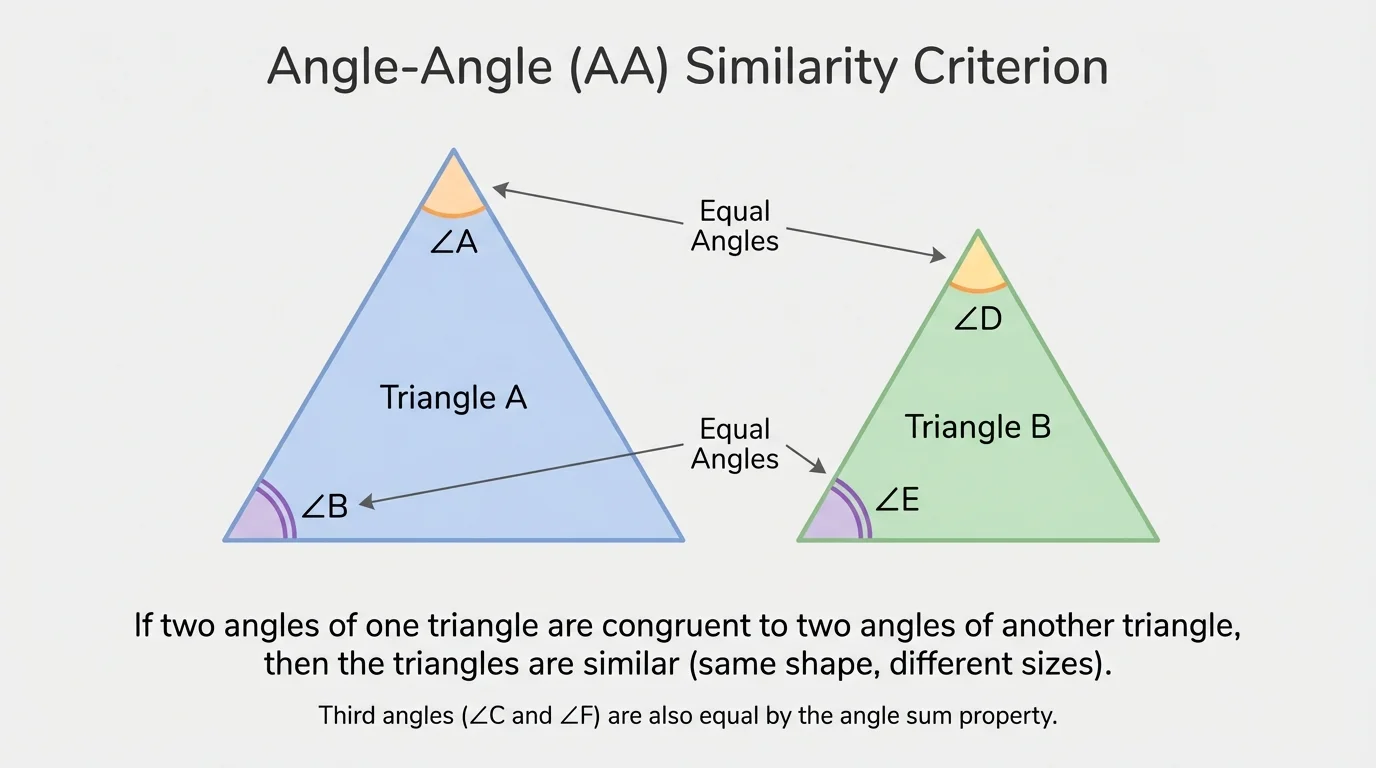
When all corresponding angles are equal, the triangles have the same shape. One is a scaled version of the other. That is why maps, blueprints, and screen graphics can represent real objects accurately: the angles stay the same while the lengths change by a common scale factor. The triangles shown are not congruent unless their sides also match exactly, but they are similar because their angle patterns agree.
Solved example 4
Triangle \(PQR\) has angles \(42^\circ\), \(58^\circ\), and \(80^\circ\). Triangle \(XYZ\) has angles \(42^\circ\), \(80^\circ\), and \(58^\circ\). Are the triangles similar?
Step 1: Compare angle measures.
The two triangles have the same three angle measures: \(42^\circ\), \(58^\circ\), and \(80^\circ\).
Step 2: Apply the \(AA\) idea.
If two angles match, the third matches too, so the corresponding angles are equal.
Step 3: State the conclusion.
The triangles are similar.
Yes, \(\triangle PQR\) and \(\triangle XYZ\) are similar.
Be careful: similar does not mean exactly the same size. That would be congruent. Similar triangles can be larger or smaller copies of one another. Their shapes match, but their side lengths may differ by a common scale factor such as \(2\), \(\dfrac{1}{2}\), or \(1.5\).
These angle ideas are not just for textbook diagrams. Architects use triangles because they are strong and stable, and they rely on angle relationships when planning roof trusses and bridge supports. If one brace creates a known angle, parallel support beams can transfer that information across a design. That is the same geometry as the angle pairs formed by a transversal.
Shadows create another application. If the Sun shines at the same angle on two objects, the triangles formed by the objects and their shadows are often similar. Then a short measured shadow can help estimate the height of a tall tree or building. That method depends on the same shape being repeated, just as in the similar triangles shown earlier in [Figure 4].
Maps and digital graphics also depend on similarity. A triangle on a map may represent a much larger triangular region in real life, but the angle measures stay the same. Engineers and game designers use scaling all the time because preserving angles keeps shapes recognizable and accurate.
"Geometry is visual logic."
— A useful way to think about angle reasoning
One common mistake is mixing up interior and exterior angles. The exterior angle is outside the triangle and forms a straight line with one interior angle. Another mistake is choosing the wrong pair of remote interior angles; they must be the two interior angles not next to the exterior angle.
A second common mistake is confusing angle pair names when parallel lines are cut by a transversal. Corresponding angles match position. Alternate interior angles are inside the parallel lines on opposite sides. Same-side interior angles are inside the lines on the same side, and they add to \(180^\circ\); they are not equal to each other.
A third common mistake is thinking that equal angles make triangles congruent. Equal angles guarantee similar shape, not equal size. To conclude congruence, you need stronger information than angle matches alone.
