A calculator can display a number like \(0.75\) neatly, but it might show something like \(3.1415926535\ldots\) and keep going as long as the screen allows. That raises an important question: if decimals can go on and on, how do we tell which numbers are really fractions and which are not? The answer leads to one of the most surprising ideas in middle school mathematics: some numbers can be written as a ratio of integers, and some cannot.
We use decimals constantly in measurements, money, science, sports statistics, and technology. A runner's time might be \(12.48\) seconds. A phone screen may have a diagonal length of about \(6.7\) inches. The decimal expansion of \(\pi\) begins with \(3.14159\ldots\). These are all decimal forms, and informally, every real number has a decimal expansion. Some decimal expansions stop. Some keep going in a repeating pattern. Others continue forever without repeating.
This decimal behavior helps us classify numbers. In particular, a rational number is any number that can be written as a fraction \(\dfrac{a}{b}\), where \(a\) and \(b\) are integers and \(b \ne 0\). Numbers that cannot be written this way are called irrational numbers.
Rational number: a number that can be written as \(\dfrac{a}{b}\), where \(a\) and \(b\) are integers and \(b \ne 0\).
Irrational number: a number that cannot be written as \(\dfrac{a}{b}\) for any integers \(a\) and \(b\) with \(b \ne 0\).
Decimal expansion: the decimal form of a number, which may terminate, repeat, or continue without repeating.
Integers such as \(5\), \(-2\), and \(0\) are rational because they can be written as fractions: \(5 = \dfrac{5}{1}\), \(-2 = \dfrac{-2}{1}\), and \(0 = \dfrac{0}{1}\). Fractions such as \(\dfrac{3}{4}\) and \(\dfrac{-7}{8}\) are rational too. But numbers like \(\sqrt{2}\) and \(\pi\) are irrational.
Rational numbers have decimal expansions with a special pattern, as [Figure 1] shows when we compare decimals that stop, decimals that repeat right away, and decimals that never settle into a repeating block. A rational decimal either terminates or repeats eventually.
A terminating decimal ends after a finite number of digits. For example, \(\dfrac{1}{2} = 0.5\), \(\dfrac{3}{4} = 0.75\), and \(\dfrac{7}{8} = 0.875\). Even a number like \(2.4\) can be thought of as terminating because it is really \(2.4000\ldots\), with zeros continuing forever.
A repeating decimal has one digit or a block of digits that repeats forever. For example, \(\dfrac{1}{3} = 0.3333\ldots\), where the digit \(3\) repeats. Also, \(\dfrac{2}{11} = 0.181818\ldots\), where the block \(18\) repeats.
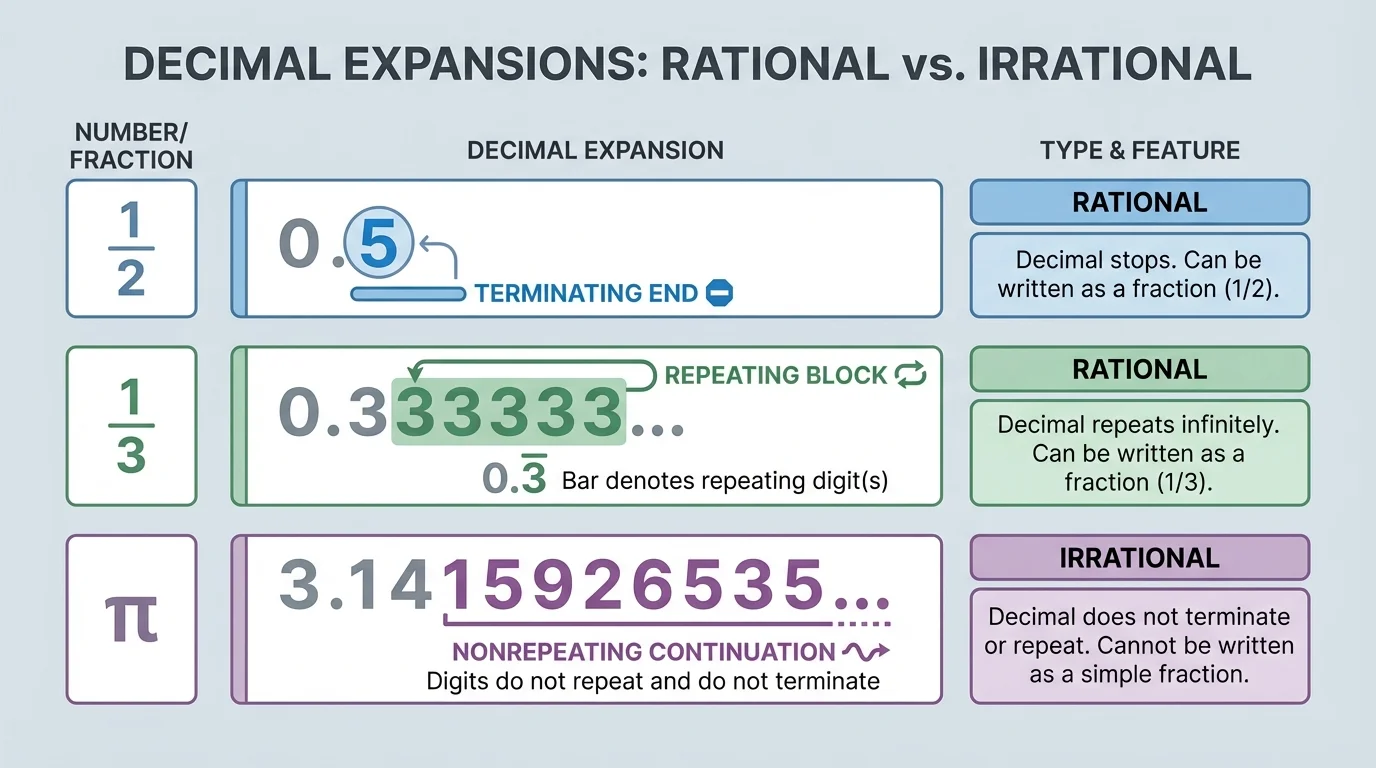
Sometimes the repetition starts immediately, and sometimes it starts later. For example, \(\dfrac{1}{6} = 0.16666\ldots\). The decimal does not repeat from the very first digit after the decimal point, but after the \(1\), the digit \(6\) repeats forever. This is what repeats eventually means.
Mathematicians often write repeating decimals with a bar over the repeating part. For example, \(0.\overline{3}\) means \(0.3333\ldots\), and \(0.1\overline{6}\) means \(0.16666\ldots\).
You already know that fractions can be converted to decimals by division. For example, \(\dfrac{3}{4}\) means \(3 \div 4\), which equals \(0.75\). This idea is the bridge between fractions and decimal expansions.
The key fact is this:
A number is rational if its decimal expansion terminates or repeats eventually.
An irrational number has a decimal expansion that goes on forever without repeating a fixed pattern. This does not mean the digits are random in every case, but it does mean there is no repeating block that continues forever.
Examples include \(\sqrt{2}\), \(\sqrt{3}\), and \(\pi\). Their decimal expansions begin like this:
\[\sqrt{2} = 1.41421356\ldots\]
\[\sqrt{3} = 1.73205080\ldots\]
\[\pi = 3.14159265\ldots\]
These decimals never end and never enter a repeating cycle. That is why these numbers are not rational.
The diagonal of a square with side length \(1\) is \(\sqrt{2}\). People in ancient times discovered that this length cannot be written as a fraction of whole numbers, and that was a shocking idea because it meant not every quantity is rational.
It is important to notice that a decimal does not need to be short in order to be rational. A number like \(0.123456\) is rational because it terminates. Also, a decimal can be very long before a pattern appears and still be rational. What matters is not how long it is, but whether it ends or repeats eventually.
Comparing decimal patterns side by side makes the classification clearer. The visual comparison in [Figure 1] matches the table below.
| Number | Decimal Expansion | Pattern | Type |
|---|---|---|---|
| \(\dfrac{3}{5}\) | \(0.6\) | Terminates | Rational |
| \(\dfrac{1}{3}\) | \(0.3333\ldots\) | Repeats | Rational |
| \(\dfrac{5}{6}\) | \(0.83333\ldots\) | Repeats eventually | Rational |
| \(\sqrt{2}\) | \(1.41421356\ldots\) | Nonterminating, nonrepeating | Irrational |
| \(\pi\) | \(3.14159265\ldots\) | Nonterminating, nonrepeating | Irrational |
Table 1. Examples showing how decimal patterns classify numbers as rational or irrational.
[Figure 2] There is a simple reason rational numbers repeat eventually. When you divide one integer by another, the decimal digits come from long division. The key idea is that the remainders start to cycle. Once the same remainder appears again, the same digits must repeat from that point onward.
For example, when finding \(\dfrac{1}{7}\), the long division creates remainders. Each remainder must be less than \(7\), so the only possible remainders are \(0, 1, 2, 3, 4, 5, 6\). There are only finitely many choices. If the remainder ever becomes \(0\), the decimal terminates. If not, one of the nonzero remainders must eventually appear again, and the decimal begins repeating.
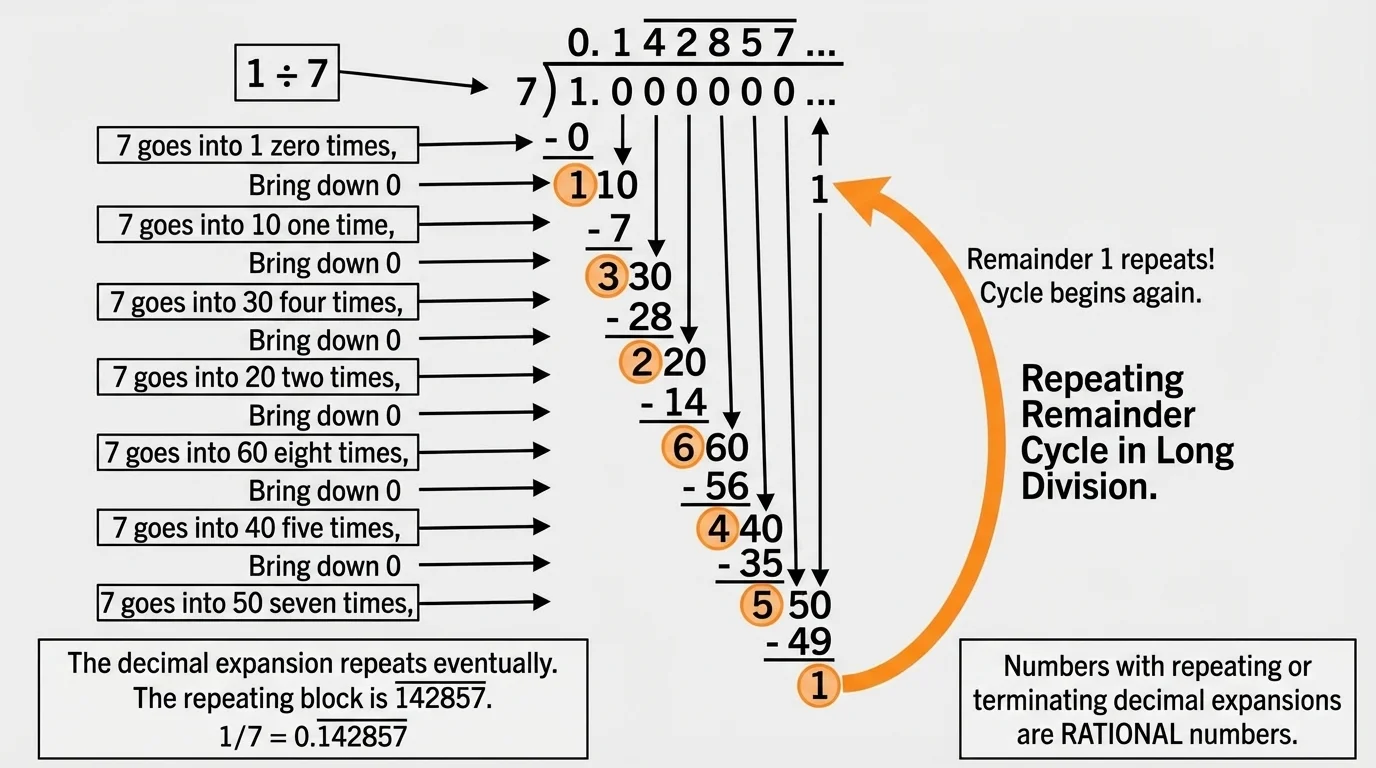
This means every rational number has one of two decimal behaviors: it terminates, or it repeats eventually. There is no third possibility for rational numbers.
Why repetition must happen
Suppose you divide by \(8\). The remainder can only be \(0, 1, 2, 3, 4, 5, 6,\) or \(7\). Since there are only finitely many remainders, the process cannot create infinitely many different remainders. Either the remainder becomes \(0\), which makes the decimal stop, or a remainder repeats, which makes the decimal digits repeat.
This informal idea is enough to understand the pattern without going into a full proof. It explains why fractions behave so differently from irrational numbers.
One of the most useful algebra skills in this topic is turning a repeating decimal into a fraction. The basic method is to assign the decimal to a variable, multiply to line up the repeating parts, and subtract.
For a simple repeating decimal such as \(0.\overline{3}\), let \(x = 0.\overline{3}\). Then multiply by \(10\): \(10x = 3.\overline{3}\). Subtract the first equation from the second: \(10x - x = 3.\overline{3} - 0.\overline{3}\), so \(9x = 3\). Therefore, \(x = \dfrac{3}{9} = \dfrac{1}{3}\).
For a repeating block with two digits, such as \(0.\overline{27}\), multiply by \(100\) so the repeating parts line up. In general, if the repeating block has \(n\) digits, multiply by \(10^n\).
If a decimal has a nonrepeating part first, like \(0.1\overline{6}\), we still use the same idea, but we may need two different powers of \(10\) to line up the repeating parts.
The best way to understand this process is to work through it carefully.
Example 1: Convert a terminating decimal to a rational number
Write \(0.875\) as a fraction.
Step 1: Write the decimal over a power of \(10\).
Since \(0.875\) has three decimal places, \(0.875 = \dfrac{875}{1000}\).
Step 2: Simplify the fraction.
Both numerator and denominator are divisible by \(125\): \(\dfrac{875}{1000} = \dfrac{7}{8}\).
So, \[0.875 = \frac{7}{8}\]
Terminating decimals are often the easiest to convert because place value tells us the denominator immediately.
Example 2: Convert a repeating decimal to a rational number
Write \(0.\overline{6}\) as a fraction.
Step 1: Let the decimal equal a variable.
Let \(x = 0.\overline{6}\).
Step 2: Multiply by \(10\) because one digit repeats.
Then \(10x = 6.\overline{6}\).
Step 3: Subtract the original equation.
\(10x - x = 6.\overline{6} - 0.\overline{6}\), so \(9x = 6\).
Step 4: Solve for \(x\).
\(x = \dfrac{6}{9} = \dfrac{2}{3}\).
Therefore, \[0.\overline{6} = \frac{2}{3}\]
This is why \(\dfrac{2}{3}\) written as a decimal becomes \(0.6666\ldots\). The repeating decimal and the fraction are exactly the same number.
Example 3: Convert a mixed repeating decimal to a rational number
Write \(0.1\overline{6}\) as a fraction.
Step 1: Let \(x = 0.1\overline{6}\).
This means \(x = 0.16666\ldots\).
Step 2: Move past the nonrepeating part.
Multiply by \(10\): \(10x = 1.6666\ldots\).
Step 3: Line up the repeating parts completely.
Multiply by \(100\): \(100x = 16.6666\ldots\).
Step 4: Subtract the two equations with matching repeating tails.
\(100x - 10x = 16.6666\ldots - 1.6666\ldots\), so \(90x = 15\).
Step 5: Solve.
\(x = \dfrac{15}{90} = \dfrac{1}{6}\).
So, \[0.1\overline{6} = \frac{1}{6}\]
The same method works for longer repeating blocks too. For instance, \(0.\overline{27} = \dfrac{27}{99} = \dfrac{3}{11}\).
[Figure 3] Even though irrational numbers are not fractions, we can still estimate them using rational numbers. On a number line, we can place \(\sqrt{2}\) between \(1\) and \(2\) because \(1^2 = 1\) and \(2^2 = 4\), and \(2\) lies between \(1\) and \(4\).
We can improve the estimate. Since \(1.4^2 = 1.96\) and \(1.5^2 = 2.25\), we know \(\sqrt{2}\) is between \(1.4\) and \(1.5\). Going further, \(1.41^2 = 1.9881\) and \(1.42^2 = 2.0164\), so \(\sqrt{2}\) is between \(1.41\) and \(1.42\).
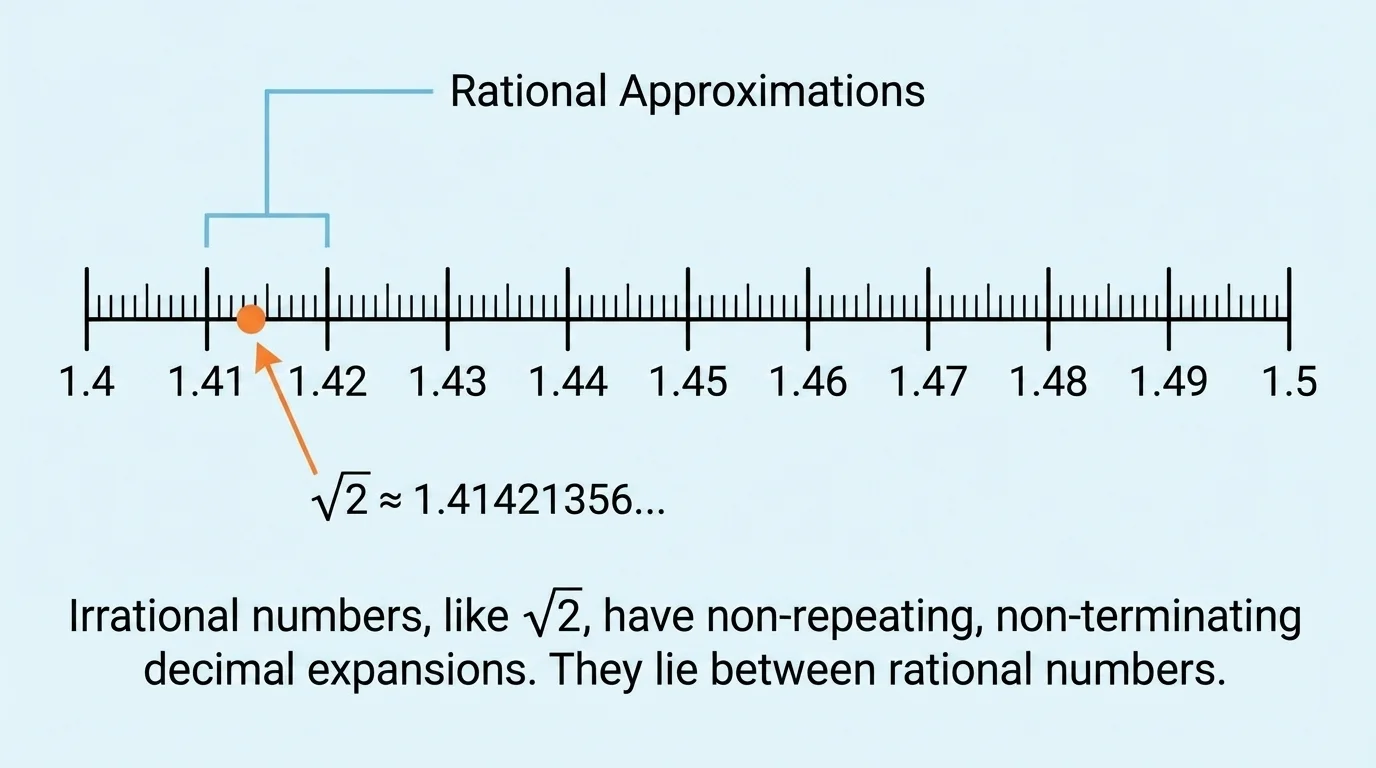
This gives an approximation such as \(\sqrt{2} \approx 1.41\) or more accurately \(\sqrt{2} \approx 1.414\). Each of these is rational, even though \(\sqrt{2}\) itself is irrational.
Example 4: Approximate an irrational number
Approximate \(\sqrt{5}\) to the nearest tenth.
Step 1: Find two nearby perfect squares.
Since \(2^2 = 4\) and \(3^2 = 9\), \(\sqrt{5}\) is between \(2\) and \(3\).
Step 2: Test tenths.
\(2.2^2 = 4.84\) and \(2.3^2 = 5.29\).
Step 3: Decide which is closer to \(5\).
Since \(4.84\) is closer to \(5\) than \(5.29\), \(\sqrt{5} \approx 2.2\) to the nearest tenth.
So, \[\sqrt{5} \approx 2.2\]
This idea of rational approximation is important in science, engineering, and computer calculations, where exact irrational values are often replaced by close decimal estimates.
Irrational numbers appear in real measurements. If a square garden has side length \(10\) meters, then the diagonal is \(10\sqrt{2}\) meters. That exact length is irrational, but a builder might use an approximation such as \(10 \times 1.414 = 14.14\) meters.
Circles create another major example. The circumference formula is \(C = 2\pi r\). Since \(\pi\) is irrational, most measurements involving circles are irrational unless rounded. A bicycle wheel, a pizza, and a satellite dish all involve practical approximations of \(\pi\).
Computers also rely on approximations. No device can display infinitely many digits, so irrational numbers are shown with only a finite decimal approximation. That is why \(\pi\) may appear as \(3.14\), \(3.1416\), or some other rounded value depending on how much accuracy is needed.
One common mistake is thinking that a long decimal must be irrational. That is false. The decimal \(0.123456789\) is rational because it terminates. Even a decimal with many digits after the decimal point can still be rational.
Another mistake is thinking that every nonterminating decimal is irrational. That is also false. The decimal \(0.272727\ldots\) goes on forever, but it repeats, so it is rational.
A third mistake is believing that approximation changes the type of number. For example, \(\sqrt{2} \approx 1.414\), but \(1.414\) is rational while \(\sqrt{2}\) is irrational. The approximation is not the exact number; it is just close to it.
Finally, it is important to remember that repeating eventually still counts as repeating. The decimal \(0.045555\ldots\) is rational because after some beginning digits, the digit \(5\) repeats forever.
Looking back at the decimal patterns in [Figure 1], the remainder cycle in [Figure 2], and the number-line estimates in [Figure 3], we see the full picture: decimal form reveals whether a number comes from a fraction, and rational approximations let us work with irrational numbers in useful ways.
