A can of soup, a traffic cone, and a basketball seem like completely different objects, but geometry links them together. Each one is a three-dimensional solid, and each one has a volume, which tells how much space it takes up. That means the same math can help engineers design tanks, help factories decide how much material is needed, and help you figure out how much ice cream fits in a cone.
When a shape is flat, we measure area. When a shape is solid and has depth, we measure volume. Volume is measured in cubic units, such as \(\textrm{cm}^3\), \(\textrm{m}^3\), or \(\textrm{in}^3\). If a box has a volume of \(24 \textrm{ cm}^3\), that means \(24\) little cubes, each measuring \(1 \textrm{ cm} \times 1 \textrm{ cm} \times 1 \textrm{ cm}\), could fit inside it.
For this topic, the most important solids are the cylinder, cone, and sphere. These appear all around us: water bottles are often close to cylinders, party hats are cones, and many sports balls are spheres. Knowing their formulas allows us to solve both school problems and practical problems.
To work with these solids, remember that the area of a circle is \(A = \pi r^2\) where \(r\) is the radius. Also remember that the diameter is twice the radius, so \(d = 2r\) and \(r = \dfrac{d}{2}\).
You also need to know the meaning of height. In a cylinder, height is the perpendicular distance between the two bases. In a cone, height is the perpendicular distance from the base to the vertex. It is not always the slanted side. That is a very common source of mistakes.
A radius is the distance from the center of a circle to its edge. A diameter is the distance all the way across the circle through the center. In problems about cylinders, cones, and spheres, you must pay close attention to whether the given measurement is a radius or a diameter. If the diameter is \(10\), then the radius is \(5\), not \(10\).
The number \(\pi\) appears in all three volume formulas because all three solids involve circles. You can leave answers in terms of \(\pi\), such as \(75\pi\), or use an approximation like \(\pi \approx 3.14\) to find a decimal answer.
Cylinder: a solid with two parallel circular bases of the same size.
Cone: a solid with one circular base and one vertex.
Sphere: a perfectly round solid in which every point on the surface is the same distance from the center.
These solids are different in shape, but each formula depends on just a few measurements. Once you know which measurement to use, the calculation becomes much easier.
A cylinder is one of the most straightforward solids for volume. A cylinder has a circular base and a height, so its volume is the area of the base multiplied by the height. Since the base is a circle, its area is \(\pi r^2\).
[Figure 1] This gives the cylinder volume formula:
\[V = \pi r^2 h\]
Here, \(V\) is volume, \(r\) is the radius of the circular base, and \(h\) is the height. You can think of a cylinder as a stack of many thin circles, all with the same area.
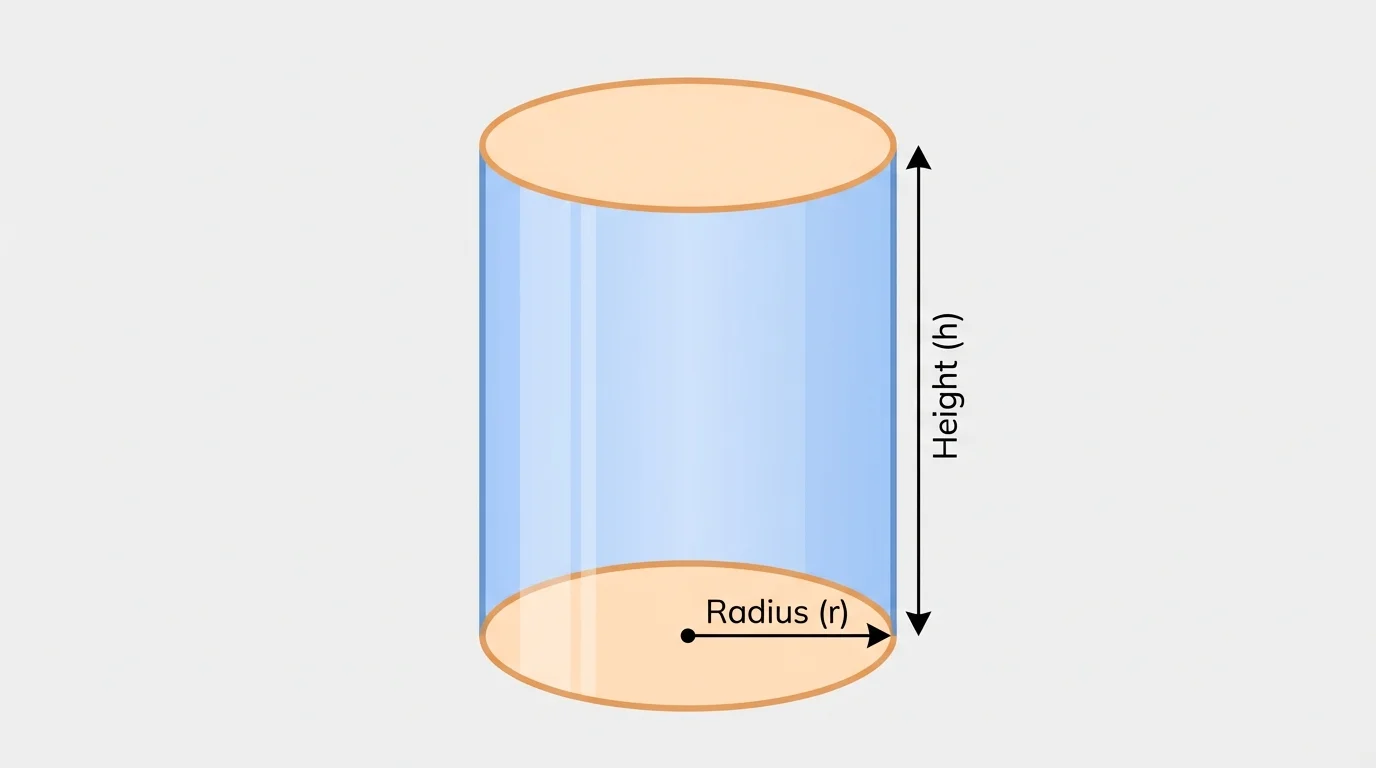
If the radius doubles, the volume does not just double, because the radius is squared. For example, changing the radius from \(2\) to \(4\) changes \(r^2\) from \(4\) to \(16\). That makes a huge difference in volume.
Why the cylinder formula makes sense
The formula \(V = \pi r^2 h\) is really just base area times height. Many volume formulas are built from this idea. For a cylinder, the base area is a circle, so the formula becomes the area of that circle multiplied by how tall the solid is.
Later, when we compare solids, [Figure 1] remains useful because it shows exactly which measurements belong in the formula and why the height must be straight up and down rather than slanted.
A cone looks similar to a cylinder because it also has a circular base. But instead of staying the same width all the way up, it narrows to a point. The comparison shows why the cone formula includes a factor of one-third when the cone and cylinder have the same base radius and the same height.
[Figure 2] The volume formula for a cone is
\[V = \frac{1}{3}\pi r^2 h\]
This means a cone with the same radius and height as a cylinder has one-third the cylinder's volume. That relationship is one of the most important facts to remember.
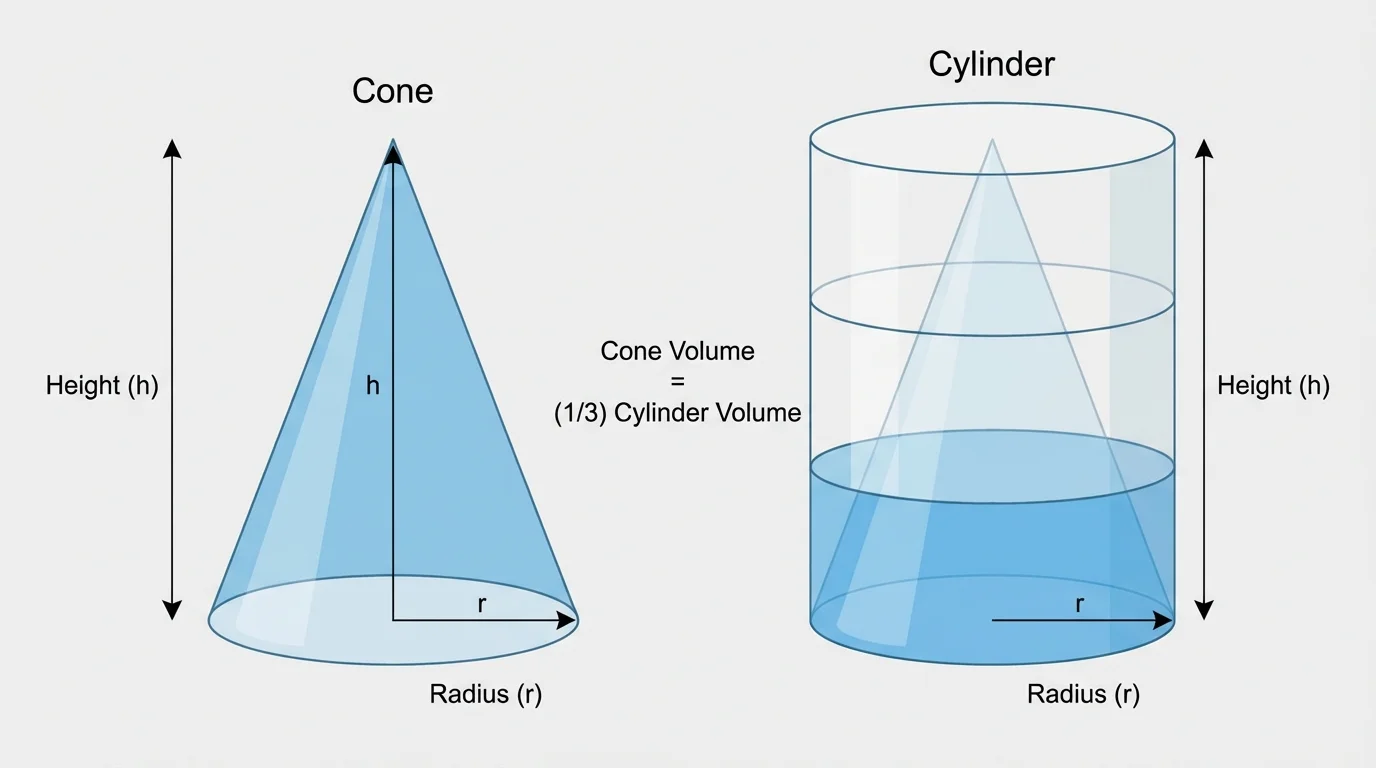
Students often forget the \(\dfrac{1}{3}\). If that happens, the answer will be three times too large. Another common mistake is using the slant height instead of the perpendicular height. For volume, the correct measurement is the height straight from the base to the top point.
Builders and designers use cone-like shapes in funnels, loudspeakers, rocket noses, and some roofs because the shape guides material or sound into a smaller region.
The cone formula is closely connected to the cylinder formula. In fact, if you know the cylinder formula well, then the cone formula is just that same formula multiplied by \(\dfrac{1}{3}\), as we see from the comparison in [Figure 2].
A sphere is different from cylinders and cones because it has no base and no height. Instead, the key measurement is the radius from the center to the surface. The diagram identifies the center, radius, and diameter, which helps you choose the correct measurement in sphere problems.
[Figure 3] The volume formula for a sphere is
\[V = \frac{4}{3}\pi r^3\]
Notice two important features. First, the radius is cubed, so a small change in radius can create a big change in volume. Second, the formula uses only the radius, not height.
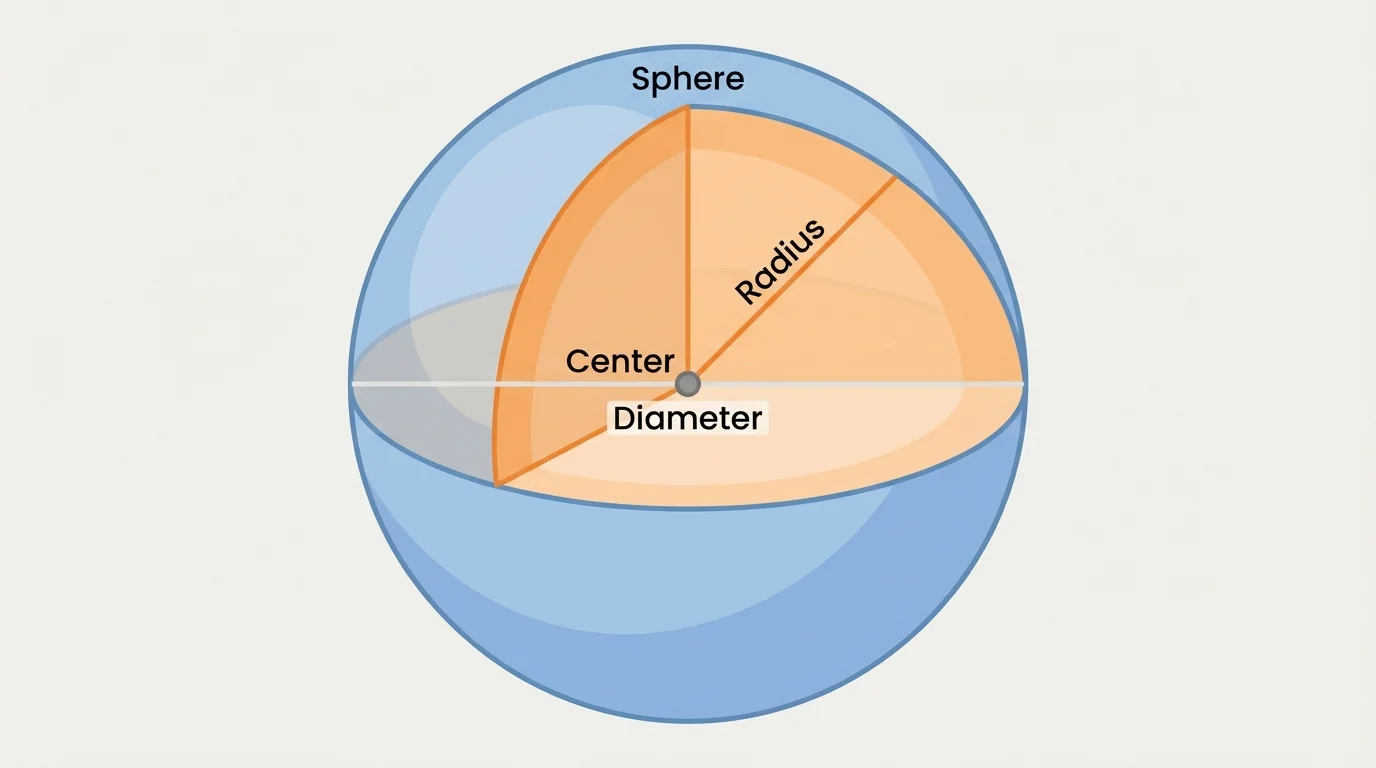
If a problem gives the diameter, divide by \(2\) before substituting. For example, if the diameter is \(12\), then the radius is \(6\). Using \(12\) as the radius would make the answer far too large.
Sports equipment, planets, bubbles, and many machine parts are modeled by spheres or nearly spherical shapes. That is why this formula matters outside the classroom too. When we later estimate storage or material amounts, [Figure 3] reminds us that everything starts from the center-to-surface distance.
All three formulas involve \(\pi\) because circles are involved in each shape. But they differ in how the measurements are used.
| Solid | Volume Formula | Key Measurements | Common Mistake |
|---|---|---|---|
| Cylinder | \(V = \pi r^2 h\) | Radius and height | Using diameter instead of radius |
| Cone | \(V = \dfrac{1}{3}\pi r^2 h\) | Radius and height | Forgetting \(\dfrac{1}{3}\) |
| Sphere | \(V = \dfrac{4}{3}\pi r^3\) | Radius only | Not converting diameter to radius |
Table 1. Comparison of the volume formulas, measurements, and common errors for cylinders, cones, and spheres.
A good habit is to identify the shape first, then write the correct formula, then check whether the measurement is a radius, diameter, or height. This slows you down just enough to avoid many simple mistakes.
Worked examples help show not just the answer, but the thinking process. Pay attention to how each problem begins by identifying the solid and the measurements.
Example 1: Finding the volume of a cylinder
A cylindrical soup can has radius \(4 \textrm{ cm}\) and height \(10 \textrm{ cm}\). Find its volume.
Step 1: Choose the correct formula.
For a cylinder, \(V = \pi r^2 h\).
Step 2: Substitute the values.
\(V = \pi (4)^2(10)\)
Step 3: Simplify.
\(4^2 = 16\), so \(V = \pi (16)(10) = 160\pi\).
The exact volume is \[160\pi \textrm{ cm}^3\] and the approximate volume is \(160 \cdot 3.14 = 502.4\), so \[V \approx 502.4 \textrm{ cm}^3\]
The units are cubic centimeters because volume measures three-dimensional space.
Example 2: Finding the volume of a cone
A cone has radius \(6 \textrm{ m}\) and height \(9 \textrm{ m}\). Find its volume.
Step 1: Write the cone formula.
\(V = \dfrac{1}{3}\pi r^2 h\)
Step 2: Substitute.
\(V = \dfrac{1}{3}\pi (6)^2(9)\)
Step 3: Compute carefully.
\(6^2 = 36\), so \(V = \dfrac{1}{3}\pi (36)(9) = \dfrac{324}{3}\pi = 108\pi\).
The exact volume is \[108\pi \textrm{ m}^3\] and the approximate volume is \(108 \cdot 3.14 = 339.12\), so \[V \approx 339.12 \textrm{ m}^3\]
Notice that if we had forgotten the \(\dfrac{1}{3}\), we would have gotten \(324\pi\), which is much too large.
Example 3: Finding the volume of a sphere
A ball has diameter \(14 \textrm{ in}\). Find its volume.
Step 1: Find the radius.
\(r = \dfrac{14}{2} = 7\)
Step 2: Use the sphere formula.
\(V = \dfrac{4}{3}\pi r^3\)
Step 3: Substitute and simplify.
\(V = \dfrac{4}{3}\pi (7)^3 = \dfrac{4}{3}\pi (343) = \dfrac{1372}{3}\pi\)
Step 4: Approximate.
\(\dfrac{1372}{3}\pi \approx 457.33 \cdot 3.14 \approx 1435.99\)
The volume is \[V = \frac{1372}{3}\pi \textrm{ in}^3 \approx 1435.99 \textrm{ in}^3\]
This example shows why reading carefully matters: the problem gave the diameter, but the formula needed the radius.
Example 4: Comparing a cylinder and a cone
A cylinder and a cone have the same radius, \(5 \textrm{ cm}\), and the same height, \(12 \textrm{ cm}\). Find both volumes.
Step 1: Find the cylinder volume.
\(V = \pi r^2 h = \pi (5)^2(12) = \pi (25)(12) = 300\pi\)
Step 2: Find the cone volume.
\(V = \dfrac{1}{3}\pi r^2 h = \dfrac{1}{3}\pi (5)^2(12) = \dfrac{1}{3}(300\pi) = 100\pi\)
Step 3: Compare.
\(100\pi\) is exactly one-third of \(300\pi\).
The cylinder volume is \[300\pi \textrm{ cm}^3\] and the cone volume is \[100\pi \textrm{ cm}^3\]
This confirms the visual relationship shown earlier in [Figure 2]: with the same radius and height, the cone has one-third the volume of the cylinder.
Geometry becomes more interesting when you can connect formulas to actual objects. The illustration links these solids to everyday items: an ice cream cone is modeled by a cone, and the scoop on top can be estimated by part of a sphere. Engineers and designers regularly use this kind of modeling.
[Figure 4] For example, a cylindrical water tank can be modeled with \(V = \pi r^2 h\). If a city needs to know how much water the tank holds, volume gives the answer. A cone-shaped funnel can be modeled with \(V = \dfrac{1}{3}\pi r^2 h\). A spherical storage container or a ball bearing can be modeled with \(V = \dfrac{4}{3}\pi r^3\).
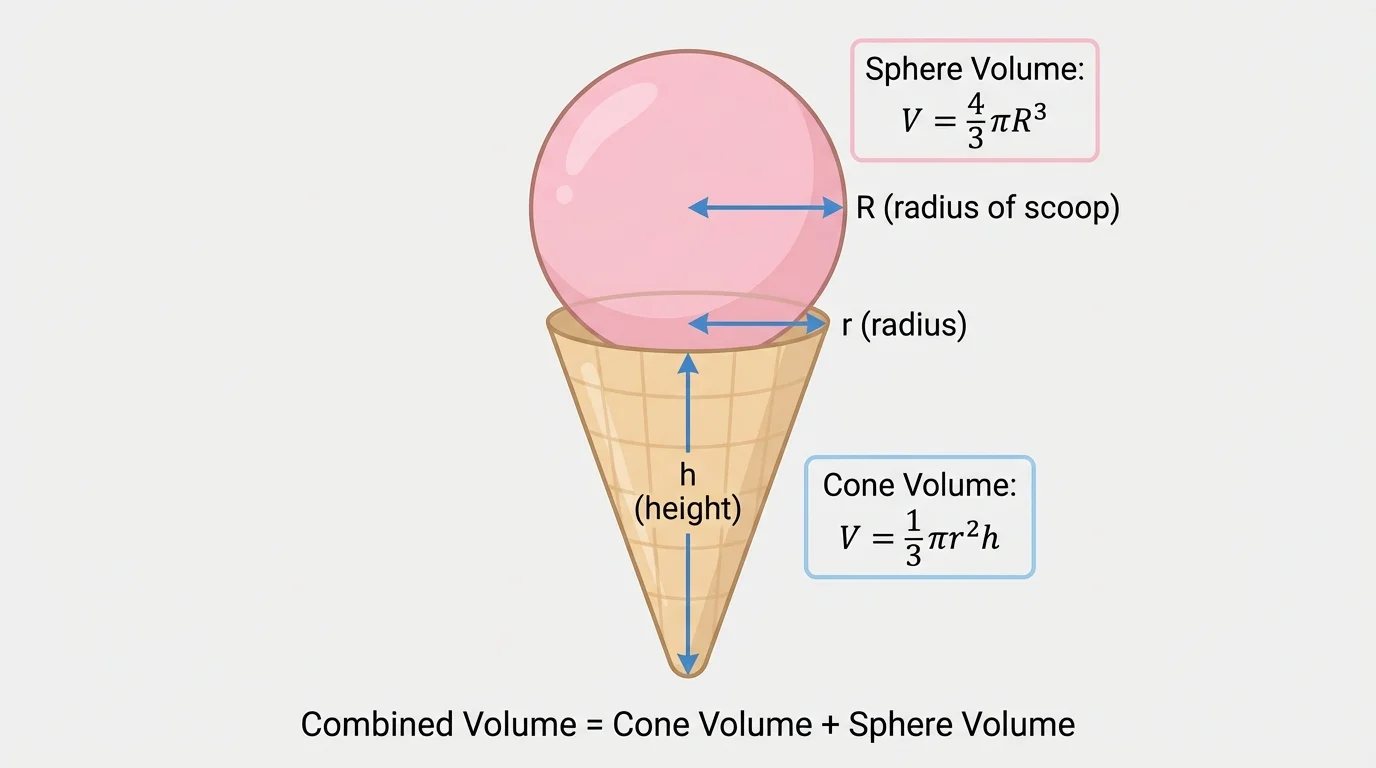
Sometimes a real object is made from more than one solid. For instance, a novelty container might have a cylindrical middle and two hemispherical ends. In that case, you find the volume of each part and add them. This is called a composite solid.
If you estimate the amount of ice cream in a cone shop special, you may add the volume of the cone and the volume of a scoop. If the scoop is a full sphere with radius \(3 \textrm{ cm}\), its volume is \(\dfrac{4}{3}\pi (3)^3 = 36\pi\). If the cone has radius \(3 \textrm{ cm}\) and height \(8 \textrm{ cm}\), its volume is \(\dfrac{1}{3}\pi (3)^2(8) = 24\pi\). The total would be \(60\pi \textrm{ cm}^3\).
When applying formulas in the real world, units matter. If measurements are in centimeters, the answer is in cubic centimeters. If measurements are in meters, the answer is in cubic meters. Mixing units, such as using radius in centimeters and height in meters, leads to incorrect answers.
Later, when you face combined-shape problems, [Figure 4] helps you see that one object can be broken into familiar solids whose volumes you already know how to calculate.
One of the best strategies is to write the formula before putting in numbers. This helps you see whether you need \(r\), \(h\), or both. It also helps you avoid mixing up the formulas for different solids.
Another good strategy is to decide whether to give an exact answer or an approximate answer. An exact answer keeps \(\pi\), such as \(72\pi\). An approximate answer replaces \(\pi\) with about \(3.14\), giving a decimal.
Reasonableness checks
After solving, ask whether the answer makes sense. A cone with the same radius and height as a cylinder should have a smaller volume. A sphere with a larger radius should have a much larger volume because the radius is cubed. These quick checks can catch mistakes before you move on.
Be especially careful with these errors:
A strong habit is to keep the exact value until the end and round only once. For example, keep \(160\pi\) until the final step instead of rounding the middle of the calculation several times.
