Two different rules can sometimes point to one exact place. That is the big idea behind systems of linear equations. If one equation tells you where points on one line are, and a second equation tells you where points on another line are, then the solution to the system is the point where both rules agree. On a graph, that agreement appears as the place where the lines cross. In algebra, it appears as an ordered pair that makes both equations true.
A system of linear equations is a set of two or more equations that are considered together. In this lesson, we focus on two linear equations in two variables, usually written with variables like \(x\) and \(y\). For example, \(y = 2x + 1\) and \(y = -x + 7\) form a system.
Each linear equation represents a line on the coordinate plane. Every point on that line is a solution to that one equation. But a system asks a harder question: which point is on both lines? That point must satisfy both equations simultaneously. The word simultaneously means "at the same time."
Solution to a system means an ordered pair \((x, y)\) that makes every equation in the system true. A point of intersection is the point where two graphs cross. For linear systems, these ideas match: the solution is the intersection point.
If a point lies on the graph of \(y = 2x + 1\), then its coordinates make that equation true. If the same point also lies on the graph of \(y = -x + 7\), then its coordinates make the second equation true too. So a point where the lines intersect is not just a picture on a graph. It is also an algebraic solution.
When two lines cross once, they have exactly one common point, as [Figure 1] shows. That common point is the intersection, and its coordinates give the solution to the system.
Suppose the graphs of two equations cross at \((2, 5)\). That means \((2, 5)\) lies on the first line and also on the second line. Because points on a graph represent solutions, \((2, 5)\) must satisfy both equations. This is why graphing can solve a system: you look for the point both lines share.
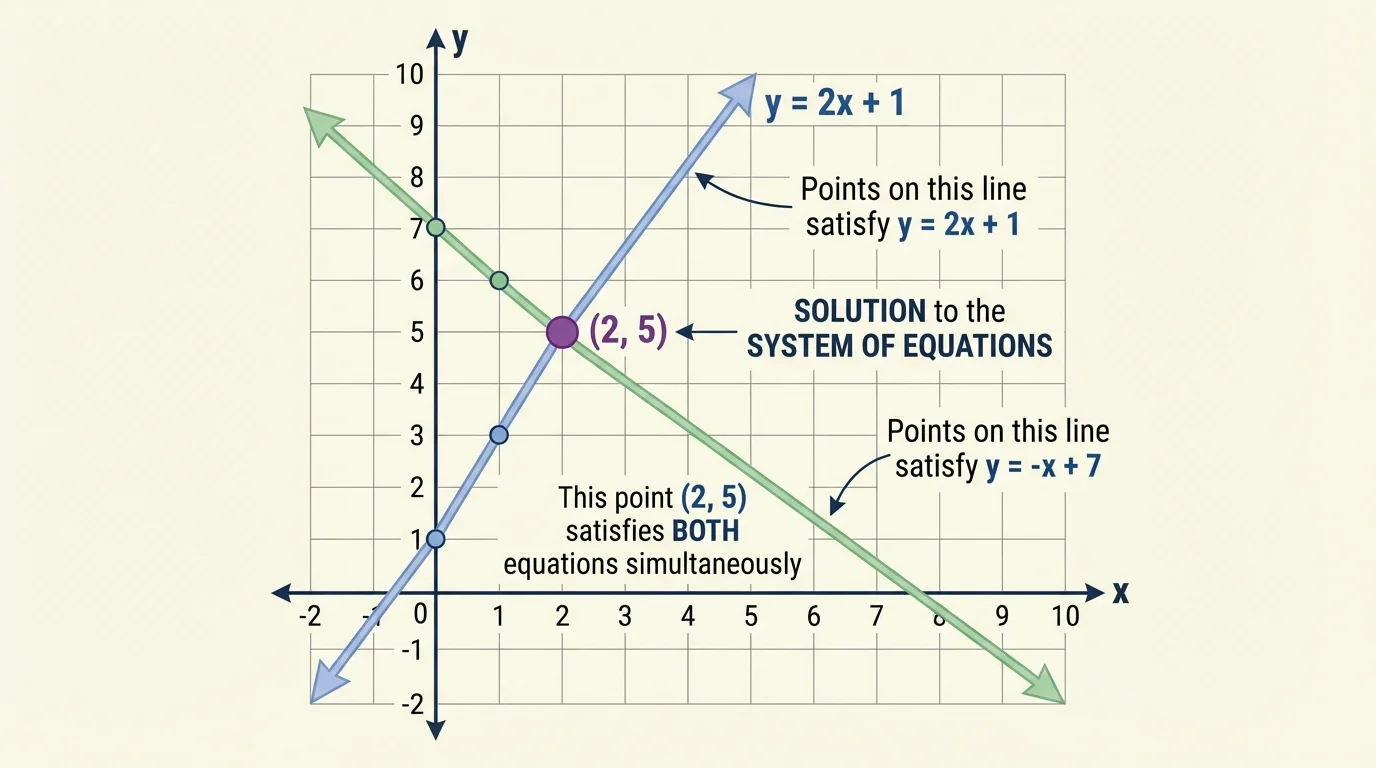
It is important to notice that not every point on either line is a solution to the system. A point on only one line satisfies only one equation. The system needs a point that works for both. That is why the crossing point matters so much.
Think of it this way: one line gives all the points where equation one is true. The other line gives all the points where equation two is true. The solution is the overlap. For two different non-parallel lines, the overlap is exactly one point.
Why graphing works
A graph is a visual record of all solutions to an equation. Since each line shows all solutions to one equation, the point where two lines meet must be a solution to both. Graphing does not create the solution; it reveals the ordered pair that already makes both equations true.
Later, when you use algebraic methods such as substitution or elimination, you are finding the same solution in a different way. The graph and the algebra should agree.
A graph can suggest a solution, but algebra can confirm it exactly. If you think \((2, 5)\) is the intersection point, substitute \(x = 2\) and \(y = 5\) into each equation.
For the system \(y = 2x + 1\) and \(y = -x + 7\): substituting into the first equation gives \(5 = 2(2) + 1 = 5\), which is true. Substituting into the second equation gives \(5 = -(2) + 7 = 5\), which is also true. Since both equations are true, \((2, 5)\) is a solution.
To check whether an ordered pair is a solution to an equation, replace \(x\) and \(y\) with the coordinates of the point. If the equation becomes a true statement, the point is on that graph.
This checking step is very useful when a graph is not perfectly precise. On paper, a line may look like it crosses at about \((1.9, 5.1)\), but the exact algebraic solution might be \((2, 5)\). Verifying with substitution helps remove doubt.
Let us solve the system \(y = x + 2\) and \(y = -2x + 8\). We want the point where the two lines intersect, and we also want to understand why that point satisfies both equations.
Worked example: finding the intersection and checking it
Step 1: Set the equations equal to each other.
Since both expressions equal \(y\), write \(x + 2 = -2x + 8\).
Step 2: Solve for \(x\).
Add \(2x\) to both sides: \(3x + 2 = 8\).
Subtract \(2\): \(3x = 6\).
Divide by \(3\): \(x = 2\).
Step 3: Find \(y\).
Substitute \(x = 2\) into \(y = x + 2\): \(y = 2 + 2 = 4\).
Step 4: Check in the second equation.
Substitute \(x = 2\) into \(y = -2x + 8\): \(y = -2(2) + 8 = 4\).
The solution is \((2, 4)\).
The lines intersect at \((2, 4)\). On a graph, that is the one point shared by both lines. Algebra confirms the same result. This matching of graph and algebra is the heart of solving systems.
Notice something powerful: even if you begin with a graph, you can still check with substitution. Even if you begin with algebra, you can still picture the lines crossing at one point. Both views describe the same mathematics.
Sometimes a system has no solution at all. This happens when the lines are parallel, as [Figure 2] illustrates. Parallel lines never meet, so there is no point that lies on both graphs.
Consider the system \(y = 3x + 1\) and \(y = 3x - 4\). Both lines have slope \(3\), so they rise at the same rate, but they have different y-intercepts: one crosses the \(y\)-axis at \(1\), and the other at \(-4\).
Worked example: showing there is no intersection
Step 1: Set the equations equal.
\(3x + 1 = 3x - 4\)
Step 2: Subtract \(3x\) from both sides.
\(1 = -4\)
Step 3: Interpret the result.
The statement \(1 = -4\) is false, so there is no value of \(x\) that makes both equations true at the same time.
This system has no solution.
Graphically, the two lines never cross. Algebraically, the variables disappear and leave a false statement. Those are two ways of saying the same thing.
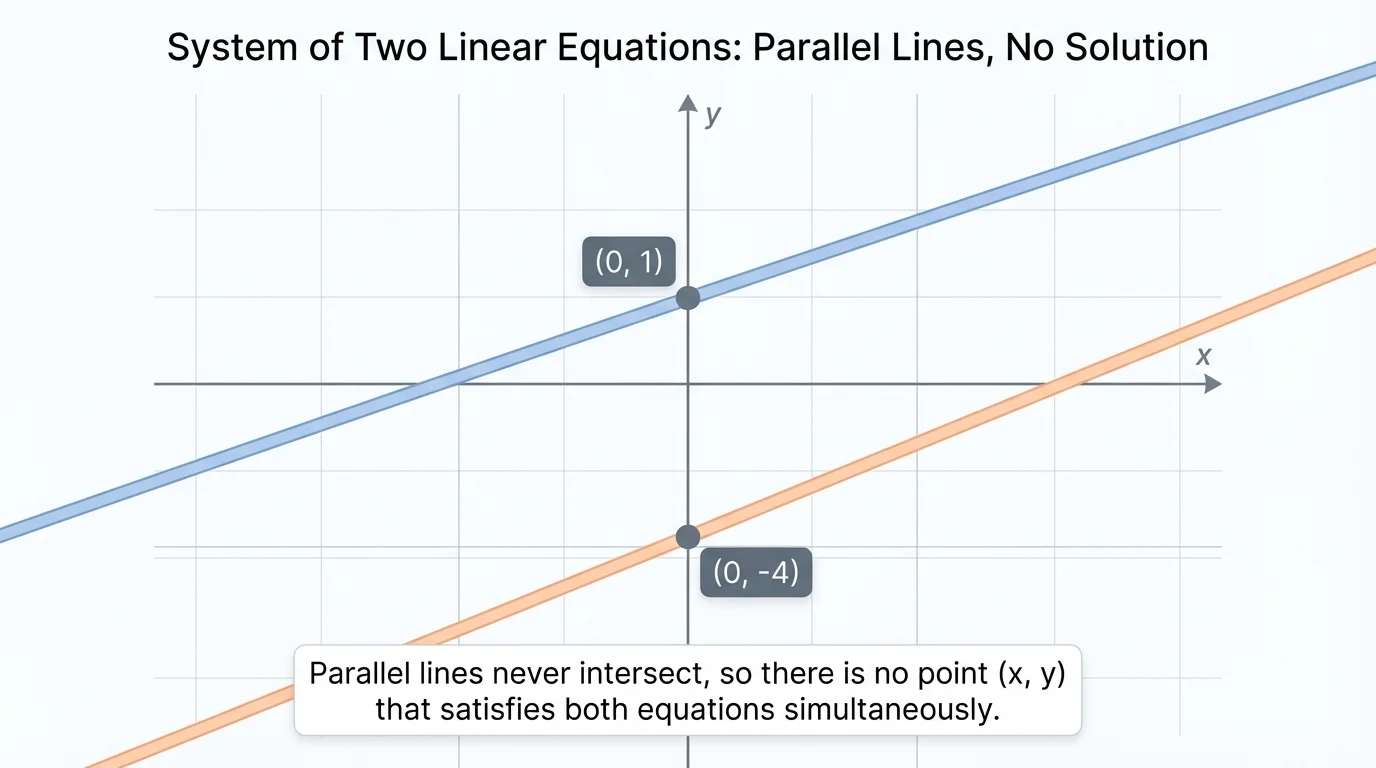
Systems with no solution are important because they show that not every pair of equations has a common answer. If two situations are modeled by parallel lines, then the conditions never happen at the same point.
A system can also have infinitely many solutions if both equations describe the exact same line, as [Figure 3] shows. In that case, every point on the line satisfies both equations.
Consider the system \(y = 2x + 3\) and \(2y = 4x + 6\). The second equation may look different, but dividing every term by \(2\) gives \(y = 2x + 3\), which is exactly the first equation.
Worked example: recognizing the same line
Step 1: Rewrite one equation in a simpler form.
From \(2y = 4x + 6\), divide both sides by \(2\): \(y = 2x + 3\).
Step 2: Compare the equations.
Now both equations are \(y = 2x + 3\).
Step 3: Interpret the graph.
Since the graphs are the same line, every point on that line is shared.
The system has infinitely many solutions.
If you choose \(x = 0\), then \(y = 3\), so \((0, 3)\) is one solution. If you choose \(x = 1\), then \(y = 5\), so \((1, 5)\) is another solution. There is no end to the points because a line contains infinitely many points.
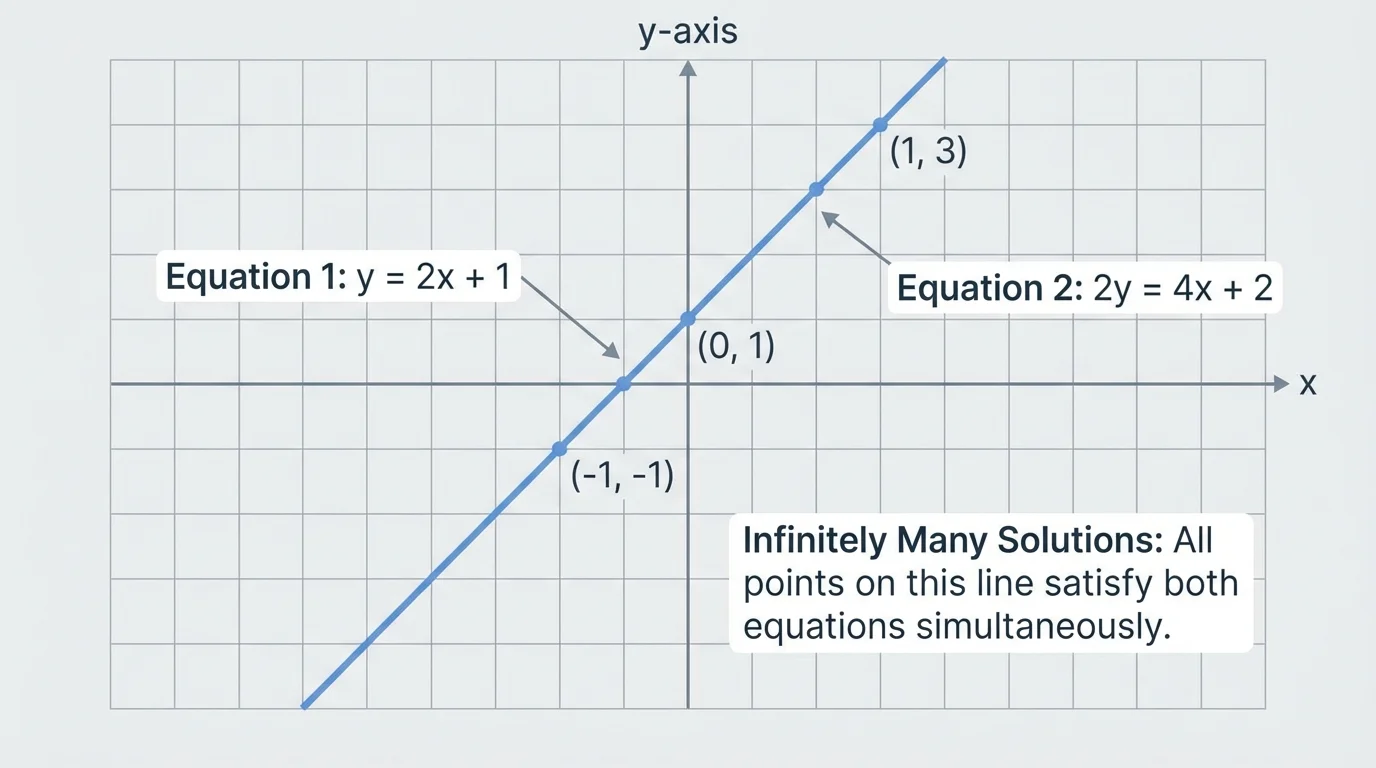
Later, when solving systems algebraically, you may get a true statement such as \(6 = 6\). That tells you the equations are equivalent and the system has infinitely many solutions. This matches the overlapping graph.
Linear equations can be written in different forms, but they still graph as lines. A common form is slope-intercept form, \(y = mx + b\), where \(m\) is the slope and \(b\) is the \(y\)-intercept. Another common form is standard form, \(Ax + By = C\).
For example, \(x + y = 6\) is in standard form. If we solve for \(y\), we get \(y = -x + 6\). This makes graphing easier because we can see the slope \(-1\) and the \(y\)-intercept \(6\).
| Equation | Form | Useful graph information |
|---|---|---|
| \(y = 2x + 1\) | Slope-intercept | Slope \(2\), \(y\)-intercept \(1\) |
| \(x + y = 6\) | Standard | Can rewrite as \(y = -x + 6\) |
| \(2x - y = 4\) | Standard | Can rewrite as \(y = 2x - 4\) |
Table 1. Examples of linear equations in different forms and the graph information each form reveals.
No matter which form you start with, the solution to a system still means the same thing: the ordered pair that makes both equations true and the point where the lines intersect.
Traffic engineers, economists, and scientists often use systems of linear equations to compare changing quantities. The graph helps them quickly see whether two trends ever match and, if so, when and where that happens.
This is another reason graphs matter. They make algebra visible. Values such as \(x = 2\) and \(y = 4\) turn into a location on the coordinate plane, and that location has meaning.
Suppose two streaming plans have different pricing rules. Plan A costs $5 plus $2 per movie, so \(y = 2x + 5\). Plan B costs $11 plus $1 per movie, so \(y = x + 11\). Here, \(x\) is the number of movies and \(y\) is total cost.
If the graphs intersect, that point tells when both plans cost the same amount. Set the equations equal: \(2x + 5 = x + 11\). Solving gives \(x = 6\). Then \(y = 17\). So at \((6, 17)\), both plans cost $17 for \(6\) movies.
This intersection is not just a graph point. It answers a real question: at what number of movies do the plans match? After that point, one plan may become cheaper than the other.
Real-world example: distance over time
Two cyclists travel along the same road. Cyclist A starts \(4\) miles ahead and rides at \(10\) miles per hour, so \(d = 10t + 4\). Cyclist B starts at the beginning and rides at \(12\) miles per hour, so \(d = 12t\).
Step 1: Set the distances equal.
\(10t + 4 = 12t\)
Step 2: Solve for time.
Subtract \(10t\): \(4 = 2t\), so \(t = 2\).
Step 3: Find the distance.
Substitute into \(d = 12t\): \(d = 12(2) = 24\).
The cyclists are at the same place after \(2\) hours, at a distance of \(24\) miles.
On a graph, the lines for the two cyclists intersect at \((2, 24)\). In a race or travel problem, that intersection often represents catching up, matching cost, or reaching the same amount.
One common mistake is choosing a point from one line and calling it the solution. A system solution must be on both lines. If an ordered pair works in only one equation, it is not a solution to the system.
Another mistake is reading the graph inaccurately. If the lines cross between grid points, estimate carefully. Then use substitution to check. The graph gives a visual answer, but algebra confirms whether the coordinates are exact.
Students also sometimes confuse the three types of systems. Keep these ideas clear: one intersection means one solution, no intersection means no solution, and the same line means infinitely many solutions. The parallel lines in [Figure 2] and the overlapping lines in [Figure 3] help make that contrast visible.
"A solution to a system is where both equations agree."
That sentence is worth remembering because it works in every method. Whether you graph, substitute, or eliminate, you are always finding the point or points that make both equations true at once.
A line is really a collection of all ordered pairs that satisfy one linear equation. When two lines are graphed together, their shared point, if one exists, is the ordered pair that satisfies both equations. That is why the graph and the algebra tell the same story.
If you can look at a system and connect these ideas — equations, graphs, ordered pairs, and intersection — then you understand what a solution really means. The graph is not separate from the algebra. It is a picture of the same truth.
