A calculator can tell you that \(\pi \approx 3.14159\), but where does that number lie on a number line, and how do you know whether it is bigger or smaller than \(\sqrt{10}\)? Mathematics often works like a zoom lens: even when a number cannot be written exactly as a fraction, you can still get closer and closer to its value. That idea is powerful because it lets us work with numbers that never end and never repeat.
A rational number can be written as a fraction of two integers, such as \(\dfrac{3}{4}\), \(-2\), or \(0.125\). Rational numbers have decimal forms that either stop, like \(0.5\), or repeat, like \(0.333...\).
An irrational number cannot be written as a fraction of two integers. Its decimal form goes on forever and does not repeat in a pattern. Famous examples include \(\sqrt{2}\), \(\sqrt{3}\), and \(\pi\).
Even though irrational numbers cannot be written exactly as simple fractions, they can still be approximated by rational numbers. For example, \(\pi\) is irrational, but \(3.14\), \(3.1416\), and \(\dfrac{22}{7}\) are all rational approximations of \(\pi\).
Irrational number means a number that cannot be expressed as a ratio of integers. Its decimal expansion never terminates and never repeats.
Approximation means a value that is close to the exact number but may not equal it exactly.
One of the most important ideas in this topic is that you do not need the exact decimal expansion of an irrational number in order to compare it, plot it, or use it in an estimate. A good nearby rational number is often enough.
To bound a number means to place it between two values. This is often the first step in approximating an irrational number.
Consider \(\sqrt{2}\). We know that \(1^2 = 1\) and \(2^2 = 4\). Since \(2\) is between \(1\) and \(4\), the number \(\sqrt{2}\) must be between \(1\) and \(2\). So we can write \(1 < \sqrt{2} < 2\).
Now we can be more precise. Check tenths: \(1.4^2 = 1.96\) and \(1.5^2 = 2.25\). Since \(2\) lies between \(1.96\) and \(2.25\), it follows that \(1.4 < \sqrt{2} < 1.5\).
This is already a much better approximation. We have narrowed the value of \(\sqrt{2}\) to an interval of width \(0.1\) instead of width \(1\).
When you take a square root, you are asking, "What number multiplied by itself gives the original number?" For example, since \(3^2 = 9\), we know \(\sqrt{9} = 3\).
You can do the same thing with other square roots. Since \(2^2 = 4\) and \(3^2 = 9\), the number \(\sqrt{5}\) must be between \(2\) and \(3\). Since \(3^2 = 9\) and \(4^2 = 16\), the number \(\sqrt{10}\) must be between \(3\) and \(4\).
You can keep refining an approximation one decimal place at a time, as [Figure 1] shows with repeated narrowing intervals. This process works because each new decimal place lets you test numbers in a smaller range.
Return to \(\sqrt{2}\). We already know \(1.4 < \sqrt{2} < 1.5\). To improve this, test hundredths. Compute \(1.41^2 = 1.9881\) and \(1.42^2 = 2.0164\). Since \(2\) lies between these results, we know that \(1.41 < \sqrt{2} < 1.42\).
We can continue. If we test thousandths, we find that \(1.414^2 = 1.999396\) and \(1.415^2 = 2.002225\). So \(1.414 < \sqrt{2} < 1.415\).
This method never ends completely, because the decimal expansion of \(\sqrt{2}\) never ends. But it gives better and better rational approximations. Truncating the decimal expansion of \(\sqrt{2}\) gives values like \(1\), \(1.4\), \(1.41\), and \(1.414\). Each one is rational, and each one is closer to the true value.
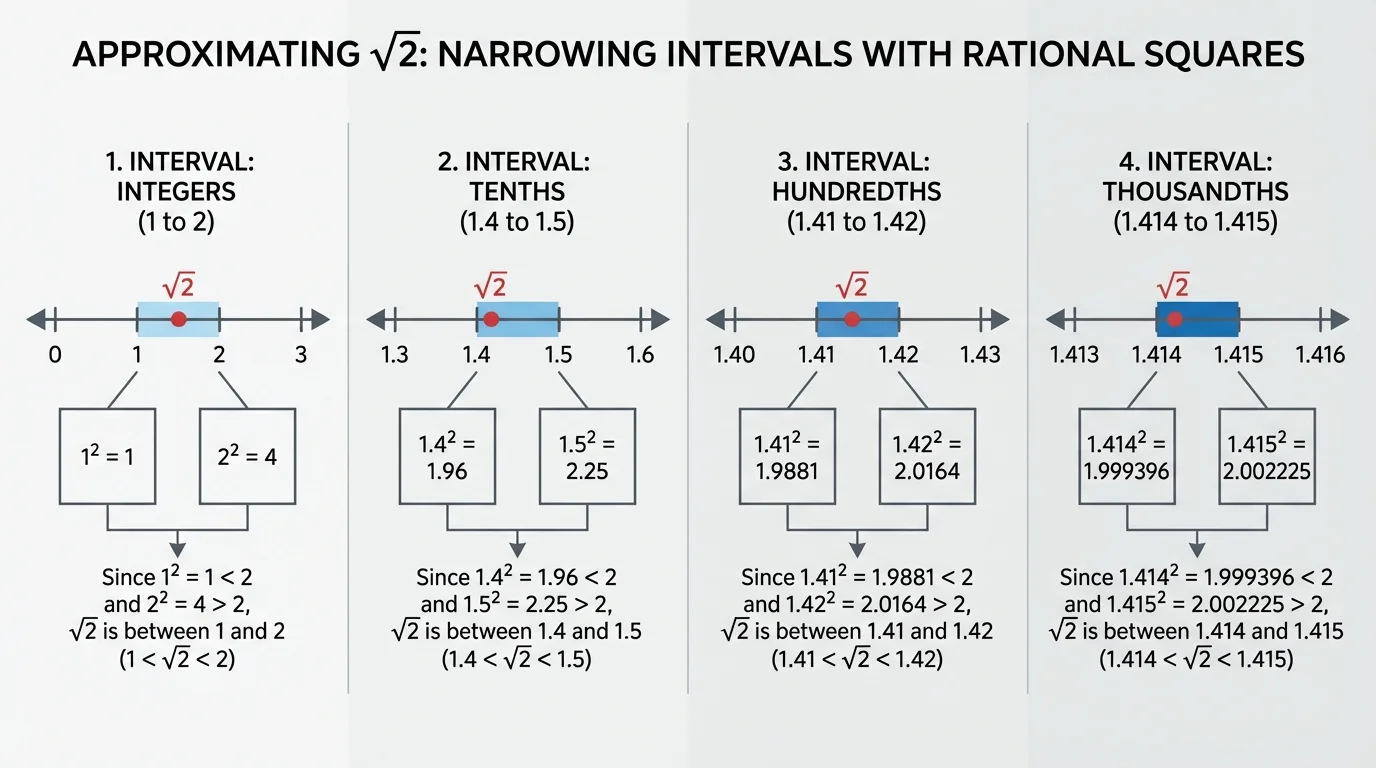
Another way to think about this is that each approximation gives a smaller "target zone." Instead of trying to find the exact irrational number all at once, you pin it down between two rational numbers that are very close together.
Truncation and rounding are not the same. Truncation cuts off the decimal digits after a certain place, so truncating \(1.414213...\) to the hundredths place gives \(1.41\). Rounding looks at the next digit, so rounding that same number to the hundredths place gives \(1.41\), but in other cases the result can differ.
If you use truncation to say \(\sqrt{2} \approx 1.41\), you are giving a lower estimate because \(1.41 < \sqrt{2}\). If you round \(\sqrt{2}\) to the nearest hundredth, you still get \(1.41\), but it now means "closest hundredth," not necessarily a lower bound.
As we saw in [Figure 1], the same idea works again and again: find nearby rational numbers, square them, and check where the original number fits.
Irrational numbers can be placed approximately on a number line, even though their decimal expansions go on forever. A number line gives a visual way to compare distances and see which numbers are larger.
As [Figure 2] shows, \(\sqrt{2} \approx 1.414\), so it belongs a little to the right of \(1.4\). The number \(\sqrt{3} \approx 1.732\), so it lies between \(1.7\) and \(1.8\). The number \(\pi \approx 3.14\), so it lies just to the right of \(3.1\).
When placing irrational numbers on a number line, first identify the two whole numbers between which the number lies. Then use tenths or hundredths to place it more accurately.
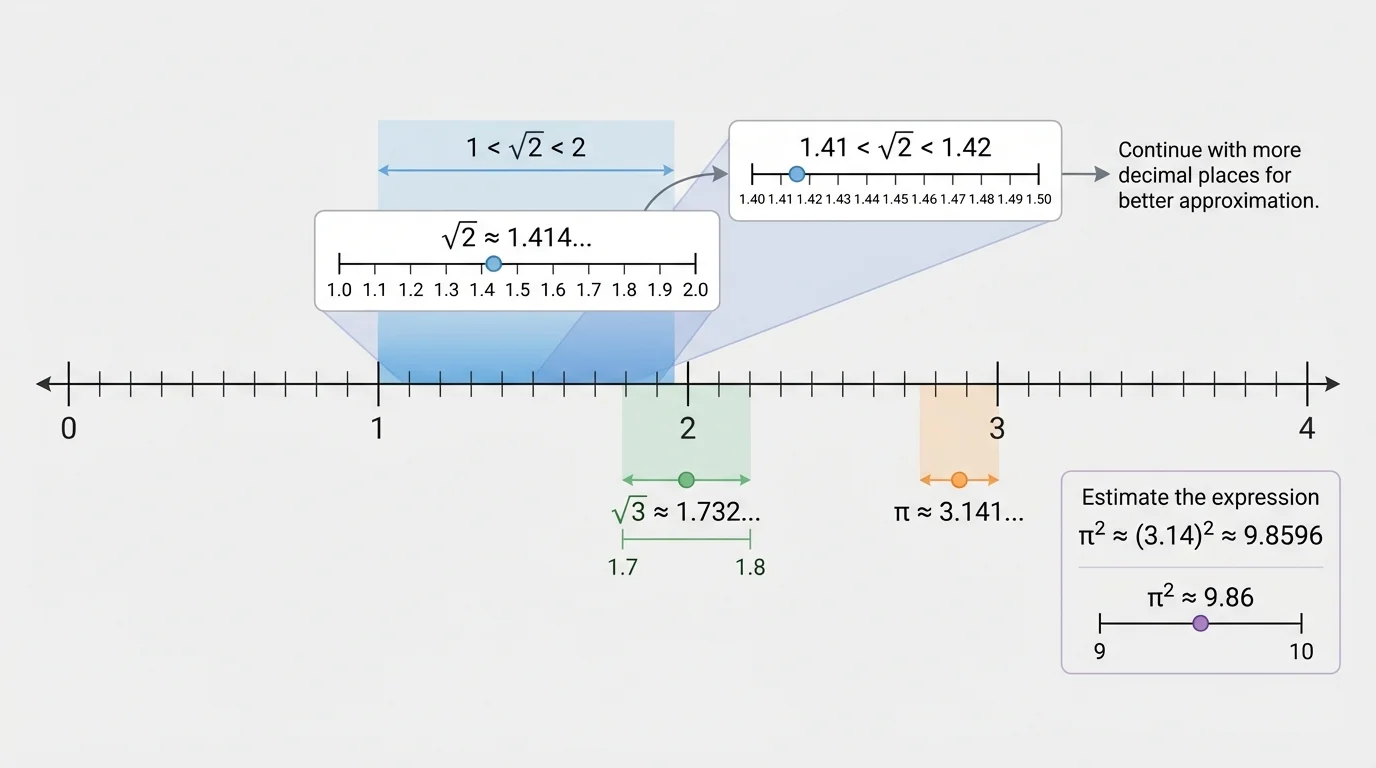
If a number line is marked only with integers, your placement will be rough. If it includes tenths, your placement will be better. If it includes hundredths, it becomes more precise. The number line does not make the number rational; it simply helps represent its location.
Later, when comparing values or estimating expressions, the picture from [Figure 2] remains useful because distance on the line matches numerical size.
To compare irrational numbers, convert them into benchmark decimals or compare them using properties you already know. Once the numbers are in a comparable form, ordering them becomes much easier.
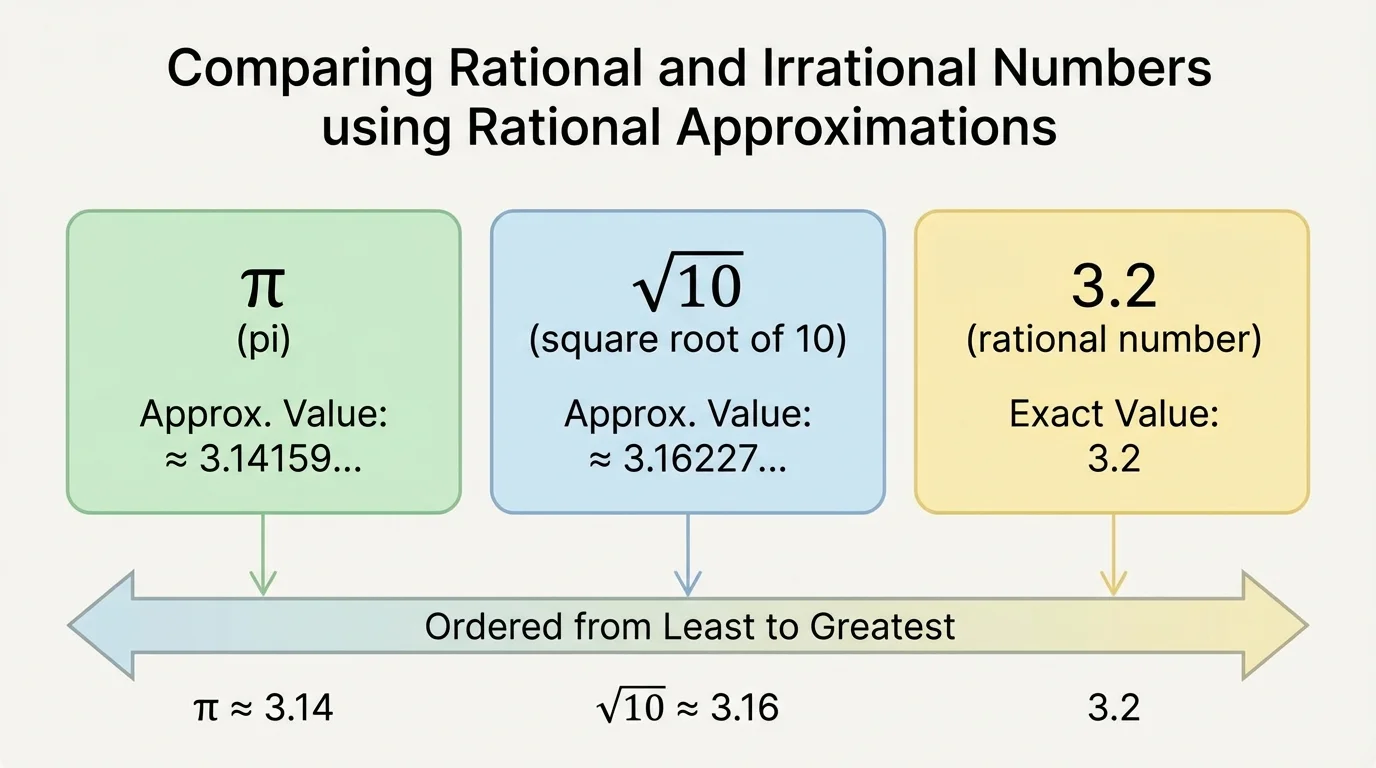
As [Figure 3] shows, compare \(\sqrt{10}\) and \(\pi\). Since \(3^2 = 9\) and \(4^2 = 16\), we know \(\sqrt{10}\) is between \(3\) and \(4\). A more accurate value is \(\sqrt{10} \approx 3.162\). Because \(\pi \approx 3.142\), we get \(\sqrt{10} > \pi\).
Here is another comparison: \(\sqrt{5}\) and \(2.3\). Since \(2.2^2 = 4.84\) and \(2.3^2 = 5.29\), the number \(\sqrt{5}\) is between \(2.2\) and \(2.3\), so \(\sqrt{5} < 2.3\).
You can also compare two irrational numbers. Compare \(\sqrt{7}\) and \(\sqrt{8}\). Since square root preserves order for positive numbers, and \(7 < 8\), it follows that \(\sqrt{7} < \sqrt{8}\). Their decimal approximations, about \(2.646\) and \(2.828\), confirm this.
| Number | Approximate decimal value | Nearby rational bounds |
|---|---|---|
| \(\sqrt{2}\) | \(1.414\) | \(1.41 < \sqrt{2} < 1.42\) |
| \(\sqrt{5}\) | \(2.236\) | \(2.2 < \sqrt{5} < 2.3\) |
| \(\sqrt{10}\) | \(3.162\) | \(3.1 < \sqrt{10} < 3.2\) |
| \(\pi\) | \(3.142\) | \(3.14 < \pi < 3.15\) |
Table 1. Approximate decimal values and rational bounds for several irrational numbers.
When the values are close together, it helps to use more decimal places. For example, \(\pi \approx 3.14159\) and \(\sqrt{10} \approx 3.16228\). The tenths place alone shows both are about \(3.1\), but the hundredths place shows that \(0.16 > 0.14\), so \(\sqrt{10}\) is larger.
Approximations become especially useful when an expression includes an irrational number. If the exact value is not practical, estimate with a nearby rational number.
For example, to estimate \(\pi^2\), use \(\pi \approx 3.14\). Then \(\pi^2 \approx 3.14^2 = 9.8596\), so \(\pi^2 \approx 9.86\).
To estimate \(2\sqrt{3}\), use \(\sqrt{3} \approx 1.73\). Then \(2\sqrt{3} \approx 2(1.73) = 3.46\).
To estimate \(\sqrt{2} + \pi\), use \(\sqrt{2} \approx 1.41\) and \(\pi \approx 3.14\). Then \(\sqrt{2} + \pi \approx 1.41 + 3.14 = 4.55\).
The ancient Greek mathematician Archimedes estimated \(\pi\) by finding perimeters of polygons inside and outside a circle. Long before calculators, mathematicians relied on rational approximations to study irrational numbers.
The quality of an estimate depends on the quality of the approximation. Using \(\pi \approx 3.1\) gives a rough answer, while using \(\pi \approx 3.1416\) gives a more accurate one.
Worked examples are one of the best ways to see how the process fits together.
Worked example 1
Show that \(\sqrt{2}\) is between \(1\) and \(2\), then between \(1.4\) and \(1.5\), and continue to get a better approximation.
Step 1: Bound \(\sqrt{2}\) between whole numbers.
Since \(1^2 = 1\) and \(2^2 = 4\), and \(2\) is between \(1\) and \(4\), we have \(1 < \sqrt{2} < 2\).
Step 2: Bound \(\sqrt{2}\) between tenths.
Compute \(1.4^2 = 1.96\) and \(1.5^2 = 2.25\). Since \(2\) is between \(1.96\) and \(2.25\), we get \(1.4 < \sqrt{2} < 1.5\).
Step 3: Bound \(\sqrt{2}\) between hundredths.
Compute \(1.41^2 = 1.9881\) and \(1.42^2 = 2.0164\). Since \(2\) is between these values, \(1.41 < \sqrt{2} < 1.42\).
Step 4: State an approximation.
A good approximation is \(\sqrt{2} \approx 1.41\), or more accurately \(\sqrt{2} \approx 1.414\).
The interval gets smaller each time, which means the approximation gets better.
This example shows the basic pattern for approximating square roots: use nearby squares, narrow the interval, and repeat as needed.
Worked example 2
Compare \(\sqrt{5}\) and \(\pi\).
Step 1: Approximate each number.
Use \(\sqrt{5} \approx 2.236\) and \(\pi \approx 3.142\).
Step 2: Compare the decimal values.
Since \(2.236 < 3.142\), it follows that \(\sqrt{5} < \pi\).
The larger integer part already tells us the answer: \(2\) is less than \(3\).
Sometimes the comparison is immediate once both numbers are written as decimals, but sometimes you need more digits if the values are close.
Worked example 3
Estimate \(\pi^2\) to the nearest hundredth.
Step 1: Choose a rational approximation for \(\pi\).
Use \(\pi \approx 3.14\).
Step 2: Square the approximation.
\(3.14^2 = 9.8596\).
Step 3: Round to the nearest hundredth.
Since the thousandths digit is \(9\), round \(9.8596\) to \(9.86\).
So \(\pi^2 \approx 9.86\).
Notice that the exact value of \(\pi^2\) is still irrational, but its estimate is rational and easy to use.
Worked example 4
Place \(\sqrt{10}\) approximately on a number line.
Step 1: Find nearby whole numbers.
Since \(3^2 = 9\) and \(4^2 = 16\), \(3 < \sqrt{10} < 4\).
Step 2: Narrow to tenths.
\(3.1^2 = 9.61\) and \(3.2^2 = 10.24\), so \(3.1 < \sqrt{10} < 3.2\).
Step 3: Place it on the line.
Since \(\sqrt{10} \approx 3.16\), place it between \(3.1\) and \(3.2\), a little closer to \(3.2\).
This agrees with the ordering shown earlier in [Figure 3].
Each of these examples uses the same central idea: irrational numbers can be understood through nearby rational numbers.
In real life, measurements are often approximate even when the formulas involve irrational numbers. If a circular garden has radius \(5\) meters, its area is \(25\pi\) square meters. A landscaper may use \(\pi \approx 3.14\) to estimate the area as \(78.5\) square meters.
Engineers, builders, and designers use square roots when finding distances. In a rectangular room with side lengths \(3\) meters and \(4\) meters, the diagonal is \(\sqrt{3^2 + 4^2} = \sqrt{25} = 5\) meters exactly. But in many designs the numbers are not so neat, and the diagonal may be an irrational number that must be approximated.
Computer graphics and video games also rely on distance formulas, which often produce irrational numbers. The computer uses decimal approximations because exact irrational values are not practical for every calculation.
One common mistake is to confuse a bound with an exact value. Writing \(1.4 < \sqrt{2} < 1.5\) does not mean \(\sqrt{2} = 1.4\) or \(\sqrt{2} = 1.5\). It means the number lies somewhere between them.
Another mistake is stopping too early when comparing close numbers. If two values both begin with \(3.1\), then compare the next decimal place, and if necessary the next one after that.
A helpful strategy is to use benchmark values you already know well: \(\sqrt{4} = 2\), \(\sqrt{9} = 3\), and \(\pi \approx 3.14\). These anchors make it easier to estimate new values.
It also helps to write inequalities clearly. For example, if \(1.41^2 < 2 < 1.42^2\), then \(1.41 < \sqrt{2} < 1.42\). Keep the order of the inequality consistent from left to right.
