A blueprint of a bridge, a digital photo resized on a screen, and a map of a city all depend on one powerful geometric idea: a figure can change size without changing shape. That idea is similarity. In geometry, this is not just a visual impression. It has a precise meaning, and that meaning comes from transformations.
When engineers shrink a design, they need every angle to stay correct. When a satellite image is enlarged, coastlines should keep the same shape. When you compare two triangular supports in a roof truss, you may want to know whether one is just a scaled copy of the other. Similarity lets us answer those questions mathematically.
Two figures are similar if one can be mapped onto the other by a sequence of moves that preserves shape. Some of those moves keep size exactly the same, while one special move changes size in a controlled way. Once we understand those moves, we can decide whether two figures are similar instead of just guessing by sight.
Recall: A rigid motion is a transformation that preserves distances and angle measures. Translations, rotations, and reflections are rigid motions, so they produce congruent figures.
Similarity is broader than congruence. Congruent figures have the same shape and the same size. Similar figures have the same shape, but their sizes may differ.
A transformation is a rule that moves a figure in the plane. As [Figure 1] shows, translations, rotations, and reflections can reposition a figure without changing its side lengths or angle measures. These are called rigid motions.
To create similar figures of different sizes, we also use a dilation. A dilation stretches or shrinks a figure from a fixed center by a scale factor. If the scale factor is greater than \(1\), the image gets larger. If the scale factor is between \(0\) and \(1\), the image gets smaller. A dilation preserves angle measures and multiplies every length by the same factor.
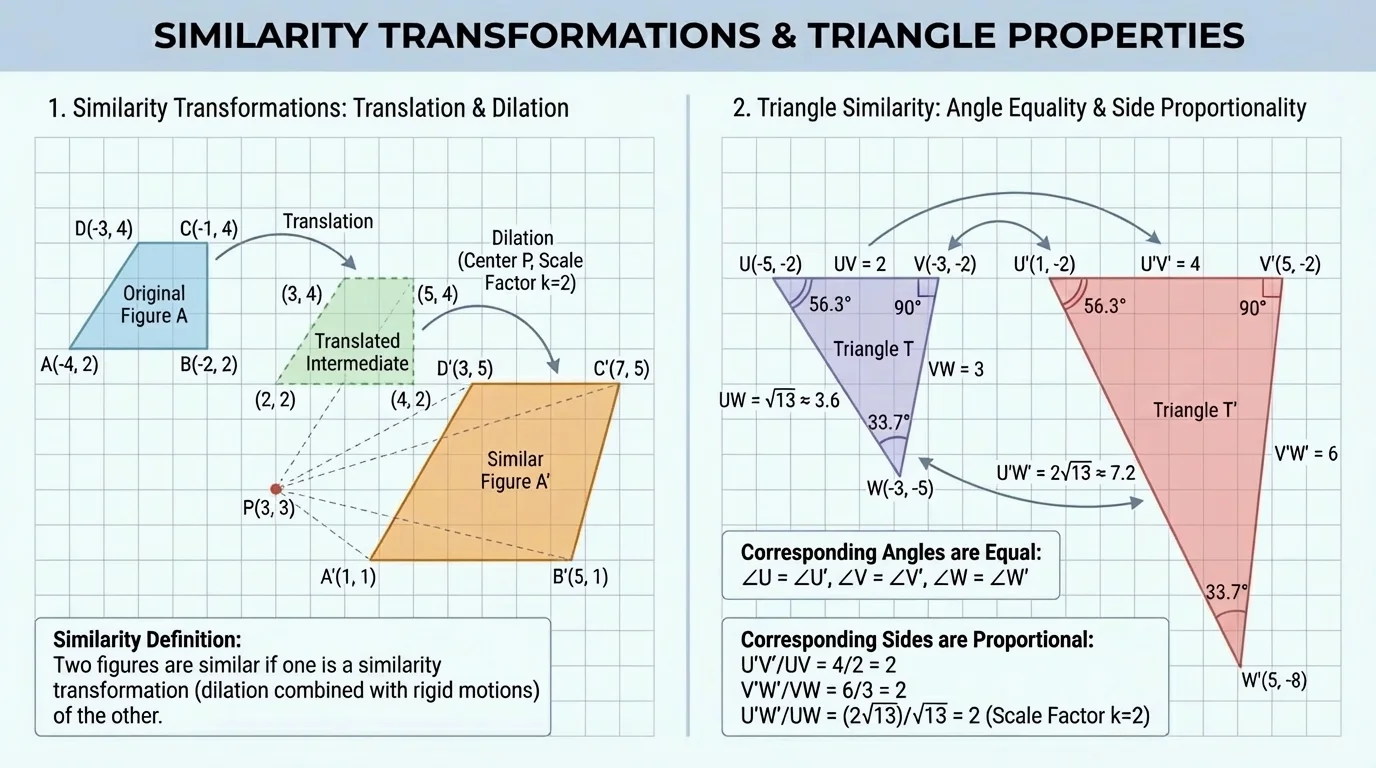
Suppose a segment has length \(5\). After a dilation with scale factor \(2\), its image has length \(10\). After a dilation with scale factor \(\dfrac{1}{2}\), its image has length \(2.5\). The key idea is that all lengths are multiplied by the same factor, not by different factors.
Similar figures are figures for which there exists a sequence of rigid motions and a dilation that maps one figure onto the other.
Scale factor is the factor by which all lengths are multiplied during a dilation.
Corresponding parts are matching vertices, sides, and angles in two figures that line up under the similarity transformation.
This definition is the heart of the topic. If you can translate, rotate, reflect, and dilate one figure so that it lands exactly on the other, then the two figures are similar. If no such sequence exists, they are not similar.
There are two connected ways to think about similarity. The first is transformational: can one figure be moved and dilated to match the other? The second is measurement-based: do corresponding angles match, and are corresponding side lengths in the same ratio?
For polygons, especially triangles, these tests work together. If corresponding angles are equal and corresponding sides are proportional, then the figures have the same shape. That measurement evidence supports the existence of a similarity transformation.
To decide whether two figures are similar, ask these questions:
If even one pair of corresponding angles fails to match, or if the side ratios are inconsistent, the figures are not similar.
Why proportional sides matter
If one figure is a dilation of another by scale factor \(k\), then every length in the original becomes \(k\) times as large in the image. That means for any pair of corresponding sides, \(\dfrac{\textrm{image side}}{\textrm{original side}} = k\). Because the same \(k\) works for every side, the side lengths are proportional.
Rigid motions do not change lengths at all, and dilation changes all lengths by one common factor. That is why similarity transformations lead naturally to proportional side lengths.
Triangles are especially important because their shape is completely determined once enough angle and side information is fixed. As [Figure 2] illustrates, when two triangles are similar, every pair of corresponding angles has equal measure and every pair of corresponding sides is proportional.
Suppose \(\triangle ABC\) is similar to \(\triangle DEF\). The notation \(\triangle ABC \sim \triangle DEF\) tells us the correspondence is \(A \leftrightarrow D\), \(B \leftrightarrow E\), and \(C \leftrightarrow F\). Then:
Corresponding angles are equal:
\[\angle A = \angle D, \quad \angle B = \angle E, \quad \angle C = \angle F\]
Corresponding sides are proportional:
\[\frac{AB}{DE} = \frac{BC}{EF} = \frac{AC}{DF}\]
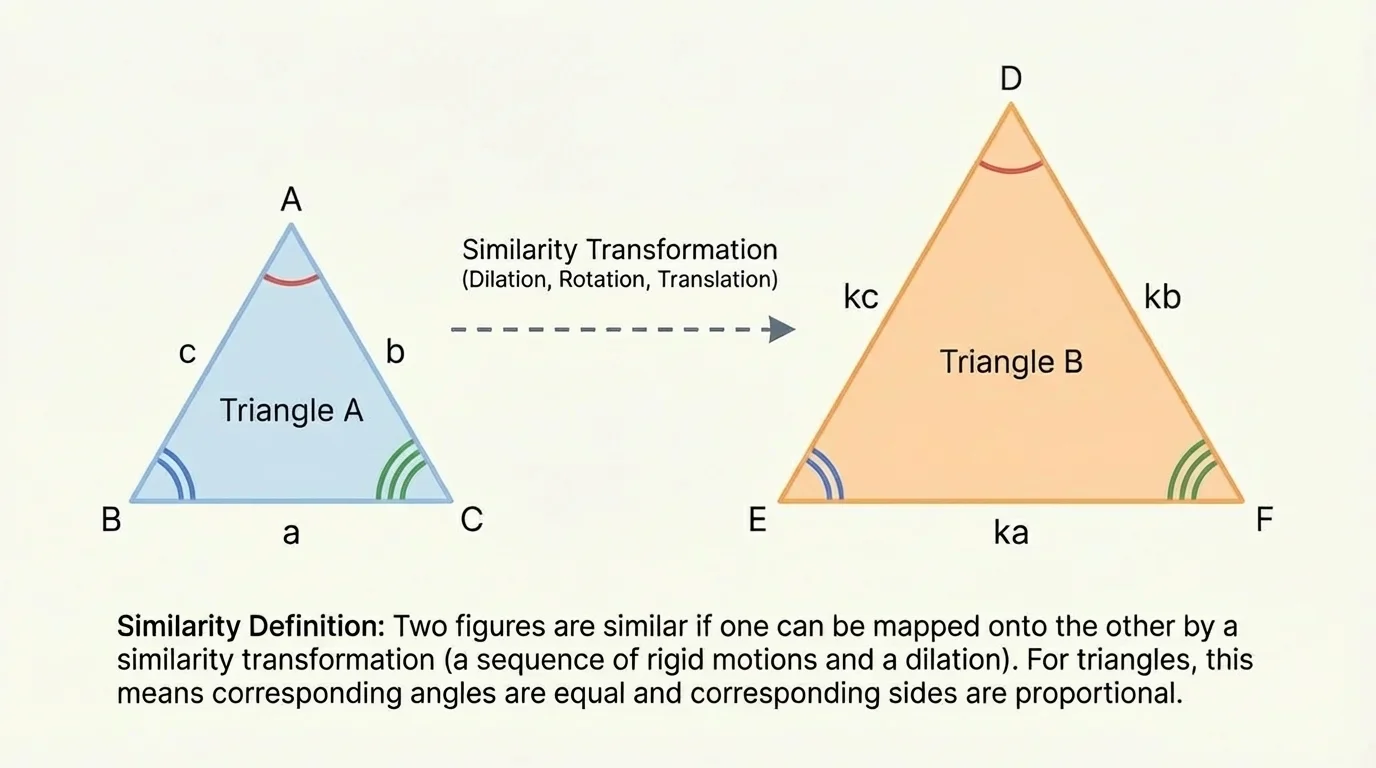
These facts are not separate from the definition of similarity. They come directly from it. A dilation preserves angle measures and multiplies all side lengths by the same scale factor. Rigid motions preserve both lengths and angles. So if one triangle can be transformed into the other by rigid motions and a dilation, then equal corresponding angles and proportional corresponding sides must result.
The reverse idea is also important: if two triangles have equal corresponding angles and proportional corresponding sides, then one triangle is a scaled copy of the other, so a similarity transformation exists. For triangles, this gives a very practical way to test similarity.
Triangle similarity is one of the main reasons trigonometry works. The sine, cosine, and tangent ratios stay constant for all right triangles with the same acute angle because those triangles are similar.
That fact explains why a calculator can give the same sine value for an angle like \(30^\circ\) no matter how large or small the triangle is. The side lengths may change, but the ratios stay the same.
Suppose one triangle has side lengths \(3\), \(4\), and \(5\), and another has side lengths \(6\), \(8\), and \(10\). Are the triangles similar?
Worked example
Step 1: Match corresponding sides.
The shortest sides correspond: \(3\) and \(6\). The next sides correspond: \(4\) and \(8\). The longest sides correspond: \(5\) and \(10\).
Step 2: Compare the ratios.
\(\dfrac{6}{3} = 2, \quad \dfrac{8}{4} = 2, \quad \dfrac{10}{5} = 2\)
Step 3: Interpret the result.
All corresponding side lengths have the same ratio, \(2\). So one triangle is a dilation of the other with scale factor \(2\).
Therefore, the triangles are similar.
As [Figure 3] will show, coordinates can make a similarity transformation especially clear. This example shows a common pattern: if every side in one triangle is exactly \(2\) times the matching side in the other, then the triangles have the same shape and differ only in size.
Now compare triangles with side lengths \(4\), \(6\), \(9\) and \(8\), \(12\), \(20\). The ratios are \(\dfrac{8}{4} = 2\), \(\dfrac{12}{6} = 2\), and \(\dfrac{20}{9} \neq 2\). Because the ratios are not all equal, these triangles are not similar.
Coordinates make a similarity transformation very visible in a case where a triangle is enlarged from the origin. Consider \(A(1,1)\), \(B(3,1)\), and \(C(1,4)\). Another triangle has vertices \(A'(2,2)\), \(B'(6,2)\), and \(C'(2,8)\). Are the triangles similar?
Worked example
Step 1: Look for a common scale factor in the coordinates.
Each image point is obtained by multiplying both coordinates by \(2\): \( (1,1) \to (2,2)\), \( (3,1) \to (6,2)\), and \( (1,4) \to (2,8)\).
Step 2: Identify the transformation.
This is a dilation centered at the origin with scale factor \(2\).
Step 3: Conclude similarity.
Because a dilation maps \(\triangle ABC\) onto \(\triangle A'B'C'\), the triangles are similar.
The triangles are similar, with scale factor \(2\).
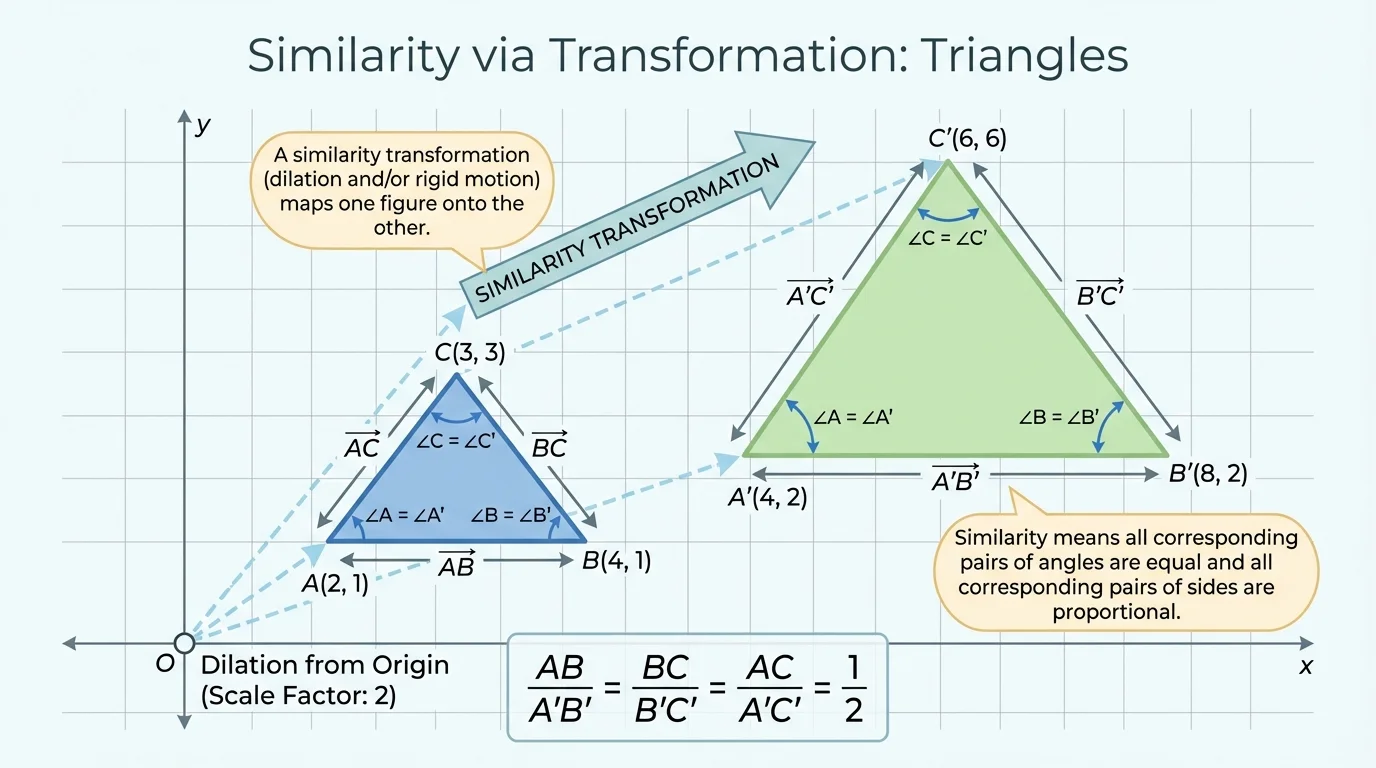
You can also check side lengths. In \(\triangle ABC\), the horizontal side \(AB\) has length \(2\) and the vertical side \(AC\) has length \(3\). In \(\triangle A'B'C'\), the matching lengths are \(4\) and \(6\). Again, every corresponding side is multiplied by \(2\), which matches what we saw earlier in [Figure 1] about dilation.
Suppose \(\angle P = 50^\circ\), \(\angle Q = 60^\circ\), and \(\angle R = 70^\circ\). Another triangle has \(\angle X = 50^\circ\), \(\angle Y = 60^\circ\), and \(\angle Z = 70^\circ\). Also suppose \(PQ = 5\), \(QR = 7\), \(PR = 8\), while \(XY = 10\), \(YZ = 14\), \(XZ = 16\). Explain why the triangles are similar.
Worked example
Step 1: Match corresponding angles.
Since \(\angle P = \angle X\), \(\angle Q = \angle Y\), and \(\angle R = \angle Z\), the correct correspondence is \(P \leftrightarrow X\), \(Q \leftrightarrow Y\), and \(R \leftrightarrow Z\).
Step 2: Compare corresponding side lengths.
\(\dfrac{XY}{PQ} = \dfrac{10}{5} = 2, \quad \dfrac{YZ}{QR} = \dfrac{14}{7} = 2, \quad \dfrac{XZ}{PR} = \dfrac{16}{8} = 2\)
Step 3: Connect to transformations.
All side lengths are scaled by \(2\), and all corresponding angles are preserved. So one triangle can be dilated by scale factor \(2\) and then repositioned by rigid motions to match the other.
Therefore, \(\triangle PQR \sim \triangle XYZ\).
This example captures the meaning of triangle similarity: same angle pattern, same shape, and one constant scale factor relating all matching sides. That is exactly the relationship displayed in [Figure 2].
One common mistake is assuming that figures are similar just because they "look alike." Drawings can be misleading, especially if they are not to scale. Geometry requires justification.
Another mistake is matching the wrong sides. In a similarity statement such as \(\triangle ABC \sim \triangle DEF\), the order matters. It tells you that \(AB\) corresponds to \(DE\), \(BC\) corresponds to \(EF\), and \(AC\) corresponds to \(DF\). Using the wrong correspondence can make correct ratios appear incorrect.
| Idea | What stays the same | What may change |
|---|---|---|
| Congruent figures | Angles and side lengths | Position or orientation |
| Similar figures | Angles and shape | Side lengths by one scale factor, position, orientation |
Table 1. Comparison of congruent figures and similar figures.
Also, equal perimeter does not imply similarity, and equal area does not imply similarity. Two rectangles can have the same area and still have different shapes. For example, a rectangle \(2 \times 8\) and a rectangle \(4 \times 4\) each have area \(16\), but their side ratios are different: \(\dfrac{2}{8} = \dfrac{1}{4}\) while \(\dfrac{4}{4} = 1\). They are not similar.
Similarity transformation versus measurement check
The transformation viewpoint and the side-angle viewpoint describe the same idea from two directions. A successful similarity transformation guarantees equal corresponding angles and proportional sides. Equal corresponding angles together with proportional corresponding sides show that the needed transformation exists.
This dual viewpoint is powerful. In some problems, coordinates make the transformation obvious. In others, side lengths and angle measures are easier to compare. Either way, the conclusion should agree.
Scale drawings are one of the clearest uses of similarity. If a map uses a scale where \(1\) centimeter represents \(5\) kilometers, then every distance on the real landscape is proportional to the matching distance on the map. The map is a reduced similar image of the region.
Architects rely on similarity when turning full-size buildings into sketches and blueprints. Engineers use it when building prototypes. Photographers and graphic designers use it when resizing images without distortion. If the width is multiplied by \(1.5\), the height must also be multiplied by \(1.5\) to keep the image similar rather than stretched.
In right-triangle trigonometry, similarity explains why angle-based ratios are dependable. Two right triangles that share an acute angle are similar, so the ratio of opposite side to hypotenuse is the same in both triangles. That constant ratio is the sine of the angle.
"Same shape" in geometry means more than visual resemblance; it means a precise relationship preserved by transformations.
This precision is what makes geometry useful in science and technology. A medical scan enlarged for viewing, a machine part reduced in a CAD drawing, and a terrain model used in planning all depend on preserving shape through similarity.
To say that two figures are similar is to say there is a chain of geometric moves connecting them: perhaps a rotation, then a translation, then a dilation. Because rigid motions preserve lengths and angles, and dilation preserves angles while scaling every length by the same factor, the result is a figure with the same shape as the original.
For triangles, this leads directly to the main meaning of similarity: all corresponding angles are equal, and all corresponding sides are proportional. Whenever you see those two facts together, think of one triangle as a scaled copy of the other. Whenever you see a dilation combined with rigid motions, expect angle equality and side proportionality to follow.
