A surveyor can find the width of a river without ever crossing it. An engineer can combine two forces acting at an angle and predict the net force. A drone can estimate distance using only angles and one measured segment. All of these situations depend on triangles that are not right triangles. Right-triangle trigonometry is powerful, but many real problems involve oblique triangles. That is where two major tools take over: the Law of Sines and the Law of Cosines.
In a right triangle, one angle is fixed at \(90^\circ\), so relationships like \(\sin\theta = \dfrac{\textrm{opposite}}{\textrm{hypotenuse}}\) work directly. But in a general triangle, none of the angles has to be \(90^\circ\). You still need a way to connect sides and angles. The Law of Sines connects ratios of sides to the sines of their opposite angles, and the Law of Cosines connects all three sides with one angle.
These laws help with two major kinds of tasks: finding unknown measurements and modeling real situations. In geometry, that might mean solving a triangle. In physics, it might mean combining two forces that are not perpendicular. In surveying, it might mean finding an inaccessible distance.
Recall the standard labeling rule for a triangle: angle \(A\) is opposite side \(a\), angle \(B\) is opposite side \(b\), and angle \(C\) is opposite side \(c\). Also remember that the angles of any triangle add to \(180^\circ\).
This labeling matters because both laws depend on matching each angle with the side across from it. If you mix up opposite pairs, the calculation will be wrong even if the algebra is perfect.
Before using these laws, organize the triangle information carefully. There are several common information patterns:
The first two often lead naturally to the Law of Sines. The \(\textrm{SAS}\) and \(\textrm{SSS}\) cases often lead to the Law of Cosines. The last one, \(\textrm{SSA}\), is special because it can produce more than one triangle, which is why it is called the ambiguous case.
Oblique triangle means any triangle that is not a right triangle. Included angle is the angle between two known sides. Opposite side is the side directly across from a given angle.
When you know what type of information you have, choosing the correct law becomes much easier.
In an oblique triangle, each side is linked to its opposite angle, as [Figure 1] shows with the matching pairs \((a, A)\), \((b, B)\), and \((c, C)\). That opposite-pair structure is the heart of the Law of Sines.
The law states that in any triangle, the ratio of a side to the sine of its opposite angle is constant:
\[\frac{a}{\sin A} = \frac{b}{\sin B} = \frac{c}{\sin C}\]
You can also write it in reciprocal form:
\[\frac{\sin A}{a} = \frac{\sin B}{b} = \frac{\sin C}{c}\]
Use whichever form makes substitution easier. The Law of Sines is especially useful when you know:
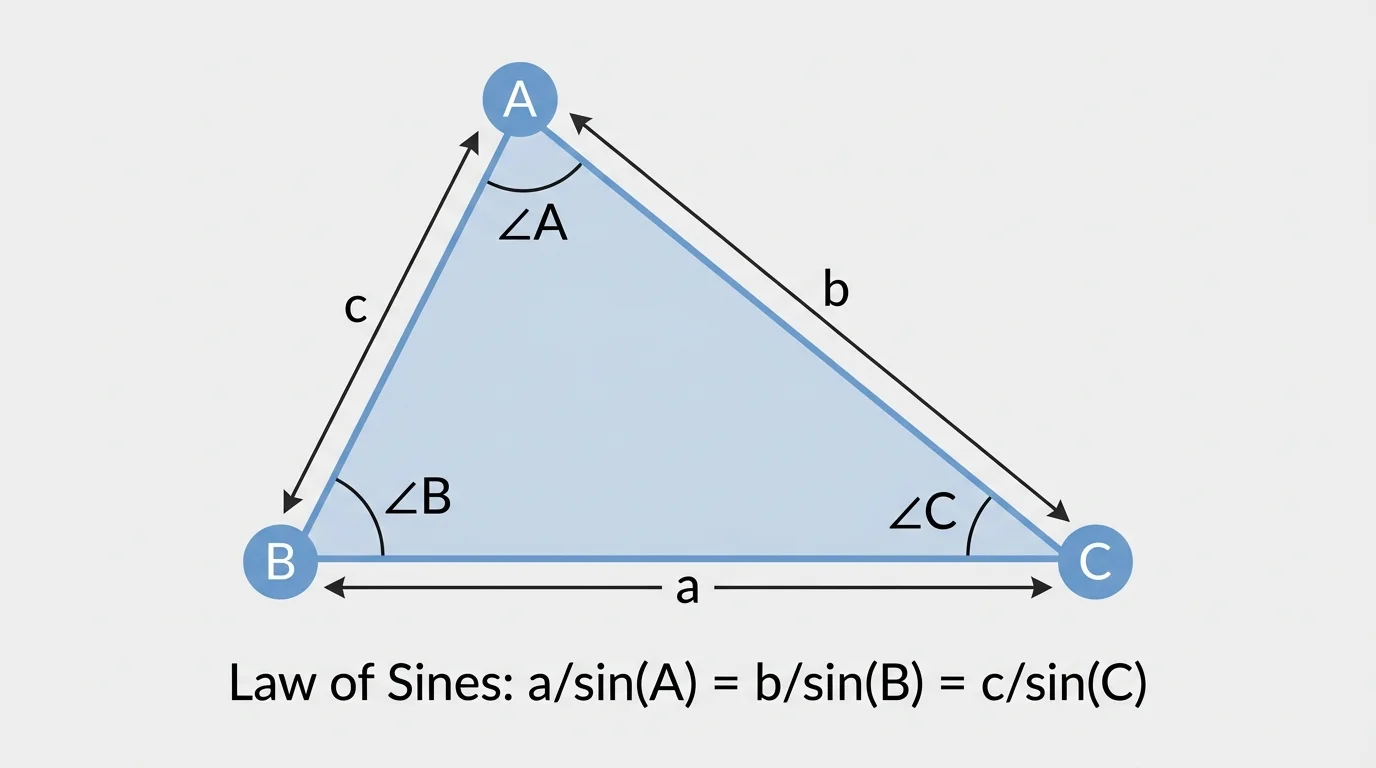
Notice that the law does not compare neighboring side-angle pairs. Side \(a\) goes with angle \(A\), not with angle \(B\) or \(C\). Students often lose accuracy here by pairing a side with the wrong angle.
If two angles are known, first find the third angle using \(A + B + C = 180^\circ\). Then substitute into the law and solve. If one missing angle comes from an inverse sine calculation, check whether there may be a second possible angle. That issue leads directly to the ambiguous case, which we will discuss next.
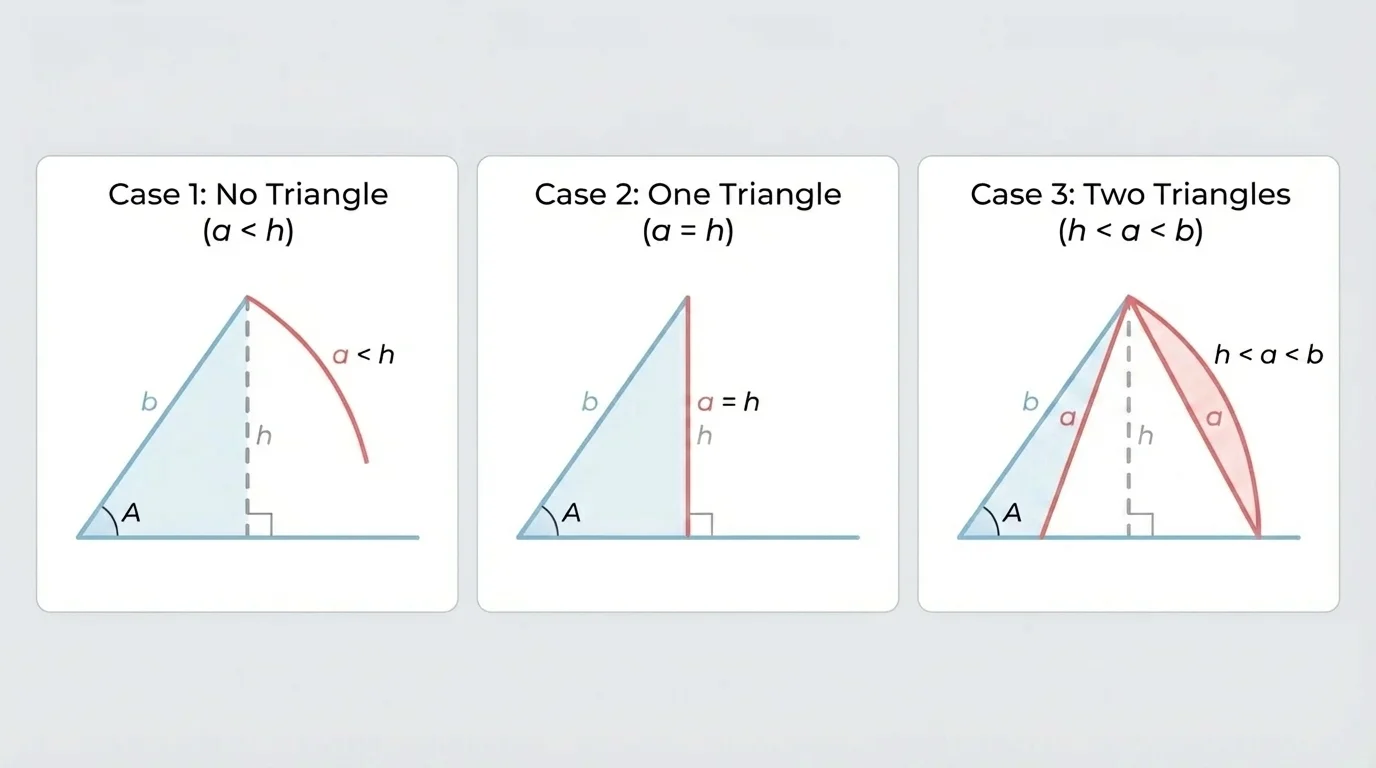
The ambiguous case appears in an \(\textrm{SSA}\) situation, where you know two sides and an angle that is not between them. The geometry can be tricky because one side can swing into different positions, and as [Figure 2] illustrates, that can lead to zero, one, or two possible triangles.
A helpful way to think about this is to compare one given side to a height. Suppose angle \(A\) is acute, side \(a\) is opposite \(A\), and side \(b\) is another given side. The height from side \(b\) is \(h = b\sin A\).
For acute \(A\): if \(a < h\), no triangle exists. If \(a = h\), there is one right triangle. If \(h < a < b\), there are two possible triangles. If \(a \geq b\), there is one triangle. This is why inverse sine alone can be misleading in an SSA problem.
Later, when solving an SSA problem numerically, always ask whether both an acute angle and its supplement could fit the triangle. Since \(\sin \theta = \sin(180^\circ - \theta)\), the same sine value can correspond to two different angles.
The ambiguous case is one of the few times in high school geometry when the same measurements can describe two different triangles. That surprises many students because most geometry problems feel like they should have exactly one answer.
This is not a flaw in the formula. It reflects the actual geometry of how a side can pivot while still keeping the same opposite-height relationship.
Suppose triangle \(ABC\) has \(A = 42^\circ\), \(B = 68^\circ\), and \(a = 15\). Find side \(b\).
Worked example
Step 1: Find the third angle if needed
Here, the third angle is not necessary for finding \(b\), but we can compute it: \(C = 180^\circ - 42^\circ - 68^\circ = 70^\circ\).
Step 2: Set up the Law of Sines using an opposite pair
\(\dfrac{a}{\sin A} = \dfrac{b}{\sin B}\)
Substitute: \(\dfrac{15}{\sin 42^\circ} = \dfrac{b}{\sin 68^\circ}\).
Step 3: Solve for \(b\)
\(b = \dfrac{15\sin 68^\circ}{\sin 42^\circ}\)
Using a calculator, \(\sin 68^\circ \approx 0.9272\) and \(\sin 42^\circ \approx 0.6691\).
So \(b \approx \dfrac{15(0.9272)}{0.6691} \approx 20.79\).
Therefore, \[b \approx 20.8\]
The result makes sense because angle \(B\) is larger than angle \(A\), so side \(b\) should be longer than side \(a\).
Let \(A = 35^\circ\), \(a = 12\), and \(b = 18\). Find angle \(B\), if possible.
Worked example
Step 1: Apply the Law of Sines
\(\dfrac{\sin B}{b} = \dfrac{\sin A}{a}\)
So \(\sin B = \dfrac{b\sin A}{a} = \dfrac{18\sin 35^\circ}{12}\).
Step 2: Compute the sine value
\(\sin 35^\circ \approx 0.5736\), so \(\sin B \approx \dfrac{18(0.5736)}{12} \approx 0.8604\).
Step 3: Find possible angles
One solution is \(B \approx \sin^{-1}(0.8604) \approx 59.4^\circ\).
But \(180^\circ - 59.4^\circ = 120.6^\circ\) has the same sine, so a second possibility is \(B \approx 120.6^\circ\).
Step 4: Check whether both fit in a triangle
If \(B = 59.4^\circ\), then \(C = 180^\circ - 35^\circ - 59.4^\circ = 85.6^\circ\), which works.
If \(B = 120.6^\circ\), then \(C = 180^\circ - 35^\circ - 120.6^\circ = 24.4^\circ\), which also works.
Therefore, there are two possible triangles, with \[B \approx 59.4^\circ \textrm{ or } B \approx 120.6^\circ\]
This is exactly the situation represented earlier in [Figure 2]. The same side lengths and one non-included angle can create two distinct triangles.
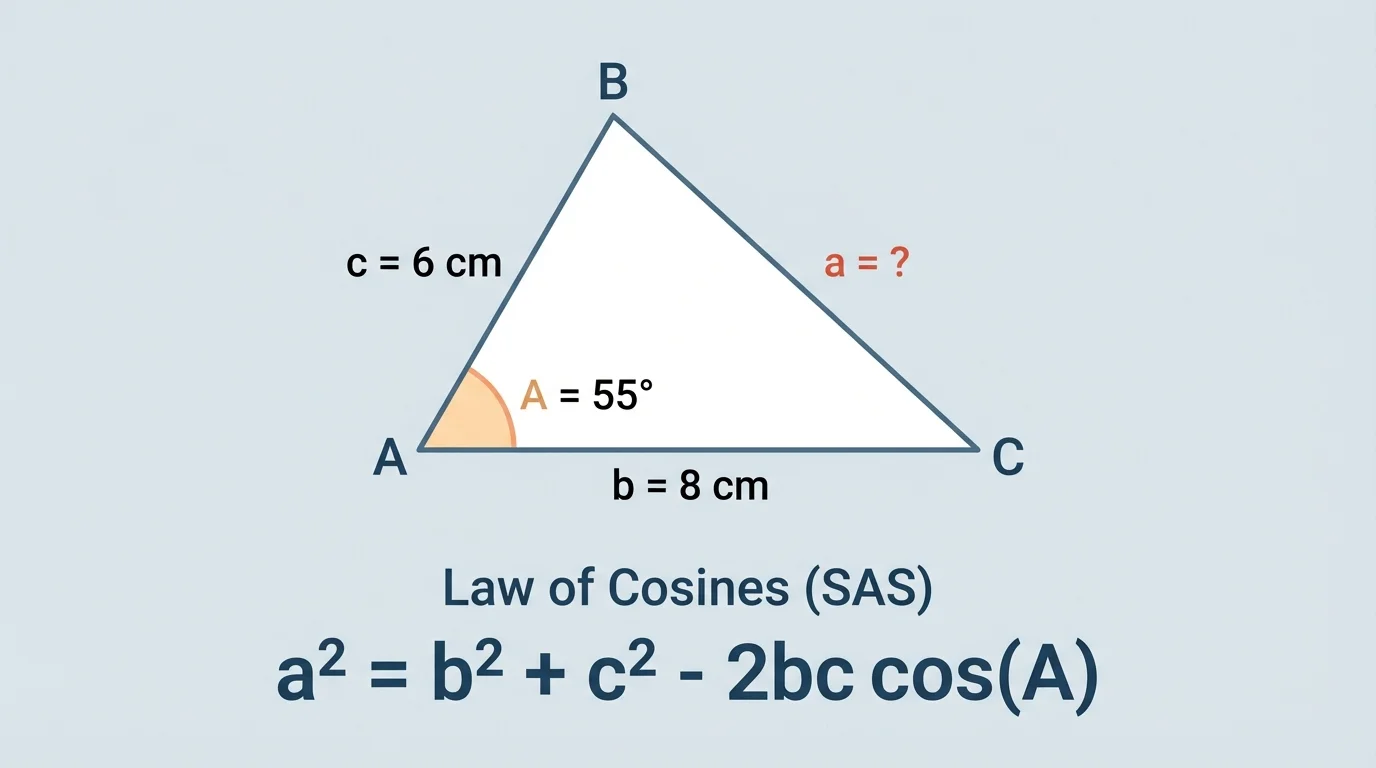
When you know two sides and the included angle, or all three sides, the Law of Sines is usually not the best first choice. Instead, use the Law of Cosines. In an \(\textrm{SAS}\) triangle, the included angle controls the length of the opposite side.
[Figure 3] The Law of Cosines comes in three forms:
\[a^2 = b^2 + c^2 - 2bc\cos A\]
\[b^2 = a^2 + c^2 - 2ac\cos B\]
\[c^2 = a^2 + b^2 - 2ab\cos C\]
This law is like an expanded version of the Pythagorean theorem. In fact, if \(C = 90^\circ\), then \(\cos 90^\circ = 0\), so the formula becomes \(c^2 = a^2 + b^2\). That means the Pythagorean theorem is a special case of the Law of Cosines.
Use the Law of Cosines in two common ways:
Be careful: when finding an angle, solve for the cosine first and then use inverse cosine, not inverse sine.
Suppose \(b = 7\), \(c = 11\), and \(A = 48^\circ\). Find side \(a\).
Worked example
Step 1: Choose the correct formula
Since side \(a\) is opposite angle \(A\), use \(a^2 = b^2 + c^2 - 2bc\cos A\).
Step 2: Substitute the known values
\(a^2 = 7^2 + 11^2 - 2(7)(11)\cos 48^\circ\)
\(a^2 = 49 + 121 - 154\cos 48^\circ\)
Step 3: Evaluate
\(\cos 48^\circ \approx 0.6691\)
So \(a^2 \approx 170 - 154(0.6691) \approx 170 - 103.04 = 66.96\).
Then \(a \approx \sqrt{66.96} \approx 8.18\).
Therefore, \[a \approx 8.2\]
The answer fits the geometry: side \(a\) should be between the smaller and larger given sides for an included angle of \(48^\circ\).
Suppose a triangle has sides \(a = 9\), \(b = 10\), and \(c = 14\). Find angle \(C\).
Worked example
Step 1: Start with the formula involving \(C\)
\(c^2 = a^2 + b^2 - 2ab\cos C\)
Step 2: Substitute values
\(14^2 = 9^2 + 10^2 - 2(9)(10)\cos C\)
\(196 = 81 + 100 - 180\cos C\)
\(196 = 181 - 180\cos C\)
Step 3: Solve for \(\cos C\)
\(15 = -180\cos C\)
\(\cos C = -\dfrac{15}{180} = -\dfrac{1}{12}\)
Step 4: Use inverse cosine
\(C \approx \cos^{-1}\left(-\dfrac{1}{12}\right) \approx 94.8^\circ\).
Therefore, \[C \approx 94.8^\circ\]
Since the longest side is \(c = 14\), angle \(C\) should be the largest angle. The answer is obtuse, which is reasonable.
One of the most important skills is recognizing which law to use before doing any calculation. The table below gives a quick guide.
| Given information | Best first method | Why |
|---|---|---|
| \(\textrm{ASA}\) | Law of Sines | You know an angle-side opposite pair after finding the third angle if needed. |
| \(\textrm{AAS}\) | Law of Sines | An opposite side-angle pair is available. |
| \(\textrm{SAS}\) | Law of Cosines | The included angle directly determines the third side. |
| \(\textrm{SSS}\) | Law of Cosines | You can compute an angle from the three side lengths. |
| \(\textrm{SSA}\) | Law of Sines, with caution | Check for the ambiguous case. |
Table 1. Choosing between the Law of Sines and the Law of Cosines based on the given triangle information.
A common strategy is to use one law first and then switch to the other. For example, in an \(\textrm{SAS}\) problem, you might use the Law of Cosines to find the third side and then use the Law of Sines to find another angle. There is nothing wrong with combining methods.
Why the laws complement each other
The Law of Sines is strongest when at least one opposite side-angle pair is known. The Law of Cosines is strongest when the triangle information revolves around side lengths and an included angle. Together, they let you solve essentially any triangle once enough information is given.
That flexibility is what makes trigonometry useful outside the classroom. Real measurements rarely arrive in the exact form a textbook would prefer.
[Figure 4] Suppose a surveyor wants to find the distance across a river to a tree. The surveyor walks along one bank, measures a baseline, and takes angle measurements from two observation points. That creates a triangle, and the unknown distance can be found without crossing the water.
For example, let the baseline between points \(P\) and \(Q\) be \(80 \textrm{ m}\). Let the measured angles to the tree \(T\) be \(\angle P = 63^\circ\) and \(\angle Q = 52^\circ\). Then \(\angle T = 180^\circ - 63^\circ - 52^\circ = 65^\circ\). Using the Law of Sines, \(\dfrac{80}{\sin 65^\circ} = \dfrac{PT}{\sin 52^\circ}\), so \(PT \approx \dfrac{80\sin 52^\circ}{\sin 65^\circ} \approx 69.5 \textrm{ m}\).
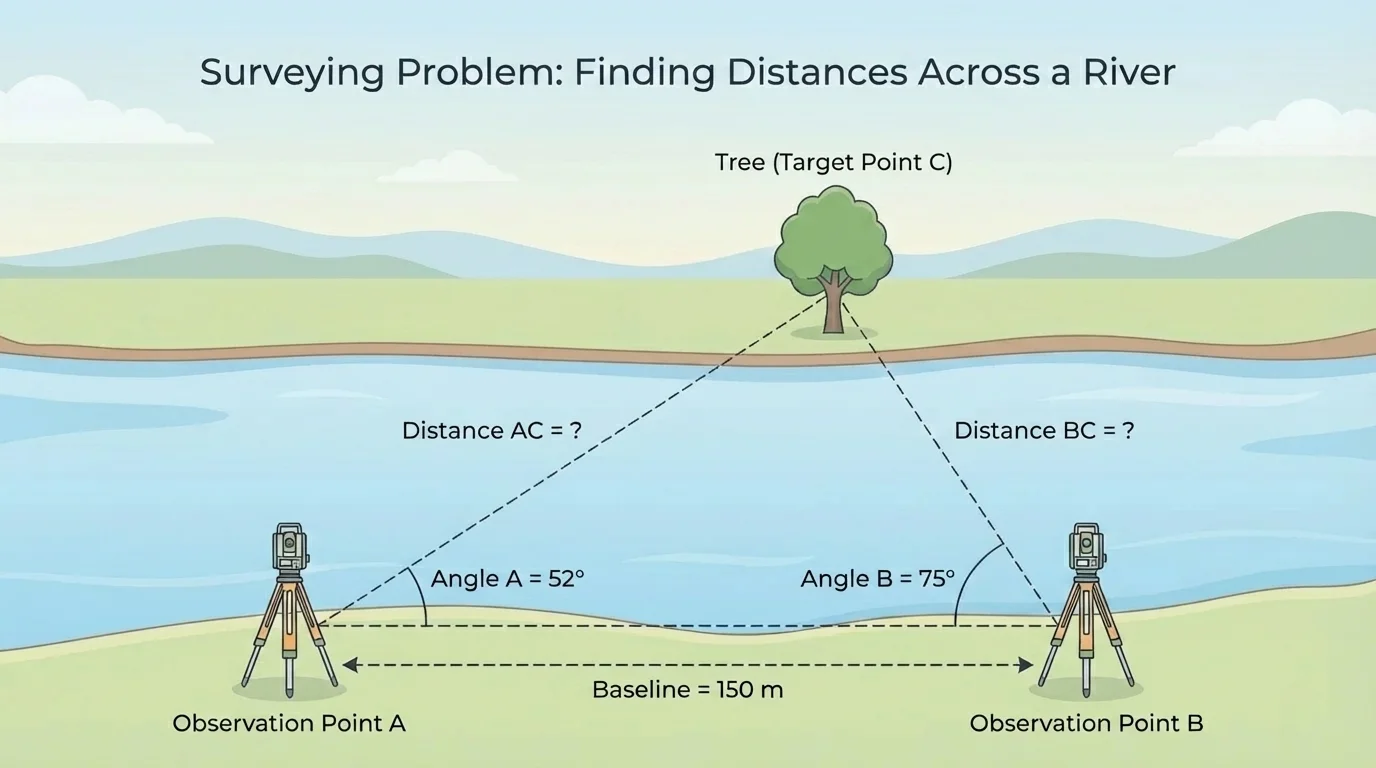
Surveying works because triangles let us turn a difficult direct measurement into an easier indirect one. The same logic appears in astronomy, navigation, and computer graphics.
Another application is resultant force. If two forces act on an object at an angle, they can be represented as two sides of a triangle. The net effect is the single force that would replace them both.
Suppose one force has magnitude \(30 \textrm{ N}\), another has magnitude \(45 \textrm{ N}\), and the angle between them measures \(70^\circ\). To find the magnitude of the resultant force \(R\), use the Law of Cosines:
\[R^2 = 30^2 + 45^2 - 2(30)(45)\cos 110^\circ\]
Why \(110^\circ\) instead of \(70^\circ\)? In the triangle method for vector addition, the interior included angle is supplementary to the angle between the original vectors when they are placed tail-to-tail. Since \(110^\circ = 180^\circ - 70^\circ\), we get \(R^2 \approx 900 + 2025 - 2700(-0.342) \approx 3848.4\), so \(R \approx 62.0 \textrm{ N}\).
That kind of calculation matters in structural design, robotics, and physics. When forces are not perpendicular, right-triangle shortcuts no longer work, but general triangle trigonometry still does.
"Mathematics reveals its power when direct measurement is impossible."
Whether you are measuring land or combining forces, the same geometric relationships keep appearing.
Many wrong answers come from small errors rather than big misunderstandings. One common mistake is calculator mode. If the problem gives angles in degrees, your calculator must be in degree mode, not radian mode.
Another frequent error is mismatching opposite pairs in the Law of Sines. Looking back at [Figure 1], side \(a\) must pair with angle \(A\), side \(b\) with angle \(B\), and side \(c\) with angle \(C\). In the Law of Cosines, students sometimes use the wrong included angle or forget the minus sign in \(-2bc\cos A\).
You should also check whether the final answer makes sense:
Rounding too early can also create trouble. Keep several decimal places during calculations, then round the final answer appropriately.
