A triangle looks simple, but it hides two remarkable circles: one that touches all three sides exactly once, and another that passes through all three vertices. That is not a coincidence or a drawing trick. It happens because a triangle contains special points where distance relationships line up perfectly. Those same circle ideas also lead to one of geometry's most elegant angle facts: if a quadrilateral fits exactly inside a circle, then its opposite angles always add to \(180^\circ\).
These ideas are central to classical geometry because they connect construction, proof, symmetry, and measurement. Architects use related ideas in design layouts, computer graphics professionals use them to model shapes, and surveyors depend on geometric centers and distance relationships. When you learn how to construct these circles, you are also learning how to see hidden structure in a figure.
For any nondegenerate triangle, there is exactly one circle that is tangent to all three sides. This is the inscribed circle, often called the incircle. There is also exactly one circle that passes through all three vertices. This is the circumscribed circle, often called the circumcircle.
Each circle has a special center. The center of the incircle is found by intersecting angle bisectors. The center of the circumcircle is found by intersecting perpendicular bisectors of sides. These are not random rules to memorize; they follow from precise distance properties. Geometry becomes much easier when you understand why the centers are located where they are.
Recall two important facts. First, a point on an angle bisector is equidistant from the two sides of the angle. Second, a point on the perpendicular bisector of a segment is equidistant from the segment's endpoints. These two ideas are the foundation of both circle constructions.
A second major goal is to connect triangles and circles to angle theorems. Once points lie on a common circle, arc relationships begin controlling the angles. That is why quadrilaterals inside circles, called cyclic quadrilaterals, have such strong angle properties.
Incenter is the point where the three angle bisectors of a triangle intersect. It is the center of the incircle.
Circumcenter is the point where the perpendicular bisectors of the sides of a triangle intersect. It is the center of the circumcircle.
Tangent means a line touches a circle at exactly one point.
Cyclic quadrilateral is a quadrilateral whose four vertices all lie on the same circle.
When a circle is tangent to a side of a triangle, the radius to the point of tangency is perpendicular to that side. When a circle passes through a vertex, that vertex is the same distance from the circle's center as every other point on the circle. Those two ideas explain the two constructions.
In geometry, a incenter is defined by equal distance from the sides, while a circumcenter is defined by equal distance from the vertices. That difference is easy to miss, but it is the key distinction between the two centers.
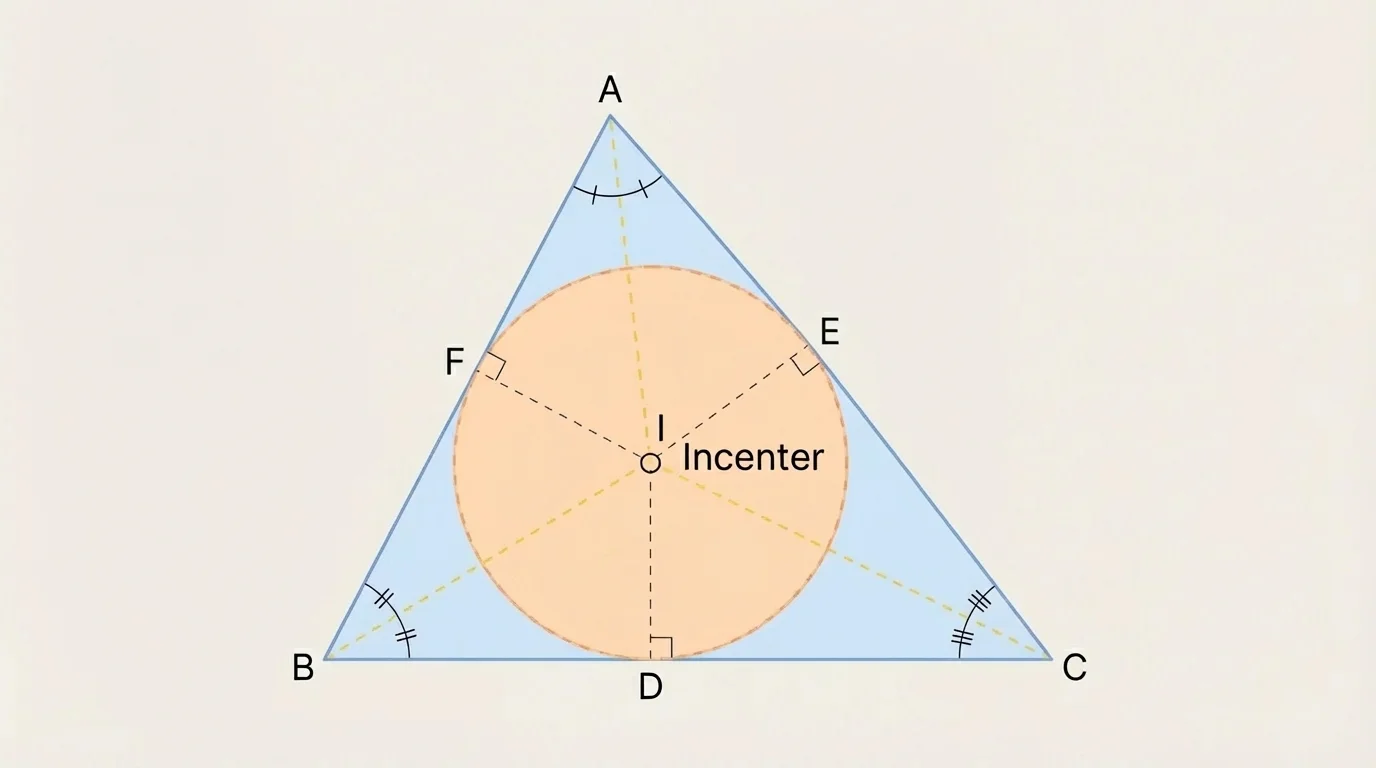
The inscribed circle is built from angle bisectors because the center must be equally distant from all three sides. As [Figure 1] shows, once two angle bisectors intersect, their intersection is the point that balances the triangle's sides by distance, not by side length.
Start with triangle \(\triangle ABC\). Construct the bisector of \(\angle A\) and the bisector of \(\angle B\). Let them intersect at point \(I\). Since \(I\) lies on the bisector of \(\angle A\), it is equidistant from sides \(AB\) and \(AC\). Since \(I\) also lies on the bisector of \(\angle B\), it is equidistant from sides \(BA\) and \(BC\).
Because distance from a point to a line means the length of the perpendicular segment, point \(I\) has equal perpendicular distances to all three sides. That means a circle centered at \(I\) with radius equal to the perpendicular distance from \(I\) to any side will touch all three sides.
Here is the standard compass-and-straightedge construction.
Step 1: Draw a triangle \(\triangle ABC\).
Step 2: Construct the bisector of \(\angle A\).
Step 3: Construct the bisector of \(\angle B\). Their intersection is \(I\), the center of the incircle.
Step 4: From \(I\), draw a perpendicular to one side, such as \(BC\). Let the foot of the perpendicular be \(D\).
Step 5: Draw the circle with center \(I\) and radius \(ID\). This circle is tangent to all three sides.
Why the construction works
If \(I\) lies on an angle bisector, then its perpendicular distances to the two sides of that angle are equal. Intersecting two angle bisectors forces equality of distances to all three sides. A circle centered at that point with radius equal to one of those distances must touch each side exactly once, so it is the unique incircle.
There is another important fact hiding here: all three angle bisectors of a triangle meet at one point. This concurrency is what guarantees the incenter exists and is unique.
Later, when comparing constructions, we will return to [Figure 1] because it makes the side-distance idea visible: the incenter is not chosen by eyeballing the middle of the triangle; it is chosen by equal perpendicular distances.
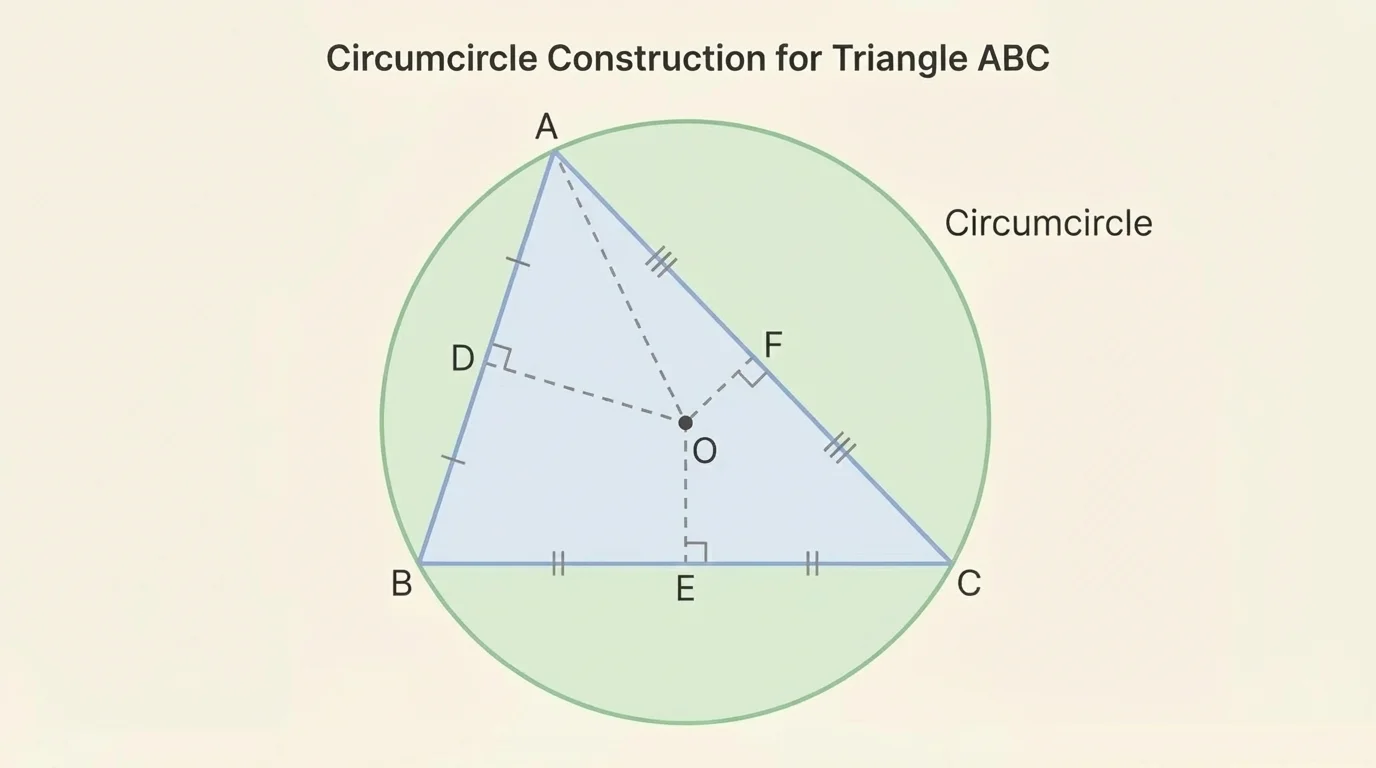
The circumscribed circle is built from perpendicular bisectors because its center must be equally distant from all three vertices. As [Figure 2] illustrates, once two perpendicular bisectors meet, their intersection gives a point from which the triangle's vertices are all the same distance away.
Take triangle \(\triangle ABC\). Construct the perpendicular bisector of side \(AB\) and the perpendicular bisector of side \(BC\). Let them intersect at point \(O\). Because \(O\) lies on the perpendicular bisector of \(AB\), we know \(OA = OB\). Because \(O\) lies on the perpendicular bisector of \(BC\), we know \(OB = OC\).
Therefore, \(OA = OB = OC\). So if we draw a circle centered at \(O\) with radius \(OA\), it passes through \(A\), \(B\), and \(C\). That is exactly the circumcircle.
Here is the standard construction.
Step 1: Draw a triangle \(\triangle ABC\).
Step 2: Construct the perpendicular bisector of side \(AB\).
Step 3: Construct the perpendicular bisector of side \(AC\). Their intersection is \(O\), the circumcenter.
Step 4: Draw a circle centered at \(O\) through one vertex, such as \(A\). Since \(OA = OB = OC\), the circle also passes through \(B\) and \(C\).
The circumcenter is not always inside the triangle. Its location depends on the triangle type, which makes it one of the most visually interesting triangle centers.
Just as all three angle bisectors meet at one point, all three perpendicular bisectors of a triangle also meet at one point. That concurrency guarantees a unique circumcenter.
The equal-distance-to-the-vertices idea in [Figure 2] contrasts directly with the incenter idea. For the incircle, equal distance is measured to sides. For the circumcircle, equal distance is measured to vertices.
As [Figure 3] shows, the two constructions look similar because each uses intersecting lines to locate a center, but they answer different questions. The incenter asks, "Where is the point equally far from the three sides?" The circumcenter asks, "Where is the point equally far from the three vertices?"
For an acute triangle, the circumcenter lies inside the triangle. For a right triangle, the circumcenter lies at the midpoint of the hypotenuse. For an obtuse triangle, the circumcenter lies outside the triangle.
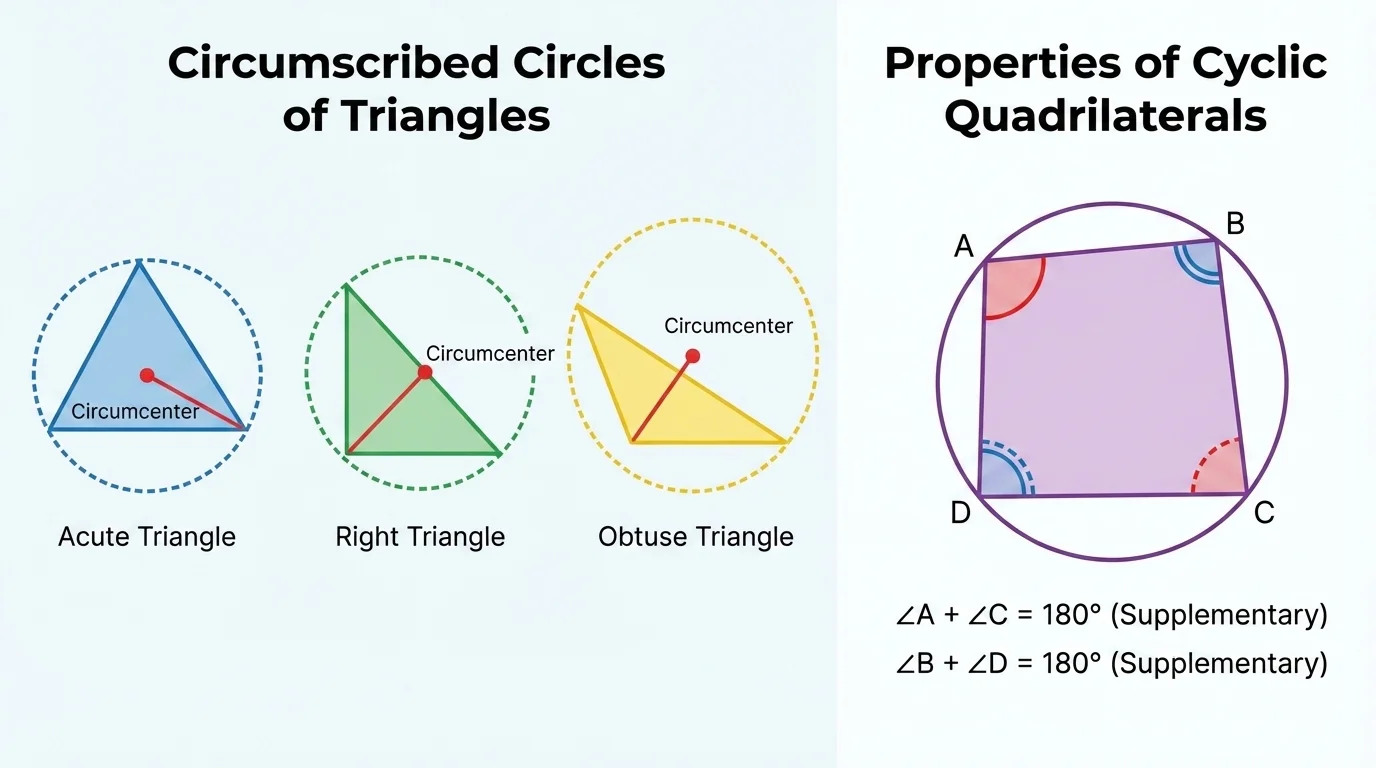
The incenter, however, always lies inside the triangle because angle bisectors always point inward. This makes sense: the incircle must fit inside the triangle and touch all three sides.
| Center | Constructed from | Equal distance to | Circle relation |
|---|---|---|---|
| Incenter | Angle bisectors | Sides | Center of incircle |
| Circumcenter | Perpendicular bisectors | Vertices | Center of circumcircle |
Table 1. Comparison of the incenter and circumcenter of a triangle.
The special right-triangle case is worth remembering: if \(\triangle ABC\) is right with hypotenuse \(AB\), then the circumcenter is the midpoint of \(AB\). That means the circumcircle's diameter is the hypotenuse.
To prove properties of quadrilaterals inscribed in a circle, we need one central circle theorem: an inscribed angle measures half the measure of its intercepted arc. If an inscribed angle intercepts an arc of measure \(m\), then the angle measure is \(\dfrac{m}{2}\).
Inscribed-angle idea
If \(\angle ABC\) is an inscribed angle intercepting arc \(AC\), then \(m\angle ABC = \dfrac{1}{2}m(\overset{\frown}{AC})\). This theorem turns arc relationships into angle relationships, which is exactly what makes cyclic quadrilateral proofs work.
A quadrilateral whose four vertices lie on a circle is called a cyclic quadrilateral. Suppose \(A\), \(B\), \(C\), and \(D\) lie on the same circle. Then each interior angle is an inscribed angle intercepting an arc formed by the opposite endpoints.
This is where the geometry becomes beautifully efficient: opposite angles in the quadrilateral intercept arcs that together make the whole circle.
As [Figure 4] shows, the most important property is that opposite angles are supplementary. In cyclic quadrilateral \(ABCD\), \(\angle A\) and \(\angle C\) each intercept arcs on opposite sides of the circle.
Let \(\angle A\) intercept arc \(BCD\), and let \(\angle C\) intercept arc \(DAB\). These two arcs together form the full circle, so their measures add to \(360^\circ\).
By the inscribed-angle theorem, \(m\angle A = \dfrac{1}{2}m(\overset{\frown}{BCD})\) and \(m\angle C = \dfrac{1}{2}m(\overset{\frown}{DAB})\). Adding gives
\[m\angle A + m\angle C = \frac{1}{2}\left(m(\overset{\frown}{BCD}) + m(\overset{\frown}{DAB})\right) = \frac{1}{2}(360^\circ) = 180^\circ\]
So opposite angles are supplementary:
\[m\angle A + m\angle C = 180^\circ\]
By the same reasoning,
\[m\angle B + m\angle D = 180^\circ\]
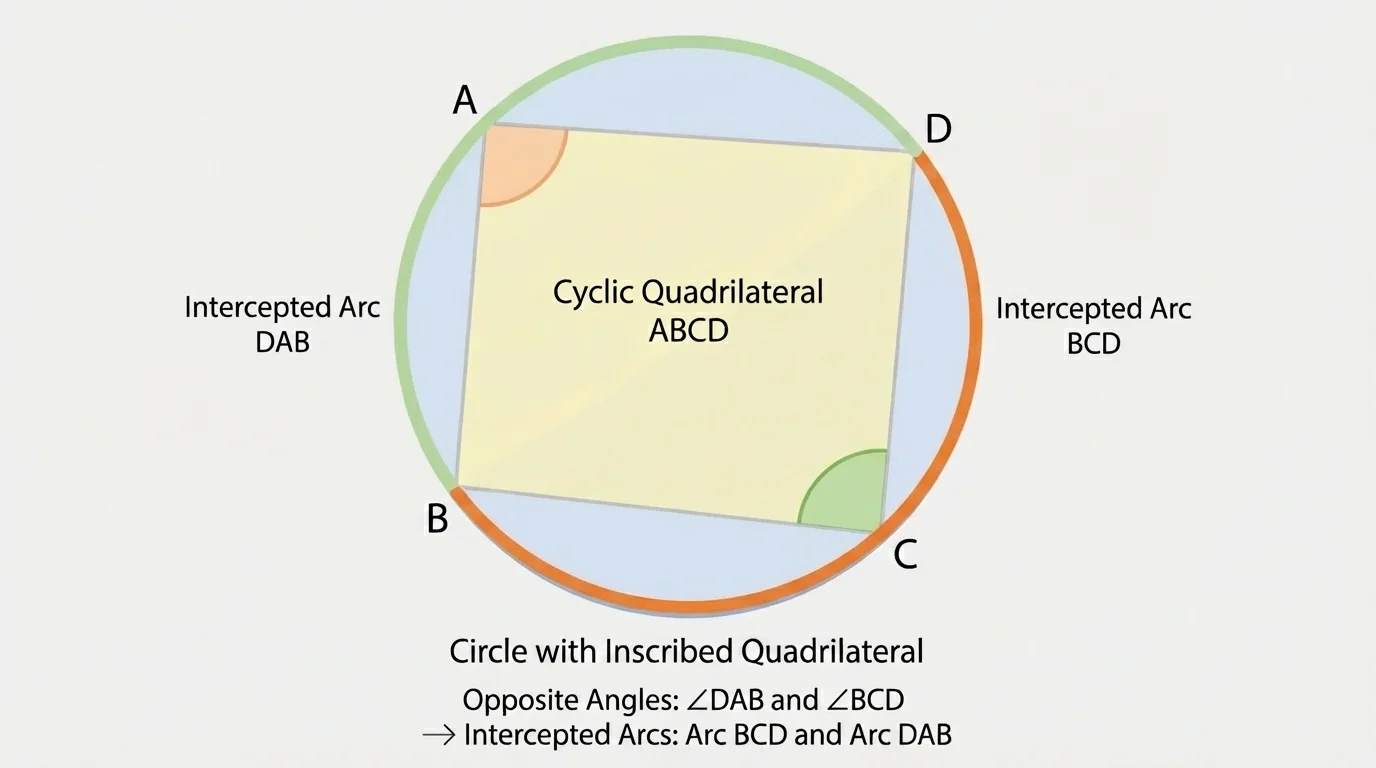
As [Figure 5] helps illustrate, this proof is powerful because it does not depend on the shape being a rectangle, trapezoid, or any other special quadrilateral. The only requirement is that all four vertices lie on one circle.
A second property follows from the first: an exterior angle of a cyclic quadrilateral equals the opposite interior angle. If side \(BC\) is extended to point \(E\), then exterior angle \(\angle ACE\) equals interior angle \(\angle ADB\), assuming the vertices are labeled accordingly.
Why? The exterior angle of any quadrilateral equals \(180^\circ\) minus the adjacent interior angle. But in a cyclic quadrilateral, the opposite interior angle is also \(180^\circ\) minus that same adjacent interior angle because opposite angles are supplementary. Therefore the exterior angle equals the opposite interior angle.
In symbols, if exterior angle \(x\) is supplementary to interior angle \(\angle C\), then \(x = 180^\circ - m\angle C\). If \(m\angle A + m\angle C = 180^\circ\), then \(m\angle A = 180^\circ - m\angle C\). So \(x = m\angle A\).
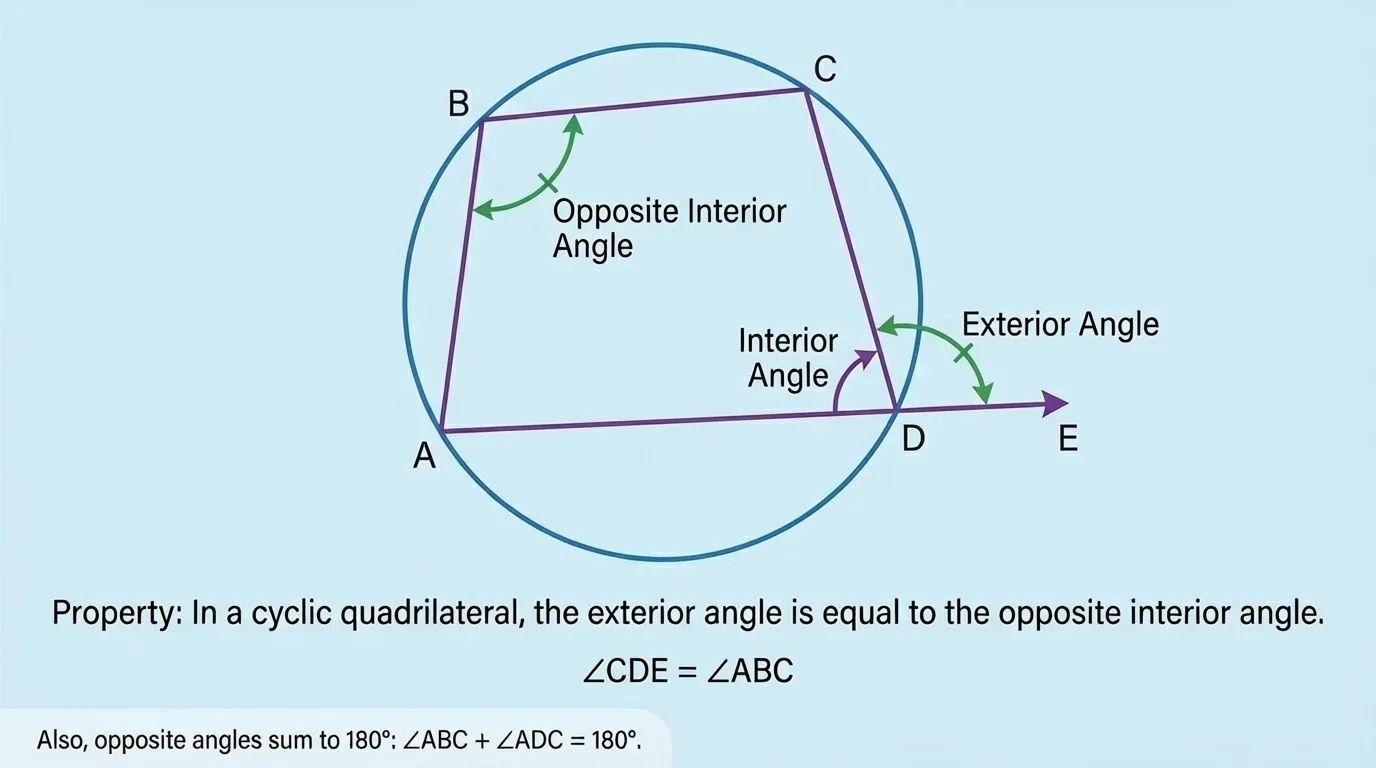
Later angle-chasing problems often rely on both results at once. The arc argument in [Figure 4] proves the supplementary-angle theorem, and then the supplementary-angle theorem quickly gives the exterior-angle result.
Now let's apply the ideas carefully.
Example 1: Why does the incenter give the incircle?
In \(\triangle ABC\), point \(I\) is the intersection of the bisectors of \(\angle A\) and \(\angle B\). Prove that a circle centered at \(I\) can be drawn tangent to all three sides.
Step 1: Use the angle bisector property.
Since \(I\) lies on the bisector of \(\angle A\), its perpendicular distances to sides \(AB\) and \(AC\) are equal.
Step 2: Use the second bisector.
Since \(I\) lies on the bisector of \(\angle B\), its perpendicular distances to sides \(BA\) and \(BC\) are equal.
Step 3: Combine the equalities.
The distance from \(I\) to \(AB\) equals the distance to \(AC\), and also equals the distance to \(BC\). So \(I\) is equidistant from all three sides.
Step 4: Draw the circle.
Let \(r\) be the perpendicular distance from \(I\) to any side. A circle with center \(I\) and radius \(r\) is tangent to all three sides.
Therefore \(I\) is the center of the inscribed circle.
This example shows that the construction is really a proof about equal distances, not just a drawing procedure.
Example 2: Finding an unknown angle in a cyclic quadrilateral
Quadrilateral \(ABCD\) is inscribed in a circle, and \(m\angle A = 72^\circ\). Find \(m\angle C\).
Step 1: Use the cyclic quadrilateral theorem.
Opposite angles in a cyclic quadrilateral are supplementary, so \(m\angle A + m\angle C = 180^\circ\).
Step 2: Substitute the known value.
\(72^\circ + m\angle C = 180^\circ\)
Step 3: Solve.
\(m\angle C = 180^\circ - 72^\circ = 108^\circ\)
So the missing angle is
\[m\angle C = 108^\circ\]
Notice how the condition that a quadrilateral is inscribed in a circle immediately creates a supplementary relationship between opposite angles, even though the angles are not adjacent.
Example 3: Exterior angle of a cyclic quadrilateral
Quadrilateral \(PQRS\) is cyclic. If \(m\angle P = 95^\circ\), find the exterior angle at \(R\) formed by extending one side through \(R\).
Step 1: Find the interior angle at \(R\).
Since opposite angles are supplementary, \(m\angle R = 180^\circ - 95^\circ = 85^\circ\).
Step 2: Find the exterior angle.
An exterior angle and its adjacent interior angle form a straight line, so the exterior angle is \(180^\circ - 85^\circ = 95^\circ\).
Step 3: Compare with the opposite interior angle.
The exterior angle equals \(95^\circ\), which matches \(m\angle P\).
Therefore the exterior angle at \(R\) equals the opposite interior angle, and its measure is \(95^\circ\).
This example illustrates the theorem numerically and shows how it follows from supplementary angles.
Example 4: Circumcenter in a right triangle
Suppose \(\triangle XYZ\) is right at \(Y\), and hypotenuse \(XZ = 14\). Find the circumradius.
Step 1: Use the right-triangle circumcenter fact.
In a right triangle, the circumcenter is the midpoint of the hypotenuse.
Step 2: The radius is half the hypotenuse.
\(R = \dfrac{14}{2} = 7\)
Step 3: State the result.
The circumcircle has radius \(7\).
So
\(R = 7\)
The position shown earlier in [Figure 3] explains why this is true: in a right triangle, the circumcenter sits exactly on the hypotenuse's midpoint.
These constructions are not just classical exercises. In engineering and design, locating a point equidistant from boundaries can matter when placing sensors, supports, or circular components inside triangular frames. That is an incircle-style problem.
In surveying and navigation, finding a point equidistant from landmarks resembles a circumcenter-style problem. If three known points define a triangle, the circumcenter identifies the center of a circle through all three. Similar ideas appear in geographic triangulation and location modeling.
Computer graphics and robotics also use geometric centers. When software fits circular paths through selected points or computes collision boundaries inside polygonal regions, it relies on the same distance logic that underlies the incircle and circumcircle.
Even the cyclic quadrilateral theorem has practical echoes. Whenever cameras, lenses, rotating parts, or circular arrangements are modeled, angle relationships on circles become useful because they stay consistent even when the shape changes, as long as the points remain on the same circle.
"Geometry reveals structure by turning distance into logic and shape into proof."
Once you understand these constructions, many other geometry theorems become easier. You stop seeing a triangle as just three segments and start seeing centers, equal distances, tangencies, and hidden circles all at once.
