How can just a few words make you feel jumpy, warm, or calm? Authors are like word-painters. They choose special words that help us know what a character feels and help us picture, hear, smell, taste, or feel what is happening. When we notice those words, reading becomes much richer and more exciting.
When we read, we do more than say the words out loud. We think about what the words mean. Some words tell us about feelings. Other words help us imagine what something looks like, sounds like, smells like, tastes like, or feels like. These are important clues in stories and poems.
Feeling words tell how a person or character feels, such as happy, worried, lonely, or proud.
Sensory words are words that help us use our senses in our minds. They help us imagine sight, sound, smell, taste, and touch.
Phrases are groups of words that work together to give one idea.
Readers who notice these clues understand books better. They can tell if a part of a story feels funny, scary, peaceful, or exciting. They can also make a picture in their minds while they read.
Some words say a feeling in a direct way. A sentence might say, "Mila was sad." The word sad clearly tells the feeling. [Figure 1] shows simple emotion clues and expressions that help readers match words to feelings. Other feeling words are happy, afraid, angry, proud, and excited.
Sometimes the author does not name the feeling directly. Instead, the author gives a clue. Read this: "Ben's hands shook when the thunder crashed." The sentence does not say "Ben was scared," but the words hands shook and thunder crashed help us infer that Ben feels afraid.
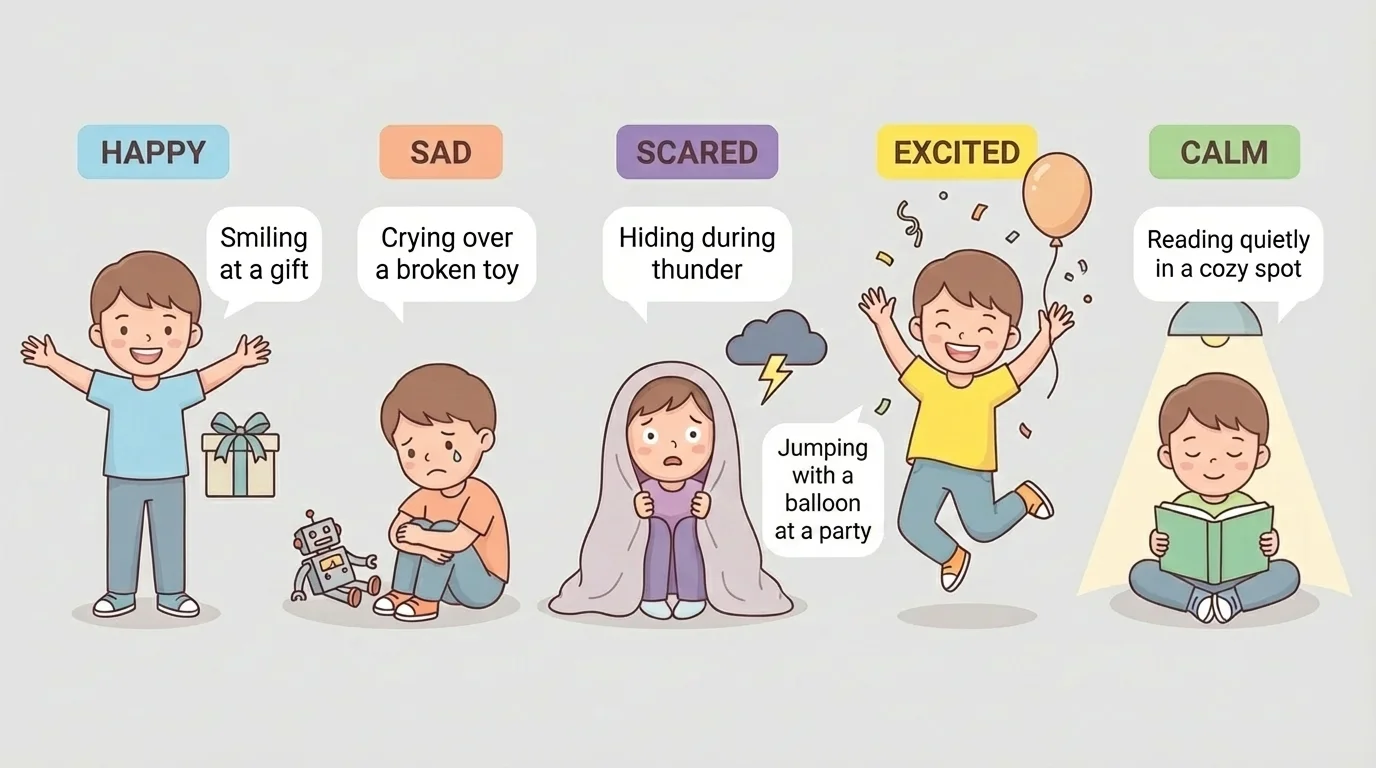
Look at another example: "Ana grinned and skipped to the door." The words grinned and skipped suggest a cheerful feeling. The author uses actions to show the emotion.
Finding a feeling clue
Sentence: "Jamal hid behind his dad when the big dog barked."
Step 1: Look for important action words.
The words hid behind are strong clues.
Step 2: Think about what that action means.
If someone hides when a dog barks, that person may feel scared or nervous.
Step 3: Name the feeling.
The sentence suggests Jamal feels afraid.
A feeling can also come from a whole phrase, not just one word. In "her eyes filled with tears," the phrase helps us understand that a character may feel sad. In "he could not stop smiling," the phrase suggests joy. Faces and actions often work together to show a feeling clue.
Authors also choose words that wake up our senses. A sensory word helps us imagine something with our eyes, ears, nose, tongue, or skin. [Figure 2] shows how the five senses connect to describing words that readers often notice in poems and stories.
Sight words help us picture what we see. In "the bright yellow sun," the words bright yellow help us imagine the sky.
Sound words help us hear with our minds. In "the bees buzzed," the word buzzed gives a sound clue.
Smell words help us imagine smells. In "fresh bread filled the room," the word fresh and the phrase filled the room create a strong smell clue.
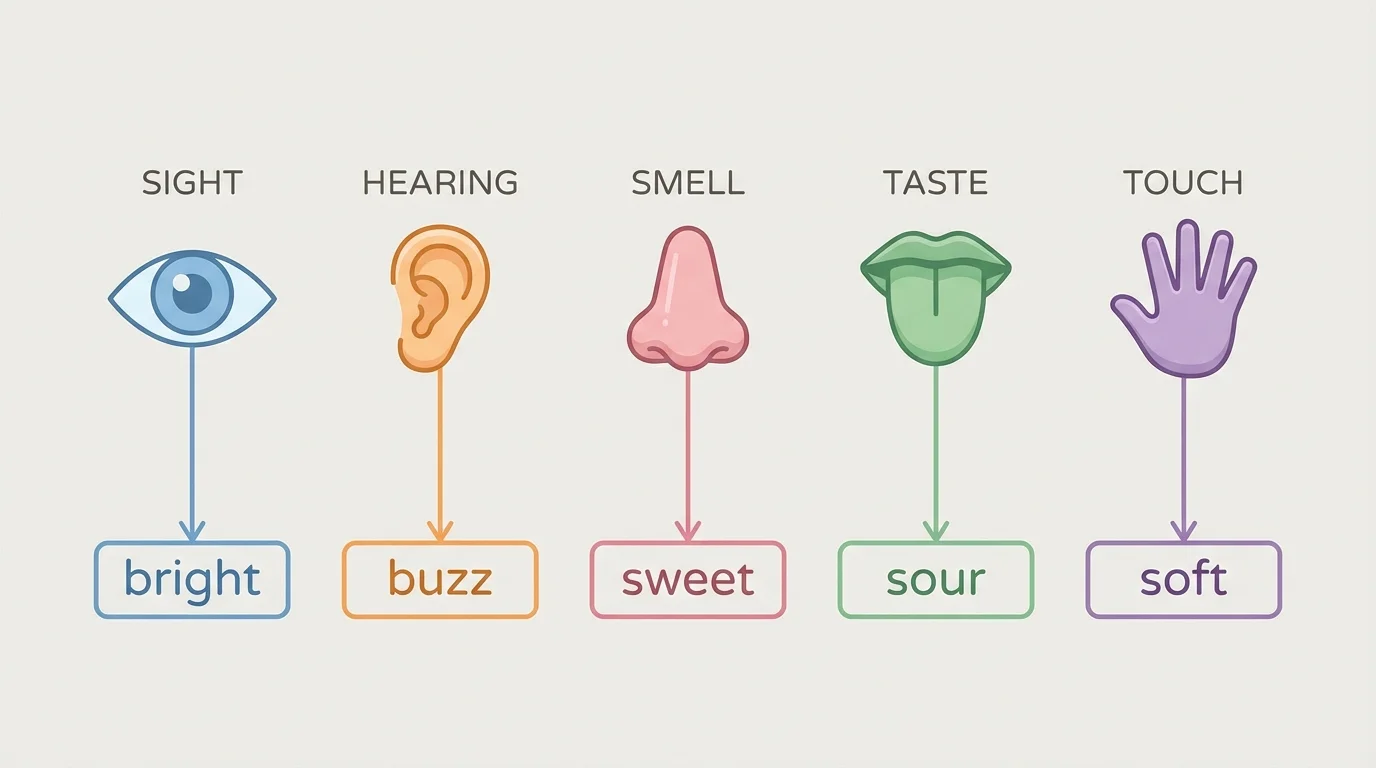
Taste words tell how something tastes. In "the lemonade was sour," the word sour gives a taste clue.
Touch words tell how something feels on the body. In "the kitten's fur was soft," the word soft is a touch clue.
One line can use more than one sense
Authors often mix senses together. "The warm popcorn popped with a crackly sound" gives touch with warm and sound with crackly. This helps the reader feel closer to the scene.
Sometimes one sentence gives both a feeling and a sense clue. "Lila hugged the warm blanket and felt safe." The word warm appeals to touch, and the word safe tells a feeling.
A phrase can be very powerful because two or more words work together. In "the icy wind nipped my cheeks," the phrase icy wind helps us feel the cold. The phrase nipped my cheeks makes the cold seem even stronger.
Read this line: "The lonely swing creaked in the empty park." The word creaked appeals to sound. The phrase empty park may also create a lonely feeling. The author has chosen words carefully so the reader can hear the scene and feel its mood.
In poems, phrases can be especially important because poets use only a few words. Every word has a job. A short line like "silver rain tapped the roof" gives us sight with silver rain and sound with tapped.
Poems are often short, but they can feel very big in your mind because poets choose exact words that create strong pictures, sounds, and feelings.
When you notice phrases, do not rush. Ask, "What does this group of words help me feel?" and "What can I see, hear, smell, taste, or touch in my mind?"
Stories and poems both use special word choices, but they may do it in different ways. A story may show how a character feels through actions, dialogue, and events. A poem may use fewer words, but those words are often packed with meaning, as [Figure 3] illustrates by comparing a story sentence with a poem line.
In a story, you might read, "Tomas stomped up the stairs and slammed his door." The actions stomped and slammed suggest anger. In a poem, you might read, "Mad feet thundered down the hall." That line also suggests anger, but it does so in a shorter, more musical way.
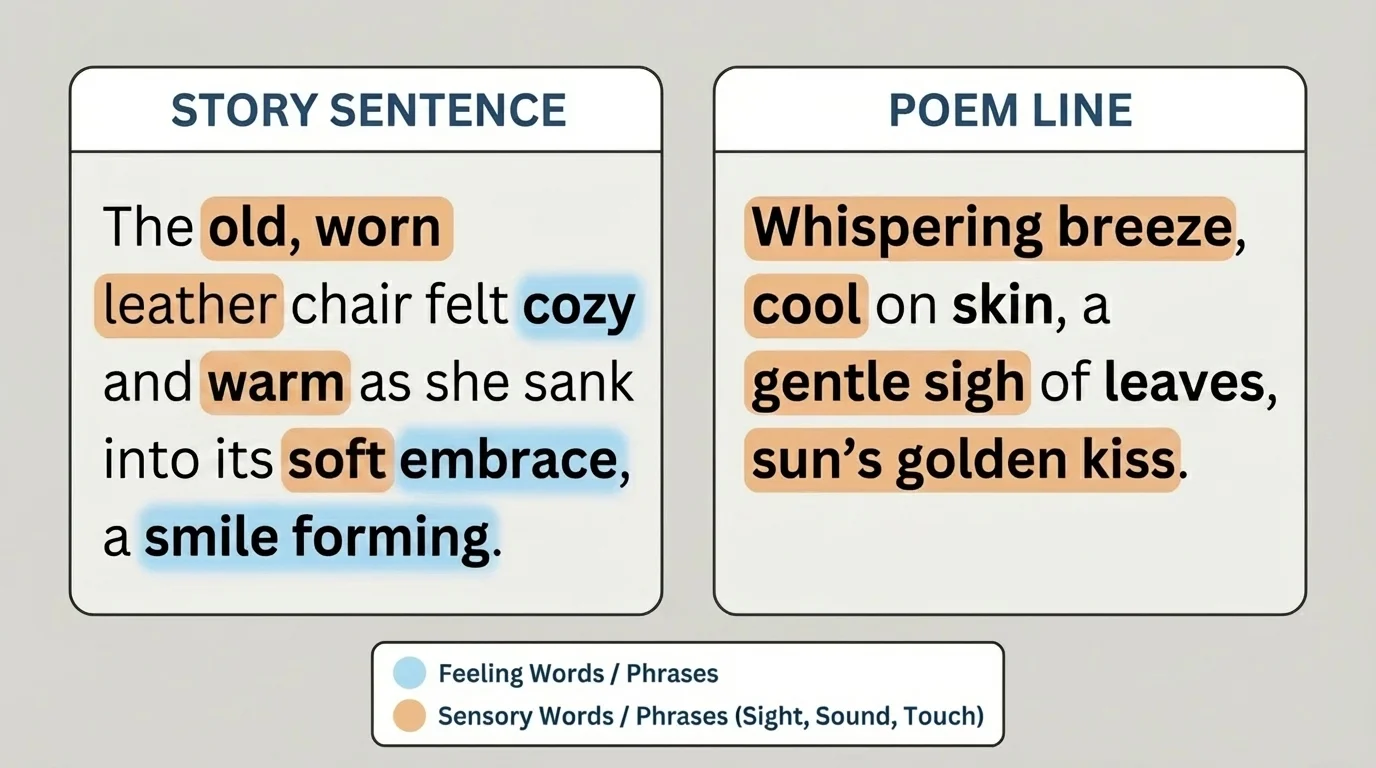
Here is another comparison. Story sentence: "The soup smelled spicy, and Eva smiled." Poem line: "Spicy steam danced to my nose." Both lines use smell clues. The story line also gives a feeling clue with smiled.
Later, when readers compare texts, they can remember that both stories and poems can use the same kinds of clues even when they sound different.
Good readers slow down when they find strong describing words. They pay attention to words that seem important. A word such as mood means the feeling a text gives the reader. Words can build a calm mood, a silly mood, or a spooky mood.
One way to notice clues is to listen for strong verbs and describing words. Words like whispered, roared, shivered, glowed, and sticky often do important work.
Another way is to think about the character's actions. If a character hides, laughs, trembles, or dances, those actions may tell a feeling even when the author does not say it directly.
Readers already know that stories have characters, setting, and events. The words that show feelings and senses help us understand those parts more clearly.
You can also ask simple questions while reading: "How does the character feel?" "What words helped me know that?" "What can I picture or hear?" "What words gave me that picture or sound?" These questions help readers become careful thinkers.
When you find words and phrases that show feelings and senses, you understand more than just what happens. You understand character feelings, the place in the story, and the overall mood. A rainy street may feel gloomy. A field of bright flowers may feel cheerful. The words shape the reading experience.
For example, compare these two lines: "The dog came inside" and "The muddy dog splashed inside with a happy bark." The second line gives stronger clues. We can picture the dog, hear the bark, and sense the excitement.
That is why authors choose words with care. Small words can do big jobs. They help readers feel close to the people, places, and moments in stories and poems.
