Have you ever said, "We should play outside because it is sunny," or "I like apples because they are crunchy"? You gave an idea and then told why. Authors do the same thing in books and articles. When we read, we can look for the author's idea and the reasons that help support it.
An author writes to share information. Sometimes the author wants readers to understand one important idea. That important idea is often called a point. [Figure 1] Then the author gives details that tell why the point makes sense. Those details are called reasons.
When readers find reasons, they understand the text better. [Figure 2] They can tell not just what the author says, but also why the author says it. This helps readers think carefully and remember the main idea.
Point means what the author wants the reader to think, learn, or believe.
Reason means why the author thinks the point is true, important, or a good idea.
Authors often write informational texts about animals, weather, plants, health, school, or places. In those texts, the point may be something like "Plants need sunlight" or "Recycling helps our world." The reasons explain why those points are important.
A point is the big idea the author wants to share, and a reason tells why that idea is right or important. Readers can ask, "What does the author want me to know?" and then ask, "Why does the author say that?"
Look at this short example: "Children should wear boots in the rain because boots keep feet dry." The point is children should wear boots in the rain. The reason is boots keep feet dry.
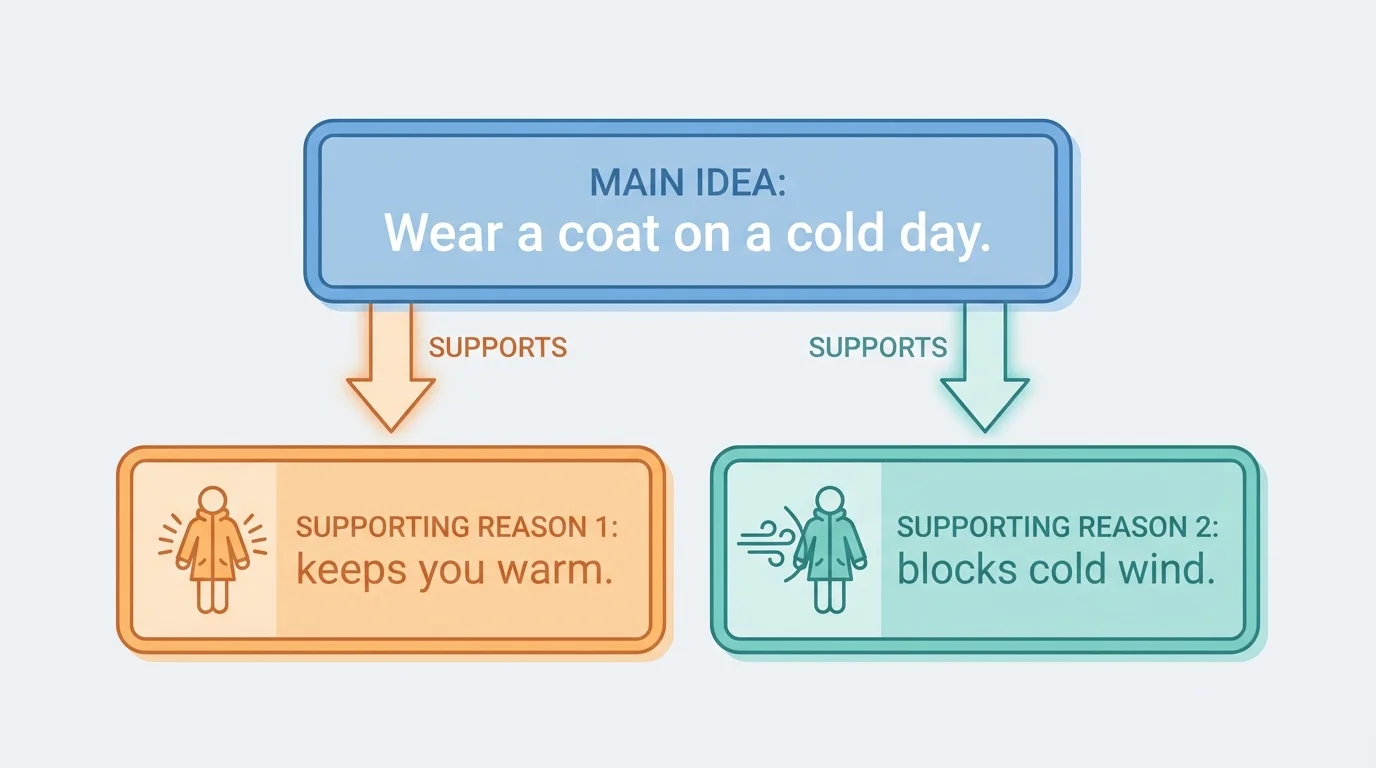
Here is another example: "Birds need nests because nests help keep eggs safe." The point is birds need nests. The reason is nests help keep eggs safe.
Sometimes the point comes first. Sometimes the reason comes first. Read this sentence: "Because water helps our bodies, it is a good drink for hot days." The point is water is a good drink for hot days. The reason is water helps our bodies.
Readers can use a simple clue word strategy to find reasons. First, find the point. Next, ask, "Why does the author think this?" Then look for words that often come before a reason.
Some clue words are because, so, since, and for. These words can help readers find the part of the sentence that explains why. Not every text uses these exact words, but they are helpful signs.
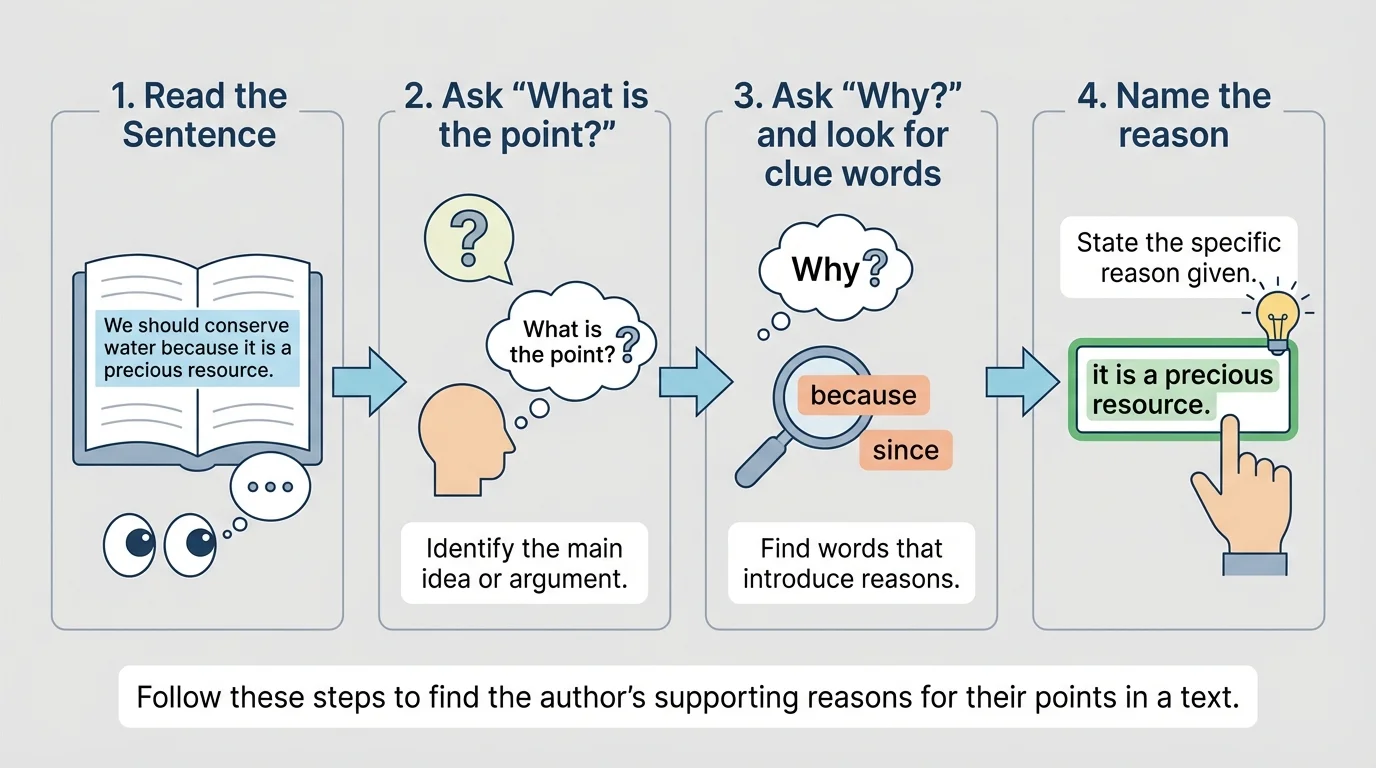
For example, read this: "Bees are helpful because they help flowers grow." The clue word because tells us a reason is coming. The point is bees are helpful. The reason is they help flowers grow.
Try thinking like a detective. If the text says, "Trees are important since they give shade," the point is trees are important. The reason is they give shade. Asking "Why are trees important?" helps the answer stand out.
Remember that informational texts teach us about the real world. When you read nonfiction, look for the main idea and details. Finding reasons is one more smart reading move that helps those details make sense.
Sometimes a reason is not in the same sentence as the point. You may need to read two or three sentences together. Good readers keep the point in mind and look for details that answer "Why?"
Read this short text: "The school garden is useful. It gives students a place to learn about plants." The point is the school garden is useful. The reason is it gives students a place to learn about plants.
Example: Finding the point and reason
Text: "Dogs can be good pets because they can be loving and playful."
Step 1: Find the big idea.
The author's point is dogs can be good pets.
Step 2: Ask why.
Why does the author think dogs can be good pets?
Step 3: Find the reason.
The reason is they can be loving and playful.
Here is another text: "A hat is useful on sunny days. It can help shade your face." The point is a hat is useful on sunny days. The reason is it can help shade your face.
Now read this one: "The library is a special place for children. It has many books to read." The point is the library is a special place for children. The reason is it has many books to read. Later, when we see more than one reason, [Figure 3] helps us picture how several reasons can all support one point.
In many informational texts, the author writes facts too. A fact is something true that can be checked. Facts can help make a reason stronger.
An author may give a reason and then add a fact, detail, or example. The reason tells why. The fact helps prove it.
Listen to this: "Milk is a healthy drink because it helps build strong bones. It has calcium." The point is milk is a healthy drink. The reason is it helps build strong bones. The fact is it has calcium. The fact supports the reason.
Reasons and facts are not exactly the same. A reason explains why the author's point makes sense. A fact gives true information that helps support that reason. Readers can notice both, but first they should find the reason.
Here is another one: "Rainforests are important because many animals live there." The point is rainforests are important. The reason is many animals live there. If the author adds, "Some rainforests are home to colorful birds, frogs, and monkeys," those are details that support the reason.
As we saw earlier in [Figure 1], one point needs support underneath it. Reasons are that support. Facts and details can make the support even stronger.
Sometimes one point has several reasons, and [Figure 3] illustrates this clearly with one big idea connected to many supporting parts. This happens often in informational texts because authors want to fully explain their ideas.
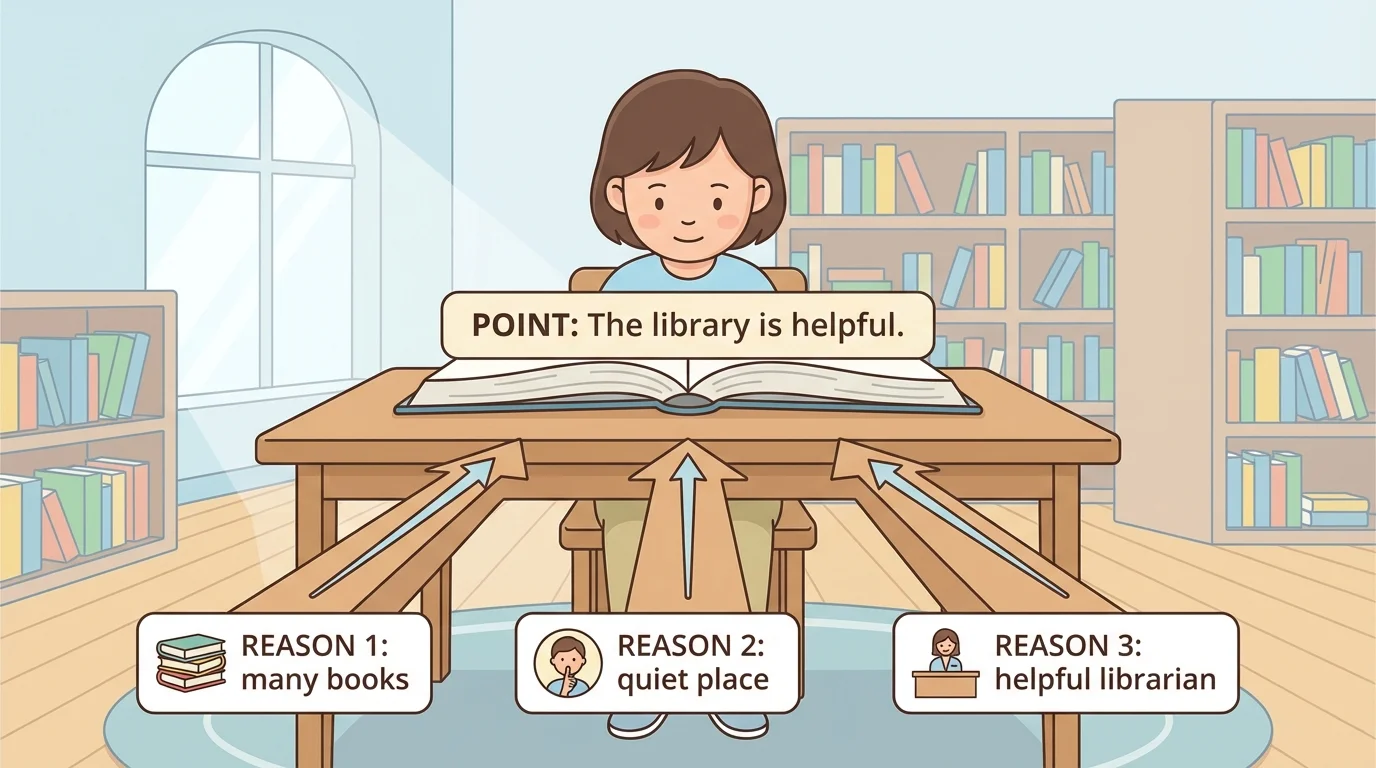
Read this example: "The library is helpful. It has many books. It is quiet for reading. A librarian can help you find what you need." The point is the library is helpful. One reason is it has many books. Another reason is it is quiet for reading. A third reason is a librarian can help you find what you need.
Authors may put the reasons in a list. They may use words like also, another, or too. These words can signal that more reasons are coming.
Here is a second example: "Bicycles are a good way to travel to the park. They are fun to ride. Riding them helps you exercise." The point is bicycles are a good way to travel to the park. The reasons are they are fun to ride and riding them helps you exercise.
After reading, a good reader can say the point and tell the reasons in simple words. This does not mean saying every sentence exactly the same way. It means understanding the author's message.
One easy way to check is to finish this thought: "The author says ___ because ___." If there is more than one reason, you can say, "The author says ___ because ___, ___, and ___." That helps readers talk about the text clearly.
Strong readers do more than remember words on a page. They notice how ideas fit together. Finding reasons helps your brain connect the author's big idea to the details that support it.
Suppose a text says, "Plants should be watered. Water helps them grow." You can explain it like this: "The author says plants should be watered because water helps them grow." That shows you found both the point and the reason.
Think again about the reading path from [Figure 2]. First find the point, then ask why, then look for clue words and supporting details. This simple habit helps you understand many kinds of nonfiction texts.
When you read about animals, weather, food, or school, listen for what the author wants you to know. Then look for the reasons. That is how readers learn to understand and explain informational text.
