Have you ever heard someone say something and thought, "Wait... what does that mean?" That happens to everyone. Good listeners do not just remain confused. They ask questions. Questions help us learn, understand, and connect with other people. When we ask and answer questions, we become stronger speakers and stronger listeners too.
When a person is talking, that person is called the speaker. A listener is the person who listens. A listener's job is to pay attention, think about what was said, and ask questions when needed. Asking questions can help us gather more information. It can also help us clarify something that is hard to understand.
Questions are powerful. They help us learn about people, stories, directions, and ideas. If a teacher says, "We will plant seeds today," a student might ask, "What kind of seeds?" That question helps the student get more information. If a friend says, "My trip was amazing," a student might ask, "Where did you go?" That question helps the listener learn more.
Ask means to say a question. Answer means to respond to a question. Clarify means to make something more clear and easier to understand.
Sometimes we ask questions because we want to know more. Sometimes we ask questions because we are confused. Both kinds of questions are important. Strong listeners know when to use each type of question.
To understand a speaker, we listen to the words and notice important clues, as [Figure 1] shows. We listen for names, places, actions, and feelings. We also notice how the speaker sounds. A happy voice, a quiet voice, or an excited voice can give us more information.
We can also watch the speaker's face and body. If the speaker points to something, smiles, shrugs, or looks worried, those actions can help us understand the message. Listening is not only with our ears. It also means paying attention with our eyes and our minds.
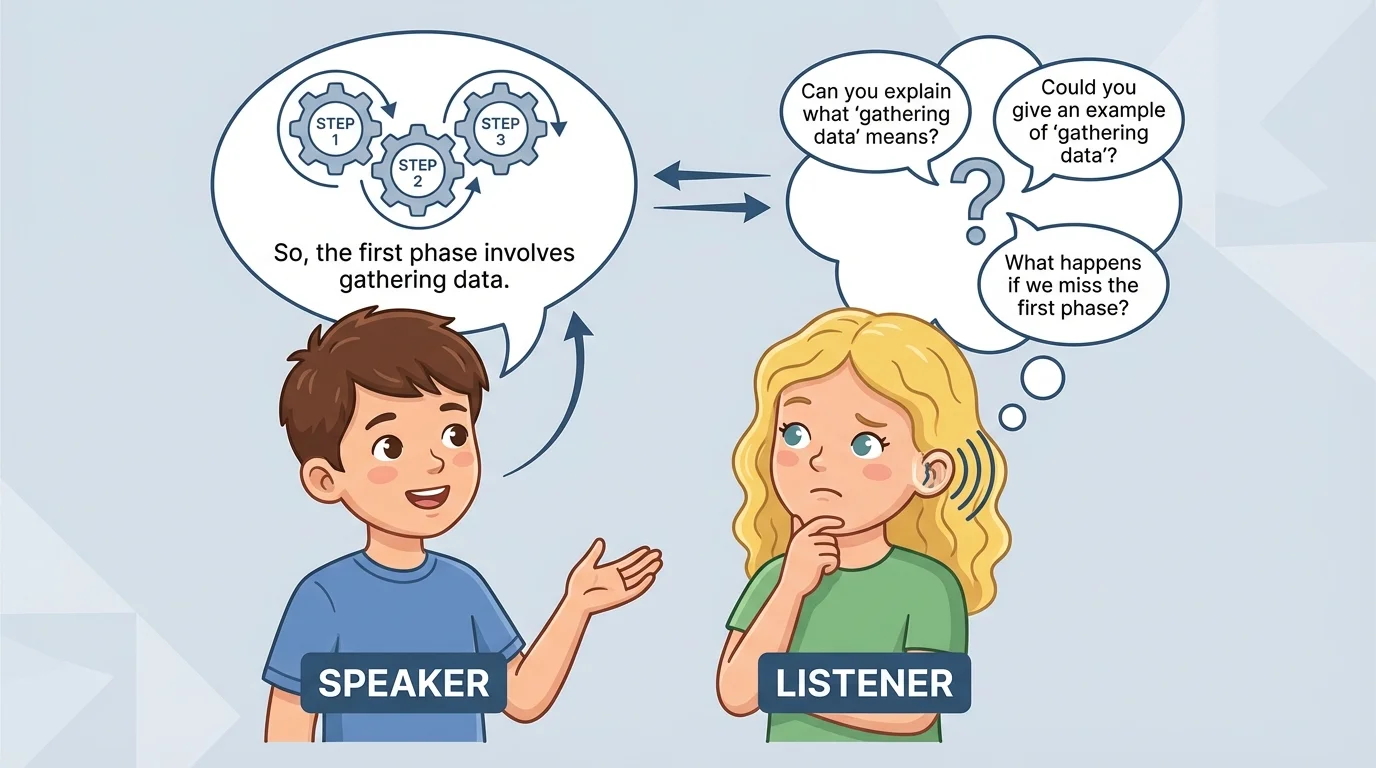
For example, if the teacher says, "Put your folder over there," and points to a shelf, the pointing helps you know where "there" is. If you still do not understand, you can ask, "Which shelf?" That is a helpful question.
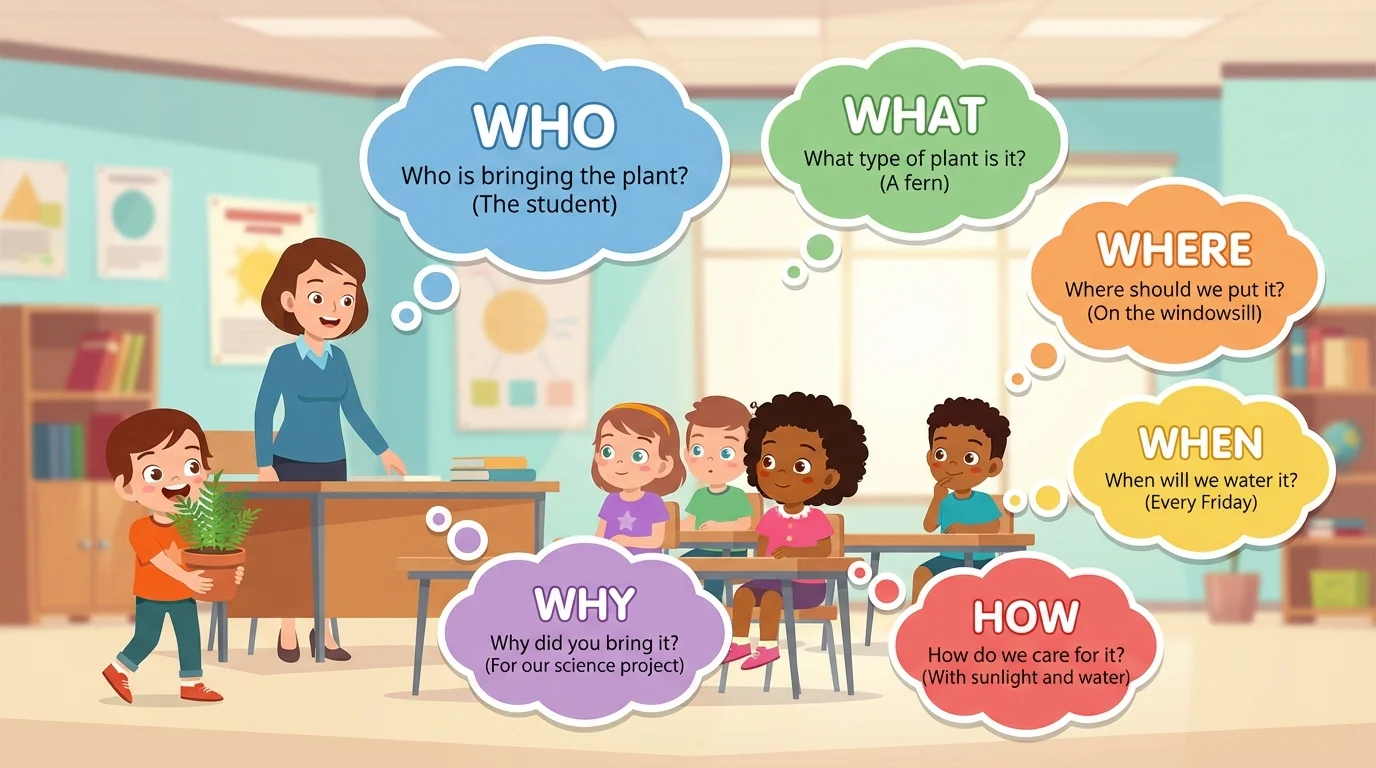
Some questions help us find new information. The question words help listeners learn details from what a speaker says. These question words are who, what, where, when, why, and how.
As [Figure 2] shows, here are some examples: Who brought the puppy? What are we making? Where is the book? When do we go outside? Why is the ice melting? How did you build that tower?
These questions match what the speaker said. If your classmate says, "I built a castle with blocks," you could ask, "How did you make the tall part stay up?" That question fits the topic and gathers more information.
Some questions are for clarification. These are helpful when a word, direction, or idea is not clear. You can say, "Can you say that again?" "What does that word mean?" "Can you show me?" or "Do you mean this one?" Later, when you choose the best question to ask, think back to the question words in [Figure 2] and pick the one that matches the missing detail.
Example: Asking to learn more
A student says, "I saw something amazing at the park."
Step 1: Think about what information is missing.
You do not know what the student saw.
Step 2: Ask a question that matches the missing information.
You can ask, "What did you see?"
Step 3: Listen to the answer.
The student might answer, "I saw a turtle near the pond."
The question helps you gather an important detail.
When we ask a question, we should stay on the same topic. If someone is talking about a rainy day, it is not helpful to suddenly ask about lunch. Good questions connect to what the speaker is saying.
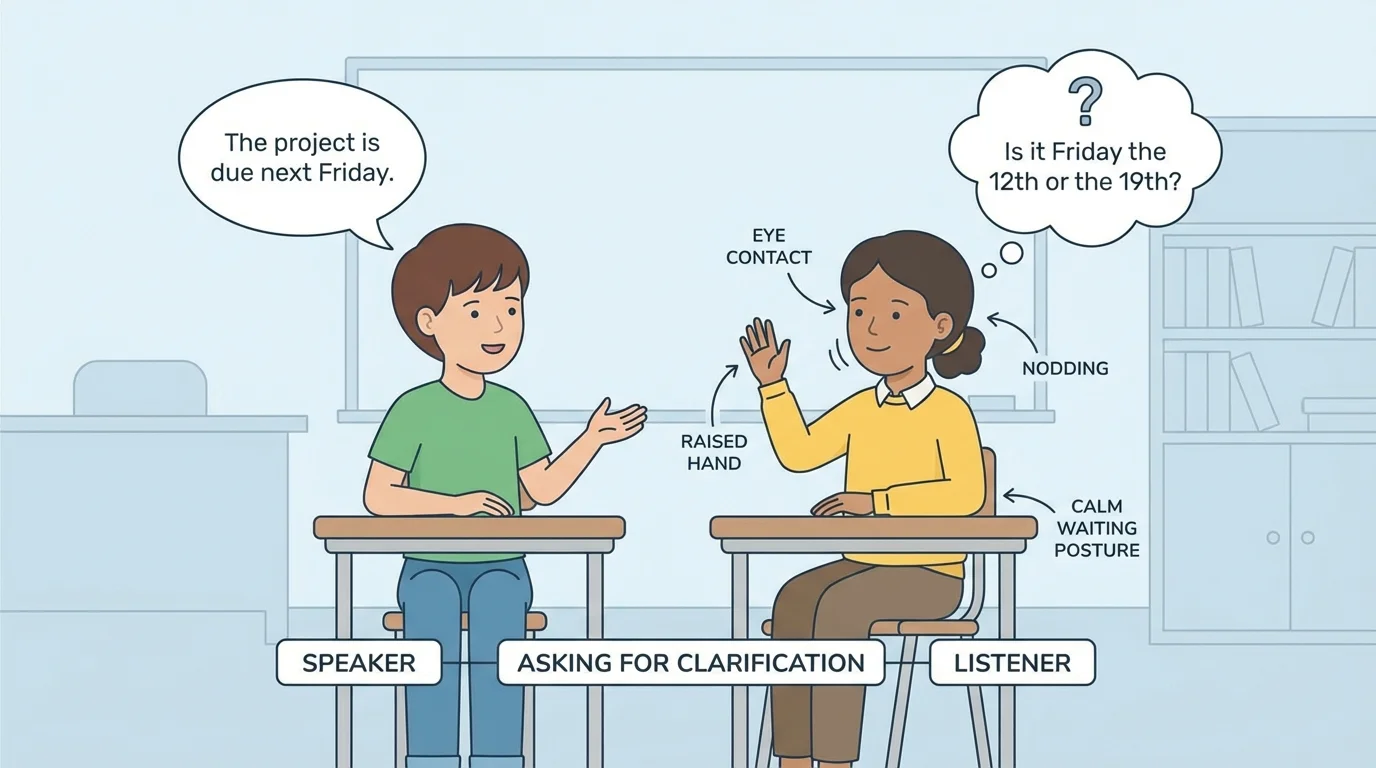
We communicate with verbal language, which means words we say, and with nonverbal language, which means messages we show without words. Eye contact, a calm body, and a nod can show that we are listening, as [Figure 3] shows.
When someone speaks to you, face the speaker if you can. Keep your body still. Look at the speaker. Nod if you understand. Raise your hand if you want to ask something in class. These actions help the speaker know you are paying attention.
Your voice matters too. Use a kind, clear voice when you ask a question. Say, "Please," "Can you help me?" or "I do not understand that part." A polite voice helps conversations feel safe and respectful.
Your face can ask a question even before your words do. A puzzled look may show that you are confused, but using clear words helps the speaker know exactly what you need.
Nonverbal language can also help with answers. A smile, a point, or showing an object can make an answer easier to understand. Just as we saw with listening clues in [Figure 1], body language works together with spoken words.
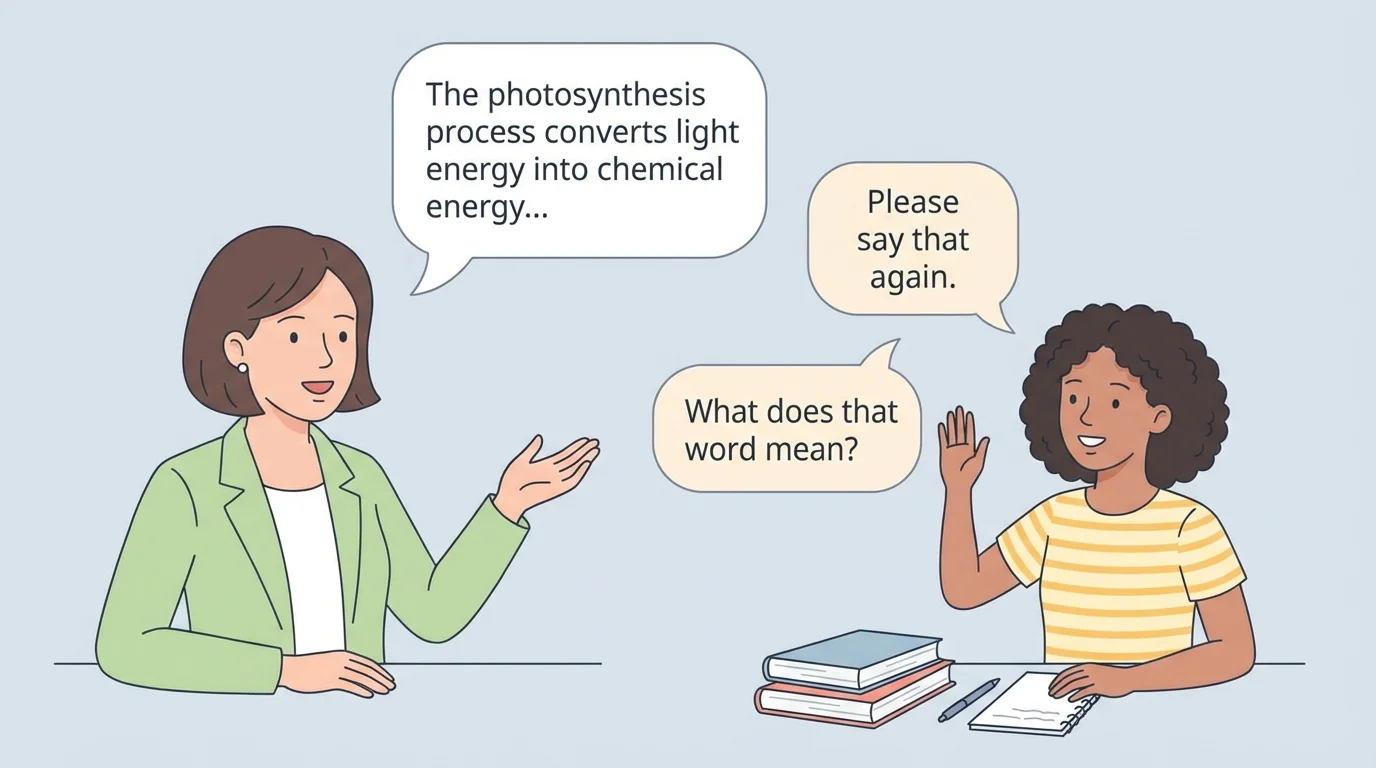
Sometimes a speaker talks too softly, too quickly, or uses a word we do not know. In those moments, asking for clarification is a helpful strategy, as [Figure 4] shows. Helpful phrases can show how to ask in a polite way.
You can say, "Please say that again." "I did not understand." "What does that word mean?" "Can you tell me more?" or "Can you show me what to do?" These questions are not rude. They help you learn.
If you still feel confused, listen again and ask another question. Sometimes we need more than one question. That is okay. Learning often happens one question at a time.
How clarification works
Clarification happens when a listener notices confusion, asks a question, and then listens to the new answer carefully. The listener and speaker work together to make the message clear.
For example, a teacher says, "Circle the word at the top." A student may ask, "Do you mean the top of the page?" The teacher answers, "Yes, the very first word." Now the student understands. The polite question fixed the confusion.
These skills matter all day long. In the classroom, we ask questions about directions, stories, science tools, and art projects. At home, we ask questions to understand rules, plans, and family stories. On the playground, we ask questions to understand game rules or solve small problems.
During story time, you might hear, "The bear rushed into the cave." You can ask, "Why did the bear rush?" That question helps you think about the story. During a game, a friend might say, "You have to stand behind the line." You can ask, "Which line?" That question helps you follow the rules correctly.
Example: Asking for clarification
A teacher says, "Put the paper in the bin by the window."
Step 1: Listen to the direction.
You hear that the paper goes in a bin.
Step 2: Notice what is unclear.
You are not sure which bin the teacher means.
Step 3: Ask a polite question.
You can ask, "Which bin by the window?"
Step 4: Listen to the answer and act.
The teacher says, "The blue bin." Now you know what to do.
The question helps you understand the direction correctly.
Asking questions also shows that you care about what someone says. When a classmate tells about a lost tooth, a new pet, or a trip, your questions show interest. That helps conversations grow.
Good conversations have turns. One person speaks. The other listens. Then the listener may ask a question. After that, the speaker answers. This back-and-forth helps everyone share and understand.
We should not interrupt when someone is talking unless it is an emergency. We wait for a pause or raise a hand in class. Then we ask our question clearly. When someone answers our question, we listen all the way to the end.
You already know how to use question marks in writing. In speaking, your voice can also sound like a question, and your words help others know what you want to learn.
We should also answer kindly. If someone asks, "Where did you find the crayon?" a helpful answer is, "I found it under the table." A shrug or the answer "I do not know" may not give enough information. Clear answers help the listener just as clear questions help the speaker.
When you need help understanding, remember the polite phrases from [Figure 4]. When you want to learn more, use strong question words like the ones in [Figure 2]. Together, these habits make you a careful listener and a thoughtful speaker.
