Have you ever read a sign that told you where to go, then listened to a story that made you laugh, and then looked at a cereal box to find your favorite kind? Reading does many jobs every day. A strong reader does more than read words aloud. A strong reader reads to understand.
[Figure 1] Sometimes we read to enjoy a story. Sometimes we read to learn something new. Sometimes we read to follow directions. Sometimes we read to find one important fact. Print has different jobs, and readers think about that job right away.
When you pick up a book or look at a page, it helps to ask, "Why am I reading this?" If you are reading a story, you may think about characters and what happens next. If you are reading a fact page, you may look for information. If you are reading directions, you need to follow the steps in order.
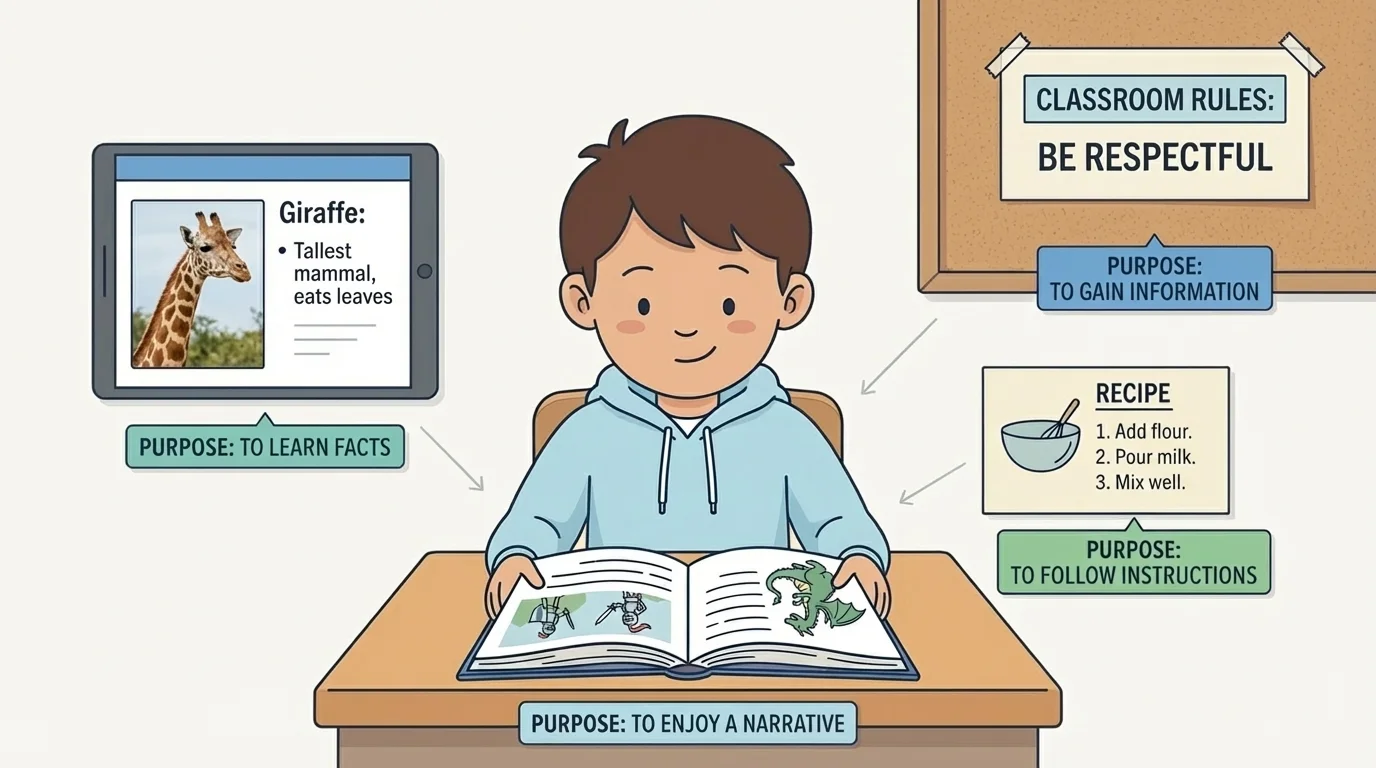
Reading with purpose helps your brain stay focused. It is like using the right tool for the right job. A flashlight helps you see in the dark. Reading with a clear purpose helps you understand the text.
Purpose means the reason for reading. Understanding means knowing what the words and sentences are telling you.
When readers know their purpose, they pay attention in the right way. That makes reading more useful and more fun.
To understand a text, a reader needs accuracy and fluency. Accuracy means reading the words correctly. Fluency means reading in a smooth way that sounds like talking, as [Figure 2] illustrates.
If a reader has to stop at every word, it is hard to remember the whole sentence. But when words are read correctly and smoothly, the mind has more space to think about meaning. For example, in the sentence, "The dog ran fast," a fluent reader says it smoothly and understands right away what happened.
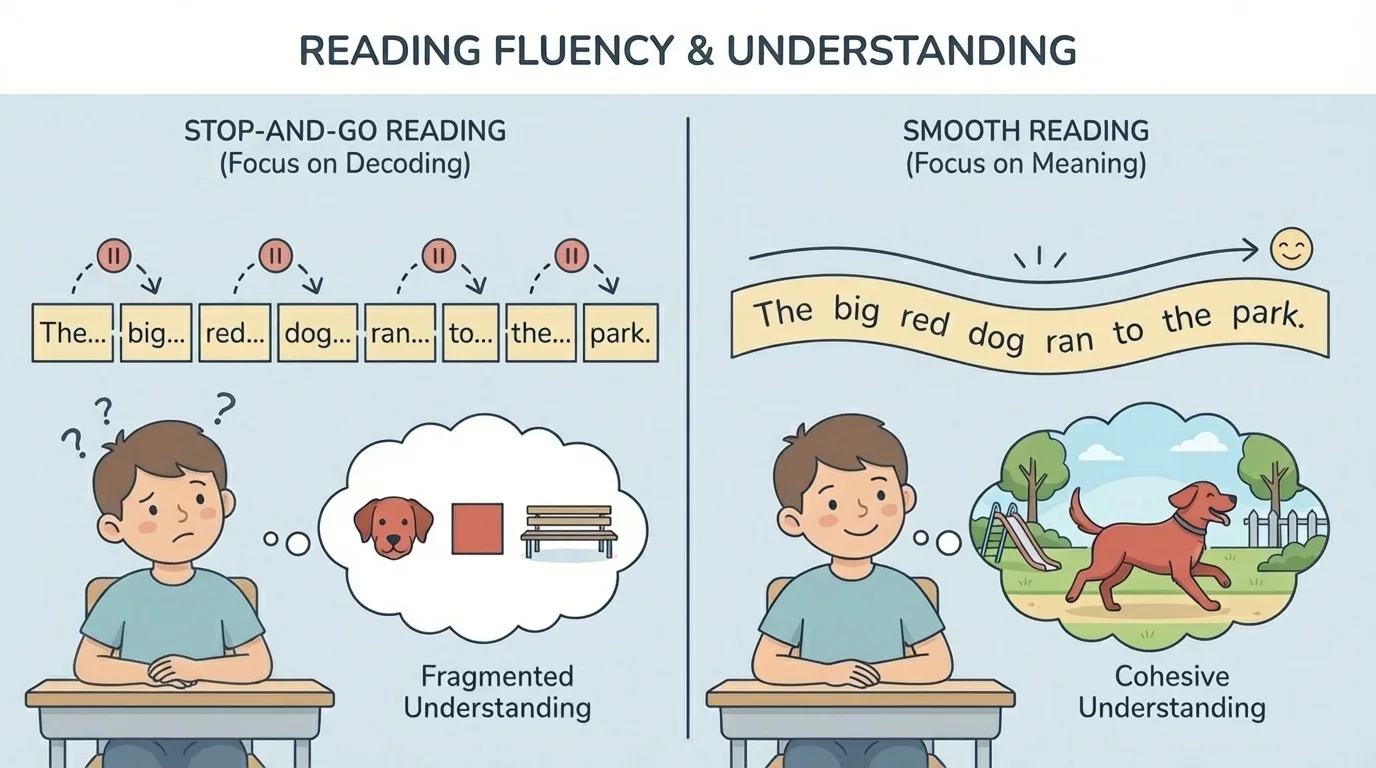
Fluent reading does not mean rushing. It means reading at a good pace, paying attention to punctuation, and making the words sound meaningful. A question should sound like a question. An excited sentence can sound excited.
When readers grow in fluency, they can notice important ideas more easily. Later, when thinking about a story or facts on a page, they can remember details better because the reading was not so bumpy. That is why smooth reading helps comprehension.
Your brain works hard while you read. It looks at letters, matches sounds, blends words, and thinks about meaning almost all at the same time.
Good readers try to make the words match the print and make the message make sense.
[Figure 3] Readers do not have to know every word right away. They can use word families and word parts to help. A word family is a group of words that share a pattern, like -at in cat, bat, and sat. Word parts are smaller pieces in words, such as beginnings and endings.
If you can read play, you may be able to read plays and played. If you know jump, you may read jumps and jumping. These parts help readers solve words instead of guessing.
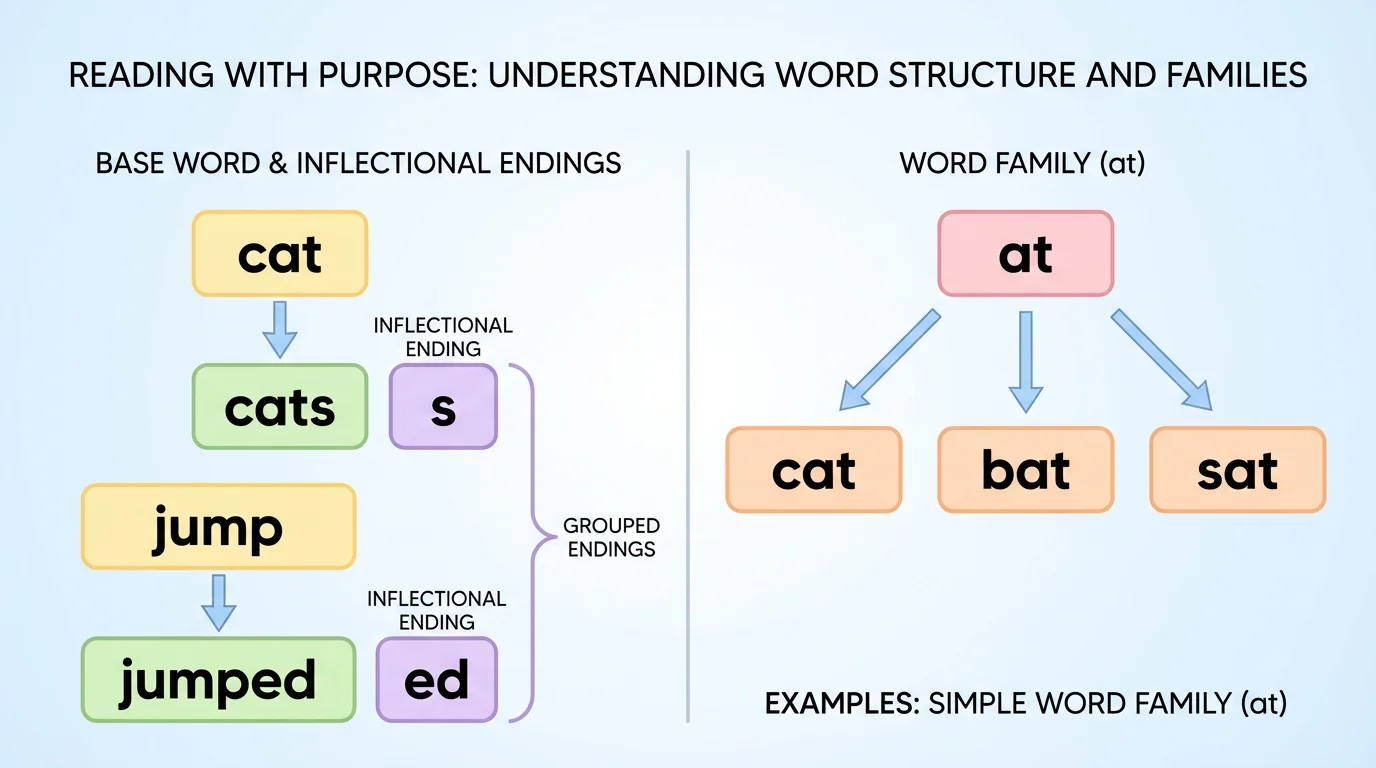
Word families help because the pattern stays the same. When children know the chunk -ake, they can read cake, bake, and make. Word parts help because readers can notice what changed. In look and looked, the base word stays the same and the ending adds meaning.
Looking closely at letters in order is important. Readers should check the beginning, the middle, and the end of the word. The word-part patterns in [Figure 3] remind us that one small change can make a new word.
Words are built in helpful ways. Many words are not completely new. They are made from parts and patterns that readers already know. When a reader notices these patterns, reading becomes faster and more accurate.
This is one reason practice matters. The more patterns a reader knows, the easier it becomes to unlock new words.
Reading is not just using your voice. It is also using your mind. While reading, good readers think about what is happening. They ask simple questions such as: Who is this about? What is happening? Where is it happening? What did I learn?
Suppose a story says, "Mia put on boots and ran outside. Snow covered the ground." A reader can think, "It is winter," even if the sentence does not say the word winter. That is part of understanding.
Sometimes meaning breaks down. A reader may say all the words but not understand the sentence. When that happens, it helps to slow down, reread, and think again. Good readers notice when something does not make sense.
Reading for meaning
Read this sentence: "The baby bird peeped from the nest."
Step 1: Read the words carefully.
Notice the important words: baby bird, peeped, and nest.
Step 2: Think about what is happening.
A baby bird is making a small sound while it is in a nest.
Step 3: Put the ideas together.
The sentence tells about a young bird in its home making a tiny call.
That is comprehension: putting the words and ideas together so the sentence means something in your mind.
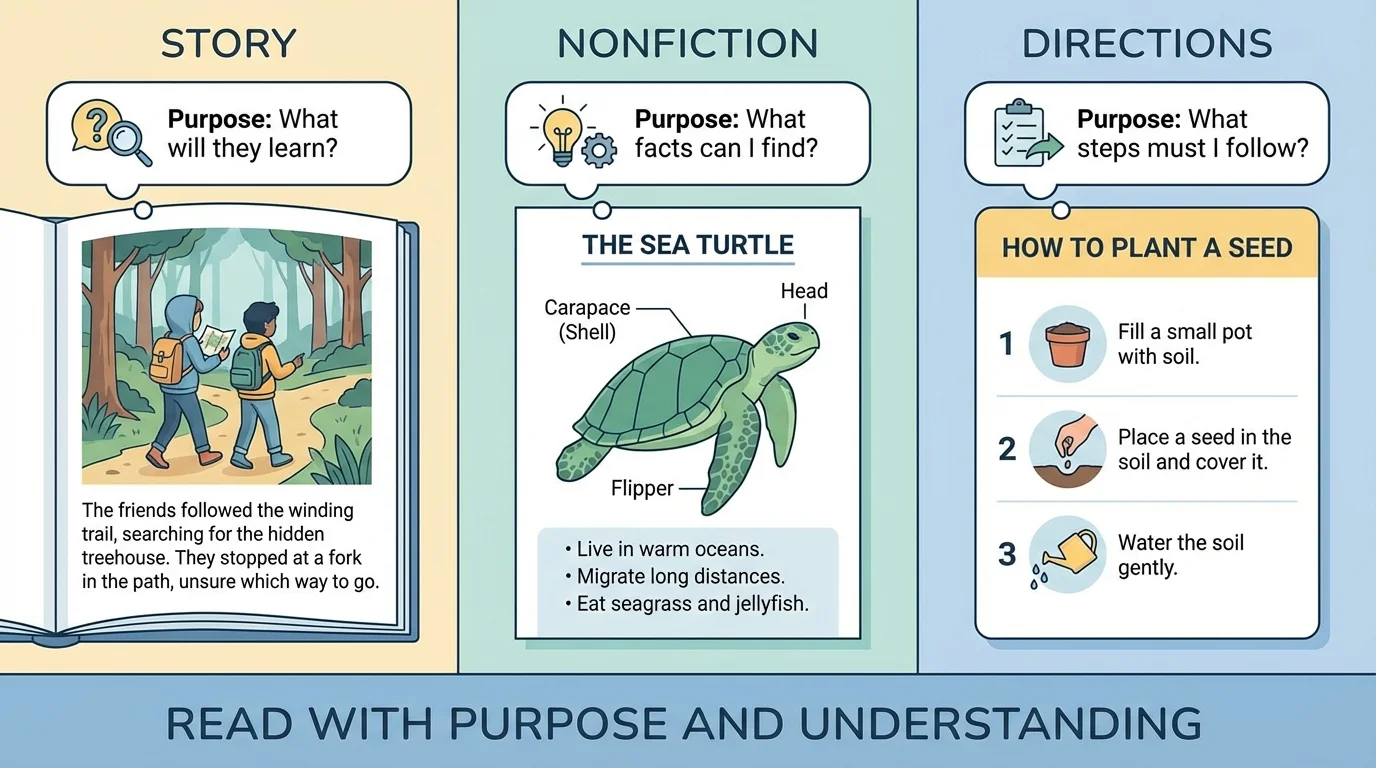
[Figure 4] Readers change how they read depending on the kind of text. A story usually has characters, a setting, and events. An informational text teaches facts. Directions tell what to do step by step.
When reading a story, you might think about the beginning, middle, and end. You may wonder how a character feels. When reading informational text, you may look for facts, labels, or headings. When reading directions, you must read carefully so you do the steps in the right order.
| Type of text | What the reader looks for |
|---|---|
| Story | Characters, events, feelings, what happens next |
| Informational text | Facts, labels, important ideas |
| Directions | Steps, order, what to do |
Table 1. A comparison of different kinds of text and what readers focus on in each one.
This is why purpose matters so much. If you read a page about frogs, you look for facts. If you read a tale about a frog prince, you think about the plot. The text types in [Figure 4] help show why readers use different kinds of attention.
Every reader finds tricky words sometimes. Good readers do not give up. They look carefully at the letters. They think about sounds. They notice familiar chunks. They reread the sentence and ask, "What would make sense here?"
Pictures can help too, but they should be helpful, not the only clue. A reader should still check the word. If the picture shows a dog, but the word begins with c and ends with t, the word may be cat, not dog.
Rereading is a strong strategy. Sometimes a sentence becomes clear on the second reading because the words connect better the next time.
Remember that letters stand for sounds, and words go in order from left to right. Those skills help readers read new words and understand whole sentences.
Strong readers check both parts: Does it look right? and Does it make sense?
Reading grows with practice. When children read on-level text often, they get better at recognizing words, reading smoothly, and understanding more. A text at the right level gives enough challenge to learn, but not so much that the reading becomes frustrating.
Reading out loud can build fluency. Reading silently can build focus and thinking. Listening to a teacher or caregiver read can also help children hear how fluent reading sounds. All of these support understanding.
As readers grow, they become more confident. They can read a story and enjoy it. They can read facts and learn something new. They can read a note, a sign, or simple directions and know what to do. That is the power of reading with purpose and understanding.
