Say the word sun. It feels like one small word, but your mouth does several jobs to say it. First you say /s/, then you open your mouth for /u/, and then you finish with /n/. Words are like tiny sound trains. When we listen carefully, we can hear each part. This helps us become stronger readers and spellers.
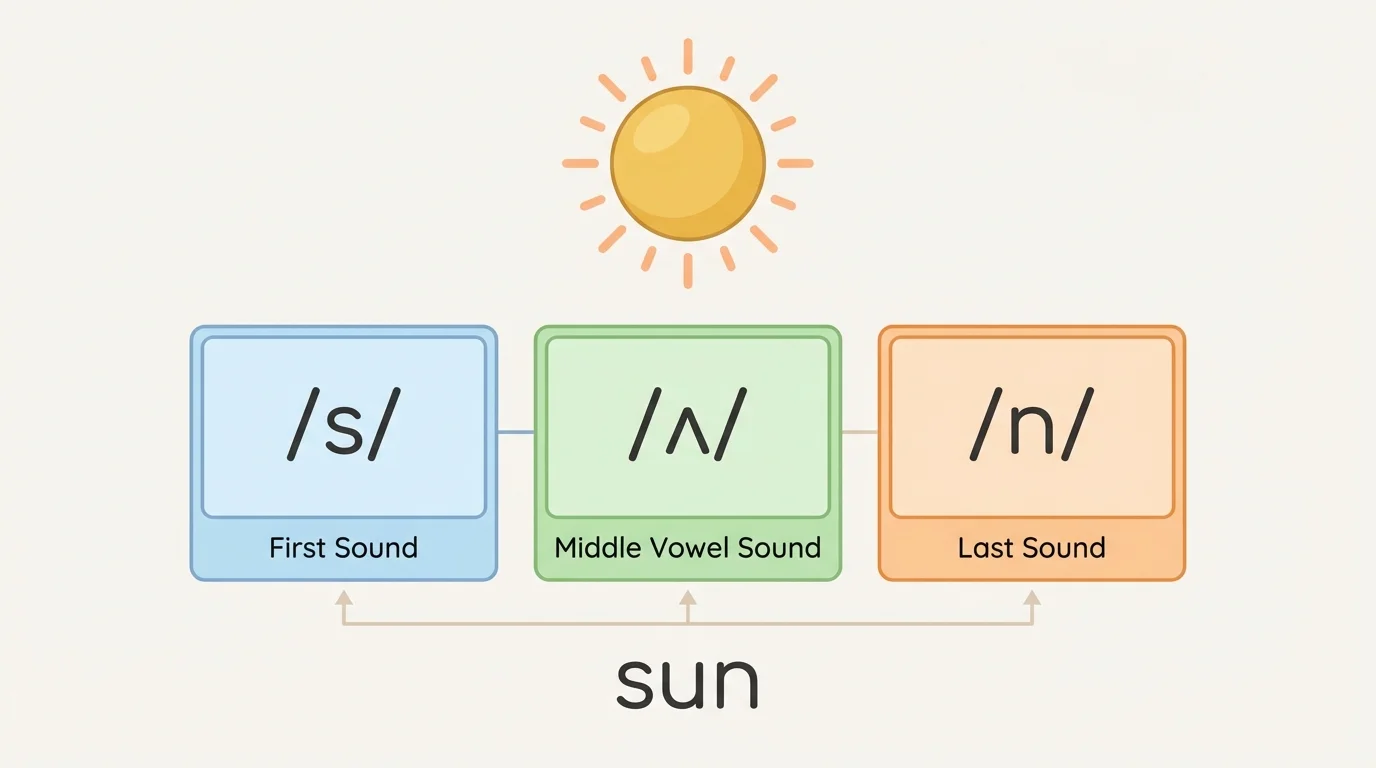
A phoneme is one small sound in a word. In short words with one syllable, we can often hear a beginning sound, a middle vowel sound, and an ending sound. A word like map has three sounds: /m/ /a/ /p/. As [Figure 1] shows, we can listen from the start of a word to the middle and then to the end.
When we isolate a sound, we listen for just one part of the word and say that part by itself. We are listening to sounds, not just letter names. For example, in dog, the first sound is /d/, the middle vowel sound is /o/, and the last sound is /g/.
Initial sound is the first sound you hear in a word. Medial vowel sound is the vowel sound you hear in the middle of a short word. Final sound is the last sound you hear in a word.
Many Grade 1 words are one-syllable words such as cat, bed, pig, hop, and bus. These are good words for careful listening because each sound can be heard in order.
The initial sound is the sound at the beginning of a word. If you hear bat, the first sound is /b/. If you hear fish, the first sound is /f/. If you hear log, the first sound is /l/.
To hear the first sound, listen right when the word begins. Try stretching the word a little in your mind: mmmman. That helps you hear /m/ first. In sun, the first sound is /s/. In top, the first sound is /t/. In jam, the first sound is /j/.
Sometimes words begin with sounds that can be held longer, like /m/, /s/, /f/, or /n/. These are often easier to hear. Other sounds, like /b/, /d/, or /t/, are quick sounds, so you have to listen closely right at the start.
Your mouth moves differently for different sounds. Put your lips together for /m/ and /b/, but put your tongue behind your teeth for /t/ and /d/. Your mouth helps make the sound you hear.
The first sound helps us sort words into groups. Moon, man, and mat all begin with /m/. Pig, pan, and pen all begin with /p/. Hearing that first sound is an important reading skill.
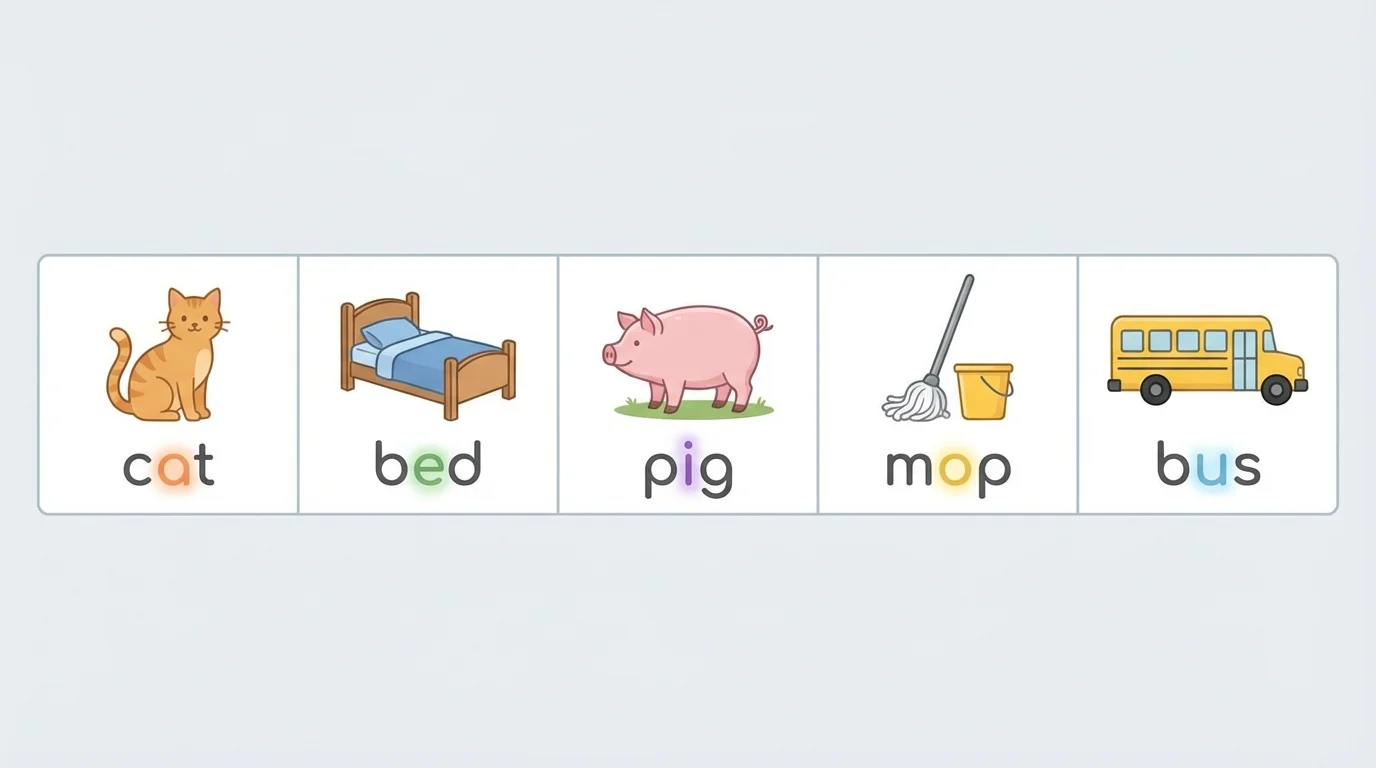
The medial vowel sound is the sound in the middle of a short word. In many one-syllable words, the middle sound is a vowel. As [Figure 2] illustrates, words like cat, bed, pig, mop, and bus each have a different vowel sound in the middle.
Listen to these examples: cat has /a/ in the middle, bed has /e/, pig has /i/, hop has /o/, and sun has /u/. The middle sound can be the trickiest one to hear, so it helps to say the word slowly.
We can stretch a word to hear the middle vowel sound better. Say caaat. The middle sound is /a/. Say peeen. The middle sound is /e/. Say fiiish. The middle sound is /i/.
Why vowel sounds matter
The middle vowel sound often changes the whole word. If the beginning and ending sounds stay the same, changing only the vowel can make a new word. For example, bit, bet, and bat do not mean the same thing because the middle vowel sound changes.
When learners confuse words like pen and pin, it is often because the middle vowel sound is hard to hear. Careful listening helps fix that. We also saw in [Figure 1] that the middle sound sits between the first and last sounds in the word.
The final sound is the sound at the end of a word. In map, the last sound is /p/. In bed, the last sound is /d/. In fish, the last sound is /sh/.
To hear the last sound, listen all the way to the end. Sometimes it helps to say the word and stop at the very end: ca-t. The ending sound is /t/. In fan, the ending sound is /n/. In dog, the ending sound is /g/.
Final sounds help us tell words apart. Cap and cab start the same and have the same middle sound, but one ends with /p/ and the other ends with /b/. Bug and bun also change because the final sound changes.
Listening to one word: lip
Step 1: Hear the first sound.
The word begins with /l/.
Step 2: Hear the middle vowel sound.
The middle sound is /i/.
Step 3: Hear the last sound.
The word ends with /p/.
The sounds in lip are /l/ /i/ /p/.
When you can say the last sound clearly, you are paying attention to the whole word, not just the beginning.
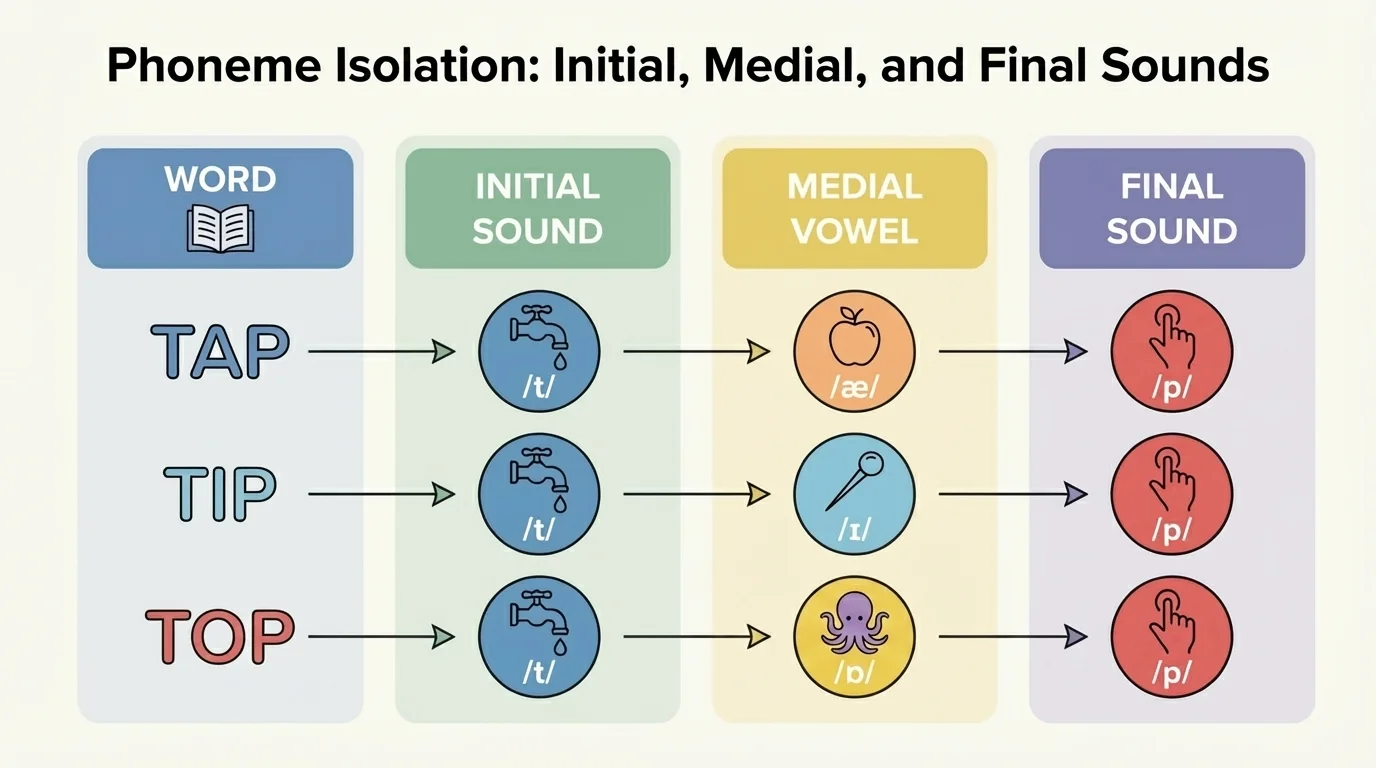
Words are easier to understand when we listen in order: first, middle, last. [Figure 3] shows how one small change in the middle can make a different word, even when the first and last sounds stay the same.
Look at these spoken words: tap, tip, and top. They all begin with /t/ and end with /p/. The only change is the middle vowel sound: /a/, /i/, or /o/. That one sound changes the word.
We can compare other words too. man and pan have different first sounds. sit and sat have different middle vowel sounds. red and rest are not both simple three-sound words, so we must listen carefully and choose words we can hear clearly.
| Word | First sound | Middle vowel sound | Last sound |
|---|---|---|---|
| cat | /k/ | /a/ | /t/ |
| bed | /b/ | /e/ | /d/ |
| pig | /p/ | /i/ | /g/ |
| hop | /h/ | /o/ | /p/ |
| sun | /s/ | /u/ | /n/ |
Table 1. Examples of one-syllable words with the initial sound, medial vowel sound, and final sound.
This kind of listening prepares students to match sounds to letters when reading and writing. The sound order matters. If the order changes, the word changes too.
Some words are a little harder. A word like ship ends with /p/, but it begins with /sh/, which is one spoken sound even though it can be written with two letters. We listen to the sound we hear, not just the number of letters.
A word like flag begins with a blend, /fl/. That means two sounds are close together at the start. For this lesson, many simple words such as cat, dog, and sun are easier to hear. Still, strong listeners can begin to notice that some words have extra sounds packed together.
Letters are symbols we see, but sounds are what we hear and say. A word may have more than one letter working together for a sound, so always listen with your ears.
When you get stuck, say the word slowly but smoothly. Do not change the word. Just stretch it enough to hear the sounds. This helps with the first sound, the middle vowel sound, and the last sound.
We can return to [Figure 3] and notice that keeping track of each sound position helps us tell whether two words are the same or different. Careful listening is like being a word detective.
When children read, they match sounds they hear to letters they see. When they spell, they listen to the sounds in a word and write letters for those sounds. If a child can hear /m/ /a/ /t/ in mat, it becomes easier to read and spell that word.
This skill also helps with word families. If you know cat, then you can listen to hat, bat, and sat. The ending part stays the same, but the beginning sound changes. In other word sets, the middle sound changes, like pin and pan. In others, the last sound changes, like cap and can.
Good readers are careful listeners. They hear where a sound belongs in a word: at the start, in the middle, or at the end. That is why learning to isolate and pronounce sounds is such an important step in reading.
