Some of the weakest arguments sound the loudest. In public debates, online comment sections, and even classroom discussions, people often act as if confidence alone proves a point. It does not. Strong argument writing depends on something more demanding: the ability to present your position clearly, address other positions honestly, and support both with the most relevant evidence. That kind of writing does not just try to win. It tries to think.
When you write an argument, your goal is not simply to announce an opinion. Your goal is to convince a reader that your reasoning deserves trust. Readers are more likely to trust a writer who shows intellectual fairness. If you ignore opposing views, misrepresent them, or respond only to the easiest version of the other side, your argument may seem biased or shallow.
Fairness does not mean weakness. It means accuracy. A strong writer can say, in effect, "I understand the best argument on the other side, and I can still explain why my position is stronger." That is much more persuasive than pretending disagreement does not exist.
This skill matters far beyond English class. Lawyers build cases by addressing opposing interpretations. Scientists defend conclusions by discussing limits in their data. Journalists weigh competing explanations. Citizens make decisions about policies, public health, technology, and the environment by comparing arguments and evidence. Learning to develop claims and counterclaims fairly is part of learning how to think responsibly.
Many professional debates become more persuasive, not less, when a speaker openly admits a weakness in their own side. That move can increase credibility because it shows the speaker values truth over appearance.
For student writers, balanced argument is especially important because it demonstrates maturity. It shows that you can move beyond "I think" and toward a reasoned position built from analysis, evidence, and awareness of your audience.
An argument is made of connected parts, as [Figure 1] shows. A claim is the main position a writer wants the audience to accept. A counterclaim is an opposing or alternative position. Evidence consists of the facts, examples, data, quotations, and observations used to support a claim or counterclaim.
A claim should be arguable. "Reading can be enjoyable" is not a very strong claim because few readers would disagree, and it is too general. "High schools should require a media literacy course because students need structured practice evaluating online information" is stronger because it is specific, debatable, and significant.
A counterclaim is not just a sentence beginning with "Some people disagree." It is a real competing idea that deserves accurate treatment. For the media literacy example, a counterclaim might be that schools already have overloaded schedules and should strengthen existing classes instead of creating a new requirement.
Evidence gives the argument substance. Without evidence, a claim is only an assertion. With evidence, it becomes a position that can be tested and evaluated.
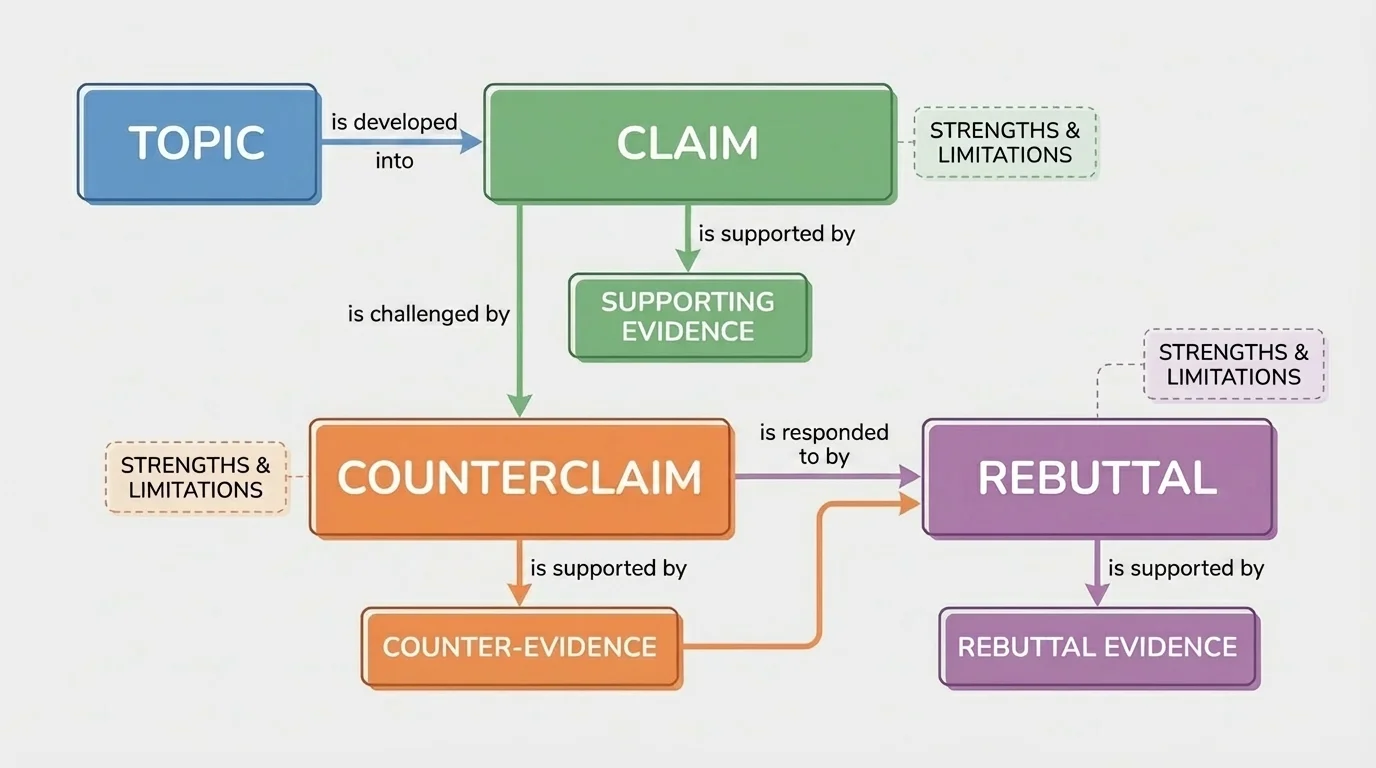
Another important part of argument is the rebuttal, which answers the counterclaim. A rebuttal does not insult the opposing side. Instead, it explains why the counterclaim is less convincing, less complete, or less practical than the writer's own position.
Claim is the writer's main argument or position.
Counterclaim is a reasonable opposing viewpoint.
Evidence is the information used to support a position.
Rebuttal is the response to a counterclaim that explains why the main claim remains stronger.
These parts work together. A claim without a counterclaim can feel one-sided. A counterclaim without a rebuttal can make the writer seem uncertain. Evidence without analysis can feel like a pile of facts. Effective argument writing connects all of them.
A strong claim is arguable, specific, and significant. It should address an issue that matters and make a point that requires support. Claims that are too broad become hard to prove. Claims that are too obvious do not invite analysis.
Compare these examples:
| Weak Claim | Why It Is Weak | Stronger Claim |
|---|---|---|
| Schools should change. | Too vague | High schools should start classes later because adolescent sleep patterns make very early schedules less effective for learning. |
| Phones are bad. | Too broad and simplistic | Phones should be limited during class time because constant notifications reduce focus and make discussion less effective. |
| Exercise is important. | Too obvious | Schools should protect physical education funding because regular exercise improves both health and concentration. |
Table 1. Comparison of weak and stronger claims in argumentative writing.
A good claim also suggests the type of evidence needed. If your claim is about learning, you may need academic studies, school data, or expert analysis. If your claim is about policy, you may need cost information, case studies, or examples from other schools or communities.
Your claim should also leave room for complexity. Mature arguments usually avoid absolute language such as always, never, or everyone, unless the evidence truly supports such certainty. Overstatement often weakens credibility.
Fair treatment of a counterclaim means presenting the opposing view in a form that someone who holds that view would recognize as accurate. This is harder than it sounds. Many weak arguments rely on the straw man fallacy, which happens when a writer oversimplifies or distorts the opposing side so it becomes easier to attack.
For example, if your claim is that schools should limit phone use during instruction, an unfair counterclaim would be, "Some people think students should be allowed to do whatever they want on their phones all day." That does not represent the real opposing position. A fairer version would be, "Some argue that phones can support learning through research, scheduling, translation tools, and emergency communication."
Notice what changes. The fair version is stronger, more specific, and more reasonable. That means your rebuttal must also become stronger. This is a good thing. When you answer the best version of the opposing argument, your own reasoning becomes more convincing.
Fairness is a persuasive strategy. Representing a counterclaim accurately does not weaken your argument. It shows that you understand the issue in full and are not depending on distortion to make your point seem stronger.
You should develop counterclaims thoroughly, not just mention them. That means explaining the logic behind them and supplying relevant support. If the opposing side has evidence, acknowledge it. Then explain why it does not outweigh your own evidence, or why it applies only in certain situations.
Not all evidence helps equally. Writers sort evidence by usefulness, as [Figure 2] illustrates. The best evidence is both relevant evidence and sufficient. Relevant evidence directly connects to the point being argued. Sufficient evidence provides enough support for a reasonable reader to take the claim seriously.
Suppose you argue that later school start times improve student performance. A personal anecdote such as "My cousin felt better after getting more sleep" may be true, but it is limited. Stronger evidence would include sleep research on teenagers, attendance data, or results from districts that changed schedules.
Evidence can take several forms: statistics, expert testimony, case studies, textual quotations, historical examples, and firsthand observations. Each form has strengths and limits. Statistics can reveal patterns, but they need interpretation. Expert testimony can add authority, but experts may disagree. Anecdotes can make an issue vivid, but they rarely prove a general claim by themselves.
Good writers choose the most relevant evidence for both claim and counterclaim. If the opposing side has a strong practical concern, such as cost or scheduling difficulty, you should not ignore it. Address it with concrete information.
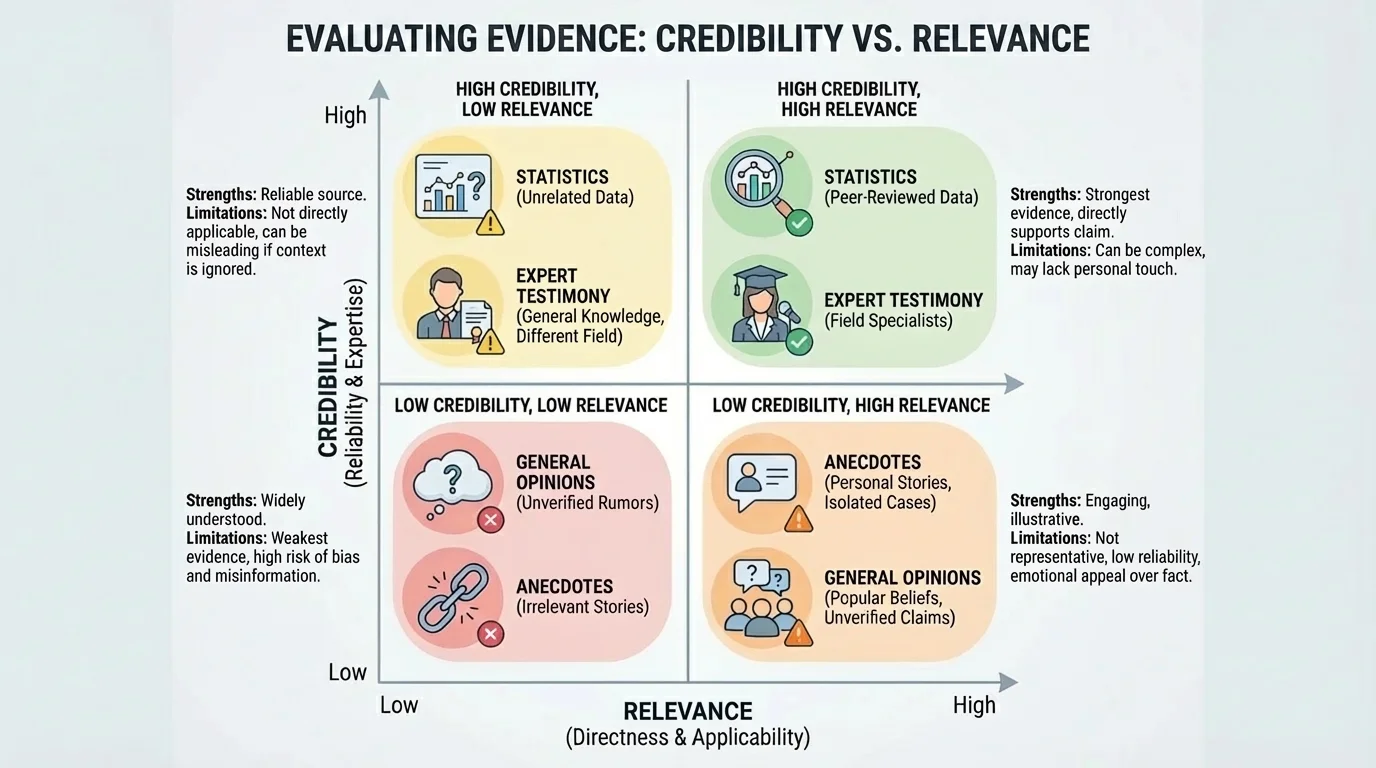
A useful question is: Does this evidence prove the point I am making, or does it merely sound impressive? Students sometimes include quotations or statistics that are loosely connected to the topic but do not truly support the specific claim. That is padding, not reasoning.
Writers must also consider source credibility. Evidence from peer-reviewed research, established news organizations, official reports, and qualified experts is usually stronger than unsupported claims from anonymous posts or random opinion sites. Even credible sources, however, should be used carefully. A source may be trustworthy in one area but less reliable in another.
Case study: selecting stronger evidence
Claim: Schools should provide free menstrual products in restrooms.
Step 1: Start with the issue.
The writer must prove that access affects students in meaningful ways such as attendance, health, dignity, or equity.
Step 2: Compare possible evidence.
A social media post saying the idea is "good" is weak evidence. District reports showing reduced missed class time are stronger. Expert statements from health professionals are also stronger.
Step 3: Include counter-evidence fairly.
If opponents argue that the policy costs too much, the writer should include actual budget data rather than dismissing the concern.
Step 4: Explain the evidence.
The writer should show why attendance and health evidence matters more than generalized objections, especially if the cost is relatively small.
Evidence becomes powerful only when it is explained. After presenting evidence, a writer should connect it to the claim. Ask: What does this evidence show? Why does it matter? How does it affect the argument?
Strong argument writing does not treat one side as perfect and the other as worthless. Instead, it evaluates the limitations and strengths of both. This creates a more realistic and thoughtful argument.
A strength is a feature that makes a claim persuasive. For example, a proposal may be supported by strong data, practical benefits, or fairness. A limitation is a factor that weakens the argument, narrows its application, or raises unanswered questions. A proposal may be effective in theory but difficult to fund. It may work in urban schools but not in rural districts. It may solve one problem while creating another.
Pointing out limitations does not mean giving up your claim. It means showing judgment. Consider this pattern: "The counterclaim raises a valid concern about cost; however, the evidence suggests that the long-term academic and health benefits outweigh the short-term expense." That sentence acknowledges a real strength in the opposing side while still defending the main claim.
This kind of analysis is more persuasive because most serious issues are complex. Readers often distrust writing that seems too certain about complicated problems. They are more likely to believe a writer who recognizes trade-offs and still makes a strong case.
"The test of a first-rate intelligence is the ability to hold two opposed ideas in mind at the same time and still retain the ability to function."
— F. Scott Fitzgerald
In argument writing, that idea means you can recognize value in an opposing view without abandoning your own conclusion. In fact, such recognition often makes your conclusion more convincing.
The same claim may need to be framed differently for different readers, as [Figure 3] illustrates. A writer who ignores audience will often sound either too simplistic or too disconnected from what readers care about. Audience awareness shapes which evidence you choose, how much background you provide, and what concerns you address first.
Consider a proposal for later school start times. If your audience is students, you might emphasize sleep, stress, and concentration. If your audience is parents, you may need to address transportation and after-school schedules. If your audience is a school board, cost, logistics, attendance, and academic performance may matter most.
Bias also matters. Bias does not always mean unfairness in a dramatic sense. It can simply mean a tendency to see an issue from a particular perspective. A reader may value tradition, efficiency, freedom, safety, or equality more strongly than another reader. Anticipating bias means thinking ahead about where readers may resist your claim and responding respectfully.
Audience knowledge level matters too. If readers already know the issue well, you can move more quickly into analysis. If readers are unfamiliar with it, you need to define terms, give context, and avoid assuming too much. Effective writers do not talk down to readers, but they also do not leave key ideas unexplained.

One way to anticipate audience reaction is to ask four questions: What does this audience already know? What do they care about? What might they fear or doubt? What values are most likely to influence their judgment? Your argument should answer those questions before readers have to ask them.
This is one reason balanced treatment of counterclaims matters. When readers feel that their concerns are recognized, they are more likely to stay open to your reasoning.
Earlier writing skills still matter here: a clear thesis, careful paragraph structure, credible source use, and explanation of quotations all support stronger arguments. Advanced argument does not replace those skills; it builds on them.
For example, if your audience worries that stricter phone rules are too controlling, you should address student independence directly. If your audience worries that phone access is essential for safety, you should explain whether exceptions exist and how communication would still be handled.
Clear organization helps readers follow fair reasoning, as [Figure 4] demonstrates. Even strong evidence can lose power if the essay's structure is confusing. Most academic arguments follow a pattern that introduces the claim, develops support, presents a counterclaim, and answers it through rebuttal.
One effective structure is this: introduction with claim, body paragraphs supporting the claim, a paragraph or section presenting the counterclaim fairly, a rebuttal paragraph responding to it, and a conclusion that reinforces the overall judgment. Another approach weaves counterclaims into each body section, especially when the issue has several major points.
Transitions are important. Phrases such as supporters argue, critics respond, this evidence suggests, however, even though, and a key limitation is help the reader track shifts in reasoning.
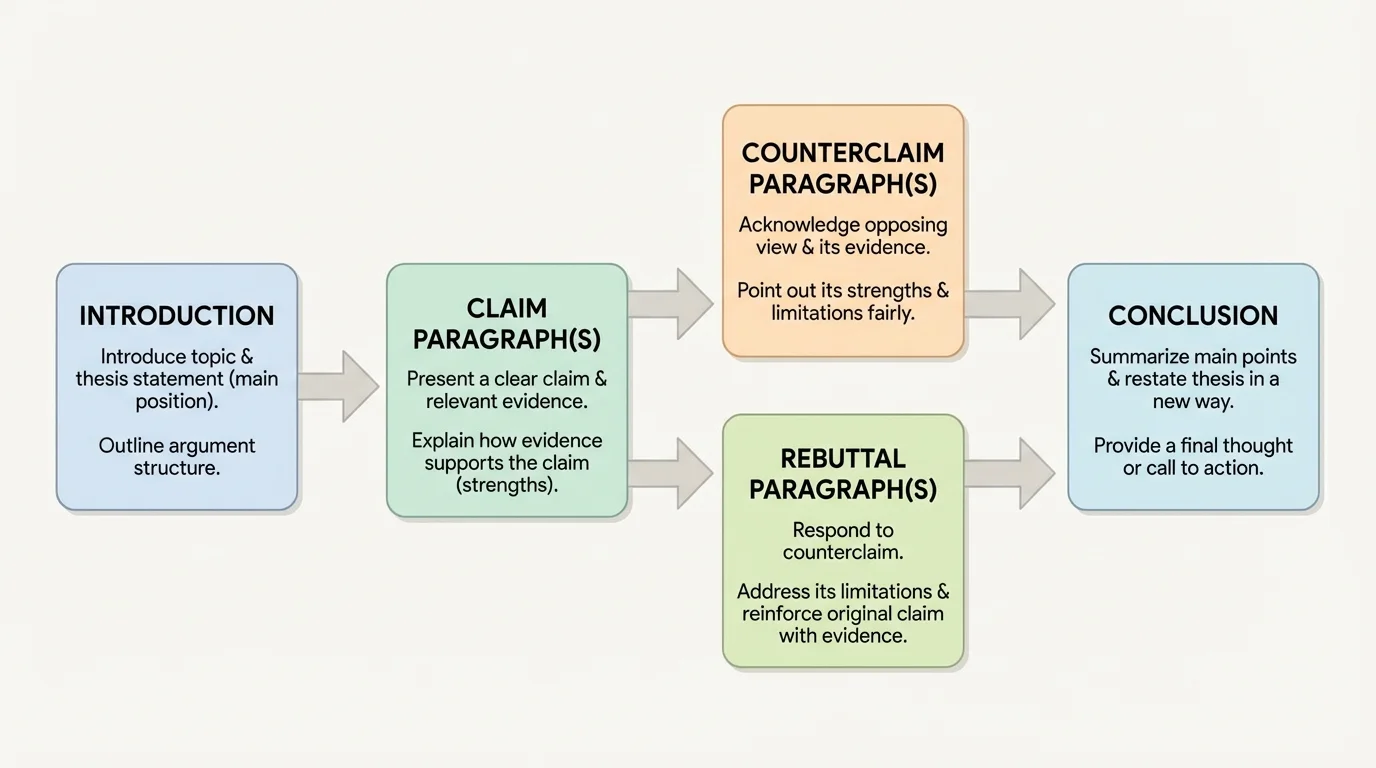
Organization should reflect logic, not just formula. If the counterclaim is especially important to your audience, you may address it earlier. If your strongest evidence responds directly to a common objection, place those ideas close together. The best structure is the one that helps your reader understand how the parts of the argument connect.
Consider this claim: school cafeterias should offer more plant-based meal options. A thoughtful writer might support this with evidence about health, environmental impact, and student choice. A fair counterclaim would note concerns about cost, student preferences, and nutritional planning. The writer should then compare the strength of the evidence. If schools with expanded options maintain participation and control costs, that evidence may outweigh generalized assumptions that students will reject the meals.
Now consider a second issue: should governments regulate social media platforms more strictly to reduce misinformation? This topic requires especially careful audience awareness. Some readers value free expression most. Others value safety and public accuracy. A fair argument would present both concerns clearly. It might note that regulation can reduce harmful false claims, but it can also create legitimate concerns about censorship and who decides what counts as misinformation. The strongest writing would not hide that tension. It would address it directly and explain why one approach remains more convincing.
Mini-model paragraph
Claim: High schools should require a media literacy course.
Step 1: State the claim precisely.
Students need explicit instruction in evaluating digital sources because misinformation spreads quickly online.
Step 2: Add relevant evidence.
Studies of online reading habits and classroom research can show that many students struggle to distinguish reliable reporting from manipulated content.
Step 3: Present the counterclaim fairly.
Opponents may argue that graduation requirements are already crowded and that these skills should be taught in existing English or history courses.
Step 4: Rebut with analysis.
That concern is practical, but because online evaluation requires focused practice across platforms, a dedicated course or clearly defined requirement may provide more consistent instruction than scattered lessons.
Notice that the paragraph does not simply attack the opposing side. It recognizes a practical problem, answers it, and explains why the main claim still stands.
As we saw earlier in [Figure 1], argument becomes strongest when claim, evidence, counterclaim, and rebuttal are linked rather than treated as separate pieces. And the comparison of evidence types in [Figure 2] matters here too, because a serious debate about policy depends on stronger support than anecdotes alone.
One common mistake is cherry-picking, which means selecting only the evidence that helps your side while ignoring relevant evidence that complicates the issue. This can make an argument appear dishonest or incomplete.
Another mistake is emotional exaggeration. Strong arguments can appeal to values and concern, but they should not depend on panic, insult, or loaded language. Saying a policy is "a total disaster" without careful support is not analysis.
A third mistake is weak rebuttal. Some writers mention a counterclaim only to dismiss it in one sentence. If the opposing point is meaningful, it deserves more than a quick wave away. Effective rebuttals use reasoning and evidence, not attitude.
Finally, avoid assuming the audience already agrees with you. Even if your readers share your values, they still need clear logic and evidence.
Your tone should be confident but not arrogant, serious but not stiff. Academic argument works best when the language is precise. Instead of writing, "This proves my side is right," try, "This evidence suggests that the policy would likely improve attendance while creating manageable logistical challenges." Precision sounds more thoughtful because it is more thoughtful.
Writers can also strengthen style through careful verbs. Compare says with argues, claims, concedes, demonstrates, or suggests. These verbs help communicate how evidence functions in the argument.
Good argument writing is not just about having a position. It is about earning a reader's trust through fairness, relevance, and analysis. When you can present your claim clearly, treat counterclaims honestly, select the most relevant evidence for both, and adapt your reasoning to your audience, your writing becomes stronger in every setting where serious thinking matters.
