A single word can change how a reader understands an entire topic. In medicine, the difference between saying a virus is "dangerous" and saying it is "highly contagious" is not just stylistic; it changes the meaning. In history, calling a conflict a "fight" is far less informative than describing it as a "civil war," a "rebellion," or a "revolution." When you write about complex ideas, the words you choose are not decoration. They are tools for thinking, explaining, and guiding a reader through difficult material.
Strong informative and explanatory writing depends on precision. [Figure 1] Precision means selecting words that communicate exactly what you mean, not approximately what you mean. It also requires using the right terminology for the subject you are discussing. A chemistry explanation should not sound like a sports recap, and an analysis of economic policy should not rely on casual, blurry language. The more complex the topic, the more important accurate language becomes.
When a subject is difficult, readers depend on the writer to reduce confusion. Exact wording helps readers distinguish between similar ideas, follow a sequence of reasoning, and understand important differences in a comparison between vague and precise wording. If a writer says a government "did something about inflation," the reader learns almost nothing. If the writer says the government "raised interest rates to slow consumer spending," the explanation becomes more useful and more credible.
Precise language also builds trust. Readers are more likely to believe a writer who names causes accurately, describes evidence carefully, and avoids overstatement. Compare these two claims: "Social media hurts teens" and "Heavy social media use can increase anxiety in some teenagers, especially when it disrupts sleep or encourages constant comparison." The second sentence is more careful, more limited, and more informative. It does not just sound smarter; it actually communicates more knowledge.
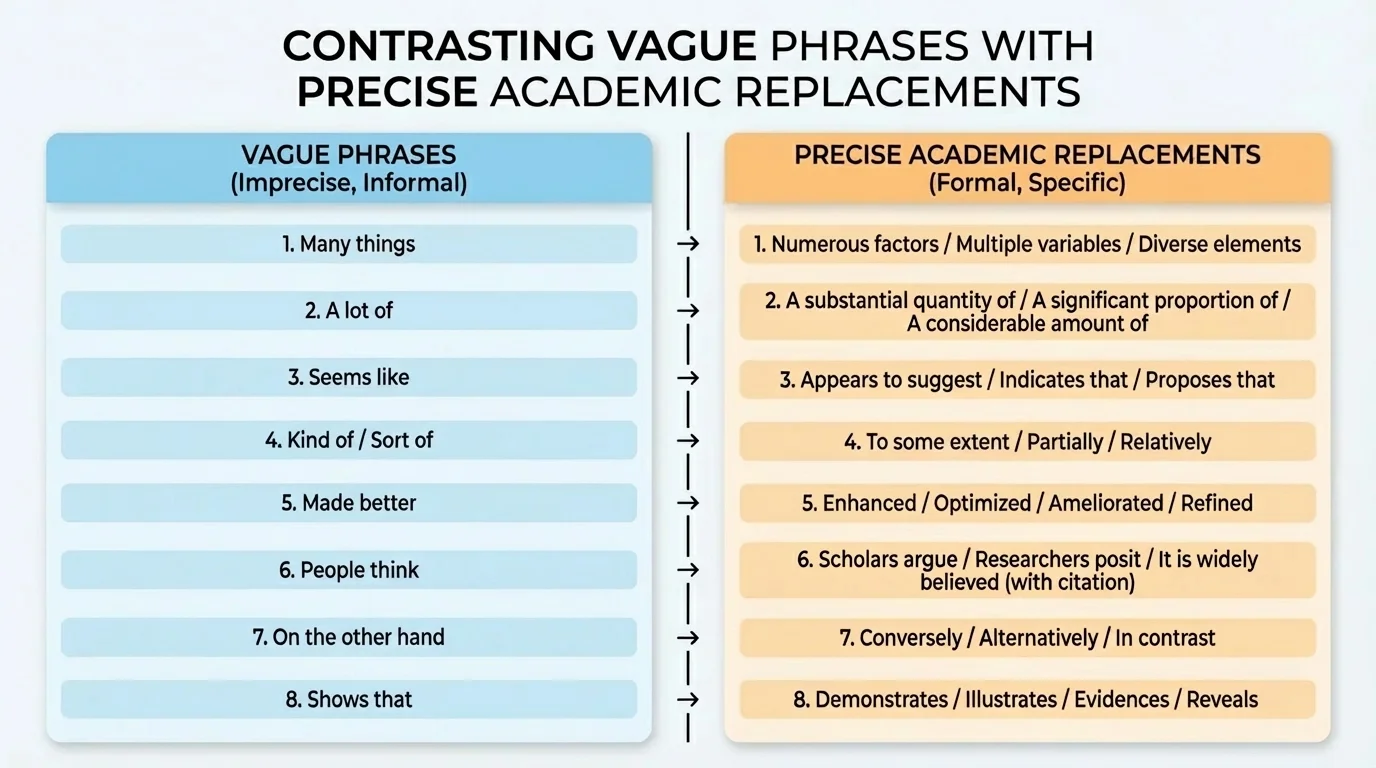
Complex subjects often involve categories, processes, and relationships. If your words are broad or imprecise, the ideas blur together. Precision helps separate one concept from another. In biology, there is a difference between a hypothesis, a theory, and a law. In literature, there is a difference between theme, motif, and symbol. In civics, there is a difference between a right, a law, a policy, and an amendment. A writer who chooses the exact term helps the reader understand the structure of the subject itself.
Precise language is wording that is accurate, specific, and appropriate to the idea being explained. Domain-specific vocabulary is language used mainly in a particular field or discipline, such as biology, economics, literature, or history.
Because complex writing often deals with ideas that are abstract, technical, or unfamiliar, precision is not optional. It is part of how a writer manages complexity. Instead of simplifying a topic into something inaccurate, a skilled writer explains the complexity with words that are exact enough to be trustworthy and clear enough to be understood.
Precise language has several qualities. First, it is specific. Specific words name the exact person, process, condition, or effect being discussed. Second, it is accurate. The language matches the facts and does not exaggerate. Third, it is concise. Precision is not the same as sounding complicated. A precise sentence often uses fewer words because it avoids empty fillers.
Consider the difference between general and precise wording:
| General wording | More precise wording |
|---|---|
| things changed | voting laws expanded |
| a lot of people moved | thousands of rural workers migrated to cities |
| the character was sad | the character showed grief, isolation, and regret |
| the reaction happened fast | the reaction occurred within seconds |
| the company did better | the company increased quarterly revenue |
Table 1. Examples showing how general wording can be revised into more precise language.
Notice that the better versions are not always longer. They are simply more exact. "Things changed" tells the reader almost nothing. "Voting laws expanded" identifies what changed. A precise word often carries information that would otherwise require an entire extra sentence.
Precision also depends on choosing strong verbs. Weak verbs such as "is," "does," "has," and "makes" are sometimes necessary, but too many of them can flatten an explanation. Stronger verbs such as "indicates," "illustrates," "contributes," "restricts," "accelerates," "undermines," or "contradicts" express a clearer relationship between ideas.
Every field develops specialized terms because general language cannot capture every important distinction. Domain-specific words help experts communicate efficiently and accurately. In science, terms such as photosynthesis, diffusion, and ecosystem each refer to a precise concept. In history, terms such as imperialism, industrialization, and suffrage carry specific meanings tied to events and systems. In literary analysis, diction, allusion, and irony allow a writer to discuss craft with more accuracy than casual language can provide.
Using domain-specific vocabulary does not mean inserting difficult words just to sound academic. It means selecting the terms that the subject truly requires. If you are writing about climate science, "weather" and "climate" are not interchangeable. If you are writing about government, "democracy" and "republic" are related but not identical. If you are writing about algebra, an expression and an equation are different ideas. Specialized vocabulary lets you explain those differences correctly.
Why specialized vocabulary develops
As knowledge in a field grows, people need language that can separate one idea from another. A field creates technical terms so that discussion can become more exact. Without those terms, writers would have to use long, awkward descriptions every time they introduced an important concept.
At the same time, specialized vocabulary must be handled responsibly. A writer should define unfamiliar terms when readers may not know them, especially on first use. Precision helps the reader; unexplained jargon blocks the reader. Good writers do both jobs at once: they use the right term, and they make that term understandable.
The best word choice depends not only on the topic but also on the audience. A writer addressing experts can assume more background knowledge than a writer addressing classmates or a general public audience. This shift in audience knowledge, as [Figure 2] illustrates, affects how much technical vocabulary you can use without losing clarity.
For example, a biology textbook might say, "Mitosis produces two genetically identical daughter cells." That sentence is appropriate for students in a biology course. But if you were explaining the idea to younger students or to someone with no science background, you might add a brief explanation: "Mitosis is the process a cell uses to divide into two matching cells." The technical term remains, but it is supported by context.
A useful rule is this: name the concept accurately, then explain it clearly. Do not replace a correct term with an inaccurate simple word. Instead, pair precision with explanation. A strong writer might write, "The policy created an economic incentive, meaning it encouraged people to change their behavior by changing costs or rewards." The key term stays in place, and the reader still understands it.
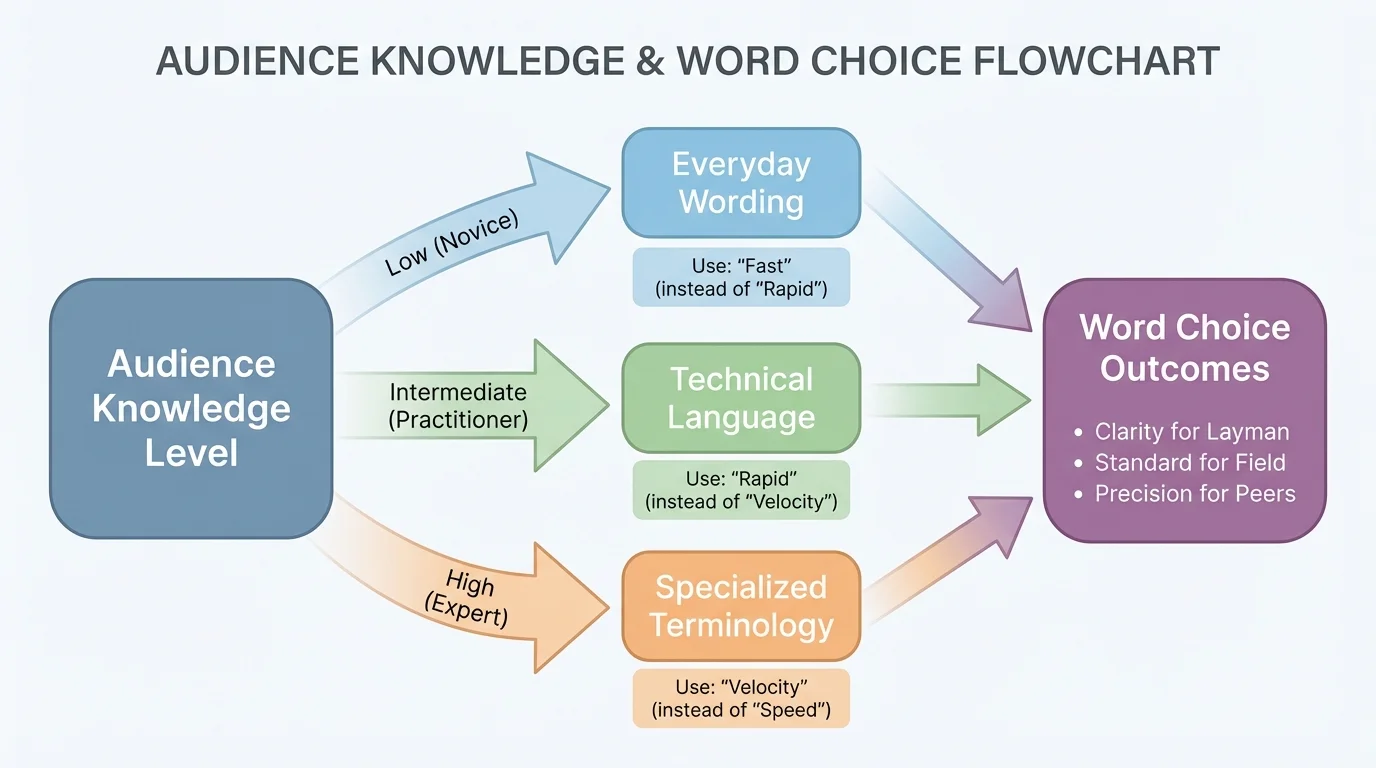
Writers should also notice when technical language becomes excessive. If every sentence is packed with specialized vocabulary, the explanation may become unreadable. Precision is not a contest to use the hardest words. It is a choice to use the right words. Sometimes the right word is highly technical; sometimes it is a clear everyday term that connects ideas smoothly for the reader.
Many academic words appear across several subjects but change slightly in meaning depending on context. For example, "model" can mean a physical representation in science, a mathematical description in statistics, or a pattern for imitation in social discussion.
This balance matters in nearly every subject. As shown earlier, good writers adjust their terminology to the reader's prior knowledge while still protecting the accuracy of the subject.
One effective strategy is to replace broad nouns with exact nouns. Instead of "stuff," "thing," "part," or "factor," identify the actual element: variable, pigment, tariff, narrator, enzyme, amendment, or algorithm. Broad nouns hide meaning; exact nouns reveal it.
A second strategy is to choose verbs that express relationships clearly. If one event caused another, say "caused," "triggered," "contributed to," or "accelerated," depending on the level of certainty. If one idea opposes another, say "contradicts," "challenges," or "complicates." If evidence supports a claim only partly, use a qualifier such as "suggests" rather than "proves." This is especially important when discussing data, scientific findings, or historical interpretation.
A third strategy is to use qualifiers carefully. Words such as "some," "many," "often," "rarely," "primarily," and "in most cases" prevent overgeneralization. Saying "all teenagers are affected the same way by screen time" is far less accurate than saying "screen time affects teenagers differently depending on content, duration, and sleep habits." Precise writing often sounds more measured because it respects complexity.
A fourth strategy is to define key terms when they might be misunderstood. A sentence such as "The story contains irony" may not help much if the reader is unsure what kind of irony you mean. A clearer explanation might be, "The story uses dramatic irony because the audience knows the truth about the letter while the main character does not."
Revision example: from vague to precise
Draft sentence: "The government changed things, and people got mad."
Step 1: Identify vague words.
The words "changed things" and "got mad" are too general to explain a complex event.
Step 2: Replace them with exact terms.
Ask what changed and how people responded. Did taxes increase? Were rights limited? Did citizens protest, revolt, or petition?
Step 3: Rewrite with historical precision.
"When the government increased bread prices and restricted public protest, workers organized demonstrations across the capital."
The revised sentence names the policy, the response, and the people involved.
These strategies make explanations more than "school-sounding." They make them intellectually honest. A precise writer does not hide behind vague wording. The writer takes responsibility for meaning.
Precision is not only about vocabulary. It also depends on sentence structure. Even accurate words can become confusing if a sentence is ambiguous. An ambiguity occurs when a sentence can be understood in more than one way. For example, "The teacher discussed the essay with the student that was confusing" makes it unclear whether the essay or the student was confusing. A more precise sentence would be "The teacher discussed the confusing essay with the student."
Pronouns can also create confusion if their references are unclear. In the sentence "When the scientists tested the chemical, they changed quickly," the word "they" is unclear. Did the scientists change quickly, or did the chemicals react quickly? Precise writing replaces unclear pronouns with specific nouns when needed.
Modifiers matter as well. Compare "Students nearly read 100 pages" with "Students read nearly 100 pages." The first sentence suggests they did not actually read them; the second means they read close to 100 pages. Small shifts in placement can create major differences in meaning.
From earlier writing study, remember that clear sentences usually have a stable subject, a purposeful verb, and a logical order of details. Precision builds on those basics. It does not replace them.
Sentence-level precision also requires consistency in tense and comparison. If you compare two novels, use parallel language. If you describe a process, keep the sequence clear. Readers should not have to decode your grammar before they can understand your ideas.
[Figure 3] Strong explanatory writing requires more than precise words in isolated sentences. The whole paragraph must guide the reader through a concept in a logical order with the structure of an effective explanatory paragraph. A precise paragraph often begins by naming the central concept clearly, then defining or narrowing it, then supporting it with evidence or examples, and finally explaining why that evidence matters.
Consistency is essential. If you start by referring to "renewable energy," do not suddenly switch to "power sources" or "resources" if those broader terms create confusion. Repeating an exact term is often better than replacing it with an imprecise synonym. In academic writing, variety is useful, but clarity matters more than avoiding repetition.
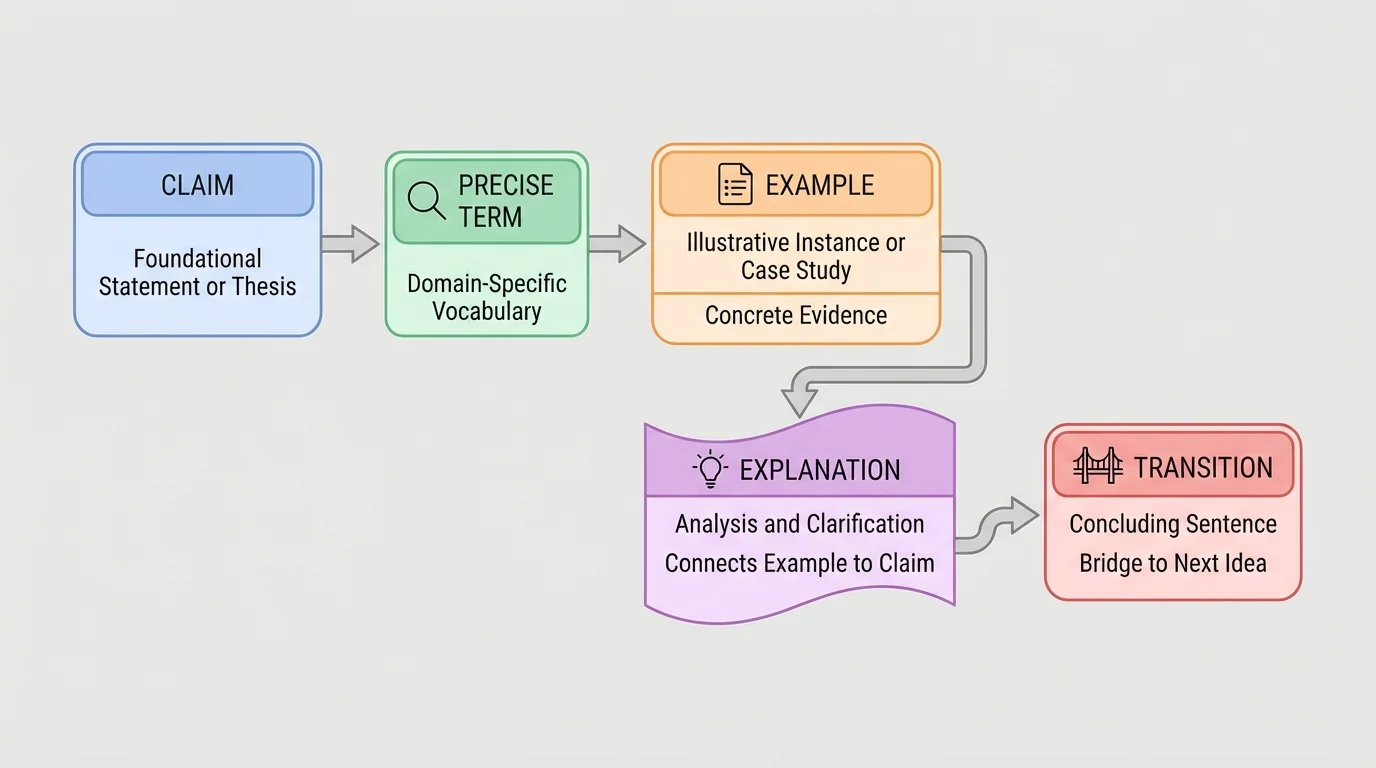
Transitions also support precision. Words and phrases such as "for example," "in contrast," "as a result," "specifically," "therefore," and "by comparison" signal the relationship between ideas. They help the reader follow cause and effect, comparison, sequence, or qualification. Without these signals, even accurate details can feel disconnected.
Writers should also decide what organizational pattern best fits the topic. A process explanation may need chronological order. A science explanation may need classification and cause-and-effect. A literary analysis may move from claim to textual evidence to interpretation. The organization itself can make complex ideas easier to understand, especially when paired with precise terminology.
Suppose you are explaining how an economy responds to inflation. A weak paragraph might jump from prices to wages to interest rates without clear connections. A precise paragraph would define inflation first, identify causes or effects, and explain each in a controlled order. In that kind of paragraph, words like "purchasing power," "monetary policy," and "consumer demand" are not decoration; they are the framework of the explanation.
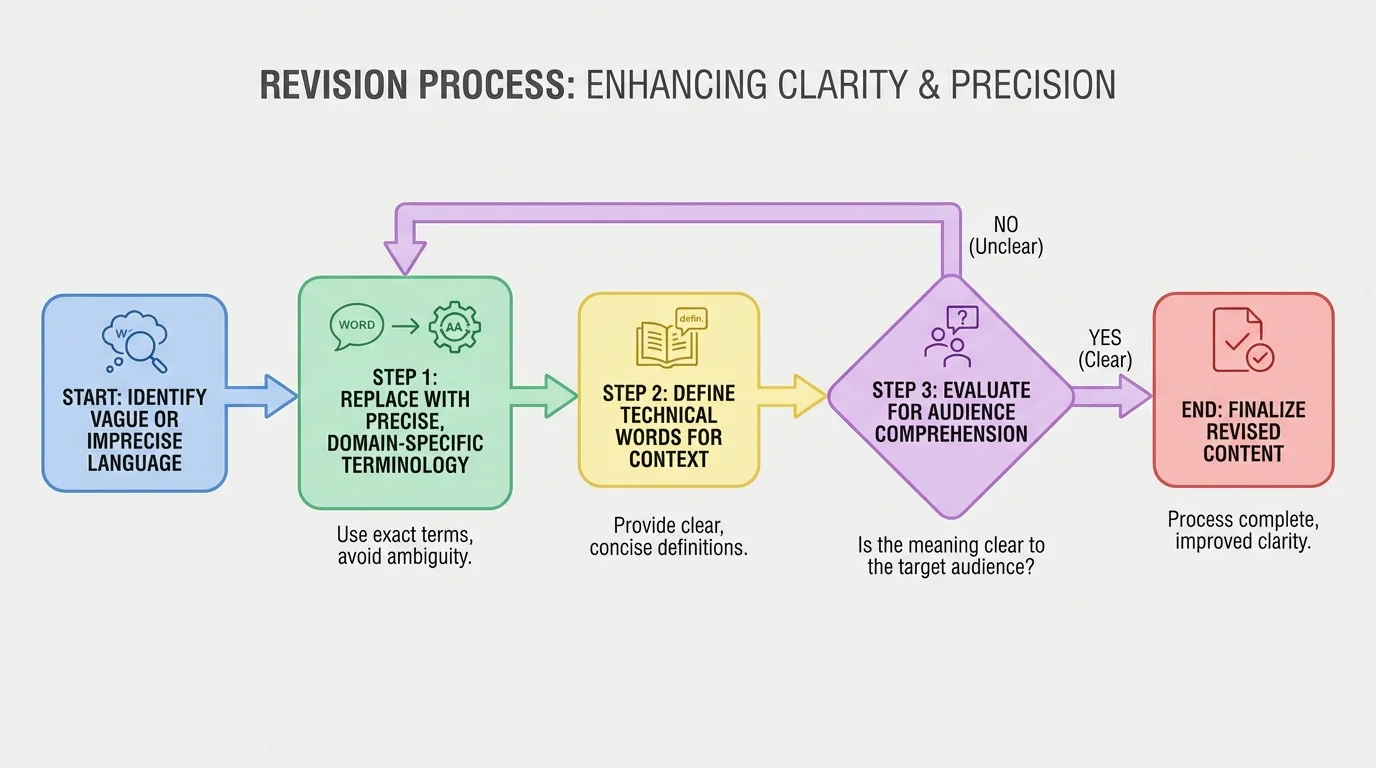
[Figure 4] Precision often emerges during revision rather than in a first draft. Early drafts help you discover what you think; revision helps you say it exactly. This process involves identifying vague wording, testing whether technical terms are necessary, and checking whether the explanation fits the audience.
One useful revision method is to underline every general word in a paragraph. Circle words like "thing," "good," "bad," "a lot," "somehow," "shows," or "changed." Then ask: What exactly do I mean here? Can I replace this word with a more accurate noun, verb, or adjective? If not, do I need to add a short explanation?
Another method is to check every claim for level of certainty. Are you stating a fact, making an interpretation, or describing a possibility? The wording should match the evidence. "Proves" is stronger than "suggests." "Caused" is stronger than "contributed to." "Always" is stronger than "often." Precision requires choosing the level of certainty that the evidence actually supports.
Revision example: matching wording to evidence
Original sentence: "The experiment proves that music improves concentration."
Step 1: Check the strength of the evidence.
If the experiment was small or limited, "proves" may be too strong.
Step 2: Add necessary qualifiers.
Maybe the result applied only to one group under certain conditions.
Step 3: Revise accurately.
"The experiment suggests that instrumental music may improve concentration for some students during short study sessions."
The revised sentence is more precise because it reflects the limits of the evidence.
Revision should also test definitions. If you use a technical term, ask whether a reader at your intended level can understand it. If not, define it briefly, add an example, or place it in a clarifying phrase. As shown in [Figure 4], revision is a sequence of decisions about exactness, clarity, and fit.
In science, precise language separates observation from inference. "The liquid turned blue" is an observation. "The reaction produced copper ions" is an inference that may need evidence. In history, precision helps distinguish event from interpretation. "The law passed in 1964" is a factual statement. "The law transformed public life" is an interpretive claim that requires support. In literature, saying "the author uses imagery" is weaker than explaining that "the author uses visual imagery of decay to reinforce the theme of moral collapse."
In mathematics, exact language is equally important. A writer should distinguish between "solve," "simplify," "estimate," and "prove." The statement "the graph goes up" is less precise than "the function increases as the value of the independent variable increases." If a relationship is proportional, linear, or exponential, the exact term matters because each describes a different pattern. For example, linear growth can be modeled by an equation such as \(y = mx + b\), while exponential growth follows a form such as \(y = ab^x\). Using the wrong term changes the concept itself.
In economics, precise words shape how readers understand public issues. "Prices rose" is not the same as "inflation increased." A single product becoming more expensive is different from a broad rise in average prices across an economy. Terms such as supply, demand, deficit, recession, and productivity each identify specific conditions or relationships.
"The difference between the almost right word and the right word is really a large matter."
— Mark Twain
Across all subjects, the pattern is the same: complex ideas require exact labels, careful relationships, and language that matches the evidence. Precision is one of the main ways a writer turns information into understanding.
One common mistake is using advanced words incorrectly. A word is not precise if it is wrong. Calling any government action "totalitarian," any disagreement "irony," or any scientific explanation a "theory" in the everyday sense can mislead readers. Always make sure the term matches its academic meaning.
A second mistake is relying on unnecessary jargon. Jargon is specialized language that can be useful within a field, but when overused or left unexplained, it can shut readers out. If a term is essential, keep it and define it. If it is not essential, consider a simpler option.
A third mistake is using inflated language instead of clear language. Students sometimes think academic writing must sound complicated, so they choose words like "utilize" when "use" would be clearer, or "facilitate the implementation of" when "help carry out" would do the job. Precision is not verbal decoration. It is exact meaning.
A fourth mistake is creating false precision. Saying "exactly 90%" without evidence is not stronger than saying "most." Precision must come from accurate knowledge, not from invented detail. Specificity without support can be misleading.
Writers become more precise partly by revising, but also by reading deeply. Academic vocabulary grows when you notice how skilled writers define terms, connect ideas, and distinguish between similar concepts. When reading a textbook, article, speech, or essay, pay attention to the words that carry the main ideas. Ask what those words allow the writer to say that general language could not say as efficiently.
It helps to keep a vocabulary record by subject. In science, for example, you might collect words related to systems, structure, and change. In history, you might gather terms for political systems, economic conditions, and social movements. In literary analysis, you might track terms for form, style, and interpretation. Over time, this builds a toolkit of accurate words for future writing.
Context matters too. Memorizing definitions is useful, but true command comes from seeing words used in real explanations. A term becomes powerful when you understand not only what it means, but how it functions inside an argument or analysis.
