A confident voice can make a weak argument sound powerful. That is why skilled listeners do more than hear words: they test ideas. In classrooms, interviews, debates, podcasts, team meetings, and public speeches, people try to persuade others every day. Some speakers are careful and fair. Others rely on emotion, selective evidence, or dramatic wording. Learning to evaluate a speech means learning how not to be easily misled.
Critical listening is an active process. Instead of asking only, "Did I understand what the speaker said?" you also ask, "Is the speaker's position clear? Are the reasons strong? Is the evidence reliable? How is the language influencing the audience?" This kind of listening matters in collaborative discussions because strong discussion depends on hearing a full range of positions, weighing responses carefully, and distinguishing thoughtful argument from shallow persuasion.
In high school and beyond, you will hear arguments about school policies, voting, environmental decisions, technology, health, and economics. A speaker may sound convincing because of confidence, status, or emotional intensity. But a persuasive performance is not automatically a sound argument. Evaluating the message means paying attention both to what is said and to how it is said.
Point of view is the speaker's perspective on an issue, shaped by experiences, values, and purpose. Stance is the speaker's clear position or side on that issue. Reasoning is the logical connection between ideas that supports a conclusion. Evidence includes facts, examples, statistics, testimony, or observations used to support claims. Rhetoric is the strategic use of language and presentation to influence an audience.
When you evaluate a speaker well, you are not just deciding whether you agree. You are examining whether the speaker deserves your agreement. That requires attention to claims, premises, evidence, assumptions, and responses to other positions.
A spoken argument usually includes several parts. First, there is a central claim: what the speaker wants the audience to believe or do. Second, there are reasons that explain why the audience should accept that claim. Third, there is evidence meant to support those reasons. Finally, there is the speaker's delivery, including pacing, emphasis, word choice, and tone, which can strengthen or distort the message.
As you listen, it helps to separate these layers. A speaker might have a strong claim but weak proof. Another might present credible evidence but use unfair rhetoric against opponents. Another may respond thoughtfully to criticism, which increases trust. Evaluation is most accurate when you look at all of these elements together.
A speaker's point of view is more than an opinion. It reflects where the speaker is coming from. A student arguing for later school start times may focus on sleep, stress, and academic performance. A parent might focus on transportation and after-school schedules. A coach may think about practice time. These different viewpoints shape which facts seem most important.
A speaker's stance is the specific position taken. For example, "The school should begin classes at 8:45 instead of 7:30" is a stance. When evaluating stance, ask whether the speaker states it clearly or hides it behind vague language. A precise stance is easier to test because listeners can examine whether the reasons actually support it.
Point of view does not automatically mean unfairness. Everyone speaks from some perspective. The real question is whether the speaker acknowledges complexity or presents a narrow view as if it were the only reasonable one. A thoughtful speaker often recognizes limits, competing priorities, or possible objections. A biased speaker may ignore inconvenient facts or misrepresent other positions.
Research on persuasion shows that audiences often remember a speaker's confidence and emotional impact more easily than the actual quality of the evidence. That is one reason critical listening requires deliberate attention.
Purpose also matters. Is the speaker trying to inform, persuade, defend, inspire, or provoke? A speaker asking for policy change may highlight urgency. A speaker trying to calm conflict may use measured language. Understanding purpose helps you evaluate why certain ideas are emphasized and why others are pushed into the background.
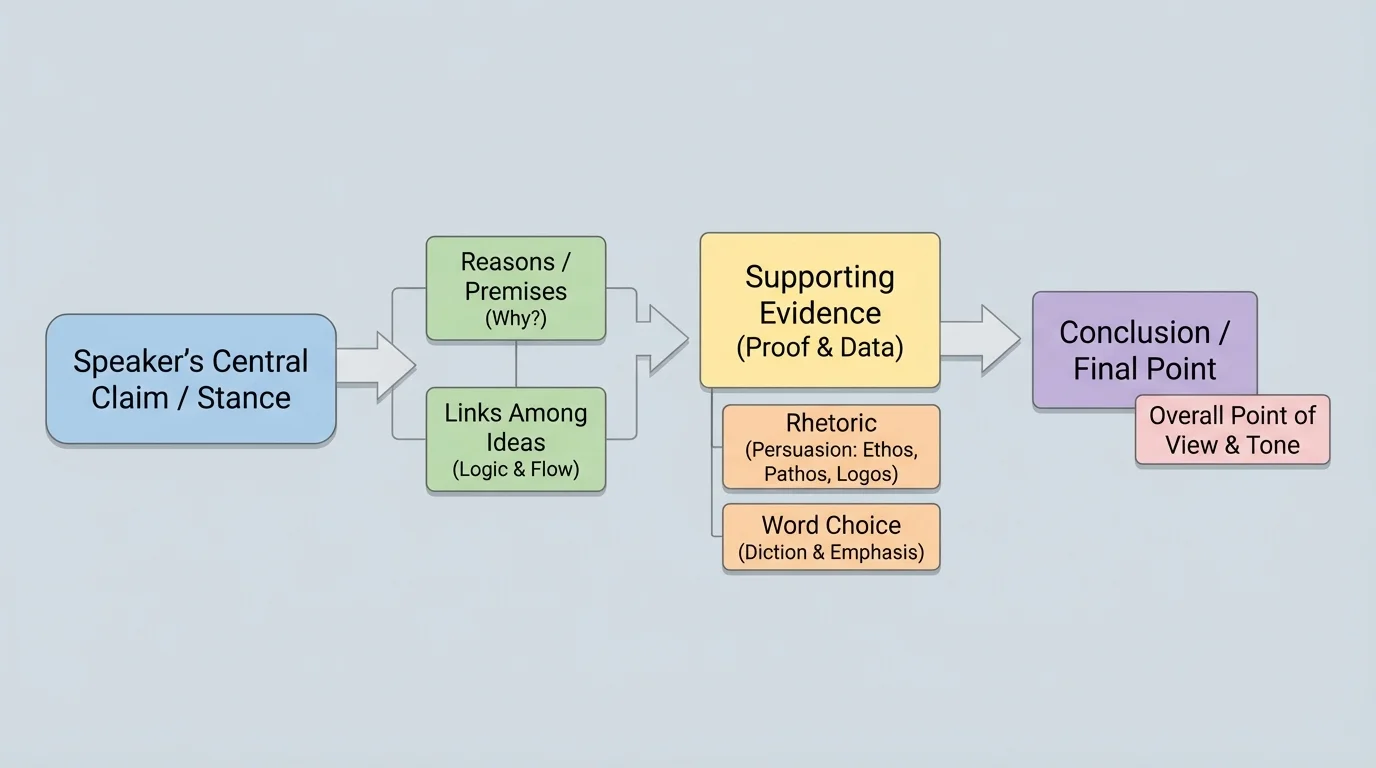
Strong arguments are built from connected ideas, as [Figure 1] illustrates through the movement from claim to reasons and supporting proof. The basic building blocks are often premises, which are statements the speaker uses as support. If the premises are believable and relevant, and if they connect logically to the conclusion, the reasoning is stronger.
Consider this spoken claim: "Our school should expand mental health support because students under chronic stress struggle to focus, attendance drops when stress becomes overwhelming, and counseling access can reduce those barriers." The conclusion is that support should expand. The premises are that stress affects focus and attendance, and that counseling helps address the problem. To evaluate the reasoning, ask whether these premises are true, complete, and linked logically to the recommendation.
Many speakers also rely on hidden assumptions. An assumption is an unstated idea the argument depends on. In the example above, one assumption may be that the school has some responsibility for reducing barriers to learning. Another may be that added support is practical and worth the cost. Good listeners notice these unstated links, because weak arguments often depend on assumptions that have not been defended.
You should also trace the logical links among ideas. Ask: Does each point actually support the next one? Does the speaker move fairly from evidence to conclusion, or jump too quickly? For example, if one student says, "A few classmates dislike the cafeteria food, so the entire lunch program is failing," the reasoning is weak. A small example does not justify such a broad conclusion.
Reasoning becomes stronger when the speaker explains cause and effect carefully, distinguishes correlation from causation, and avoids overgeneralization. If test scores rise after a new program begins, that does not automatically prove the program caused the increase. Other factors may also have contributed. Strong speakers recognize that complexity; weak speakers ignore it.
Not all support counts as equally strong evidence, as [Figure 2] makes clear by comparing different kinds of proof. In spoken arguments, evidence may include statistics, expert testimony, observations, case studies, historical examples, surveys, or personal anecdotes. A listener's job is to ask not just whether evidence is present, but whether it is good.
Quality means credibility. Where did the information come from? Is the source current, qualified, and trustworthy? A claim like "Studies show teenagers need more sleep" is stronger if the speaker identifies a medical or scientific source than if the speaker vaguely says "everyone knows this."
Relevance means the evidence directly supports the point being made. A speaker discussing school lunch nutrition should not rely mostly on student complaints about cafeteria lines. That may show inconvenience, but not nutrition. Sufficiency means there is enough evidence. One example can illustrate a point, but it usually cannot prove a broad claim by itself.
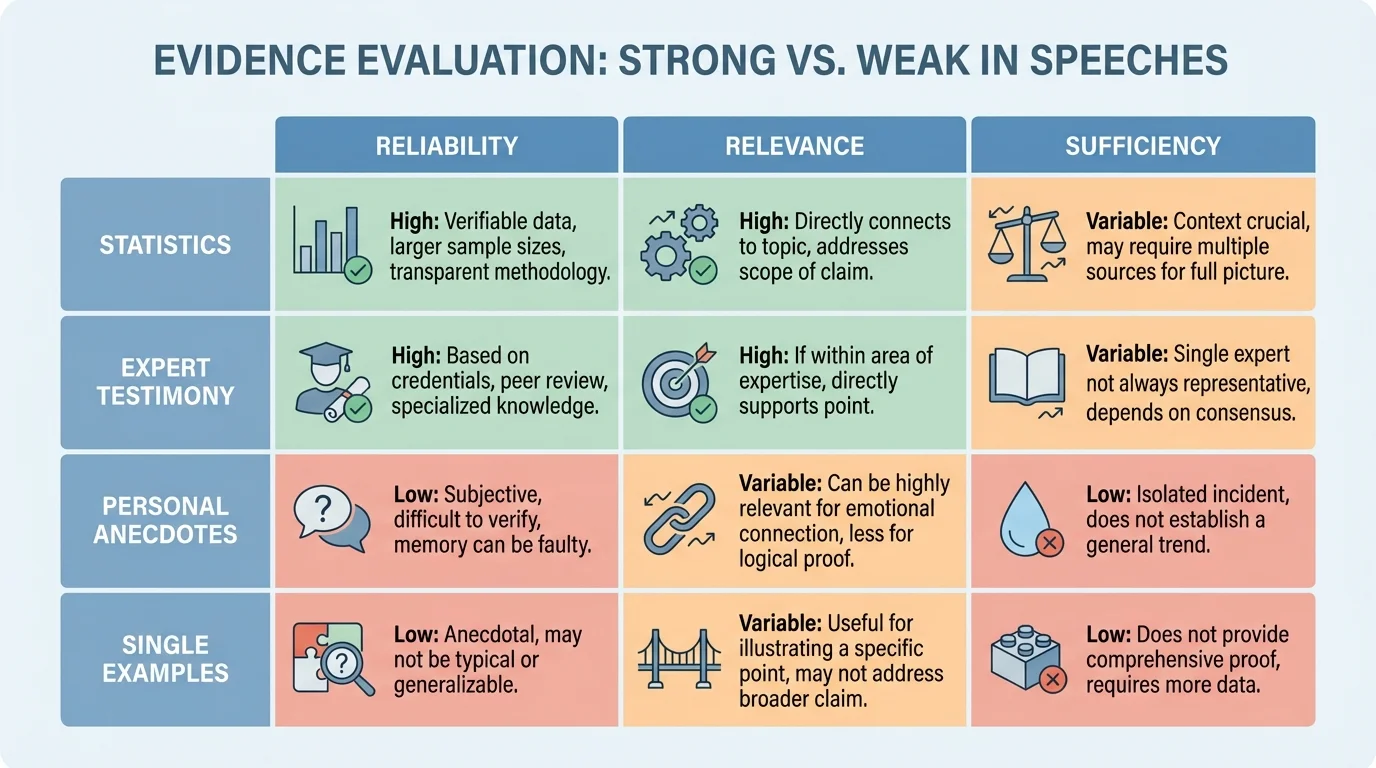
Different types of evidence serve different purposes. Statistics can reveal patterns. Expert testimony can provide specialized knowledge. Anecdotes can make an issue feel human and immediate. But anecdotes are often emotionally powerful precisely because they are memorable, and that can trick listeners into overestimating their importance. One dramatic story does not always represent the larger reality.
Suppose a speaker says, "Phones should be banned in all classes because my friend's grades improved after giving up social media." That is a real example, but it is too limited to justify a universal school policy. A stronger argument would combine individual examples with broader data, such as classroom observations, academic studies, or school discipline records. When you evaluate evidence, ask whether the speaker has chosen proof because it is representative or simply because it is dramatic.
Case study: Evaluating evidence in a school board speech
A speaker argues that the district should add more career and technical education courses.
Step 1: Identify the claim
The speaker wants the school board to expand course offerings connected to trades, technology, and applied skills.
Step 2: Examine the evidence
The speaker cites local job growth in skilled trades, graduation data, and employer partnerships. These sources are more persuasive than personal preference alone because they connect the proposal to measurable need.
Step 3: Test sufficiency
If the speaker gives only one employer's opinion, the evidence is limited. If the speaker combines labor statistics, student interest surveys, and budget details, the case is much stronger.
The quality of the argument depends not on how excited the speaker sounds, but on whether the evidence is credible, relevant, and broad enough.
Fair speakers also address evidence that might complicate their position. If they discuss cost, scheduling trade-offs, or staffing challenges honestly, their argument becomes more trustworthy. Selective evidence may persuade quickly, but balanced evidence persuades more responsibly.
Language shapes reaction even when facts stay similar, and [Figure 3] shows how two speakers can frame the same issue very differently. This is the domain of rhetoric: the strategic use of language, structure, and delivery to influence an audience. Rhetoric is not automatically deceptive. It is a normal part of public speaking. The question is whether it helps clarify the issue or manipulates the audience unfairly.
Word choice matters. Compare these two statements: "The policy needs revision" and "The policy is a disaster." The second is much more emotionally charged. Strong listeners notice loaded language, vague praise, fear-driven wording, and labels that push the audience toward judgment before the reasoning is complete.
Emphasis also matters. A speaker may repeat certain words, slow down, raise volume, or place key facts at the beginning or end to make them more memorable. These choices are powerful because audiences tend to remember what receives the strongest stress. Emphasis can help organize a speech, but it can also distract from weak support if style overshadows substance.
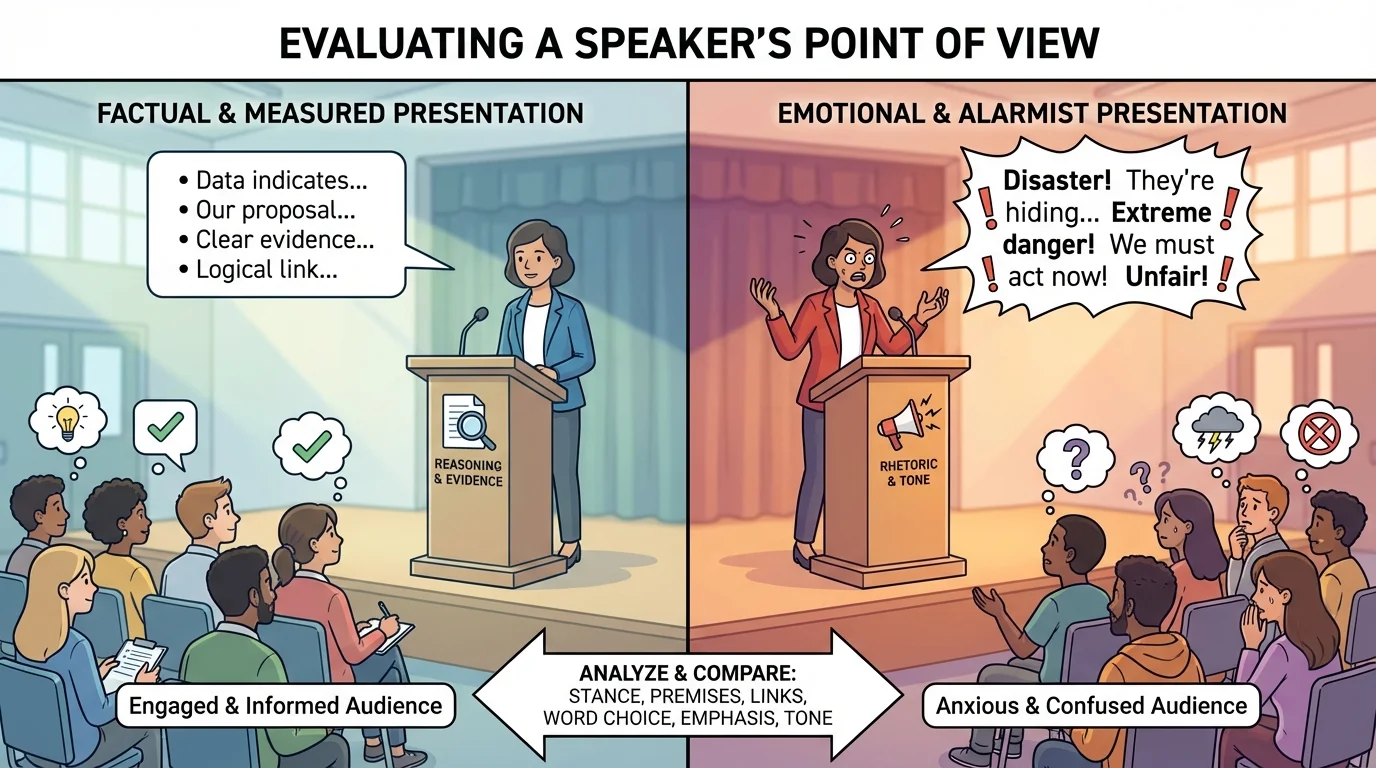
Tone is the speaker's attitude toward the subject and audience. A tone may be respectful, urgent, skeptical, sarcastic, hopeful, or accusatory. Tone influences credibility. A calm, precise tone often signals control and seriousness. An angry or mocking tone may energize some listeners but alienate others. When evaluating tone, ask whether it fits the purpose and whether it helps or harms understanding.
Classical rhetoric often refers to three major appeals: ethos, logos, and pathos. Ethos appeals to credibility and character. Logos appeals to logic and reason. Pathos appeals to emotion. Most effective speeches use all three, but the balance matters. If emotion overwhelms logic, the speech may become manipulative. If logic is present without credibility, the audience may not trust it. If credibility is emphasized without evidence, authority may replace proof.
| Rhetorical feature | What it does | Question to ask |
|---|---|---|
| Word choice | Frames the issue | Are the words neutral, precise, or emotionally loaded? |
| Emphasis | Signals importance | What is repeated or stressed most strongly? |
| Tone | Shapes audience response | Does the attitude support trust and understanding? |
| Ethos | Builds credibility | Does the speaker seem informed and fair? |
| Logos | Builds logical support | Do the reasons and evidence hold together? |
| Pathos | Creates emotional impact | Is emotion clarifying the issue or replacing analysis? |
Table 1. Major rhetorical features and the questions listeners can use to evaluate them.
As seen earlier in [Figure 3], tone and word choice can reshape the audience's reaction before the evidence is fully considered. That is why careful listeners separate emotional effect from argumentative strength.
In discussions, seminars, debates, and panels, evaluation includes more than the prepared speech. You should also judge how a speaker responds to questions, objections, and other viewpoints. A strong participant listens carefully, acknowledges opposing concerns, and answers directly. A weak participant may dodge the question, repeat talking points, interrupt, or attack the person rather than the idea.
This matters especially in collaborative settings where the goal is not simply to win but to test ideas fairly. Hearing a full range of positions requires intellectual openness. If one speaker dismisses all disagreement as ignorance or bad motives, that weakens the discussion. If another speaker restates an opponent's argument accurately before responding, that strengthens credibility and shows seriousness.
Evaluating responses, not just speeches
A speaker's answers often reveal more than the original presentation. Clear responses show whether the speaker understands the issue deeply enough to handle challenge, revise a claim, or admit limits. Strong responses are specific, respectful, and connected to evidence.
Notice whether the speaker changes standards unfairly. For example, some speakers demand exact proof from opponents but rely on vague impressions for their own side. Others ignore counterevidence completely. Responsible discussion includes not only asserting a position but also engaging honestly with competing positions.
Some arguments fail because their reasoning is flawed. These flaws are often called fallacies. A fallacy is not simply disagreement; it is an error in reasoning that makes an argument weaker than it appears.
One common fallacy is the hasty generalization, where a speaker draws a broad conclusion from too little evidence. Another is the ad hominem, where the speaker attacks a person instead of addressing the argument. A false dilemma presents only two choices when more exist. A slippery slope claims that one step will inevitably lead to extreme consequences without sufficient proof.
There is also the straw man, in which a speaker oversimplifies or distorts an opponent's position in order to attack it more easily. If a student says, "We should reconsider homework load," and another responds, "So you want students to stop working entirely," that response is unfair because it attacks an exaggerated version of the original claim.
From earlier work on argument, remember that a strong claim needs support, and support must actually connect to the claim. Persuasion without logic may feel convincing in the moment, but it does not become sound reasoning just because it is dramatic.
Recognizing fallacies does not mean dismissing a whole speech instantly. Instead, it helps you pinpoint exactly where the reasoning weakens. That allows for more accurate evaluation and better discussion.
One useful approach is to move through a set of questions while listening. First, identify the claim and the stance. Second, determine the main premises and the links among ideas, much like the structure shown in [Figure 1]. Third, examine the evidence for credibility, relevance, and sufficiency, using the distinctions introduced in [Figure 2]. Fourth, analyze rhetoric: word choice, tone, emphasis, and emotional appeals. Finally, evaluate how the speaker responds to other positions.
You can also ask whether the speaker is fair. Does the speaker acknowledge complexity? Does the speaker use precise language? Does the speaker answer likely objections honestly? Fairness does not require neutrality on every issue, but it does require intellectual responsibility.
Listening framework in action
A student leader says, "Our school should create a flexible study hall because students are overwhelmed, clubs and jobs make schedules difficult, and a dedicated academic period would improve both grades and well-being."
Step 1: Clarify the stance
The stance is specific: create a flexible study hall.
Step 2: Identify premises
The speaker assumes that workload and scheduling pressures reduce student success, and that a study hall would address those pressures.
Step 3: Evaluate evidence
If the speaker uses survey data, grade trends, and examples from similar schools, the support is stronger than if the argument rests only on personal frustration.
Step 4: Evaluate rhetoric
If the speaker uses respectful urgency, the tone may strengthen the message. If the speaker uses exaggerated claims like "students are being crushed every second," emotional language may weaken credibility.
This method helps listeners move from reaction to analysis.
Good evaluation is not cynical. It does not assume every speaker is deceptive. Instead, it treats public speech seriously by asking whether the argument is clear, fair, supported, and logically sound.
Consider a public meeting where one speaker argues for stricter cellphone rules in class. The speaker says phones distract students, cites teacher observations, and notes that schools with consistent rules report fewer interruptions. This argument has a clear stance and some relevant support. To evaluate it well, a listener would ask whether the evidence is broad enough, whether the speaker addresses educational uses of phones, and whether alternatives short of a strict ban have been considered.
Now consider a second speaker who opposes the rule by saying, "Phones help students stay safe, and banning them treats everyone like a problem." This statement raises a real concern, but it may rely more on framing than evidence. The phrase "treats everyone like a problem" is rhetorically charged. A strong listener notices both the valid issue of safety and the emotionally loaded wording.
In another setting, a speaker at a climate forum may present careful scientific evidence but speak in a highly alarmed tone. The urgency may fit the topic, but evaluation still requires attention to reasoning and proof. Emotional seriousness is not a substitute for evidence, yet emotional force does not automatically make an argument unsound either. The challenge is to judge balance.
In collaborative dialogue, the strongest speakers are often those who make their positions clear, support them responsibly, and still treat opposing views accurately and respectfully. They do not rely on volume, ridicule, or selective proof alone. They build trust by showing that their conclusions deserve consideration.
"The test of a first-rate intelligence is the ability to hold two opposed ideas in mind at the same time and still retain the ability to function."
— F. Scott Fitzgerald
That idea matters in discussion because serious evaluation often requires you to understand an opposing position fully before deciding whether it is weak, partial, or persuasive. Listening critically is not passive. It is one of the most powerful forms of thinking.
