Some of the biggest failures in teams do not happen because people are untalented. They happen because people talk past one another, rush decisions, avoid disagreement, or leave work so vague that no one knows what to do. The same is true in classrooms, student organizations, workplaces, and even governments. A strong group is not just a collection of smart individuals. It is a community that knows how to discuss ideas honestly, make decisions fairly, and turn plans into action.
When students work with peers, they are doing more than finishing an assignment. They are practicing a form of citizenship. In a democracy, people must listen to different viewpoints, speak clearly, weigh evidence, disagree without attacking, and help a group move forward. These same habits matter when a class team prepares a presentation, designs a science investigation, debates a policy issue, or creates a service project.
Collaboration is the process of working with others toward a shared result. Good collaboration improves thinking because one person may notice evidence another missed, ask a sharper question, or challenge a weak assumption. A group that works well can produce ideas that are more thoughtful, more creative, and more accurate than ideas developed alone.
But collaboration is not automatically effective. A group can become disorganized, unfair, or superficial. One student may dominate. Another may stay silent. Someone may assume the group agrees when people are actually confused. Deadlines may arrive before the team has even decided on a clear plan. That is why groups need clear norms, clear goals, and clear responsibilities.
Research on group problem-solving shows that teams often perform better when members feel safe enough to speak honestly, ask questions, and admit uncertainty. Respectful discussion is not just polite; it improves the quality of thinking.
For students in grades 9 through 12, collaborative discussion also becomes more demanding. You are expected not only to share opinions, but to build on others' ideas, evaluate responses, use evidence, and participate effectively with diverse partners. That means you must be able to contribute your own thinking while also helping the group hear the full range of positions on an issue.
A civil discussion is a discussion in which people treat one another with respect, even when they disagree strongly. Civil does not mean weak, vague, or fake. It means that the discussion focuses on ideas, evidence, and reasoning rather than insults, interruptions, or personal attacks.
A democratic discussion is one in which participants have a meaningful chance to contribute and be heard. It does not require that every person speak the same amount in every moment, but it does require that no one is unfairly excluded and that the group makes room for multiple perspectives.
Civil discussion centers on respect, self-control, and attention to ideas rather than personal conflict.
Democratic discussion gives participants a fair opportunity to speak, listen, question, and influence the group's thinking.
Collaborative guidelines are agreed-upon norms and procedures that help a group work productively and fairly.
These ideas matter especially when the topic is controversial. If a group is discussing school dress codes, climate policy, social media regulation, or a historical event with multiple interpretations, students may bring different experiences and values to the table. A democratic group does not silence disagreement. It makes disagreement discussable.
That requires a full hearing of positions. Hearing a position does not mean instantly agreeing with it. It means understanding it accurately enough to respond fairly. A mature discussion often includes sentences such as, "If I understand your point, you are saying..." or "Your argument depends on the idea that..." Those moves reduce confusion and make discussion more honest.
Effective collaboration has visible habits. Productive groups do not merely wait for a turn to speak. They listen to understand, ask clarifying questions, and connect their comments to what has already been said.
As [Figure 1] suggests, the first major norm is active listening. Active listening means giving full attention, noticing key points, and responding in a way that shows you understood. It includes eye contact when appropriate, note-taking, paraphrasing, and asking follow-up questions. If a classmate says, "I think the policy sounds fair in theory, but not in practice," an active listener might reply, "Can you explain what part seems unfair when real students are affected?"
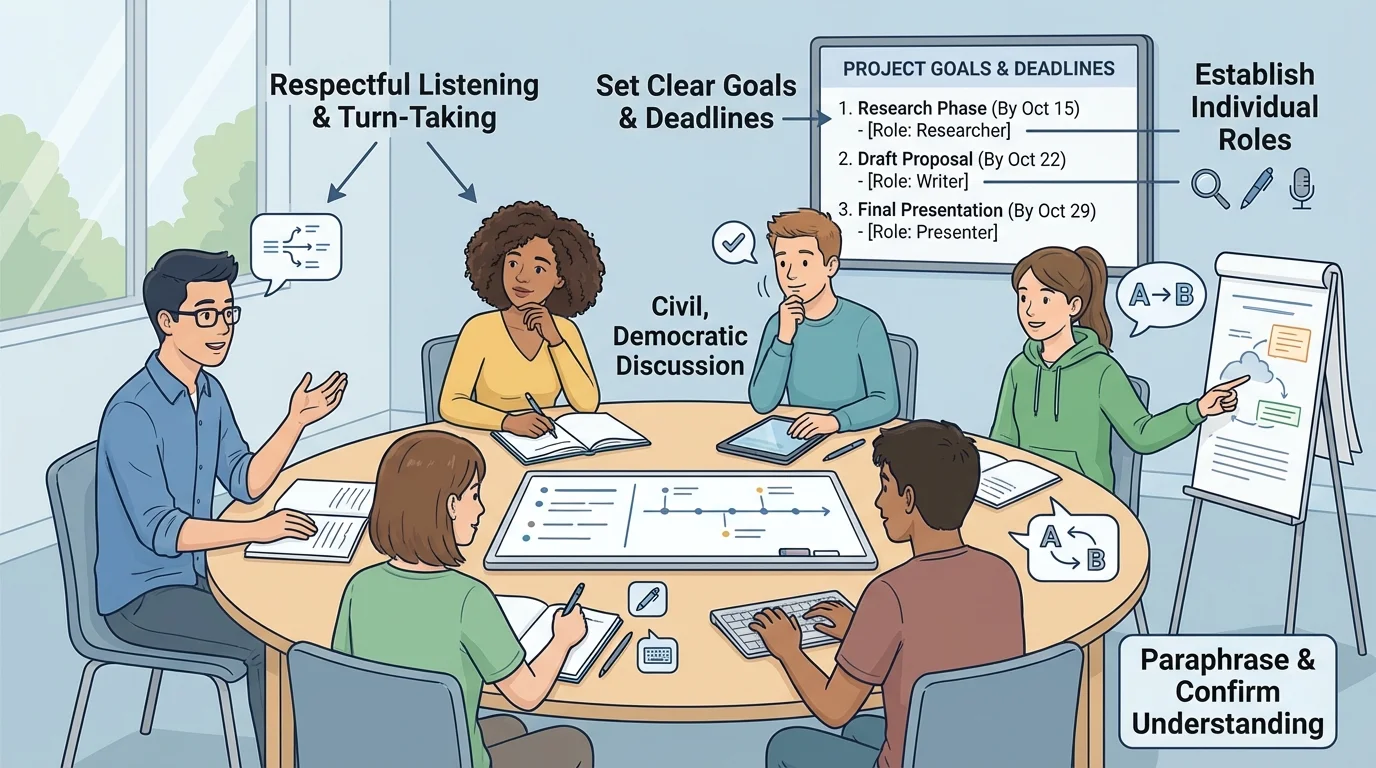
A second norm is speaking with evidence. Strong collaborative talk is not based only on "I just feel like it." Feelings matter, but academic and civic discussion also requires reasons, examples, and support from texts, data, observations, or experience. If a student argues that school should start later, that claim becomes stronger when supported by research on teen sleep, transportation concerns, or learning outcomes.
A third norm is respectful disagreement. Mature groups understand that disagreement can sharpen ideas. Instead of saying, "That makes no sense," a student might say, "I see the goal of your argument, but I think the evidence points in another direction." This keeps the focus on reasoning rather than status or emotion.
A fourth norm is balanced participation. Some students think talking more means contributing more. That is not always true. A good contributor may ask a timely question, summarize the discussion at a key moment, or invite a quieter person into the conversation. As we see in [Figure 1], discussion quality improves when students share the space instead of treating the conversation like a contest.
A fifth norm is accountability to the group's purpose. If the task is to evaluate possible solutions, the discussion should not drift into unrelated stories. If the task is to prepare a presentation, the group must move from brainstorming to organizing and rehearsing. Staying focused is a form of respect for everyone's time.
Hearing the full range of positions means more than letting different opinions exist in the room. It means making sure they are expressed clearly, understood accurately, and weighed fairly. A group may need to pause and ask, "Whose view have we not heard yet?" or "Are we dismissing an idea before we fully understand it?"
One practical way to protect the full range of positions is to use discussion moves intentionally. These include inviting participation, paraphrasing before disagreeing, asking for evidence, and distinguishing fact from interpretation. Such moves help prevent a group from becoming an echo chamber.
Groups often fail not because they lack ability, but because they start with a vague goal such as "finish the project" or "work on the presentation." Effective teams break a large task into visible parts. A clear goal tells the group exactly what success looks like.
As [Figure 2] illustrates, a strong goal is specific and shared. Instead of saying, "Let's make it good," a group might say, "By Thursday, we will complete a five-minute presentation with three evidence-based claims, one visual aid, and a conclusion connecting our topic to current events." That goal gives the team a target that everyone can understand.
Deadlines work best when they include intermediate checkpoints. If the final presentation is due in one week, the group should not wait until the night before to combine slides or divide speaking parts. Backward planning helps: start with the due date, then map earlier deadlines for research, outline approval, draft completion, and rehearsal.
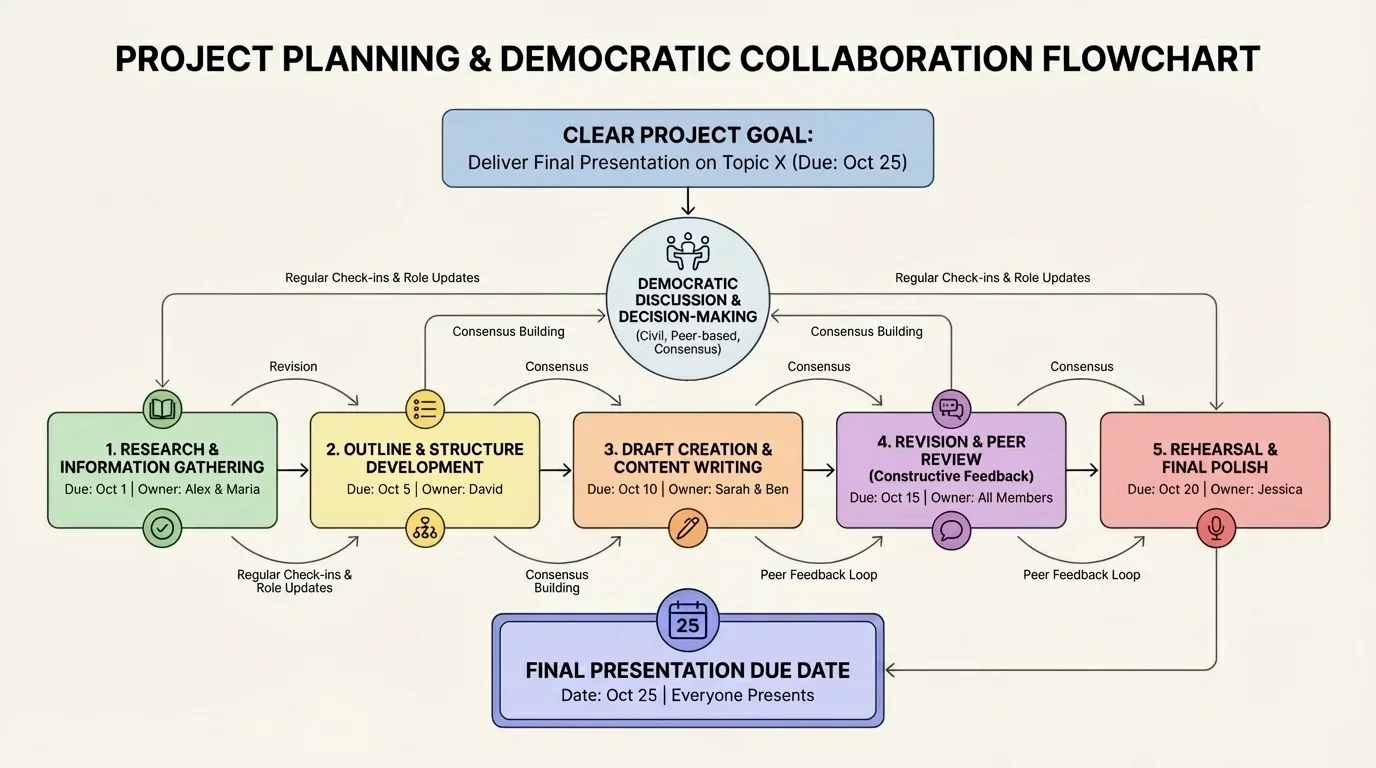
Checkpoints reduce stress and reveal problems early. If research is due by Tuesday and only one source has been found, the group can respond before the whole project falls behind. Without checkpoints, small delays turn into major crises.
Clear deadlines also protect fairness. When expectations are written or stated precisely, it is easier to know whether everyone is contributing. Vague plans often allow misunderstandings such as "I thought someone else was doing that part." Clear planning reduces those excuses.
Case study: turning a broad assignment into an action plan
A group must create a panel discussion on whether schools should limit student phone use during class.
Step 1: Define the final goal
The group agrees to produce a panel with four speakers, each presenting one claim supported by at least two credible sources.
Step 2: Break the task into parts
The team lists tasks: research, claim selection, script drafting, slide design, and rehearsal.
Step 3: Set deadlines
Research by Monday, claim approval by Tuesday, draft scripts by Wednesday, slides by Thursday, rehearsal by Friday.
Step 4: Check progress
At each checkpoint, the group confirms completion and revises the plan if someone needs help.
The assignment becomes manageable because the group replaces a vague intention with a sequence of clear commitments.
Good groups also leave space for revision. A deadline is not only an endpoint; it is a chance to evaluate whether the work meets the goal. A group might discover that its evidence is weak or that its main claim is too broad. Revising before the final due date is a sign of strong planning, not failure.
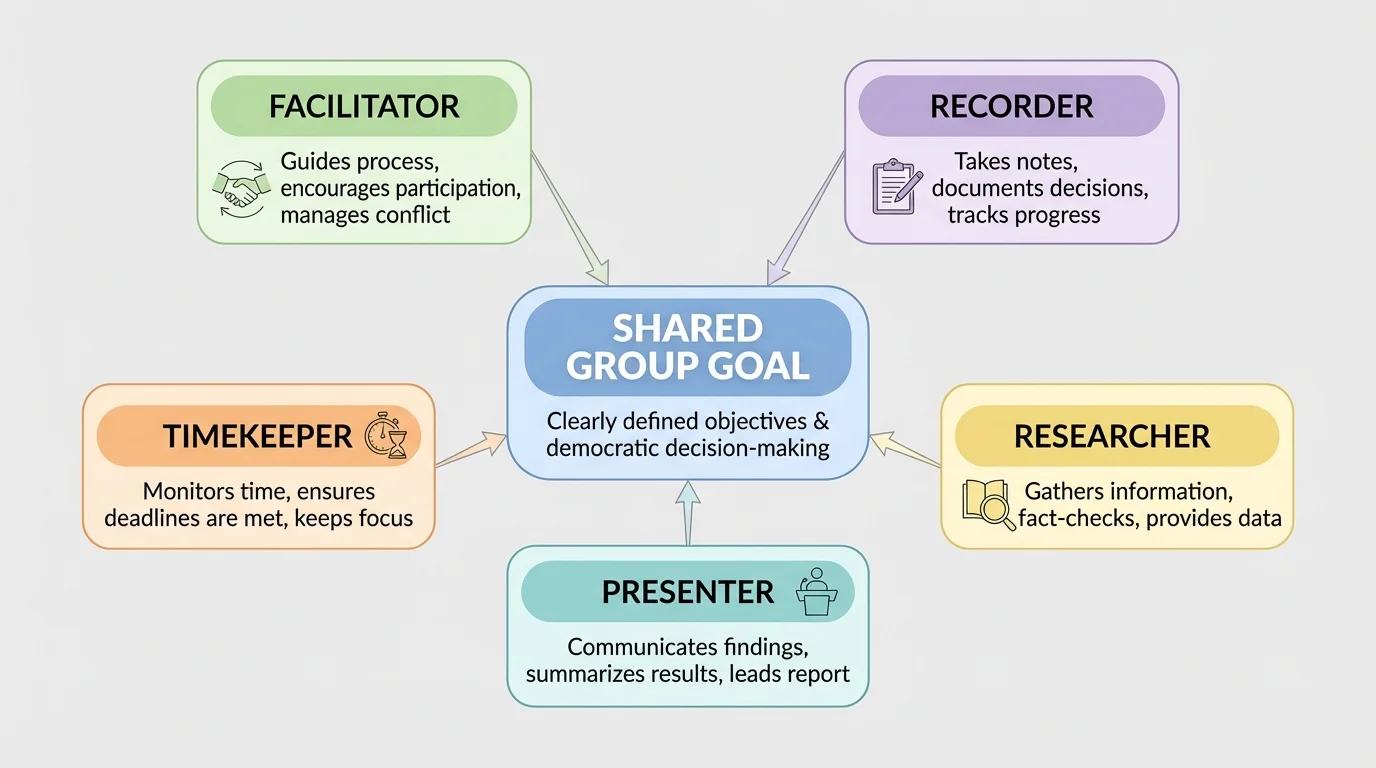
When several people work together, role clarity matters. A facilitator helps guide the conversation, keep the group on task, and make sure multiple voices are heard. A recorder keeps notes and tracks decisions. A timekeeper monitors deadlines. A researcher gathers sources. A presenter helps shape how the group communicates its final work.
As [Figure 3] shows, roles are useful because they reduce confusion. If no one is responsible for tracking sources, evidence may be incomplete. If no one watches the time, discussion may stay stuck in one stage. If no one facilitates, one or two personalities may control the conversation.
Still, roles should not become rigid labels. In effective groups, roles are assigned based on need, skill, and fairness. A student who is usually quiet might still serve as facilitator and grow in confidence. A strong speaker should not automatically become the only presenter every time. Rotating roles can help all members develop a wider range of skills.
Groups also need to distinguish between equal worth and identical tasks. Fairness does not always mean everyone does the exact same kind of work. One student may analyze sources while another designs visuals. What matters is that the workload is balanced, the roles are understood, and the contributions are necessary to the shared result.
To avoid resentment, groups should state responsibilities clearly. For example: "Jordan finds two scholarly sources and writes the evidence summary; Maya builds the visual aid; Luis drafts the introduction; Amina facilitates meetings and assembles the final script." Specific responsibility is more useful than a general promise to "help with research."
Shared work succeeds when responsibility is both individual and collective. Each person must complete assigned tasks, but the group as a whole remains responsible for the quality of the final product.
Later, if a task falls behind, the group can respond more effectively because everyone knows who owns which part. This creates accountability without confusion.
Not every group decision should be made in the same way. Effective teams choose methods that fit the situation. The goal is not only to make a decision quickly, but to make it fairly and with enough support that the group can move forward.
As [Figure 4] illustrates, one method is consensus, which means the group reaches a decision that all members can support or at least accept. Consensus is valuable when commitment matters deeply, such as choosing a central claim for a major presentation. It takes time, but it can produce stronger unity.
A second method is majority vote. This can be useful for smaller choices, such as selecting one of several acceptable design options. Voting is efficient, but it has limits. If the group votes too quickly on major issues, minority perspectives may be ignored before they are fully considered.
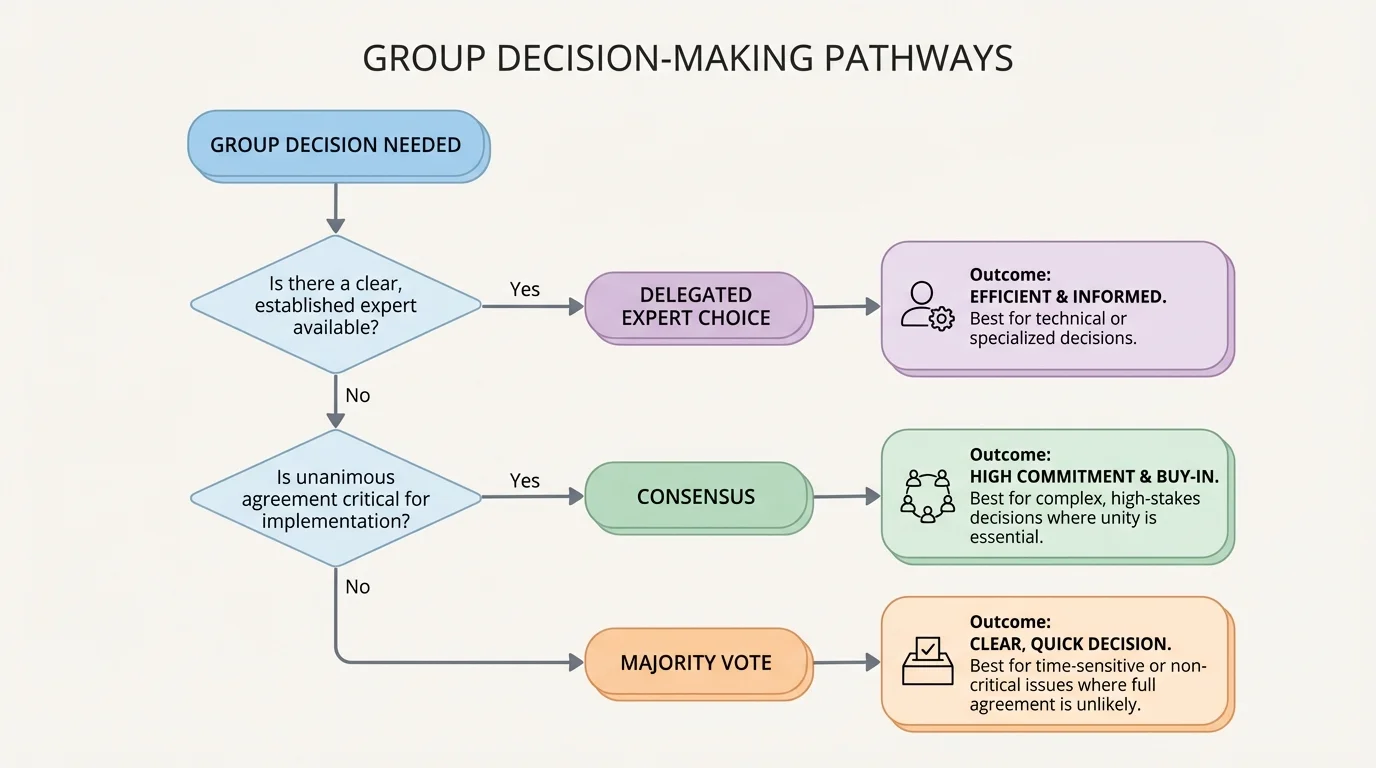
A third method is delegated decision-making. Sometimes the group decides that one member or a small pair will make a choice in an area where they have expertise or responsibility. For example, the student designing the infographic may choose color layout after hearing the group's preferences. Delegation can save time, but it should remain transparent and agreed upon.
Fair decision-making also depends on how the discussion happens before the choice is made. If the group has not heard all serious positions, then even a democratic method can produce a weak outcome. The process matters as much as the result.
| Decision Method | Best Use | Strength | Possible Risk |
|---|---|---|---|
| Consensus | Major ideas, shared claims, sensitive issues | Builds commitment and careful thinking | Can take time |
| Majority vote | Smaller choices among acceptable options | Efficient and clear | May overlook minority concerns |
| Delegated choice | Specialized or technical decisions | Saves time and uses expertise | Can feel unfair if not agreed upon |
Table 1. Comparison of three common decision-making methods used in collaborative work.
Later in a project, the same group may use different methods for different decisions. Effective collaboration is flexible: the team matches the method to the stakes, the timeline, and the need for broad support.
Conflict in a group is not always a sign of failure. Sometimes it means people care about the work and are willing to test ideas seriously. The key question is whether the conflict becomes productive or destructive.
Productive conflict focuses on the issue. Destructive conflict becomes personal, sarcastic, dismissive, or hostile. If a student says, "You never listen," the conversation may spiral. If the student says, "I do not think my point was addressed yet; can I restate it?" the problem becomes easier to solve.
Groups should also know how to respond to unequal participation. If one person dominates, the facilitator can say, "Let's pause and hear from others before returning to that point." If someone stays silent, the group can invite them in respectfully: "We have not heard your view yet. What do you think?" Invitation is better than pressure.
Constructive accountability means addressing problems directly without shaming people. It includes naming the issue, restating the shared goal, clarifying expectations, and creating a plan for improvement. Accountability should protect both the work and the relationships in the group.
Missed deadlines should be addressed early. A team might say, "The source summary was due today, and we need it to finish the outline. What happened, and what support do you need to complete it by tonight?" That response is firm, specific, and forward-looking.
Sometimes disagreement comes from differences in interpretation rather than effort. A student may think "three sources" means any websites, while another assumes it means credible academic or journalistic sources. Clear communication prevents many conflicts that seem personal but are actually procedural.
If a conflict cannot be solved within the group, involving a teacher may be appropriate. That is not weakness. In complex collaboration, knowing when to seek support is part of responsible problem-solving.
The habits of strong collaboration extend far beyond one classroom assignment. Student government, debate teams, athletic leadership groups, community service projects, internships, and workplace teams all depend on discussion that is respectful, evidence-based, and organized. A person who can help a group hear multiple perspectives and move toward a fair decision is valuable in almost any setting.
These skills also matter in public life. Democracies depend on people who can evaluate claims, resist misinformation, participate with diverse others, and disagree without treating opponents as enemies. Civil discussion is not a minor social skill. It is part of how communities solve problems.
"The test of a first-rate intelligence is the ability to hold two opposed ideas in mind at the same time and still retain the ability to function."
— F. Scott Fitzgerald
That idea matters in collaboration. Sometimes responsible group members must hold two truths at once: they can respect a person and challenge that person's reasoning; they can support the group and still question a weak plan; they can compromise on one issue without giving up what matters most on another.
Strong collaborators are not passive. They are thoughtful, prepared, flexible, and accountable. They know when to speak, when to listen, when to ask for evidence, when to summarize, and when to help the group make a decision. Those are academic skills, leadership skills, and civic skills all at once.
