A story can be exciting for pages and still fail in its final paragraph. Readers remember endings because endings tell them what the journey meant. If a narrative begins with tension, conflict, curiosity, or discovery, the conclusion must do more than just stop the action. It must feel like it belongs to everything that came before it. A strong ending gives the reader the sense that the writer understood the experience deeply and chose a final moment that reveals why the story mattered.
In narrative writing, a conclusion should follow from what has happened and reflect on what has been experienced, observed, or resolved. That means the ending should grow naturally from the characters, setting, conflict, and events of the narrative. It should not feel pasted on. It should not suddenly change the story's meaning. Instead, it should help readers look back over the narrative and understand its emotional or thematic weight more clearly.
A narrative ending works like the final note in a song. The note may be quiet or loud, peaceful or unsettling, but it must sound like it belongs to the music before it. In the same way, the ending of a story does not need to be happy, but it does need to feel earned. An earned ending grows from earlier details, choices, and consequences.
For example, if a story follows a student who lies to protect a friend, the ending should connect to the consequences of that lie, the friendship, or what the student learns about loyalty and honesty. If the conclusion suddenly reveals that the entire story was just a dream, the ending usually feels cheap because it erases the importance of the events instead of building from them.
Conclusion is the part of a narrative that brings the story to a close and reveals the final effect of the events. Reflection is thoughtful insight about what an experience, observation, or event means. Resolution is the outcome of the main conflict or problem. These ideas often work together in a strong ending.
Not every conclusion ties up every detail. Real life often leaves questions unanswered, and narratives can do that too. But readers should still feel that the ending is intentional. A conclusion can leave some uncertainty while still showing what has changed, what has been understood, or what remains unresolved in a meaningful way.
A strong conclusion connects events, change, and meaning, as [Figure 1] shows. Instead of simply reporting that the story is over, it helps readers see how the experience has affected the narrator, the characters, or the reader's understanding of the situation.
First, a good ending provides closure. Closure does not always mean every problem is solved perfectly. It means the narrative reaches a point where the reader can understand the result of what happened. The conflict may end, a decision may be made, or a realization may become clear.
Second, a good ending includes some degree of reflection. This may be direct, as when a narrator understands something new, or indirect, as when a final image quietly suggests what has changed. Reflection helps the story feel meaningful without turning it into a lecture.
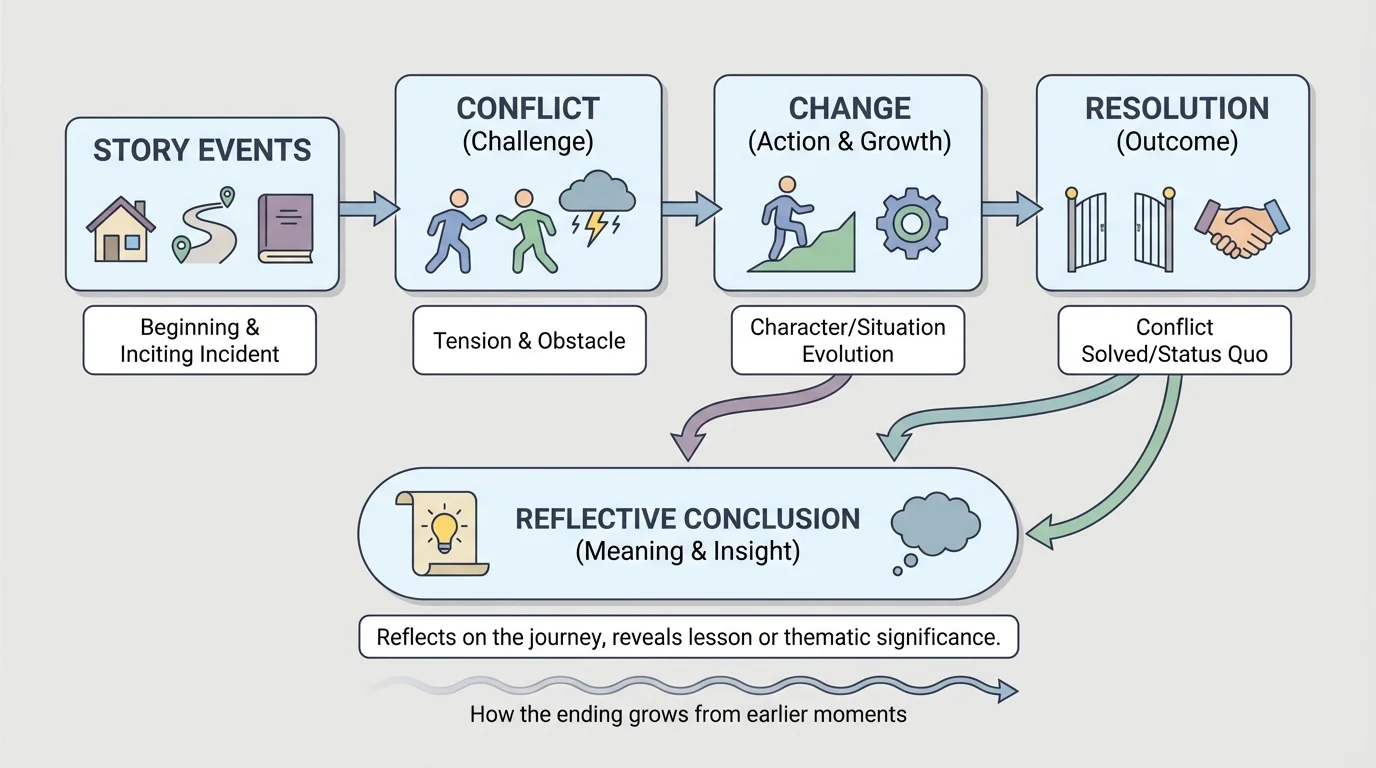
Third, a good ending matches the tone of the narrative. A humorous story may end with a sharp, funny line. A serious story may end with an image, a pause, or a difficult truth. Tone matters because an ending that feels emotionally out of place can break the story's effect.
Finally, a strong conclusion often returns the reader to a central question: What did this experience reveal? The answer may be dramatic or subtle. The important thing is that it emerges from the story itself. Events alone are not enough; the ending becomes powerful when those events lead to change or understanding.
Many narratives center on what a character or narrator goes through. In those stories, the conclusion should arise from the character arc, the pattern of emotional or personal change across the story. If a character begins fearful and ends more confident, the conclusion should reveal that change through action, thought, dialogue, or image.
Suppose a story is about a teenager training for a final race after recovering from an injury. A weak ending would say, "And then I learned never to give up." That sentence states a lesson, but it does not feel alive. A stronger ending might show the runner crossing the finish line more slowly than before, then choosing not to look at the clock right away. Instead, the runner notices the strength in their own legs and hears their coach laughing in relief. This ending follows from the experience because it focuses on what recovery has meant, not just on winning.
Events create consequences. A conclusion should acknowledge those consequences. If a character's actions harmed someone, the ending should not ignore that harm. If a long journey changed a friendship, the conclusion should show the friendship in its new state. Readers feel satisfied when endings respect the truth of what the story has made happen.
Ending from consequence, not announcement
One of the clearest signs of strong narrative writing is that the conclusion grows from consequences. Instead of announcing a theme in a general sentence, the writer lets the ending reveal what the events have changed. A broken promise may lead to silence at the dinner table. A daring choice may lead to freedom mixed with fear. These outcomes create meaning because they are specific to the story.
This is especially important in first-person narratives. If the narrator says, "I changed," readers need evidence. The conclusion should show how the narrator sees differently, chooses differently, or speaks differently. Reflection is strongest when it feels connected to lived experience rather than added after the fact.
Not all narratives focus mainly on a conflict that gets solved. Some are built around observation: a day at a hospital waiting room, a night shift at a grocery store, a neighborhood after a storm, a bus ride shared with a stranger. In these stories, the conclusion often reflects on what has been seen rather than what has been "won."
An observational narrative ending usually works by sharpening insight. The writer notices something at the end that changes the meaning of earlier details. For instance, a narrator may spend a story describing people in an airport rushing in every direction. The conclusion might focus on one child asleep across two chairs, completely still in the middle of all that movement. That final image reflects on the larger observation: even in places built for speed and departure, people carry exhaustion, trust, and vulnerability.
These endings are often quiet, but quiet does not mean weak. A reflective conclusion can be powerful because it trusts the reader. It does not need to explain every idea. It selects a final detail or moment that gathers the story's meaning.
Example: weak observational ending versus strong observational ending
A narrative describes a student volunteering at an animal shelter for the first time.
Step 1: Weak ending
"That day taught me that helping animals is important, and everyone should volunteer more."
This ending is broad and sounds more like a speech than a narrative conclusion.
Step 2: Improved ending
"When I locked the kennel for the night, the old brown dog I had been afraid to touch that morning pressed his nose into my palm once, lightly, as if we had agreed on something. On the drive home, my sweatshirt still smelled like bleach and wet fur, and for the first time all day, I did not roll the windows down."
This ending reflects on observation and experience through a specific final moment.
The improved version does not announce the lesson directly. Instead, it lets the physical details and the narrator's changed response carry the reflection.
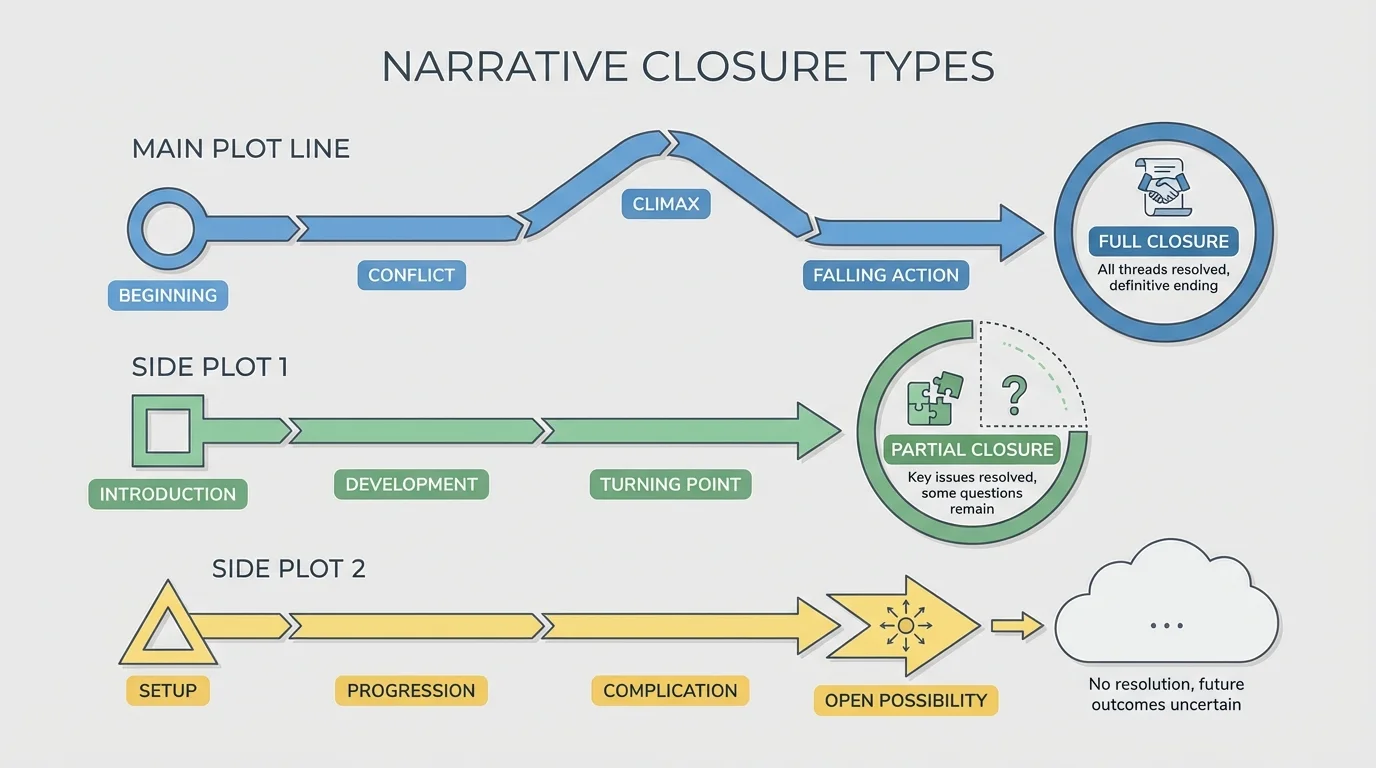
When a narrative has a central problem or conflict, the ending should show the resolution and its effect, and [Figure 2] illustrates that different plot lines can reach different kinds of closure. In stories with multiple plot lines, the main conflict may be resolved fully while a smaller relationship or internal struggle remains partly open.
For example, imagine a story with two plot lines: one follows a team preparing for a robotics competition, and the other follows tension between two friends on the team. The competition result may be clear by the conclusion, but the friendship may be only beginning to heal. That can still be satisfying if the ending makes clear where each line stands.
The key is proportion. The most important plot line deserves the clearest attention in the conclusion. Secondary plot lines may be resolved more briefly, hinted at, or left open in a way that feels intentional. Readers should not finish the story asking why the writer ignored the conflict that mattered most.
Resolution also does not mean everything becomes easy. A story can resolve its central conflict and still end with mixed feelings. A character may win a debate but lose a friendship. A family may move into a safer home while grieving what they left behind. Such endings feel realistic because they recognize that outcomes are often complicated.
In multiple-plot narratives, transitions matter. The conclusion should not jump abruptly from one plot line to another. Instead, it should create a sense of gathering. A writer might resolve the external action first, then turn inward for the final reflective sentence. This movement helps the ending feel unified. Not all story threads close in the same way, but each one should contribute to the final effect.
Writers use different ending shapes depending on the purpose of the story. One useful type is the circular ending, which returns to an image, phrase, place, or situation from the beginning. The repeated element now carries new meaning because the character or reader understands it differently.
Another type is the quiet reflective ending. This ending does not depend on a dramatic twist. Instead, it leaves the reader with a thought, image, or emotional shift. These endings are common in personal narratives and literary fiction because they emphasize insight.
A third type is the revelation ending, where the narrator realizes something important near the end. This can be effective, but it must be prepared for by earlier details. If the realization appears from nowhere, it feels forced.
A fourth type is the bittersweet ending. In this kind of conclusion, there is both gain and loss. Bittersweet endings are often memorable because they feel emotionally true. Many real experiences do not fit neatly into victory or defeat.
| Ending Type | How It Works | Best Use | Main Risk |
|---|---|---|---|
| Circular ending | Returns to an earlier image or idea with new meaning | Stories with clear change over time | Feeling too obvious or repetitive |
| Quiet reflective ending | Focuses on insight, mood, or a final image | Observational or personal narratives | Feeling vague if details are weak |
| Revelation ending | Centers on a realization | Stories about misunderstanding or growth | Feeling sudden or preachy |
| Bittersweet ending | Combines resolution with lingering loss or uncertainty | Complex conflicts and realistic outcomes | Feeling emotionally confusing if not clear |
Table 1. Comparison of common narrative ending types, their strengths, and their risks.
Many memorable endings in literature are not the loudest scenes in the story. Often the final paragraph is quieter than the climax because the writer wants readers to feel the meaning settling in after the main action is over.
The type of ending matters less than whether it fits the narrative. A circular ending in the wrong story can feel artificial. A quiet ending in a fast-paced, conflict-heavy story may feel incomplete unless it clearly grows from the action.
Weak endings often fail in predictable ways. One common problem is the moralizing ending, where the writer suddenly explains the "lesson" in a general, preachy way. Readers usually prefer to discover meaning through the story's details rather than being told exactly what to think.
Another problem is the unrelated twist. If an ending introduces information with no setup, readers feel tricked instead of satisfied. Surprise can work, but it must still follow from clues, tensions, or possibilities already present in the narrative.
A third problem is overexplaining. Some writers become nervous at the end and explain every emotion, every symbol, and every future result. This weakens the conclusion because it leaves no room for the reader's own understanding. Strong endings are often precise, not crowded.
Another weak strategy is stopping too early. If the conflict is resolved but the reader never sees its impact, the story can feel cut off. Usually, the conclusion needs at least a brief moment after the main event to show what changed.
You already know that narratives need clear sequences of events, believable characters, and purposeful details. The conclusion is where all of those earlier choices come together. A strong ending depends on the groundwork laid in the beginning and middle.
Finally, some endings repeat earlier ideas without adding anything new. A conclusion should echo the story, not copy it. The ending should deepen the reader's understanding, not simply restate what is already obvious.
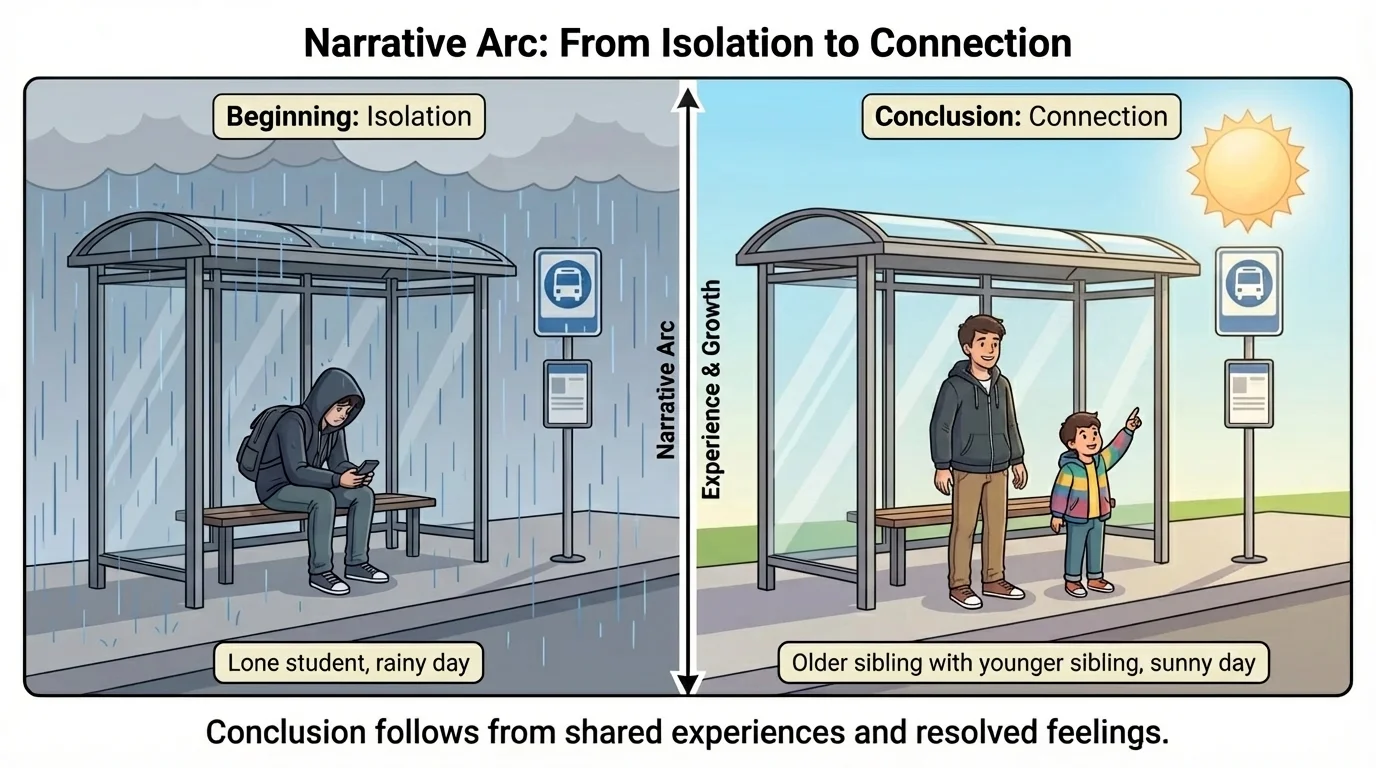
Writers often make conclusions stronger by using an echoed detail, and [Figure 3] shows how returning to an earlier image can transform its meaning. An echoed detail is a specific object, line, sound, gesture, or setting that appears earlier in the story and returns near the end. Because the story has changed, the detail feels different the second time.
For instance, a story might begin with a student waiting at a bus stop, avoiding eye contact, headphones on, trying to disappear. At the end, the same bus stop appears again, but this time the student is standing beside a younger sibling, talking openly, no headphones at all. The place is the same, but the meaning has changed.
Writers also use selective dialogue. A final line of dialogue can be powerful if it captures a shift in relationship or understanding. It should sound natural and carry the weight of the story, not just summarize it.
Another technique is the final image. Some endings work because the last visual detail stays in the reader's mind: muddy cleats left by the door, a hospital wristband in a coat pocket, a garden hose still running across the driveway after an argument ends. A final image can communicate emotion without directly naming it.
Pacing matters too. After the climax, many narratives need a brief slowing down. That pause gives the conclusion room to reflect. If the writer rushes from the peak action to "the end," the story may feel incomplete. This echoed transformation works because the narrative allows readers to notice the contrast between the first and last moments.
Writers can also use sentence length strategically. Short final sentences can create force or finality. Slightly longer final sentences can create reflection or lingering emotion. The right choice depends on the mood of the story.
Consider a narrative about a student named Lena who secretly records her grandmother telling family stories before the grandmother moves into assisted living.
Weak ending: "I realized family is important and memories last forever."
This ending is too general. It could fit almost any story about family. It does not reflect Lena's specific experience.
Revision example: making the conclusion specific and earned
Step 1: Return to an important detail
Earlier in the story, Lena struggles to understand her grandmother's habit of pausing for long stretches before finishing a memory.
Step 2: Resolve the emotional action
At the end, Lena listens back to the recordings while packing a box from her grandmother's kitchen.
Step 3: Add reflection through image and change
"On the recording, I heard the pause again, long enough for me to think the story was over. Then my grandmother's voice returned, steady and amused, finishing the sentence exactly where it needed to end. I wrapped the blue teacup in newspaper and waited through the silence before turning off the phone."
This conclusion follows from experience, reflects on what Lena has learned, and avoids stating the message in a flat way.
Now consider a narrative with multiple plot lines: a musician preparing for an audition while also dealing with conflict with an older brother. The ending does not need to solve both plot lines in the same amount of space. It might reveal the audition result in one sentence, then focus the final moment on the brother quietly tuning the musician's guitar before leaving the room. That final action reflects on reconciliation more effectively than a speech would.
Revision often improves endings more than any other part of a narrative. Writers commonly discover the true ending only after drafting the whole story. That is because the full meaning of the narrative becomes clearer once the writer sees the complete path of events.
The last sentence should feel intentional. It may offer an image, a realization, a shift in tone, or a line of dialogue. What matters is that it sounds final without sounding artificial.
Compare these two final lines for a story about a storm cleanup after neighbors finally work together:
Weak final line: "That was the day our neighborhood became united."
Stronger final line: "By sunset, every ruined branch on our street was stacked at the curb, and when Mr. Alvarez handed back our ladder, he did not let go right away."
The stronger line trusts detail. It leaves readers with action and emotion together. The conclusion reflects on what has been resolved and what has changed between people.
"A satisfying ending feels surprising in the moment and inevitable in hindsight."
— A useful principle for narrative writing
When you evaluate a narrative conclusion, ask a few important questions. Does the ending grow from the events that came before it? Does it reflect on the experience, observation, or resolution at the center of the story? Does it add meaning instead of simply stopping? Does it fit the tone and the level of closure the story needs?
The best conclusions do not wave for attention. They complete the shape of the narrative. They leave readers feeling that the story arrived where it needed to arrive, and nowhere else would have felt true.
