A novel can change how you see a person you have never met. A play can make a single pause feel louder than a speech. A poem can compress an entire argument about love, power, grief, or identity into a few lines. That is part of what makes literature demanding and worth reading: it does not just give information. It asks you to notice, infer, question, and interpret. Reading at the high end of the grades 9–10 complexity band means being able to do that work on your own with texts that are layered, subtle, and sometimes deliberately difficult.
Independent and proficient reading is more than finishing the pages. It means you can follow what a text says, recognize how it is built, and explain what it means using evidence. It also means you can stay with a text when it becomes unfamiliar. Instead of stopping at confusion, you learn how to investigate it.
Complex literature matters because it trains several kinds of thinking at once. You have to track details, recognize patterns, infer motives, and judge the reliability of what you are being told. These are not only school skills. They matter when people evaluate news, interpret social situations, or understand perspectives different from their own.
Literature also builds empathy without making anything simple. A strong literary text often refuses easy answers. A character may be admirable and flawed at the same time. A speaker may sound confident while revealing fear. A story may end without solving every conflict. Readers grow when they can tolerate that uncertainty and still reason carefully.
Some texts feel harder not because the vocabulary is unusual, but because the ideas are compressed, the structure is fragmented, or the narrator leaves out crucial information. Difficulty in literature is often a matter of design, not just word choice.
When you read complex literature well, you practice patience, interpretation, and precision. Those qualities matter in every subject where evidence and judgment matter.
At the grades 9–10 level, literature includes short stories, novels, dramatic works, and poems that require sustained attention. Some are traditional literature, meaning they come from earlier periods and may use older styles, references, or values. Others are contemporary and may sound closer to modern speech while still being conceptually demanding.
Text complexity refers to how challenging a work is to read and understand. A complex text may include layered themes, unfamiliar syntax, symbolism, shifts in time, multiple meanings, or an indirect style. Complexity is not just about length. A short poem can be more difficult than a long chapter if every word carries several meanings.
Complex literary reading is the ability to understand and interpret texts that contain challenging language, subtle ideas, layered structures, and meaningful ambiguity. It requires both comprehension of what the text says and analysis of how the text creates meaning.
Stories, dramas, and poems each create meaning differently. A story may develop a theme through narration and plot. A drama may reveal tension through speech, silence, and action. A poem may depend on image, sound, rhythm, and line breaks. Proficient readers adjust their approach to fit the form.
When reading fiction, it helps to see the text as a system in which each element affects the others, as [Figure 1] shows through the relationships among character, conflict, setting, and theme. A literary element is a major part of how a text works, such as plot, setting, character, point of view, or theme.
Plot is the sequence of events, but in strong fiction the events matter because they create pressure. Conflict gives plot energy. The conflict may be external, such as a struggle against a rival or a social system, or internal, such as guilt, fear, or divided loyalty.
Characterization is how an author reveals a character. Sometimes the text tells you directly what a character is like. More often, it shows you through choices, speech, reactions, and contradictions. A complex character is rarely defined by one trait. For example, a character who appears brave in public may act that way to hide panic or shame.
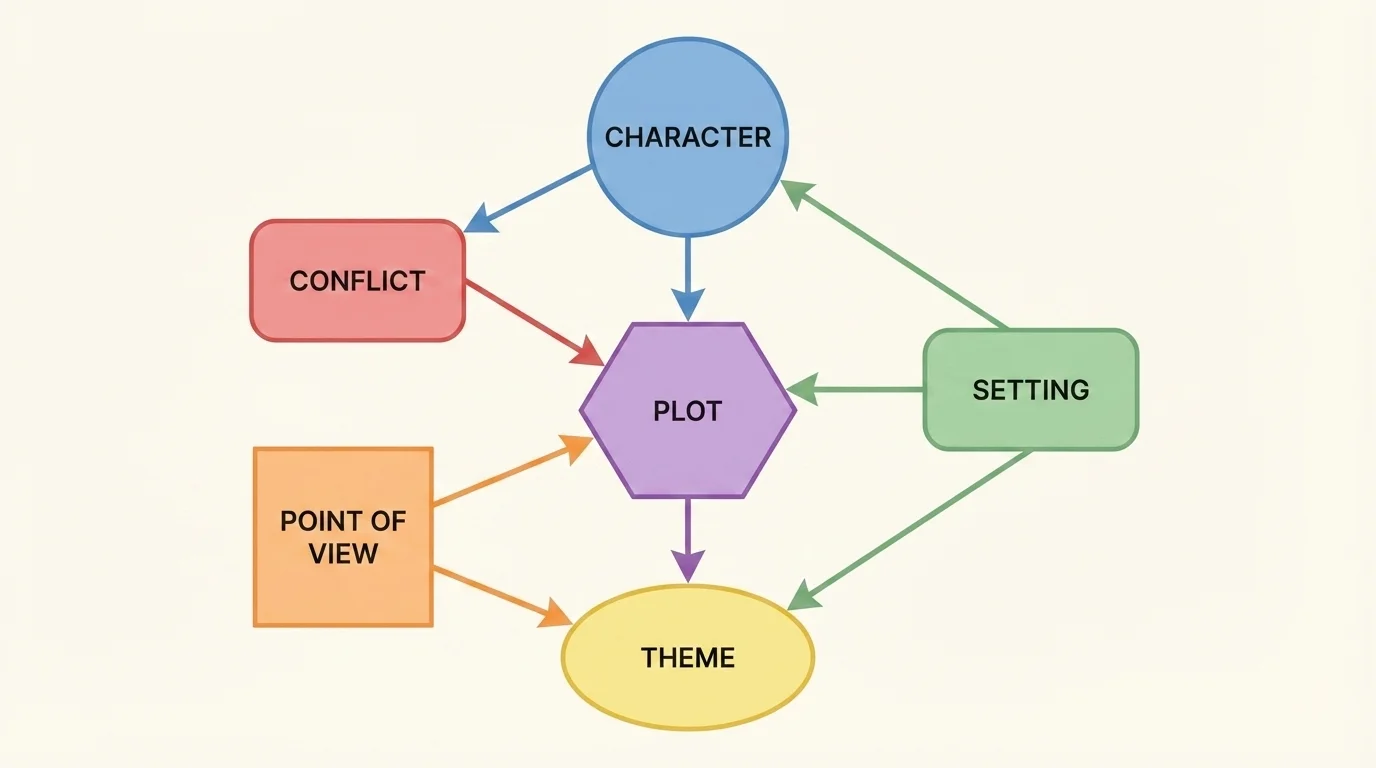
Setting is not just location. It includes time period, social environment, and conditions that shape the action. A story set during economic hardship, political unrest, or cultural change often uses setting to create pressure on characters. In many works, the setting is almost an active force.
Point of view determines who tells the story and how much the reader can know. A first-person narrator may feel immediate and intimate, but that narrator may also be limited or biased. A third-person narrator may reveal one mind or several. When readers ask, "Who is telling this, and what might they be missing?" they move from simple comprehension to analysis.
Tone is the author's or narrator's attitude toward the subject, while theme is the deeper idea the work explores. Theme is not a one-word topic like "love" or "war." It is a statement or insight such as "the desire for control can destroy trust" or "memory can preserve and distort the past at the same time." As in [Figure 1], theme grows out of the interaction of multiple elements, not from one isolated quotation.
Case study: reading a story closely
Suppose a short story presents a student who keeps winning awards but becomes increasingly isolated from friends and family.
Step 1: Identify the apparent conflict
The obvious conflict is between ambition and relationships.
Step 2: Look for complications
If the student never admits loneliness, the conflict may also involve self-deception or social pressure.
Step 3: Connect details to theme
If scenes of success feel emotionally empty, the story may suggest that achievement without connection becomes hollow.
The strongest interpretation connects plot events, emotional shifts, and repeated details rather than relying on one dramatic moment.
Good readers also pay attention to structure. A story told out of order may imitate memory, hide information, or force the reader to revise earlier assumptions. Structure affects meaning because the order of revelation shapes what the reader feels and understands.
Drama is unique because it is written to be read and performed, and [Figure 2] illustrates how meaning comes from dialogue, stage directions, and what remains unsaid. In drama, readers must imagine voice, movement, gesture, silence, and pacing. A line on the page may seem simple until you notice the pause before it or the stage direction that follows it.
Subtext is the meaning beneath the spoken words. When a character says, "I'm fine," the real meaning may be anger, fear, or refusal. In plays, subtext matters because characters often conceal as much as they reveal. Readers need to infer motive from context, tension, and pattern.
Dialogue in drama carries much of the burden that narration carries in fiction. Through dialogue, readers learn about conflict, relationships, class, power, and emotion. [Figure 2] A playwright may show dominance through interruption, hesitation through unfinished sentences, or distance through formal language.
Stage directions matter too. They may reveal tone, setting, emotional condition, or a contrast between what is said and what is done. A character who declares confidence while backing away from another character creates dramatic tension. This becomes clear when you see how a script contains both speech and performance cues.
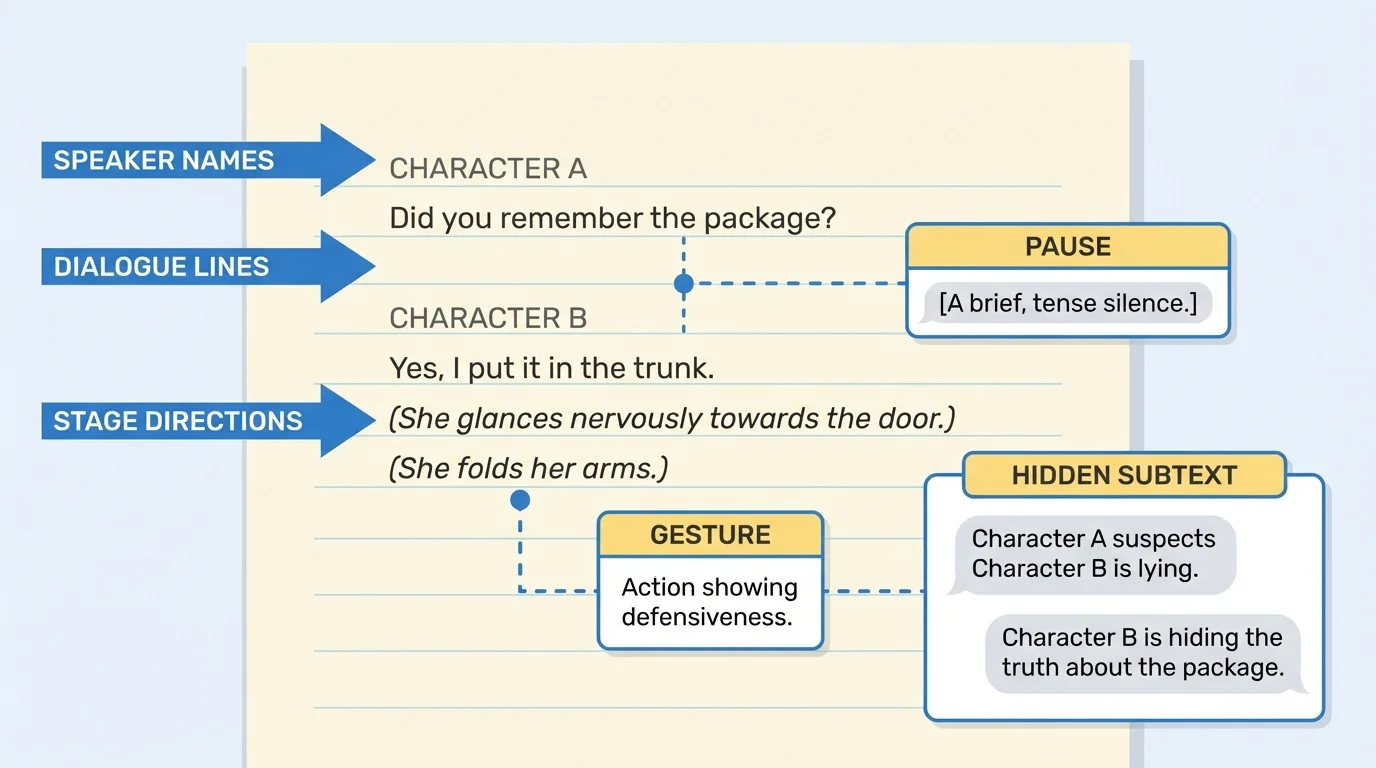
Drama often depends on dramatic irony, which occurs when the audience knows something a character does not. That gap creates suspense, humor, or tragedy. For example, if the audience knows a promise will be broken, even an innocent line can sound ominous.
When reading a play, think scene by scene. Ask what each character wants, what blocks that desire, and how the language reveals power. In strong drama, every exchange changes the relationship, even if only slightly.
Poetry rewards slow attention because every choice matters, and [Figure 3] highlights how line breaks, imagery, and sound shape meaning as much as dictionary definitions do. Unlike prose, poetry often compresses thought. It may leave connections unstated, forcing the reader to build them.
The speaker of a poem is not automatically the poet. The speaker is the voice created within the poem. Identifying the speaker helps readers ask: Who is talking? To whom? In what emotional state? With what degree of honesty or certainty?
Imagery is language that appeals to the senses. It creates pictures, textures, sounds, and sensations. If a poem describes "metallic morning light" or "dust settling on an empty piano," the images do more than decorate. They build mood and suggest meaning.
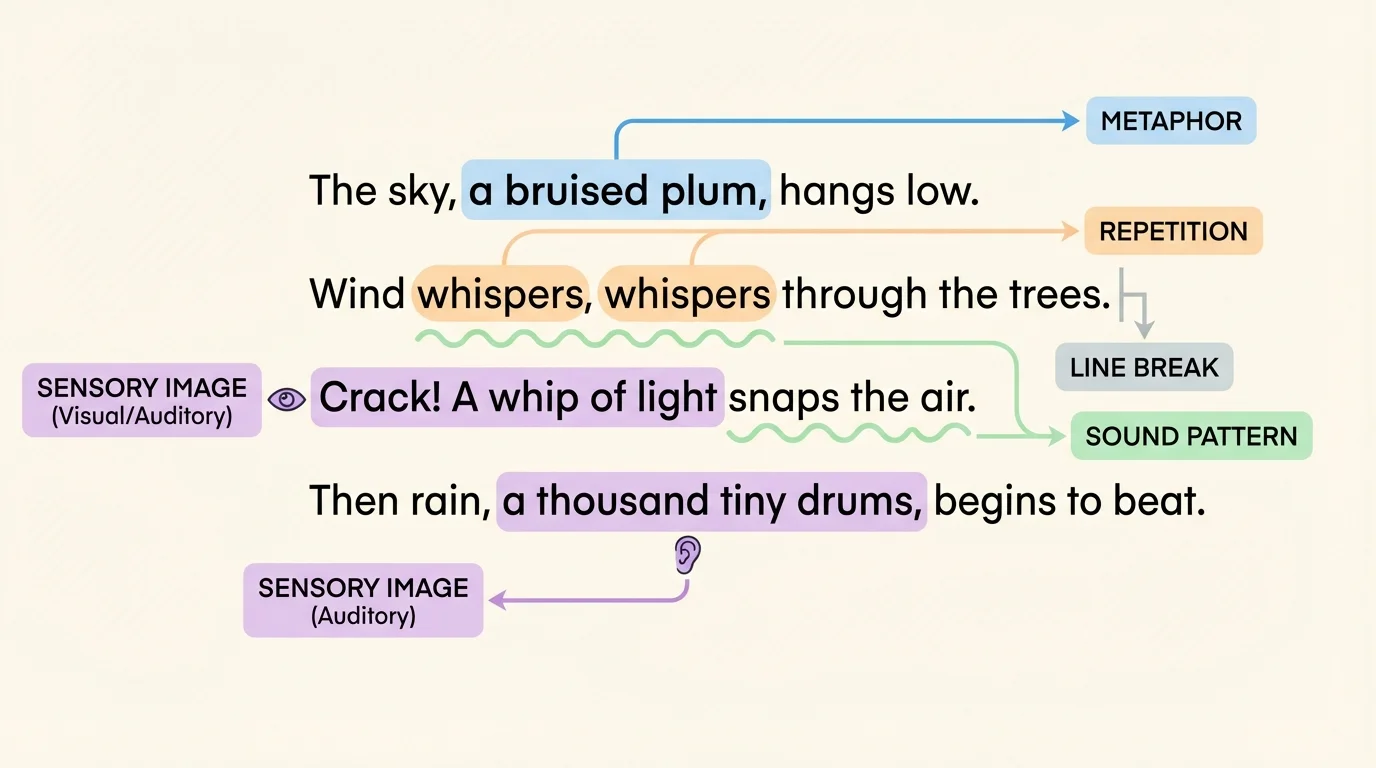
Figurative language includes metaphor, simile, personification, symbol, and other devices that say more than the literal words alone. If a poet writes that hope is "a locked window facing east," the phrase invites interpretation. Why locked? Why east? The language asks readers to think beyond the surface.
Poetry also depends on sound. Repetition, rhyme, alliteration, and rhythm can intensify emotion or create contrast. A harsh sound pattern may reinforce conflict. A smooth pattern may suggest calm or false comfort. Because sound matters, reading poetry aloud often reveals features that silent reading misses.
Line breaks matter too. Where a line ends can emphasize a word, delay meaning, or create surprise. If one line ends with "I carried your name" and the next begins "like a wound," the break controls the emotional timing. As shown in [Figure 3], form and meaning are deeply connected in poetry.
"Poetry is when an emotion has found its thought and the thought has found words."
— Robert Frost
Poems often allow more than one reasonable interpretation. That does not mean "anything goes." A strong reading must be anchored in diction, images, structure, and pattern.
Independent reading is a process, not a single pass through the text, and [Figure 4] presents a close-reading sequence that moves from first encounter to interpretation. Skilled readers do not panic when they do not understand everything immediately. They return, question, and refine.
Begin with a first reading focused on basic comprehension. Who is speaking? What happens? Where is the conflict? What is confusing? Mark places that feel important, strange, or unclear. Confusion is not failure; it is information about where the text is doing complex work.
Then reread with a narrower purpose. Track repeated words, shifts in tone, changes in setting, or patterns in imagery. Look closely at syntax, especially in older or more literary texts. A long, winding sentence may imitate thought, hesitation, or emotional overflow.
Use annotation to make your thinking visible. Underline key details, write questions in the margin, and note emerging patterns. Instead of labeling a line merely "important," write why it matters: "reveals jealousy," "changes tone," or "echoes earlier image."
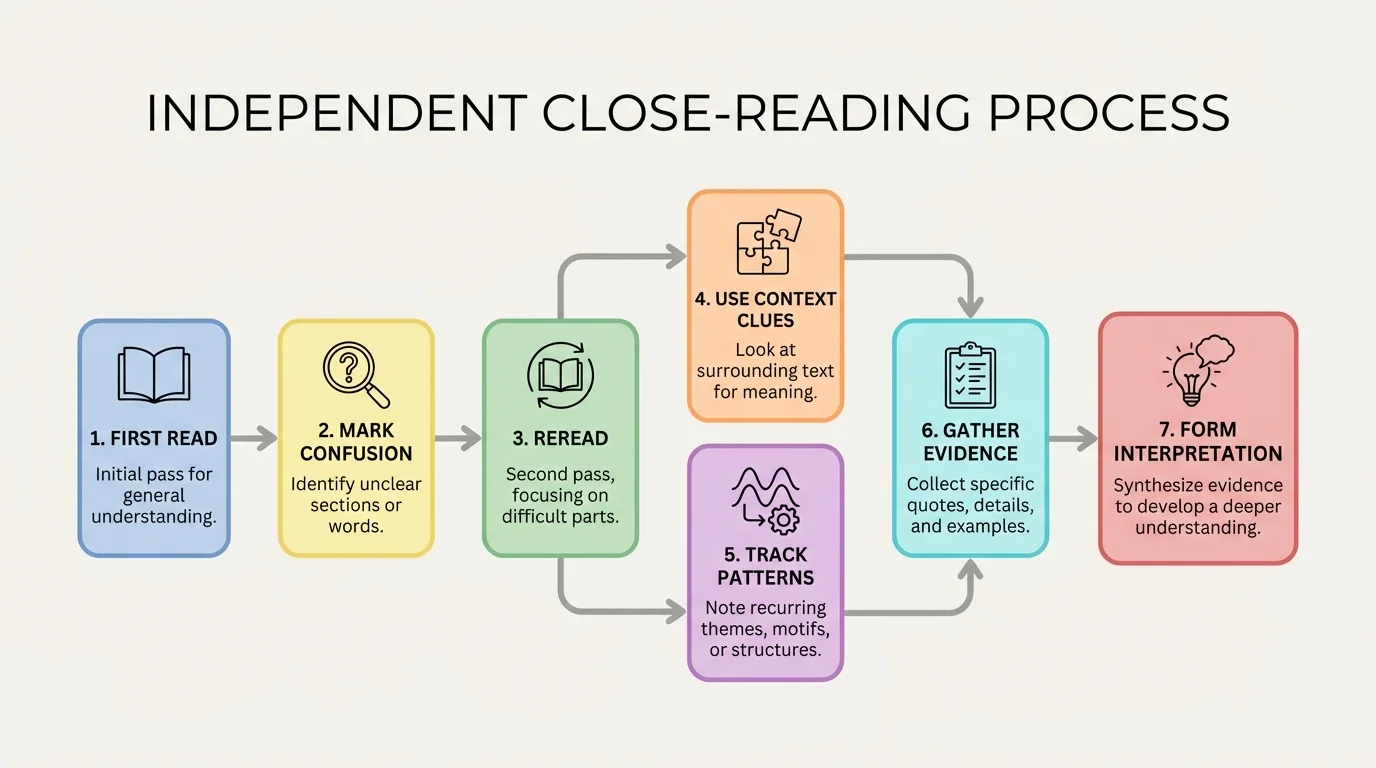
Context clues help with unfamiliar words, but readers should also use sentence structure and surrounding ideas. If a word appears in a passage full of decay, silence, and abandonment, the emotional atmosphere of the sentence may help reveal its meaning. This matters especially when a dictionary definition alone is too broad.
Gather textual evidence before making large claims. If you think a narrator is unreliable, identify the moments that justify that reading: contradictions, omissions, exaggerations, or differences between what the narrator says and what the events reveal. [Figure 4] shows that interpretation comes after noticing and collecting, not before.
Independent comprehension as disciplined thinking
Reading independently does not mean reading without support forever. It means using internalized habits of questioning, rereading, and evidence-based interpretation. The goal is to become a reader who can enter a difficult text, locate the challenge, and work through it methodically.
One useful question is: "What is the text encouraging me to notice repeatedly?" Repetition often points toward theme, motive, or emotional pressure. Another is: "What does the text refuse to say directly?" Silence can be meaningful.
Reading with scrutiny often involves comparison. A traditional text and a contemporary text may explore the same conflict in very different ways. One may use formal diction, elevated syntax, and symbolic settings. The other may use sparse dialogue, fragmented structure, or modern social context.
For example, a traditional tragedy may present conflict through honor, fate, and public duty, while a contemporary story may explore similar pressure through reputation, family expectation, or online identity. The central human problem may remain similar even when the surface features change.
Comparison works best when it is precise. Instead of saying two texts are "about love," compare how each text presents love through conflict, voice, and consequence. Does one text idealize sacrifice while the other questions it? Does one rely on lyrical language while the other uses blunt realism?
| Feature | Traditional Texts | Contemporary Texts |
|---|---|---|
| Language | May include formal, older, or highly patterned diction | May sound more immediate or conversational |
| Structure | Often follows recognizable forms or conventions | May experiment with chronology or perspective |
| Context | Reflects earlier social values and historical conditions | Reflects current issues, identities, and technologies |
| Theme | Explores enduring human concerns through inherited forms | Explores enduring concerns through newer contexts and styles |
Table 1. Comparison of common features in traditional and contemporary literary texts.
Comparison should not flatten differences. The point is not to force texts to match, but to understand how literary choices affect meaning across time.
Comprehension answers, "What is happening?" Interpretation asks, "What does it mean, and how does the text create that meaning?" Strong interpretation depends on claims that are arguable, specific, and evidence-based.
An interpretation should connect details rather than list them. Suppose you argue that a poem presents memory as both shelter and trap. To support that claim, you would point to images that feel protective as well as images that suggest confinement, then explain how the contrast develops the poem's meaning.
Ambiguity is often part of literary power. An ambiguous ending may leave readers uncertain on purpose. The task is not to erase ambiguity but to explain how it works. If two interpretations are possible, compare them and judge which one is better supported by the text.
Interpreting with evidence
Claim: A character's silence represents resistance rather than weakness.
Step 1: Identify the pattern
The character becomes silent specifically when authority figures demand agreement.
Step 2: Examine surrounding details
The narration emphasizes controlled gestures rather than fear, which changes the meaning of the silence.
Step 3: Form the interpretation
The silence functions as refusal. It withholds consent and creates tension without open rebellion.
This interpretation works because it explains a pattern and supports it with details from the text.
Readers should avoid overclaiming. Not every repeated object is a symbol, and not every sad ending proves a text is pessimistic. Interpretation becomes stronger when it remains proportional to the evidence.
Some texts are difficult because they use archaic or formal language. Others are difficult because they shift in time, leave motives unstated, or depend heavily on symbolism. Complex literature often challenges readers in more than one way at once.
When facing unfamiliar historical or cultural context, notice what the text itself provides first. Then use background knowledge carefully. Context can deepen understanding, but it should not replace close reading. You still need to show how meaning appears in the text.
Dense imagery can also create difficulty. In poetry especially, readers may feel pressured to decode every word immediately. A better strategy is to identify clusters of images. If a poem repeatedly uses glass, mirrors, water, and reflection, the pattern itself becomes meaningful even before every detail is fully explained.
Nonlinear structure creates another challenge. A story may begin near the end, return to the past, and then move back again. In such cases, keep track of what the order of telling adds. A disrupted timeline often mirrors uncertainty, trauma, secrecy, or the way memory works.
These challenges do not signal that a text is impossible. They signal that the text expects more from the reader. That expectation is exactly what builds proficiency.
To read independently at a high level, students need reading stamina, the ability to stay focused through difficult passages without giving up too quickly. Stamina grows through regular exposure to varied texts, not through occasional bursts of effort.
Range matters too. Reading only one type of literature can make you skilled in one form but unprepared for another. A strong reader can move from a short story with an unreliable narrator to a dramatic scene full of subtext to a poem built from compressed symbols and sound.
As you build range, pay attention to what remains constant across forms: careful attention to language, structure, conflict, and evidence. The exact method changes, but the habits of mind remain similar. That is why the story map in [Figure 1], the script features in [Figure 2], the poetic design in [Figure 3], and the close-reading process in [Figure 4] all connect: each reminds you that form shapes meaning, and meaning must be built from evidence.
From earlier reading work, you already know how to identify main ideas and cite evidence. Literary reading extends those skills by asking you to analyze how structure, language, and perspective create effects that are not always stated directly.
Becoming proficient does not mean every text feels easy. It means you know what to do when it does not. You can slow down, reread, annotate, compare, infer, and support your understanding with the text itself.
