A single event can look completely different depending on who tells it and how they tell it. A scene in a painting might be so small you almost miss it. The same event in a poem might become a powerful statement about human indifference. That difference is not an accident. Artists make choices, and those choices tell us what matters. When you compare two artistic media, you are not just spotting similarities. You are asking a deeper question: What does each form allow the artist to emphasize, and what does each form push into the background?
Students often compare two texts by looking only for matching details. But strong analysis goes further. It examines how a work is built. A painting uses color, scale, placement, and visual focus. A poem uses word choice, line breaks, tone, rhythm, and commentary. Even when both works deal with the same subject, they may guide the audience toward different meanings.
To compare two artistic treatments of the same subject, you need to understand medium. A medium is the form an artwork takes: poem, painting, song, film, sculpture, photograph, novel, and more. Each medium has strengths and limits. A painting can show many details at once, but it cannot directly explain its thoughts in sentences. A poem can comment, judge, and reflect, but it cannot literally place all visual details before your eyes in a single instant.
That is why comparison is such a powerful reading skill. It helps you see that meaning does not come only from what is represented, but from how it is represented. Two works may both present the same myth, historical figure, or scene, yet lead audiences to very different interpretations.
Cross-medium analysis asks you to study the relationship between content and form. The subject may stay the same, but the medium changes the experience. A viewer scans a painting with the eyes, choosing where to look. A reader moves through a poem in a sequence of words and lines. Because of that difference, each work controls attention in its own way.
When you compare works well, you notice not only what appears but also what is absent. Sometimes an omission is as meaningful as an inclusion. If a poem leaves out a dramatic image that a painting includes, that absence may shift the focus toward ideas rather than action. If a painting hides the central event in a corner, that visual minimization may suggest that the world goes on without noticing individual tragedy.
Several terms are especially useful when analyzing works across mediums. Representation means the way a subject, event, or idea is presented. Emphasis refers to what stands out as most important. Omission means something left out. Perspective is the angle or point of view from which the subject is presented. Tone is the creator's attitude toward the subject. Interpretation is the meaning an audience makes from the work.
Medium is the artistic form in which a work is created, such as painting, poetry, or film.
Composition is the arrangement of visual elements in a work of art.
Imagery is language that appeals to the senses and creates mental pictures.
Juxtaposition is the placing of two things side by side to highlight contrast.
These terms matter because comparison depends on precision. Saying "the poem is different from the painting" is too vague. Saying "the poem shifts emphasis from the mythic fall itself to society's indifference, while the painting minimizes Icarus through composition" is a much stronger analytical statement.
One of the most famous examples of cross-medium analysis is W. H. Auden's poem Musée des Beaux Arts and Pieter Brueghel's painting Landscape with the Fall of Icarus. Both works connect to the Greek myth of Icarus, the boy who flew too close to the sun with wings made of feathers and wax. The wax melted, and he fell into the sea.
At first, this myth sounds like the kind of dramatic story that should dominate an artwork. Yet both Auden and Brueghel do something unexpected. Neither work gives Icarus the central heroic spotlight readers might expect from a myth. Instead, they present ordinary life continuing around his suffering.
Remember that when you analyze literature, you are not only identifying a theme. You are explaining how specific details create that theme. The same rule applies when one of the works is visual art: details of placement, scale, and focus function like textual evidence.
Brueghel's painting, shown in [Figure 1], presents a large landscape with a plowman, a shepherd, a ship, the sea, and open sky. Icarus is present, but only as a tiny detail: his legs disappear into the water. Auden's poem refers to "Old Masters" who understood that suffering often happens while others keep eating, walking, or going about daily routines. He then turns to Brueghel's painting as an example of that idea.
In Brueghel's composition, the viewer's eye is first drawn to the bright foreground and the large human figures working in the landscape. The plowman dominates the lower part of the scene. The shepherd looks upward. A ship sails steadily onward. The sea and sky appear calm and expansive.
This arrangement matters. If Brueghel wanted Icarus to be the clear center of the painting, he could have placed him large and dramatic in the middle. Instead, the fall is tiny and easy to miss. The mythic event becomes almost hidden inside ordinary life. That artistic choice suggests that individual disaster does not automatically stop the world.
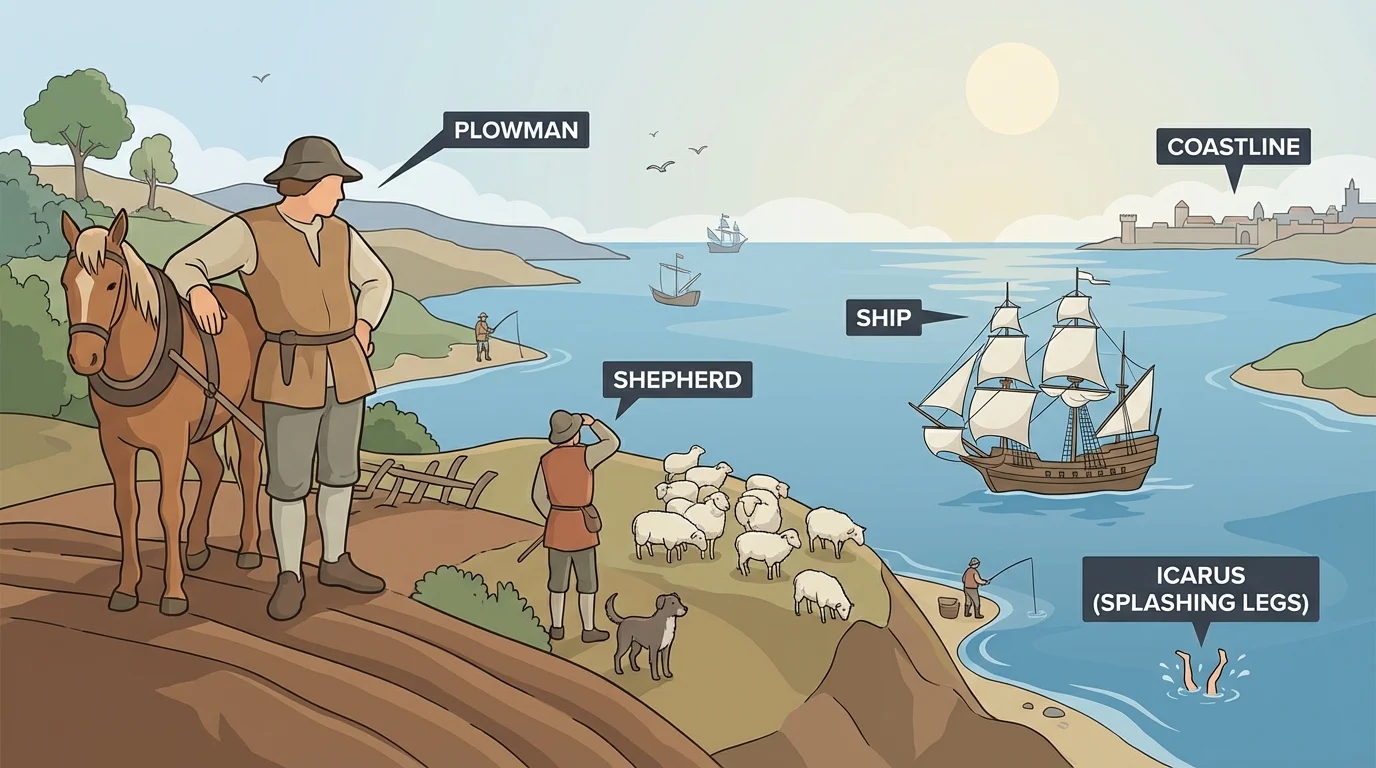
The painting also uses contrast. Icarus comes from a famous myth about ambition, pride, and failure, but the people around him are engaged in everyday labor. The contrast between the extraordinary and the ordinary creates meaning. The plowman keeps plowing. The ship keeps sailing. Nature remains beautiful and indifferent.
Notice, too, what the painting leaves out. We do not see Icarus's face. We do not see his fear in close-up. We do not see Daedalus, his father, reacting. We do not get a dramatic before-and-after sequence. Because a painting captures one visual moment, Brueghel relies on placement and scale rather than explanation. That omission of emotional close-up is part of the point.
Later, when you compare this painting with the poem, keep [Figure 1] in mind. The tiny splash of Icarus matters precisely because it is so small. Brueghel turns a legendary fall into a nearly overlooked detail, and that visual minimization becomes a statement about attention.
The title Landscape with the Fall of Icarus sounds as if Icarus should dominate the image, but many viewers do not notice him at first. That surprise is one reason the painting is so often discussed in literature classes.
Auden's poem begins broadly. It does not start with Icarus immediately. Instead, it talks about how the "Old Masters" understood suffering: while someone suffers, other people may be eating, skating, or simply going on with life. This opening gives the poem a reflective and thoughtful voice. The speaker is not just describing a picture; he is interpreting what art reveals about human behavior.
That shift is important because poetry can move through ideas in time. A reader encounters the poem line by line, and the poem builds an argument. Auden first presents a general truth about suffering and indifference, then uses Brueghel's painting as evidence. In other words, the poem does not merely copy the painting. It reads the painting and explains its significance.
The poem's tone is calm, observant, and slightly ironic. There is no loud emotional outburst. That restraint makes the poem more powerful. The speaker sounds almost matter-of-fact when noting that "everything turns away / Quite leisurely from the disaster." The word "leisurely" is especially sharp. It suggests not urgency or horror, but casual continuation.
Auden also chooses details carefully. He mentions the plowman and the "expensive delicate ship" that "must have seen / Something amazing, a boy falling out of the sky," yet sails on. This detail adds a layer that the painting leaves less explicit. The poem openly highlights the moral meaning of what is happening: people may notice suffering and still continue without responding.
At the same time, the poem leaves out many visual features from the painting. It does not spend much time on color, shape, or exact landscape design. It does not try to describe every object on the canvas. Instead, it selects details that support its interpretation of indifference. That selectiveness is one of poetry's strengths. A poem can narrow attention with language and direct the reader's judgment.
The two works direct attention differently. Brueghel emphasizes the visual world: space, scale, and placement. Auden emphasizes interpretation: the idea that suffering often occurs unnoticed or seems unimportant to others. Both works involve Icarus, but neither is really "about" heroic flight in the usual mythic sense.
The painting emphasizes foreground labor and the broad landscape. Icarus is physically present but visually minimized. The poem emphasizes a pattern of human behavior. In the poem, Icarus becomes an example inside a larger claim about suffering and indifference.
The painting leaves out explicit commentary. It does not tell you what to think in words. The poem leaves out many visual details and instead provides a framework for understanding them. The painting lets the viewer discover Icarus. The poem points to him and explains why that smallness matters.
| Feature | Brueghel's Painting | Auden's Poem |
|---|---|---|
| Main focus | Landscape and ordinary activity | Human indifference to suffering |
| Treatment of Icarus | Tiny, almost hidden visual detail | Brief but meaningful example in an argument |
| Use of time | Freezes one moment | Unfolds ideas over several lines |
| Emotional effect | Subtle, discovered through observation | Reflective, analytical, quietly critical |
| What is absent | Inner thoughts, explicit judgment, dramatic close-up | Full visual description of the landscape |
Table 1. Comparison of how the painting and poem treat the fall of Icarus.
A strong comparison also notices that each medium can do what the other cannot, as [Figure 2] helps show. The painting can create the immediate shock of realizing that the title refers to a tiny splash you almost ignored. The poem can express judgment through phrasing and tone. Together, the two works deepen each other.
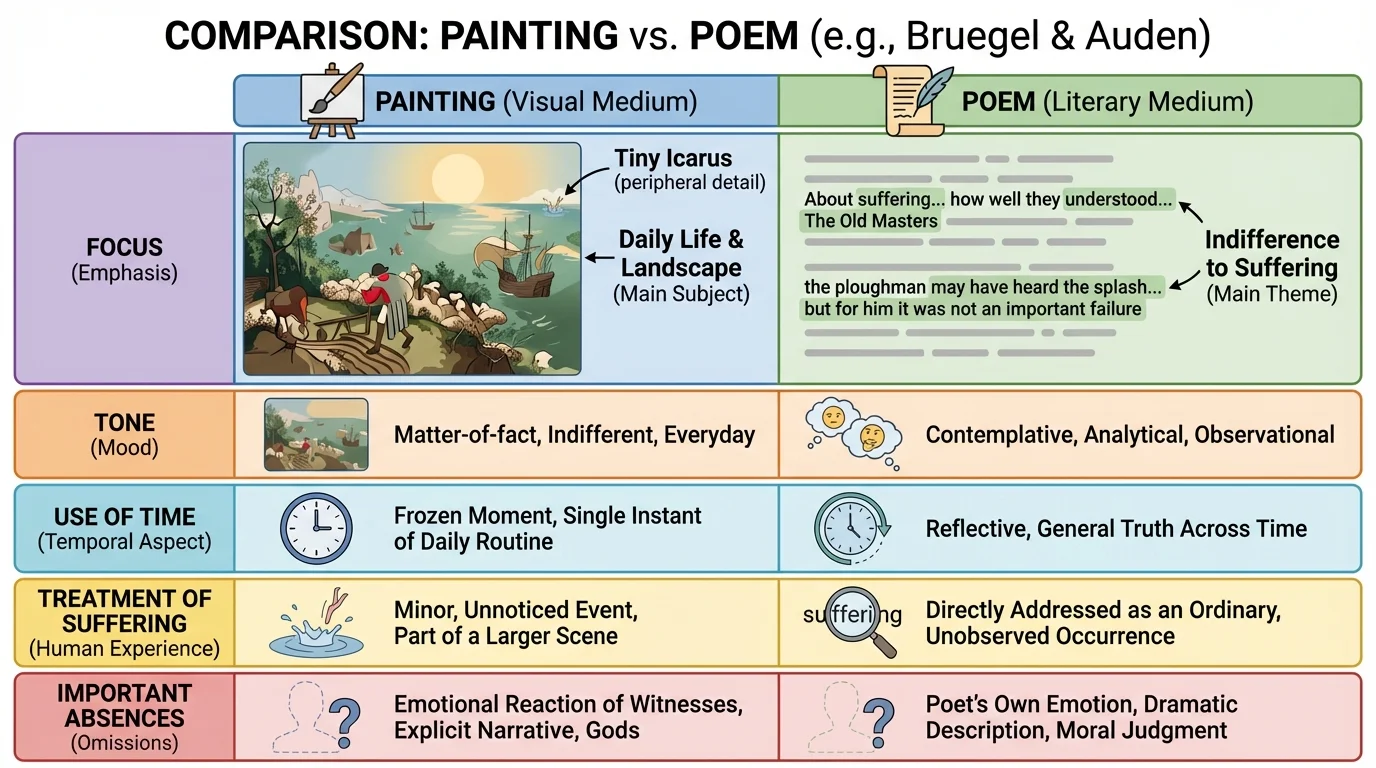
One of the most important analytical moves is discussing omission. Students sometimes think only present details matter, but absence can be meaningful. Brueghel omits emotional close-up. Auden omits much visual fullness. Those choices are not weaknesses. They are deliberate ways of shaping meaning. Each work gains power by refusing to show everything.
Model comparison claim
Brueghel's painting and Auden's poem both portray Icarus as less important to the surrounding world than readers might expect, but they achieve this effect differently.
Step 1: Identify the shared subject.
Both works refer to the fall of Icarus from Greek myth.
Step 2: Explain the difference in emphasis.
The painting emphasizes the landscape and working figures, while the poem emphasizes the idea that suffering often goes unnoticed.
Step 3: Mention what is absent.
The painting leaves out direct commentary, and the poem leaves out most visual detail.
Step 4: State the effect.
Together, these choices suggest that tragedy may be real and significant to the victim, yet barely interrupt ordinary life.
A painting and a poem do not simply package the same meaning in different wrappers. The medium itself changes the message. A painting is spatial. Your eyes move around it. You choose where to look, and the artist guides you through color, line, and size. A poem is sequential. It controls pace by arranging words in lines and sentences. The reader moves forward through thought.
This difference affects how audiences experience a subject. In Brueghel's painting, the viewer may first miss Icarus and then feel startled on discovering him. In Auden's poem, the reader is prepared by the opening reflection on suffering, so the mention of Icarus arrives as confirmation of a larger idea. The poem is more interpretive from the start.
Medium also shapes what can be emphasized. Visual art is excellent at showing relationships of size and position, which is why Brueghel's tiny Icarus is so effective. Poetry is excellent at expressing abstraction and attitude, which is why Auden can connect one painted scene to a universal truth about human life. The same subject becomes two different experiences.
"Everything turns away / Quite leisurely from the disaster."
— W. H. Auden, Musée des Beaux Arts
This line captures something the painting suggests visually. The poem turns visual arrangement into language about behavior. That move from image to idea is one of the most powerful things that happens in cross-medium comparison.
The same skill works with other texts. Consider the balcony scene from Shakespeare's Romeo and Juliet and a film version of that scene. The subject is the same: two young people confess intense love in a risky situation. But the medium changes what stands out through staging and camera perspective.
In the play text, Shakespeare emphasizes language. Readers notice metaphor, rhythm, and the tension between secrecy and desire. Juliet is compared to light; Romeo's speech shapes the scene through poetry. On the page, the emotional power comes mainly through words.
In a film version, as [Figure 3] suggests, directors can add lighting, music, facial expression, pauses, costume, and camera angles. A close-up can make the moment feel intimate. A wide shot can make the lovers seem isolated or exposed. Rain, darkness, or background sound can change the mood dramatically. These elements are not in the original lines themselves, but film can use them to guide interpretation.
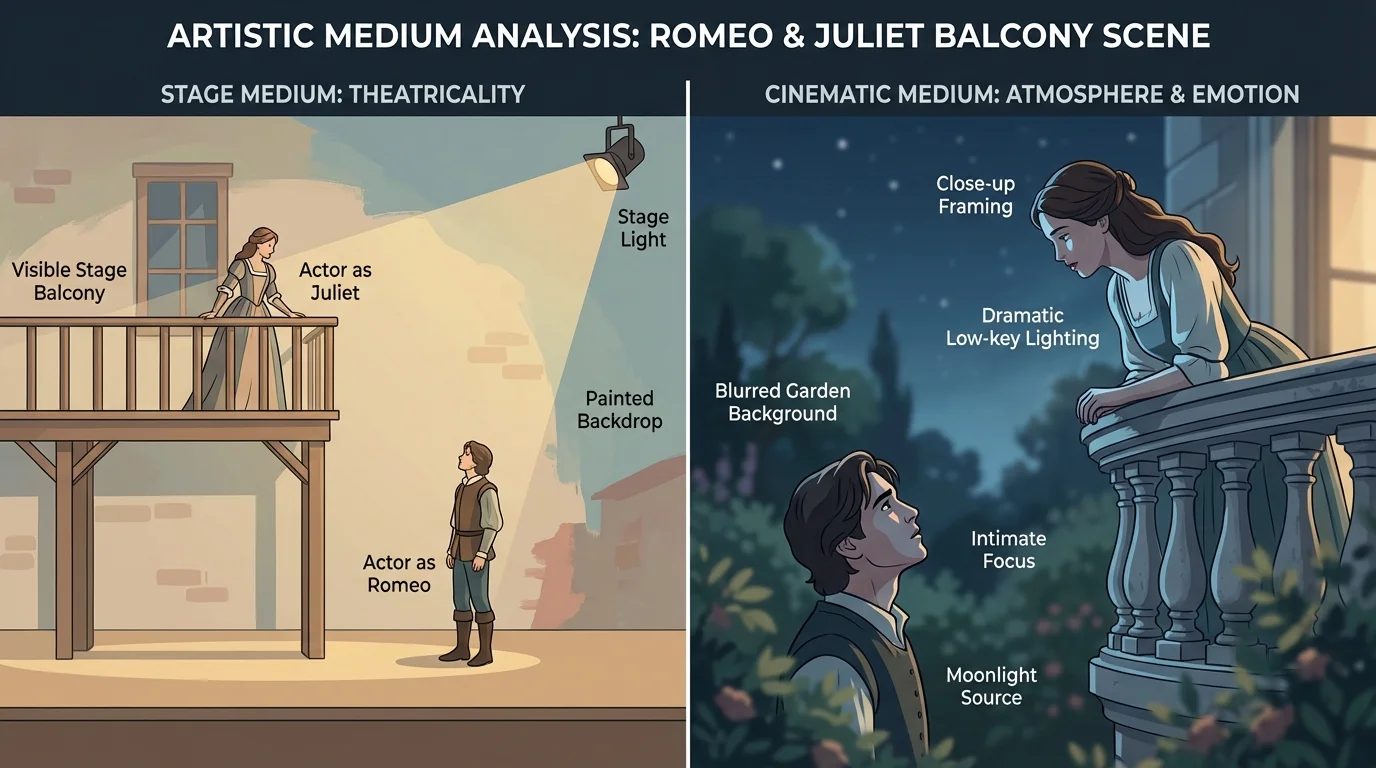
That means a film adaptation may emphasize romance, danger, innocence, or impulsiveness more strongly than the written scene does. It may also leave out lines, shorten speeches, or replace verbal imagery with visual symbolism. Just as Auden interprets Brueghel rather than merely repeating him, film adaptations interpret written texts through a new medium.
The comparison helps reinforce the larger principle: whenever a subject moves across media, choices about what to highlight and what to omit shape the audience's understanding. This is true in literature, painting, theater, film, photography, and even digital media.
When writing or speaking about two artistic mediums, begin with a clear claim. Name the shared subject or scene. Then identify the major difference in emphasis. After that, support your claim with specific evidence from both works. For a poem, quote or paraphrase important lines. For a painting or film, describe exact visual details.
Strong analysis often follows a simple pattern: claim, evidence, and interpretation. First, state what both works do and how they differ. Next, point to details. Finally, explain why those differences matter. The final step is the most important. Without explanation, a comparison becomes a list rather than an argument.
Sentence frame for analysis
Both works represent __________, but the __________ emphasizes __________, while the __________ emphasizes __________. This difference matters because __________.
Example: Both works represent the fall of Icarus, but the painting emphasizes the surrounding world and the smallness of the event, while the poem emphasizes the human habit of ignoring suffering. This difference matters because it turns a myth into a comment on everyday life.
You should also compare effects, not just techniques. Do not stop at "the painting uses composition" or "the poem uses imagery." Ask what those choices cause the audience to think or feel. Do they create sympathy, distance, irony, admiration, tension, or criticism? Interpretation completes the analysis.
One common mistake is summarizing instead of analyzing. Saying "Icarus falls and the people keep working" only repeats content. Analysis explains significance: the ordinary figures' lack of response reveals a theme of indifference.
Another mistake is treating one work as the "correct" version and the other as a copy. Artistic mediums do not compete to reproduce the same thing exactly. They create different experiences. Auden's poem is not valuable because it perfectly describes Brueghel's painting; it is valuable because it reads the painting and develops an idea from it.
A third mistake is ignoring absence. If you discuss only what is shown, you miss half the meaning. Ask yourself: What would I expect to be central? What is surprisingly small, silent, or omitted? Why might the artist have chosen that?
Finally, avoid unsupported claims. If you say the poem is critical or the painting is indifferent, point to details that prove it. Interpretation must grow out of evidence. That is true whether your evidence comes from lines of poetry, brushstroke choices, camera framing, or scene arrangement.
