Some speeches and letters outlive the moment that produced them. They are written for a crisis, but they keep speaking across centuries. A president leaving office, a nation burying soldiers, a leader defining democracy in a world at war, and a civil rights activist writing from jail may seem like very different situations. Yet each text asks the same high-stakes question: what kind of country should the United States be? Learning to read these documents closely means studying both history and language at the same time.
A seminal document is one that shapes later thinking in a powerful and lasting way. These texts are not important only because famous people wrote them. They matter because they define national values, respond to conflict, and influence later speeches, laws, movements, and public debates. When readers analyze such documents, they do more than identify a main idea. They examine how ideas are arranged, what assumptions the author makes, what emotional and ethical appeals appear, and how language turns political arguments into memorable statements.
To understand these works well, students must connect historical context to literary analysis. Historical context includes the time period, major events, social tensions, and audience expectations surrounding a text. Literary analysis looks at the author's word choice, imagery, repetition, sentence structure, tone, and argument. In seminal U.S. documents, those two kinds of reading belong together. The historical moment explains why the text matters, while the writing explains why it lasts.
Primary source means a document created during the time being studied, such as a speech, letter, law, diary, or photograph. Secondary source means a later interpretation or analysis of primary sources, such as a textbook chapter, biography, or scholarly article. Rhetoric is the art of using language effectively to inform, persuade, or move an audience.
One reason these texts remain central in American education is that they reveal enduring tensions in national life: unity versus division, freedom versus fear, order versus protest, and ideals versus reality. Reading them side by side shows that American history is not a straight line of progress. It is a continuing argument over what liberty, equality, democracy, and justice actually require.
Seminal texts help create a nation's shared memory. People quote them in classrooms, court decisions, political speeches, and public ceremonies because they offer language for thinking about the country itself. George Washington's Farewell Address warns about dangers that can weaken a republic. Abraham Lincoln's Gettysburg Address redefines the Civil War as a struggle for democratic survival. Franklin D. Roosevelt's Four Freedoms speech expands the meaning of freedom during global crisis. Martin Luther King Jr.'s Letter from Birmingham Jail argues that justice cannot wait for comfortable people to approve it.
These works also show that nonfiction can be as carefully crafted as poetry or fiction. Their authors make deliberate choices about structure, pacing, and repetition. Lincoln, for example, uses extraordinary brevity. King uses extended reasoning and responds directly to critics. Roosevelt organizes values into a memorable list. Washington adopts the voice of a departing leader offering sober counsel. Reading closely means noticing not just what each author says but how the saying works.
The Gettysburg Address is famously short, but its influence is enormous. In only a few minutes, Lincoln reshaped how many Americans understood the Civil War, the Constitution, and the nation's purpose.
Because these documents are often assigned together, they are especially useful for theme analysis. A theme is a central idea about life, society, or human values. In these texts, themes repeat across time: the responsibilities of citizenship, the fragility of democracy, the demand for moral courage, and the gap between national ideals and actual conditions. A strong reader compares how different authors approach the same theme from different historical positions.
[Figure 1] Reading these texts in sequence reveals how each responds to a different national crisis through a chronological view of the republic's struggles. Washington writes in 1796, when the young United States is trying to survive politically. Lincoln speaks in 1863 during the Civil War, when the nation's existence is in doubt. Roosevelt speaks in 1941 as global war threatens democratic societies. King writes in 1963 while the civil rights movement confronts segregation and the slow pace of reform.
Each document belongs to a specific moment, but each also looks beyond that moment. Washington is concerned with the future of self-government. Lincoln asks whether a nation based on equality can endure. Roosevelt argues that freedom must be defended not only at home but across the world. King insists that constitutional promises mean little if injustice continues in everyday life.
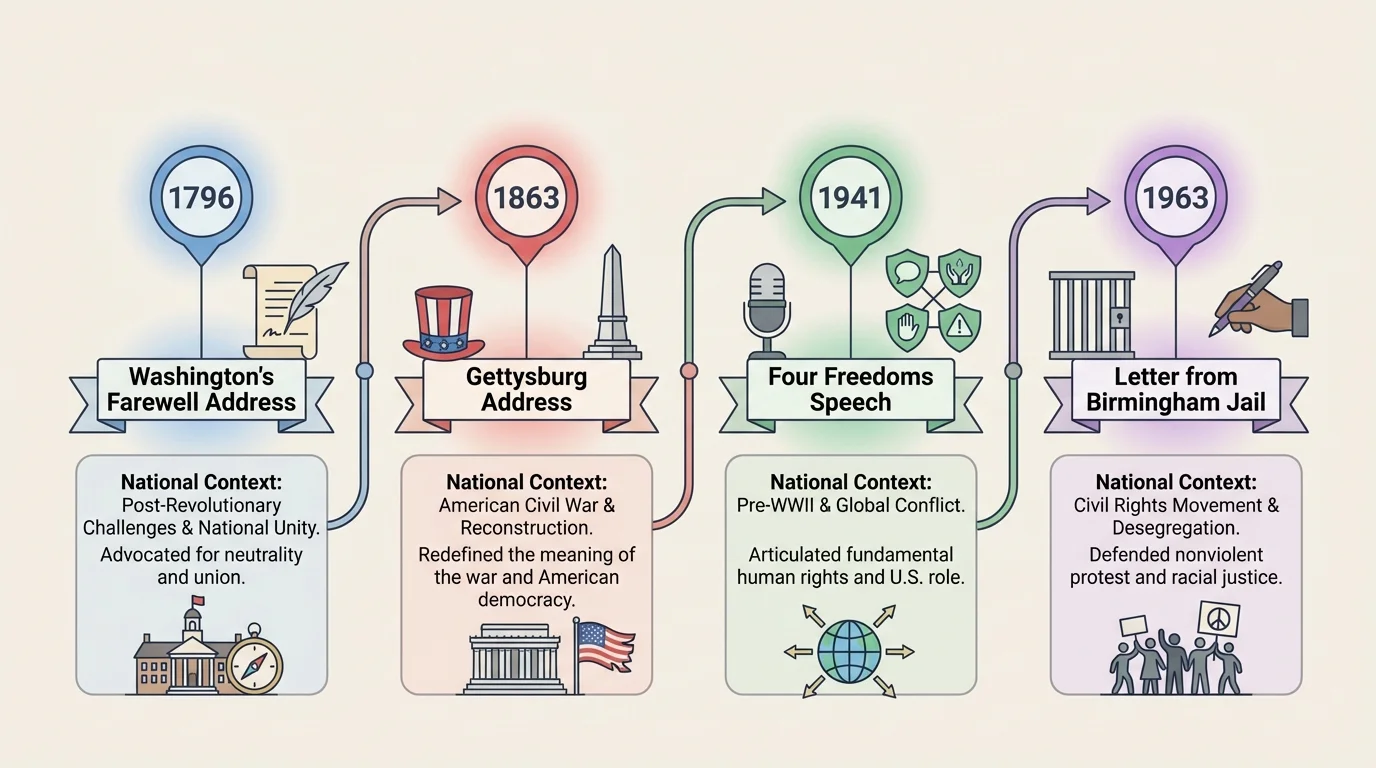
When historians study these documents, they often pair them with other primary sources: newspaper reactions, letters, government records, photographs, and speeches by supporters or opponents. Secondary sources then help explain larger patterns. For example, a historian might use military records and political debates to deepen understanding of Lincoln's address, or legal history and church statements to interpret King's letter. The document itself remains central, but outside sources sharpen interpretation.
The timeline also reminds readers that American ideals are repeatedly tested. The same country that speaks of liberty must confront factional politics, civil war, economic insecurity, racism, and global violence. The documents endure because they do not pretend those tensions are simple. Instead, they confront conflict directly and attempt to guide public judgment.
Close analysis begins with a few essential questions. What is the author's claim? What problem is the author responding to? Who is the intended audience? What is the tone: urgent, reflective, accusatory, hopeful, mournful, or formal? How does the text move from one idea to the next? In complex nonfiction, logical progression matters. An argument is not just a list of thoughts. It is a sequence in which each point prepares for the next.
Readers should also look for rhetorical appeals. An appeal to reason uses evidence, examples, and logic. An appeal to ethics builds credibility and moral authority. An appeal to emotion stirs sympathy, pride, grief, fear, or hope. Great public documents often combine all three. King, for instance, reasons carefully about justice, presents himself as a moral and religious thinker, and evokes the pain of discrimination. Lincoln honors the dead while also making a precise argument about national purpose.
Another important tool is attention to parallelism, the repetition of grammatical patterns for emphasis and rhythm. Parallelism can make an idea easier to remember and can give a speech a ceremonial or persuasive force. Roosevelt's four freedoms are memorable partly because they are presented in a balanced, repeated form. Lincoln's clauses build in measured sequence. King often repeats patterns to intensify moral pressure.
Logical progression in complex texts means tracing how an author builds an argument step by step. A text may begin with context, move to a problem, answer objections, and end with a call to action. If you can explain why each paragraph appears where it does, you are analyzing structure, not just content.
Finally, readers should consider whether the author uses allusion, references to earlier texts or ideas. Lincoln alludes to the Declaration of Independence with "all men are created equal." King draws on the Bible, the Constitution, and major thinkers such as Augustine and Aquinas. These allusions connect present conflicts to larger moral and historical traditions.
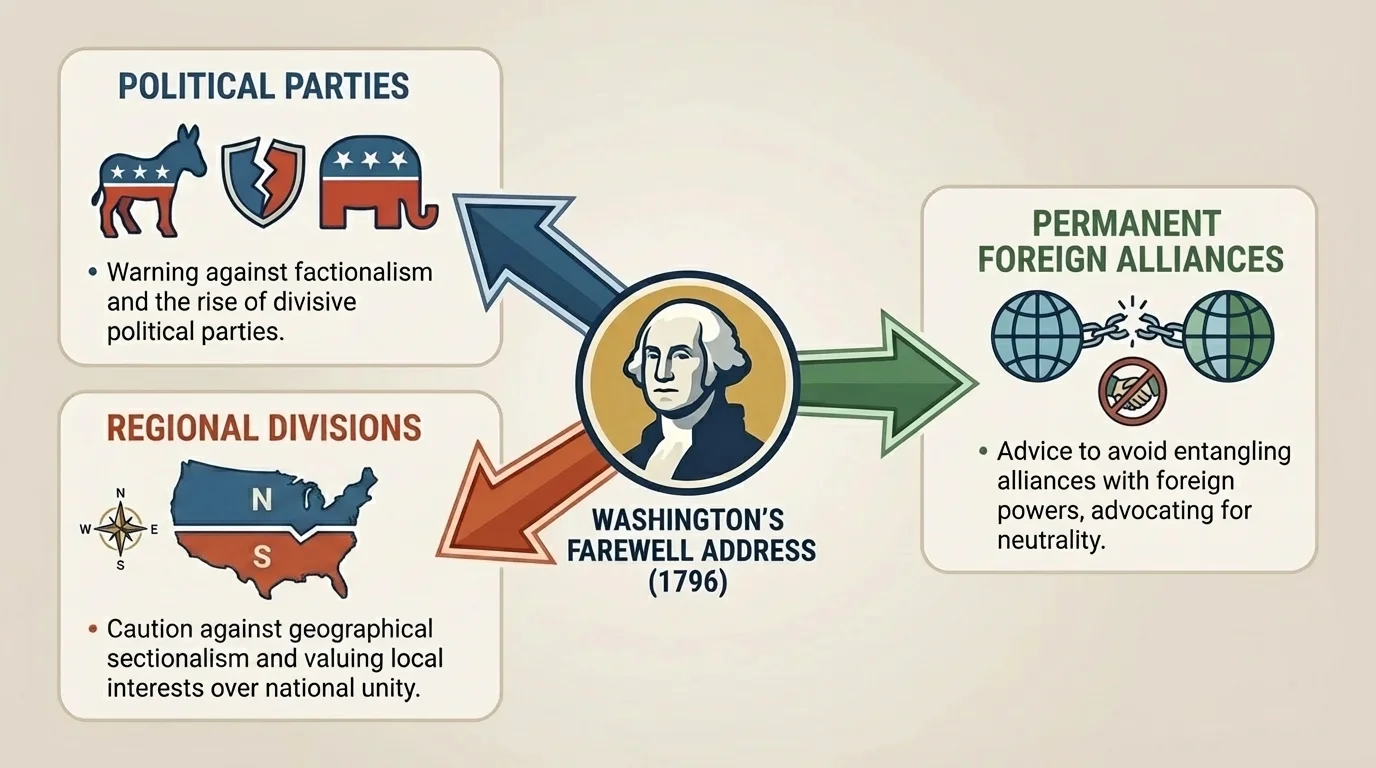
Washington's Farewell Address works like a network of connected warnings, as [Figure 2] helps illustrate. Written at the end of his presidency, the address is not a campaign speech or a celebration. Its tone is restrained, formal, and concerned. Washington presents himself as a leader stepping away from power, which strengthens his ethical appeal. Because he is leaving office, his advice sounds less self-interested and more like civic instruction.
One major theme is national unity. Washington worries that regional loyalties, party conflict, and personal ambition could fracture the republic. He warns against the "baneful effects of the spirit of party," meaning destructive factionalism. Today political parties seem normal, but Washington feared that intense partisan conflict would encourage citizens to place party above country. His argument suggests that republics survive only when citizens can disagree without destroying public trust.
Another major concern is foreign policy. Washington advises the nation to avoid permanent alliances that might pull it into unnecessary conflicts. This advice arose from a fragile moment in which European powers were fighting and the United States was relatively weak. His warning is sometimes oversimplified as total isolation, but the address is more careful than that. Washington does not reject all international relations; he cautions against attachments that distort independent judgment.
The address also stresses the importance of morality, religion, and education in preserving self-government. Whether or not modern readers agree with all of Washington's assumptions, they can see that he links political stability to civic character. A democracy, in his view, depends not only on laws and institutions but also on habits of responsibility.
As the warning pattern in [Figure 2] makes clear, Washington organizes the address by moving from gratitude and farewell into broader civic advice. The structure matters. He does not merely list concerns; he builds from personal departure to national instruction. That progression helps transform a retirement statement into a lasting political document.
[Figure 3] Lincoln's speech gains much of its power from compressed design. Delivered in 1863 at the dedication of a cemetery after the Battle of Gettysburg, the speech is astonishingly brief. Yet within a small number of sentences, Lincoln moves from the nation's founding, to the Civil War's present crisis, to a renewed mission for the future.
The opening phrase, "Four score and seven years ago," immediately places the speech in historical time and points back to 1776, the year of the Declaration of Independence. This is a crucial choice. Lincoln does not begin with the Constitution. He begins with the Declaration's principle that "all men are created equal." By doing so, he frames the war as a test of equality and democratic government, not merely as a dispute over territory or rebellion.
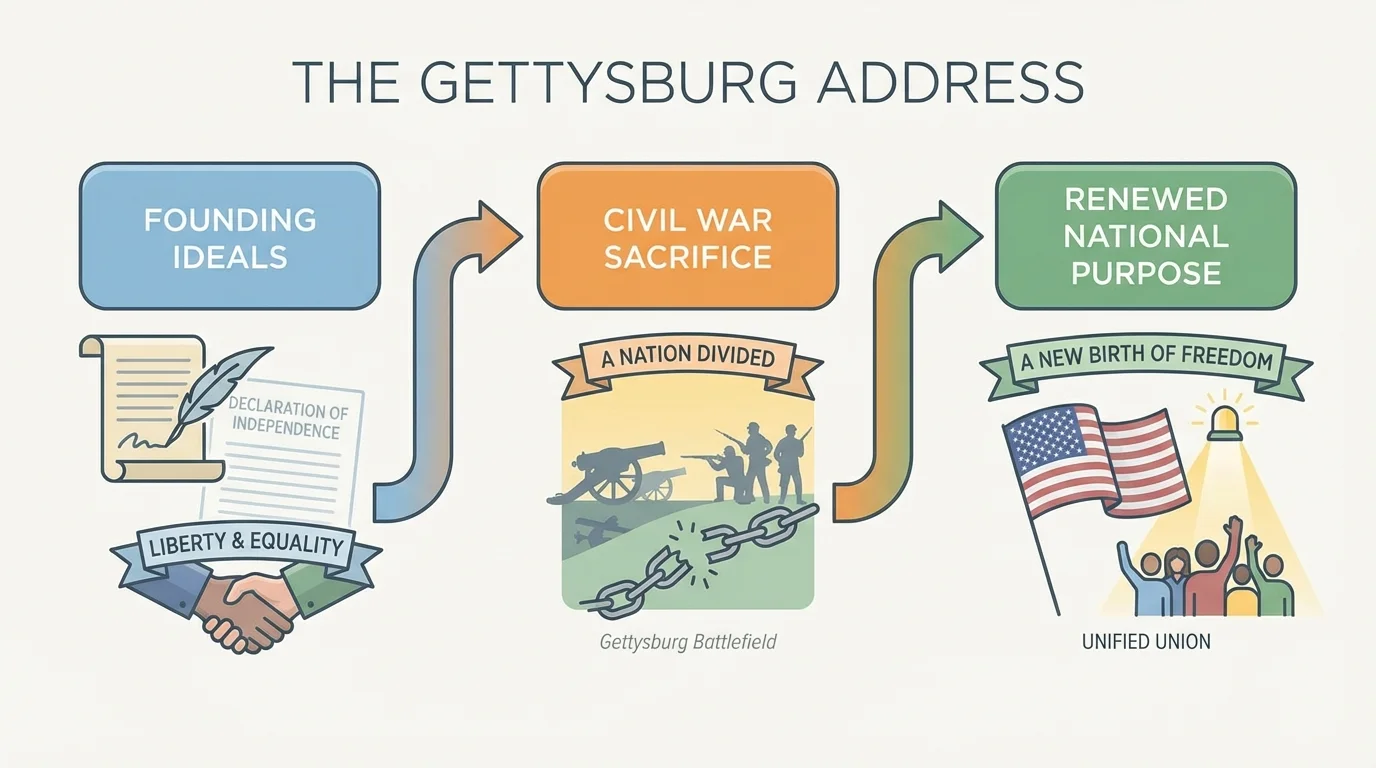
Lincoln then turns to the present, describing the nation as engaged in a great civil war that tests whether such a nation "can long endure." That sentence transforms a military conflict into a philosophical question. Can democracy survive internal division? Can a nation built on equality sustain itself when that equality is denied? The speech turns battlefield loss into national reflection.
In the final movement, Lincoln shifts from honoring the dead to challenging the living. The dead have already consecrated the ground by their sacrifice. Therefore, the audience must dedicate itself to "the unfinished work" and to a "new birth of freedom." This phrase suggests that the nation must be remade, not simply preserved. The war's purpose becomes larger than reunion alone; it becomes a struggle to expand the meaning of freedom.
"that government of the people, by the people, for the people, shall not perish from the earth"
— Abraham Lincoln, Gettysburg Address
The design shown in [Figure 3] reveals why the speech feels inevitable despite its brevity: past ideals lead to present testing, and present sacrifice leads to future duty. Lincoln's use of parallel phrasing and balanced clauses gives the speech musical force, but its logic is just as important as its sound.
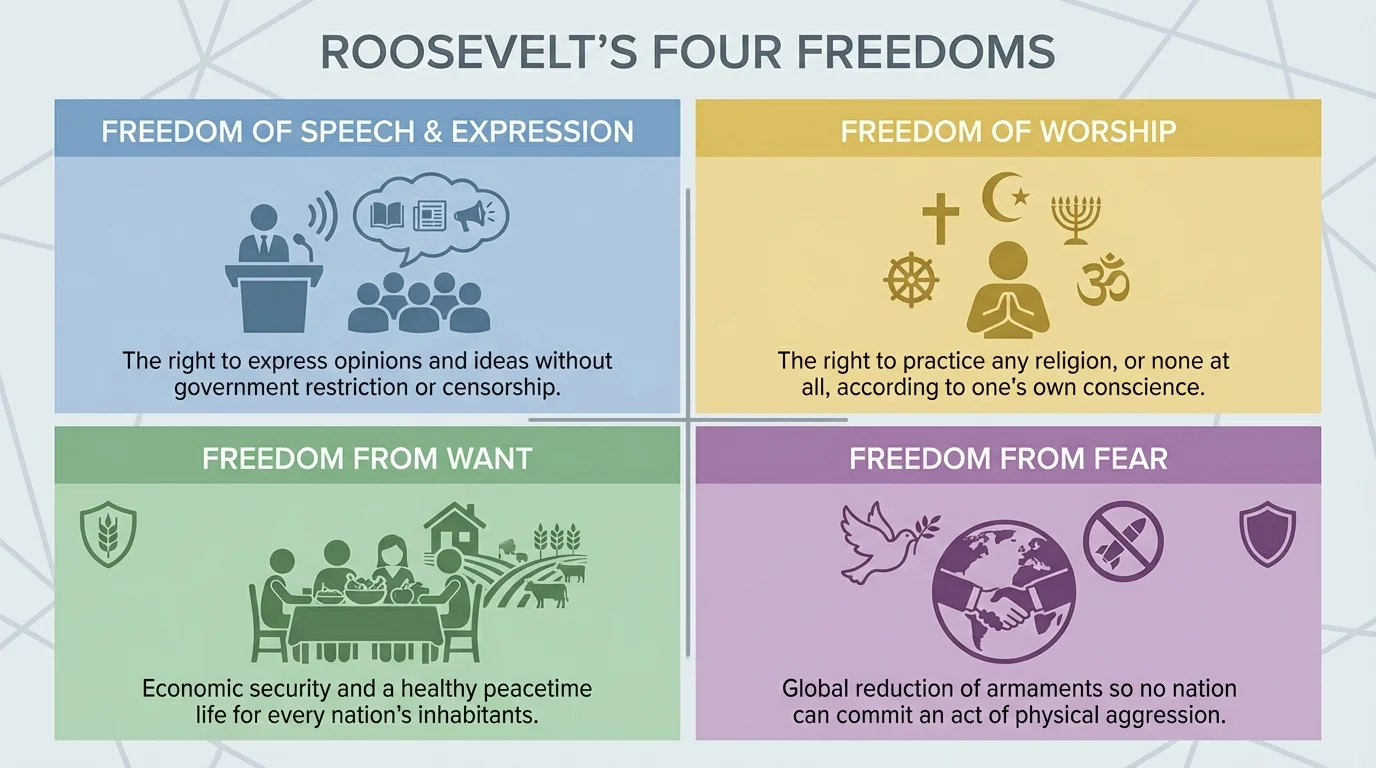
[Figure 4] Roosevelt turns broad democratic values into a memorable set of principles in a clear four-part pattern. Delivered in 1941, before the United States formally entered World War II, the speech argues that freedom is under global threat. Roosevelt wants Americans to see that events abroad matter to their own future. He links domestic values to international responsibility.
The four freedoms are freedom of speech, freedom of worship, freedom from want, and freedom from fear. The first two sound familiar as classic civil liberties. The second pair expands the discussion. Freedom from want suggests economic security and basic human welfare. Freedom from fear suggests protection from aggression and violence. Roosevelt's list therefore widens the meaning of liberty beyond narrow political rights.
This speech is especially useful for analyzing how authors define terms. Roosevelt does not treat "freedom" as one simple idea. He divides it into categories, each carrying moral and political weight. That strategy helps listeners remember the concepts and also encourages them to see freedom as both personal and collective. A society is not truly free, he suggests, if people lack basic security or live under constant threat.
Roosevelt also uses contrast effectively. Democracy is set against tyranny; security is set against aggression. The speech's logical progression moves from danger, to values, to responsibility. In other words, Roosevelt first explains the threat, then defines what must be protected, and finally encourages action. This structure makes the speech persuasive because it ties ideals to urgency.
The comparison in [Figure 4] also helps modern readers notice that the speech speaks to both rights and conditions. That distinction matters. Some freedoms require protection from government interference, while others require social and political systems that make human dignity possible.
[Figure 5] King's letter unfolds through a carefully ordered argument in its movement from criticism to moral defense to urgent action. Written in 1963 after King was jailed for participating in nonviolent protest in Birmingham, Alabama, the letter responds to white clergymen who called the demonstrations unwise and untimely. King answers them directly, which gives the text a strong sense of audience and purpose.
A central strength of the letter is its combination of logic and moral force. King explains why direct action is necessary: negotiation has failed, injustice is entrenched, and waiting usually protects the status quo. He famously argues that "justice too long delayed is justice denied." This sentence captures one of the letter's deepest claims: delay is not neutral when people are suffering. Time does not automatically solve moral problems.
King also distinguishes between just and unjust laws. Drawing on religious and philosophical traditions, he argues that a just law uplifts human personality, while an unjust law degrades it. This distinction is crucial because it rebuts the idea that all lawbreaking is automatically wrong. King supports civil disobedience when laws violate moral principles and when protest remains open, loving, and willing to accept legal penalties.
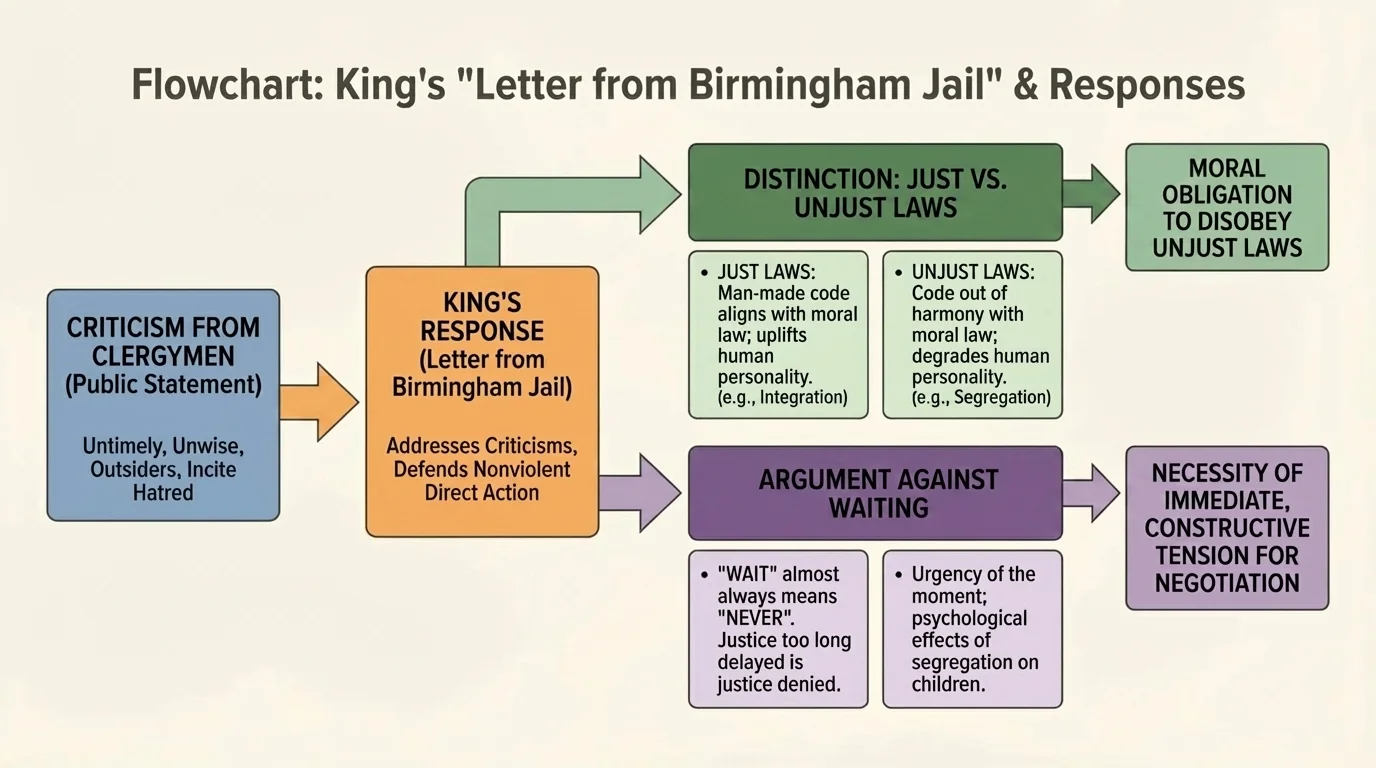
The letter is also a master class in counterargument. King does not ignore criticism; he quotes or paraphrases it, then answers it point by point. This strengthens the argument because readers can see him engaging opposing views rather than avoiding them. His tone shifts skillfully: respectful at times, disappointed at others, and deeply urgent throughout.
King's use of allusion is rich and deliberate. He refers to biblical figures, early Christians, American founders, and philosophers. These references show that his movement belongs within a long tradition of moral witness. The argument map in [Figure 5] makes clear that the letter is not an emotional outburst; it is a highly organized defense of action against injustice.
Case study: tracing King's logic
Step 1: Identify the criticism.
The clergymen argue that protest is badly timed and that activists should wait.
Step 2: Find King's response.
King explains that African Americans have already waited for generations and that negotiation without pressure usually changes nothing.
Step 3: Identify the principle behind the response.
He argues that justice requires action when laws and customs deny human dignity.
Step 4: Explain why the structure matters.
By moving from objection to response to moral principle, King makes the letter persuasive to readers who may not already agree with him.
King's letter remains powerful because it addresses a recurring question in democratic society: when institutions move too slowly, what responsibilities do citizens have? The text insists that moral clarity, disciplined protest, and public pressure are sometimes necessary to make a nation live up to its professed ideals.
Although these documents come from different centuries, several themes connect them. One is democracy as a fragile achievement rather than a permanent guarantee. Washington fears internal division. Lincoln asks whether democratic government can survive civil war. Roosevelt argues that democracy must be defended against global threats. King exposes the contradiction between democratic promises and racial injustice.
Another shared theme is the relationship between ideals and action. None of these authors treats national principles as merely decorative language. Washington wants citizens to practice restraint and responsibility. Lincoln asks the living to continue the unfinished work. Roosevelt turns values into a call for preparedness and commitment. King demands concrete action against unjust systems. In every case, ideals become meaningful only when people act on them.
A third theme is sacrifice. Lincoln speaks of soldiers who gave their lives. Roosevelt prepares citizens for the burdens of global struggle. King writes from prison, making his own body part of the argument. Even Washington's peaceful retirement carries symbolic meaning: he gives up power voluntarily, reinforcing republican principles over personal rule. Sacrifice in these texts supports legitimacy. It proves seriousness.
When comparing themes, do not stop at "both texts talk about freedom." A stronger comparison explains how each text defines freedom, what threatens it, and what response the author believes is necessary.
These documents also reveal different understandings of national identity. Is the United States primarily a union that must hold together, a democracy devoted to equality, a defender of universal freedoms, or a nation obligated to correct injustice within itself? The answer across the texts is not one idea instead of another. It is a layered identity built through debate, crisis, and revision.
Washington, Lincoln, Roosevelt, and King all persuade, but they do so in distinct ways. Washington writes in a measured, advisory voice. Lincoln uses condensed ceremonial language. Roosevelt speaks with strategic clarity suited to a broad national audience. King develops a sustained written argument full of examples, counterarguments, and allusions. Comparing these styles helps students see that effective rhetoric depends on situation and purpose.
Their structures also differ. Washington accumulates warnings and principles. Lincoln compresses his argument into a three-part movement from past to future. Roosevelt defines a set of values and ties them to coming danger. King builds a layered response to criticism and then broadens it into a moral indictment of delay and moderation. To analyze progression well, ask not only what the author says first and last, but why that order strengthens persuasion.
| Document | Immediate Context | Central Concern | Notable Strategy |
|---|---|---|---|
| Washington's Farewell Address | End of presidency in a new republic | Preserving unity and stability | Warning and civic counsel |
| Gettysburg Address | Civil War cemetery dedication | National purpose and equality | Brevity, parallelism, ceremonial logic |
| Four Freedoms Speech | Threat of world war | Defining and defending freedom | Memorable list, contrast, broad appeal |
| Letter from Birmingham Jail | Jailing during civil rights protest | Justice and urgency | Counterargument, allusion, moral reasoning |
Table 1. Comparison of the four documents by context, central concern, and rhetorical strategy.
Readers should pay close attention to tone as well. Washington sounds cautious and paternal. Lincoln sounds solemn and elevating. Roosevelt sounds confident but cautionary. King sounds disciplined, disappointed, and morally insistent. Tone shapes how audiences receive ideas. A demand for change can sound reckless in one voice and principled in another.
The documents themselves are primary sources, so analysis should begin with the words on the page. Quoting key lines, tracing repeated phrases, and identifying structural shifts are essential habits. However, secondary sources provide important support. A historian may explain debates about Washington's foreign policy, the political stakes of Lincoln's reference to the Declaration, the international crisis facing Roosevelt, or the religious and legal context behind King's arguments.
Strong interpretation balances both kinds of evidence. If a reader uses only history and ignores the writing, the document becomes background material rather than literature. If a reader uses only literary devices and ignores the historical moment, the argument may lose its urgency and real-world meaning. The best reading integrates textual evidence with context.
Primary and secondary sources work together because one gives direct evidence and the other helps explain it. A speech, letter, or address shows what was said; later scholarship helps readers understand how that language fit into broader events and why it mattered to different audiences.
This balanced method matters far beyond history class. In current events, people often see short quotations online without context. Careful readers ask when the statement was made, to whom, for what purpose, and what larger debate surrounds it. The habits used on seminal documents are also habits of responsible citizenship.
These works remain relevant because the issues they raise have not disappeared. Political polarization still tests unity. Questions about equality and citizenship still shape public life. Debates over national security and human rights still influence policy. Protest movements still confront accusations of impatience or disorder. When students read these documents, they are not studying dead language. They are entering arguments that continue in modern America.
They also matter because they show that language can do real civic work. A speech can redefine a war. A farewell can shape political tradition. A list of freedoms can broaden democratic vision. A letter from a jail cell can challenge a nation's conscience. These texts remind readers that words are not only descriptive; they can be formative. They can help a society imagine what it owes its people and what its people owe one another.
For that reason, analyzing seminal U.S. documents is not only an academic exercise. It is training in how to read public language critically, historically, and ethically. Students learn to recognize structure, evaluate arguments, compare themes, and ask whether national ideals are being fulfilled or merely repeated. That kind of reading is one of the foundations of an informed democracy.
