Some of the most important decisions in school, work, and public life are not made by one person speaking alone. They are made in rooms where people interrupt, persuade, disagree, revise, and finally decide. A strong group discussion is not just "talking together." It is a skillful process that depends on rules people build together. When peers set those rules well, discussion becomes more fair, more efficient, and more thoughtful.
For students in grades 9 and 10, collaborative discussion is not only about participating. It is about helping create the conditions that make participation meaningful. That includes deciding how people will listen, how they will disagree, how the group will make choices, what the group is trying to accomplish, when tasks must be done, and who is responsible for what. These decisions shape whether a group produces confusion or results.
Collegial discussion is a respectful, goal-directed exchange of ideas among peers who treat one another as serious contributors. Consensus is a decision reached when the group can support or accept a choice, even if it is not every person's first choice. Alternate views are different perspectives or solutions that are clearly presented and considered before a final decision is made.
Groups need rules because discussion is not automatically productive. Without agreed expectations, one person may dominate, quieter members may be ignored, deadlines may slip, and decisions may feel unfair. Shared norms make the process visible. They tell everyone what "good participation" looks like and what the group will do when problems arise.
A group discussion works best when students know that their ideas will be heard and judged by their quality, not by volume or popularity. Rules create trust. If students know that interruptions are limited, evidence matters, and disagreements must stay respectful, they are more willing to speak honestly. That makes the conversation deeper and often leads to better decisions.
Rules also save time. This may seem surprising because making rules takes a few minutes at the start. But those minutes prevent much larger problems later. A group that agrees on deadlines, turn-taking, and decision methods does not have to stop every few minutes to argue about process. Instead, it can focus on content.
Another reason rules matter is accountability. In many school groups, conflict begins when work is unevenly shared. If the group has already set deadlines, assigned roles, and agreed on what counts as contribution, it is easier to address the problem fairly. The issue becomes less personal and more procedural.
Professional teams in science, business, law, and medicine often spend time establishing meeting norms before discussing major issues. Clear process rules are not a sign of weakness; they are a sign that the group takes thinking seriously.
Strong groups understand that rules are not meant to silence people. They are meant to make sure more people can contribute. Good discussion norms increase freedom to think because they reduce chaos, confusion, and unfairness.
[Figure 1] shows clear examples of productive and unproductive behavior. One of the first jobs in a student group is to agree on discussion norms. These are shared expectations for how the group will speak, listen, and respond. Effective norms usually include listening without interrupting, referring to evidence, inviting quieter voices in, asking clarifying questions, and staying focused on the goal of the discussion.
Good listening is active, not passive. Active listening means paying close attention, taking notes if needed, and responding to what was actually said rather than preparing a reply while someone else is still speaking. In a collegial discussion, students build on ideas with phrases such as, "I want to add to that," "I see your point, but the evidence suggests something different," or "Can you explain what you mean by that conclusion?"
Another key norm is separating the person from the idea. Students should challenge claims, reasoning, or evidence, but not attack character. Saying, "That evidence is limited because it only shows one side," is appropriate. Saying, "You clearly do not understand this," is not. Productive groups critique ideas firmly while still respecting the people who share them.
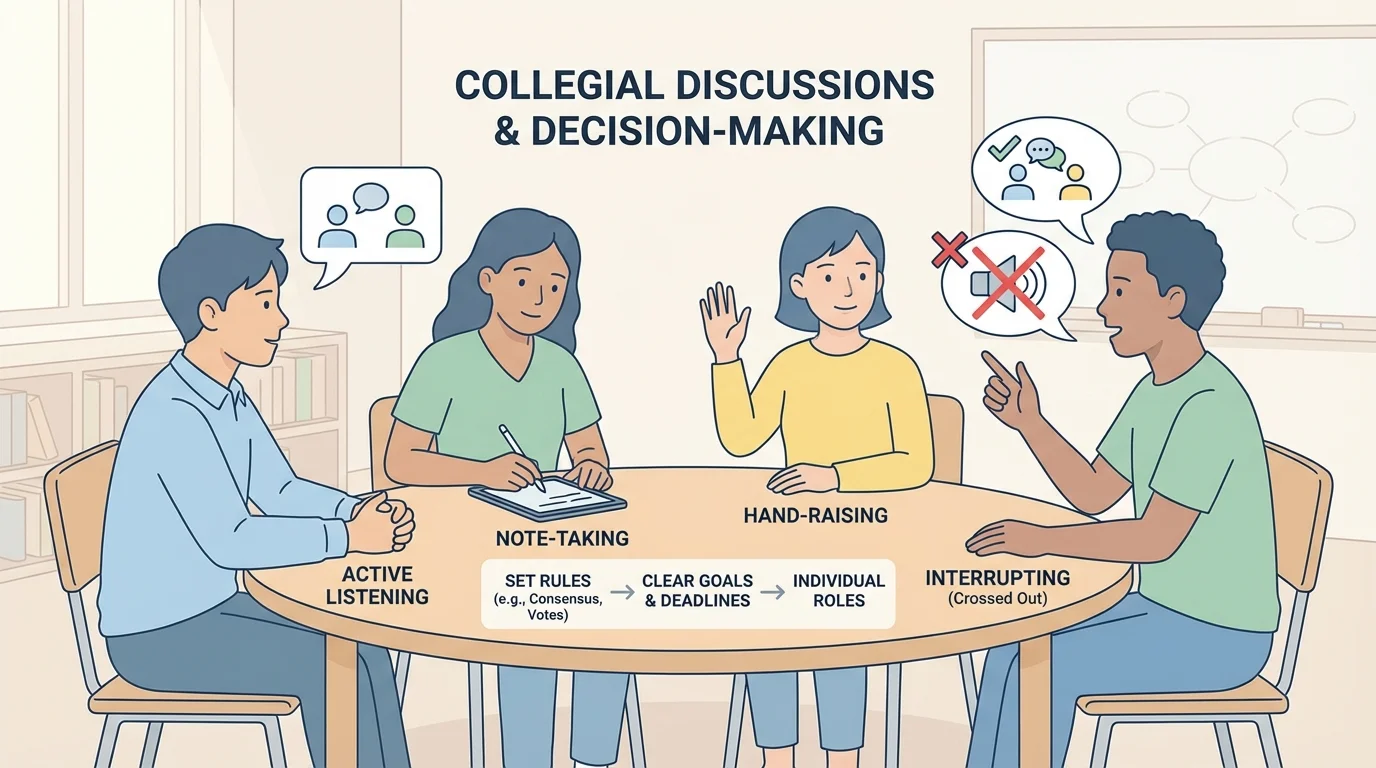
Groups should also decide how turns will work. In some discussions, students simply speak when there is a natural opening. In others, especially when the topic is controversial, the group may agree to a more structured pattern so everyone has a chance to contribute. A simple rule such as "No one speaks a second time until everyone who wants to has spoken once" can greatly improve balance.
Evidence-based speaking matters too. If students are discussing a text, article, lab result, or issue, claims should be linked to reasons and support. This makes discussion more persuasive and less emotional. It also encourages precision. Instead of saying, "I just feel like this idea is better," a stronger comment is, "This option fits our goal better because it is faster, costs less, and matches the evidence from our research."
Later, when disagreements become stronger, the behaviors introduced in [Figure 1] still matter. Respectful listening and clear turn-taking are not only for calm conversations; they are most important when the discussion becomes difficult.
Not every group decision should be made the same way. Effective teams choose a decision-making method that fits the type of issue. If the issue affects everyone's work deeply, the group may need broader agreement. If the issue is small and time is short, a quick vote may be enough.
Informal consensus works well when the group wants a solution everyone can support. This does not mean every person is equally excited. It means the group discusses options until members can say, "I can live with this," or "This is not my first choice, but I support moving forward." Informal consensus is often useful for setting rules, choosing a research focus, or agreeing on the main message of a presentation.
Voting on key issues can be useful when the group has discussed the options fully but still cannot reach agreement. A vote is fast and clear, but it should not replace discussion. If students vote too early, the process becomes a popularity contest. A strong group discusses evidence first, clarifies the options, and then votes if necessary.
Presentation of alternate views is especially important when the group wants to make a fair decision but also wants to preserve minority perspectives. In this method, students clearly present competing ideas before choosing one. Sometimes the final product even includes a brief mention of the rejected option and why it was not selected. This strengthens reasoning because the group shows it considered more than one path.
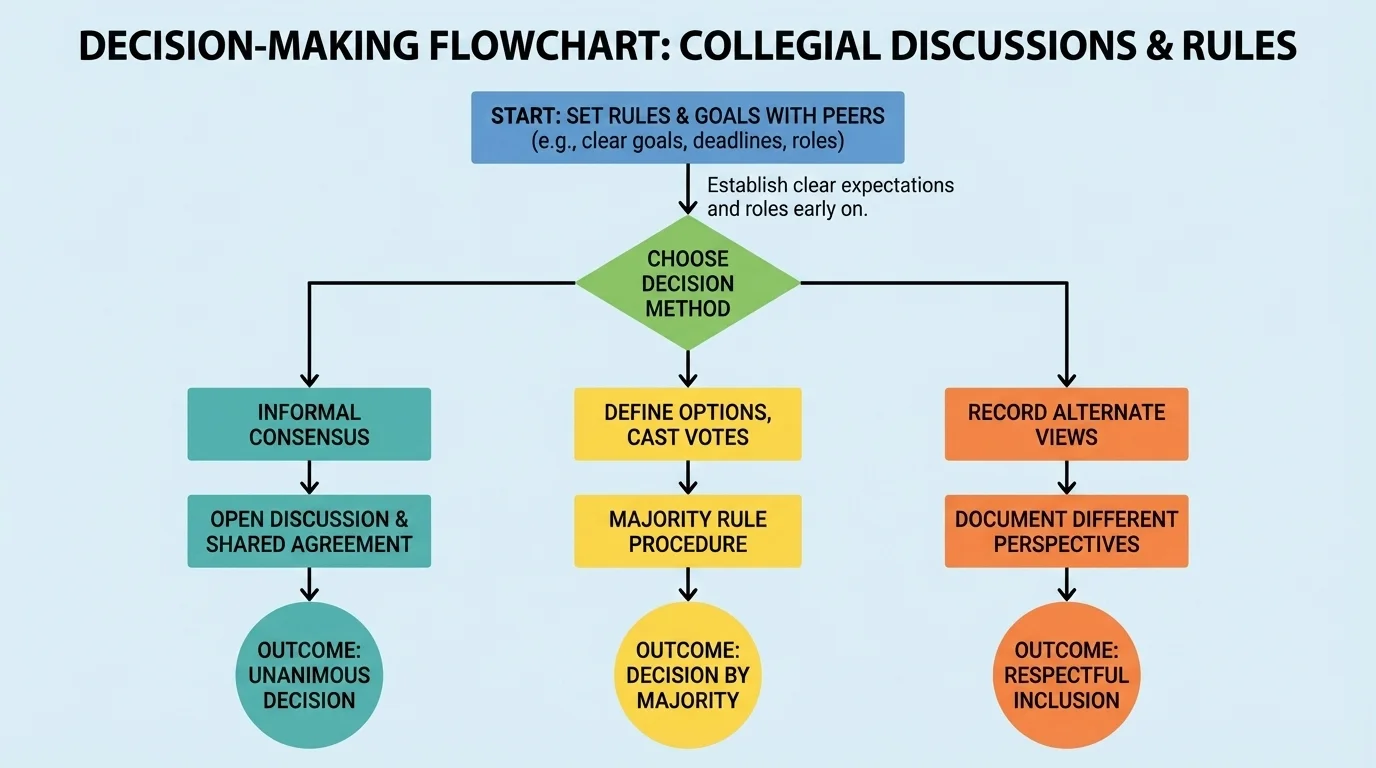
Each method has advantages and limits. Consensus can build commitment, but it may take longer. Voting is efficient, but some students may feel unheard if discussion is weak. Presenting alternate views improves fairness and critical thinking, but it requires careful listening. Mature groups are flexible. They do not treat one method as always best.
| Method | Best Used When | Strength | Possible Risk |
|---|---|---|---|
| Informal consensus | The group needs broad support | Builds commitment | Can take time |
| Vote | A decision must be made efficiently | Fast and clear | May oversimplify disagreement |
| Alternate views | Several strong options exist | Encourages fairness and reasoning | Needs strong organization |
Table 1. Comparison of common group decision-making methods.
When students later assign roles or plan timelines, the branching logic from [Figure 2] remains useful. A group may use consensus for major goals, but a simple vote for smaller choices such as presentation order or design details.
Good decisions depend on good process. A smart choice is not just about the final answer; it is also about whether the group reached that answer fairly. When students can explain how they listened, compared options, and decided, they show stronger reasoning and stronger collaboration.
A useful rule is to match the method to the stakes. If the decision will shape everyone's workload or message, seek broader agreement. If the choice is minor, do not spend half the meeting on it. Wise groups protect time for the issues that matter most.
Many group problems are not really about personality. They are about unclear goals. A group works better when its members can answer three questions: What are we trying to accomplish? What will count as success? By when must each part be done? A visible timeline, as shown in [Figure 3], turns a vague assignment into a sequence of achievable steps.
A strong goal is specific. "Do the project" is not a goal. "Create a six-minute presentation explaining two solutions to school food waste and defending the better one with evidence" is much stronger. Specific goals help students make better decisions because they know what standard they are aiming for.
Deadlines matter because group work usually involves multiple stages: planning, research, drafting, revising, and presenting. If all students think only about the final due date, important steps get delayed. Instead, groups should create smaller deadlines, sometimes called milestones. These checkpoints keep the group moving and reveal problems early.
For example, if a presentation is due on Friday, the group might decide that research is finished by Monday, slides are drafted by Wednesday, and rehearsal happens on Thursday. That schedule gives time to adjust if something goes wrong. Waiting until Thursday night to combine everyone's work almost guarantees stress and weak results.
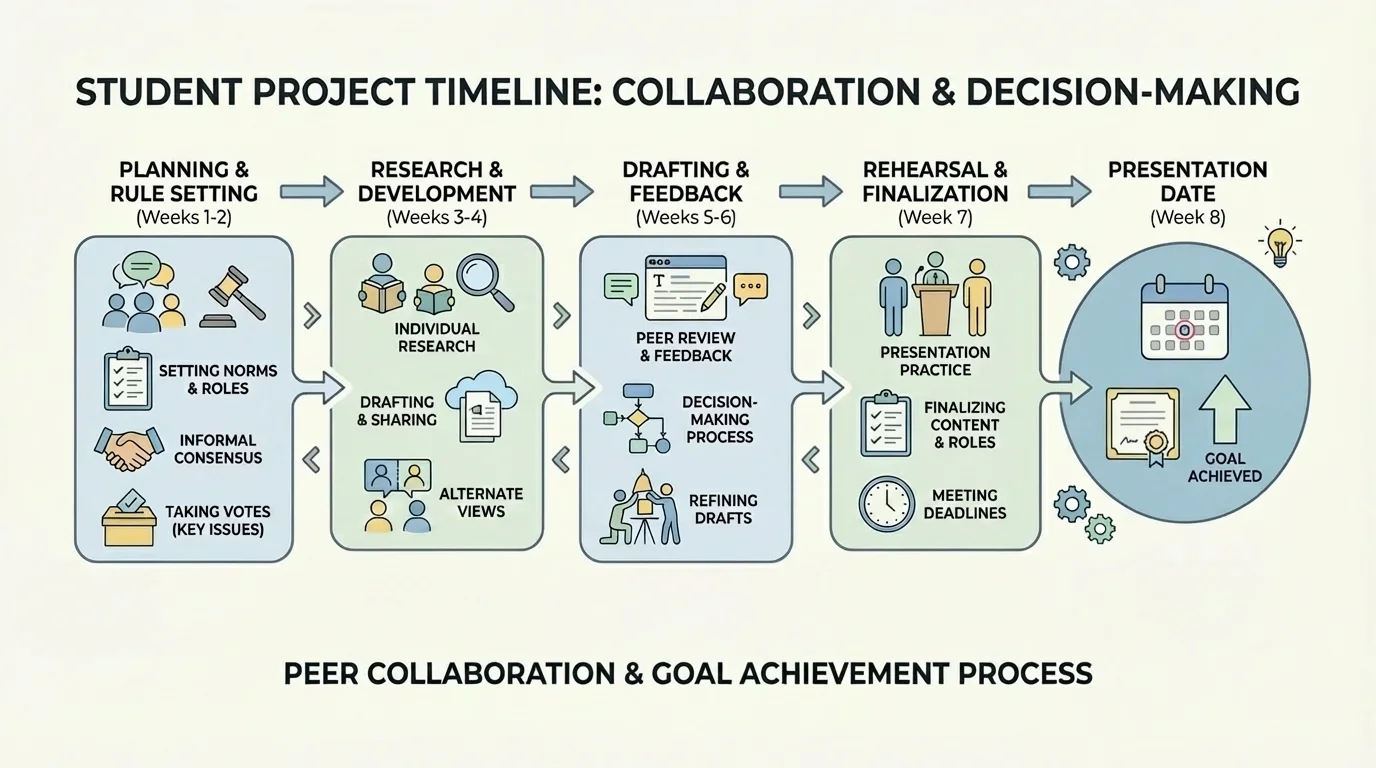
Deadlines should be realistic, not imaginary. If a task needs library research, interviews, or design work, the group should plan enough time. At the same time, deadlines should be firm enough to create action. A good deadline is clear, visible, and accepted by the whole group.
Case study: turning a broad assignment into a workable plan
A group has to prepare a class discussion on whether schools should limit student phone use during class.
Step 1: Define the goal
The group agrees that its goal is to present both sides fairly and recommend one policy supported by evidence.
Step 2: Break the work into milestones
They set deadlines for finding sources, selecting the strongest evidence, drafting speaking notes, and rehearsing.
Step 3: Match deadlines to reality
They notice one member has a game on Wednesday, so they move rehearsal to Tuesday instead of pretending Wednesday will work.
The result is a clearer process and less last-minute conflict.
As the timeline in [Figure 3] makes clear, deadlines are not only about finishing on time. They help the group see whether its plan is balanced and whether responsibilities are spread fairly across the week.
Even in a highly cooperative group, individual roles help discussion run more smoothly. A clear role gives each student a defined responsibility. Roles reduce confusion because students know who is guiding the conversation, who is keeping notes, and who is tracking time or evidence.
One common role is the facilitator. The facilitator does not control the group or make all the decisions. Instead, this person helps the group stay on topic, invites quieter members to speak, and makes sure the discussion follows the agreed norms. A second role is the recorder, who writes down key ideas, decisions, and tasks. This matters because groups often remember discussion differently. Written notes reduce later arguments about what was decided.
A timekeeper helps the group use minutes wisely by reminding members when it is time to move on. An evidence checker makes sure claims are supported and that sources or examples are accurate. A presenter or spokesperson may deliver the final result, but this role should not excuse others from contributing to the thinking.
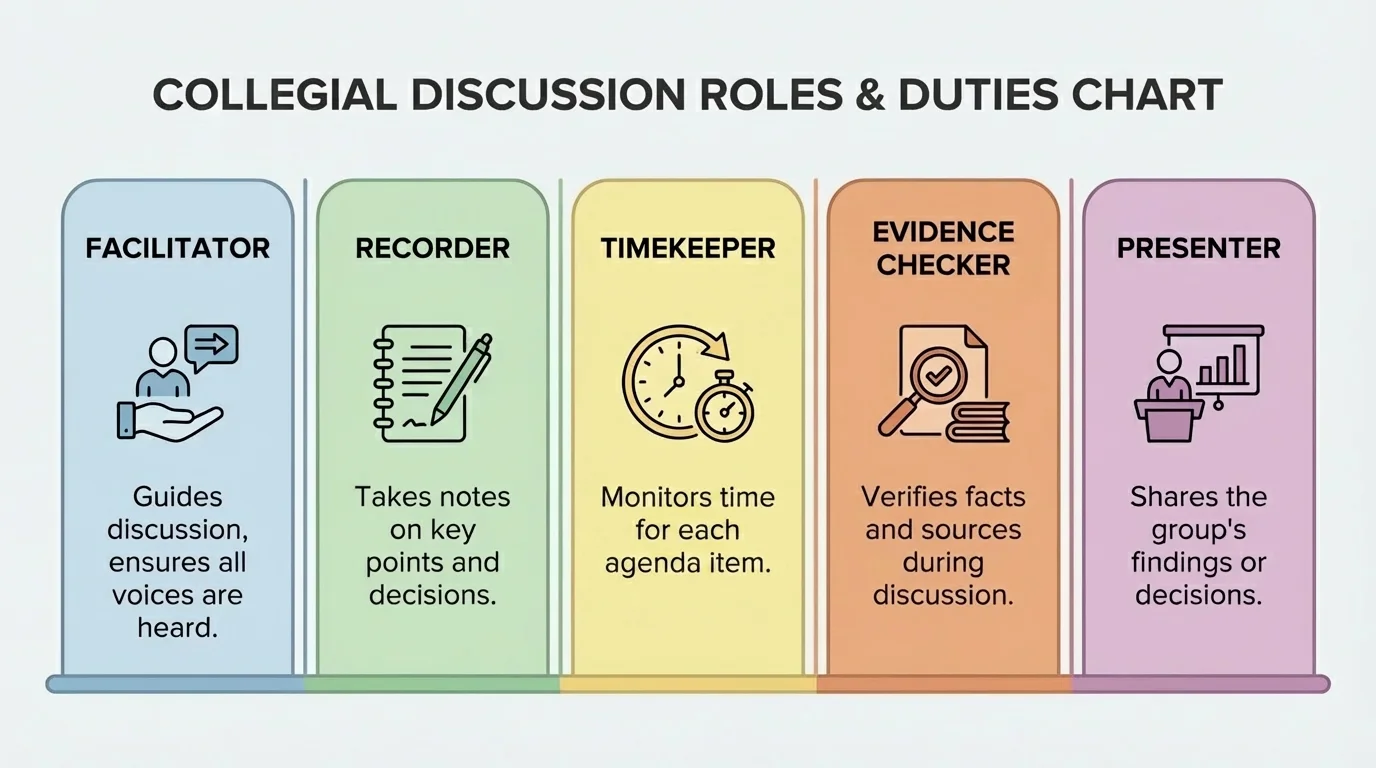
Roles should fit the task. A short planning meeting may only need a facilitator and recorder. A larger project may need several specialized roles. Good groups also understand that roles can rotate. Rotation is fair and helps students practice different skills instead of getting stuck in one position.
Accountability improves when roles are visible. If the recorder forgets to document a decision or the timekeeper says nothing while the group gets stuck, the group can address the issue clearly. This is another reason process rules matter: they make responsibilities observable.
You already know that strong speaking involves clarity, evidence, and awareness of audience. Collaborative discussion adds another layer: you must also help the group function. Speaking well in a group means not only making your own point but also helping others contribute and helping the team move toward a decision.
Later, when a group needs to revise a plan under pressure, the role structure in [Figure 4] helps members respond quickly. If each person knows their responsibility, the group can adapt without starting from zero.
Good discussion does not avoid disagreement. It uses disagreement to improve thinking. In fact, if everyone agrees instantly, the group may not be thinking deeply enough. The key is to disagree in ways that stay focused on the issue and move the conversation forward.
One useful strategy is to ask questions before arguing. If a classmate says, "We should choose the cheaper option," another student might respond, "What trade-offs come with that?" or "Are we measuring cost only in money, or also in time and quality?" Questions slow down rushed decisions and often reveal that students are using different assumptions.
Another strategy is to paraphrase before responding. For example: "So your point is that the stricter rule would reduce distractions, but you are worried it may feel unfair. I agree with the concern about distraction, but I think we need a more flexible solution." This shows listening and makes disagreement more precise.
Groups should also decide what happens when disagreement remains. Sometimes members compromise by combining parts of two ideas. Sometimes they use consensus language such as, "Can everyone support this?" Sometimes they vote. And sometimes they record the minority view so it is not erased. Presenting alternate views is especially valuable when the rejected idea still has strong reasoning behind it.
Respectful disagreement also means watching rhetoric. Strong speakers can persuade through tone, repetition, or confidence, but persuasive delivery should not replace evidence. A mature group asks not only, "Who spoke most convincingly?" but also, "Which argument is best supported?"
"The goal of argument is not victory. It is clearer thinking."
The listening habits shown earlier in [Figure 1] support this kind of disagreement. If students interrupt less, clarify more, and refer back to reasons, conflict becomes intellectually useful instead of personally destructive.
Consider a team of four students preparing a proposal for how their school can reduce lunchtime waste. At the first meeting, they do not jump straight into ideas. Instead, they spend a few minutes setting rules: one person speaks at a time, everyone must refer to evidence from at least one source, and no final decision will be made until at least two different solutions are presented.
Next, they set a goal: create a persuasive proposal that compares two realistic waste-reduction strategies and recommends one. Then they set deadlines: source collection by Monday, outline by Tuesday, draft slides by Thursday, and rehearsal by Friday morning. They assign roles: facilitator, recorder, evidence checker, and presenter, while agreeing that all members will help with research and revisions.
During discussion, one student wants compost bins, while another prefers reducing packaging from the cafeteria. Instead of arguing immediately, the group asks each student to present the strengths and limits of the idea. The evidence checker notices that the compost plan sounds exciting but may be harder to maintain. The recorder writes both options and the reasons given. After discussion, the group reaches informal consensus: focus the presentation on reducing packaging, but include composting as a strong alternate view for future action.
This example shows what successful collegial discussion looks like. The group did not simply share opinions. It created norms, listened actively, compared options, assigned roles, and made a decision in a fair process. That is the difference between talking together and collaborating effectively.
Useful sentence starters for collegial discussions
Students often participate more effectively when they have language ready for specific situations.
To build on an idea: "I want to extend that point by adding..."
To question reasoning: "What evidence supports that conclusion?"
To disagree respectfully: "I see the logic in your idea, but I interpret the evidence differently because..."
To move toward decision: "Which option best matches our goal and deadline?"
These sentence patterns make discussion clearer and more respectful.
Students often think effective collaboration means being agreeable all the time. In reality, it means being responsible to the process. Sometimes that means speaking up when an idea is weak, a deadline is unrealistic, or a quieter classmate has not been invited in.
One common mistake is deciding too quickly. If a group chooses an idea before hearing alternatives, it may miss a stronger option. A better approach is to require at least two serious possibilities before making a major choice.
Another mistake is confusing loudness with leadership. The student who speaks most is not automatically the one who contributes most. Real leadership often looks like facilitating, clarifying, and helping others participate.
A third mistake is setting deadlines that no one really believes. Unrealistic plans create the appearance of organization without the reality of progress. Stronger groups build deadlines around actual time, task difficulty, and member availability.
Finally, some groups assign roles but ignore them. Roles only work if the group uses them. A facilitator who never redirects discussion or a recorder who keeps no notes does not help the team. Roles need follow-through.
When students improve these habits, collaborative discussion becomes more persuasive, more balanced, and more effective. The group is then able to respond to others' ideas with seriousness and express its own views with greater clarity and confidence.
