A movie scene can cost millions of dollars to create, yet a writer can build a stronger one with nothing but carefully chosen words. A hallway is never just a hallway; it can feel sterile, threatening, crowded, lonely, buzzing with gossip, or heavy with dread. The difference lies in what the writer notices and how the writer says it. Strong narrative writing does not merely report events. It conveys them so vividly that readers feel as if they are inside the experience.
When writers use broad, general language, readers receive only a rough outline. If a sentence says, "The room was messy," the reader knows the basic fact but sees very little. If it says, "Textbooks sagged off the desk, a hoodie dangled from the lamp, and pizza boxes leaned like crooked towers beside the bed," the reader gets a scene, not just information. Vivid writing turns abstract knowledge into a concrete experience.
In narrative writing, details do more than decorate the page. They help shape mood, reveal conflict, slow down or speed up pacing, and direct attention to what matters. The strongest details are purposeful. They help readers understand not only what is happening, but also why it matters to the people involved.
Precise words are specific, exact words that communicate a clear meaning. Telling details are carefully chosen details that reveal something important about a character, event, or setting. Sensory language uses words and phrases connected to sight, sound, smell, taste, touch, and movement to help readers imagine an experience vividly.
Because narratives often involve more than one event, perspective, or plot line, detail selection becomes even more important. A writer cannot describe everything. Instead, the writer chooses details that guide the reader through the most important moments and relationships.
Diction, or word choice, affects how sharply readers can picture a scene, as shown in [Figure 1]. Compare the difference between "walked" and "staggered," "looked" and "glared," "car" and "rust-flecked pickup." Precise words do not just name things; they suggest attitude, emotion, and context.
Specific nouns and strong verbs usually do more work than strings of weak modifiers. Instead of writing, "She went quickly down the hallway in a nervous way," a writer might say, "She hurried down the hallway, clutching her binder against her chest." The second version is shorter, but it reveals more. It gives movement, emotion, and a visual image.
Precision also involves choosing words with the right connotation. Two words may share a basic dictionary meaning but carry different emotional shades. "Slim" and "skinny" both describe thinness, but one often sounds positive while the other can sound critical. A writer who ignores connotation may accidentally create the wrong tone.
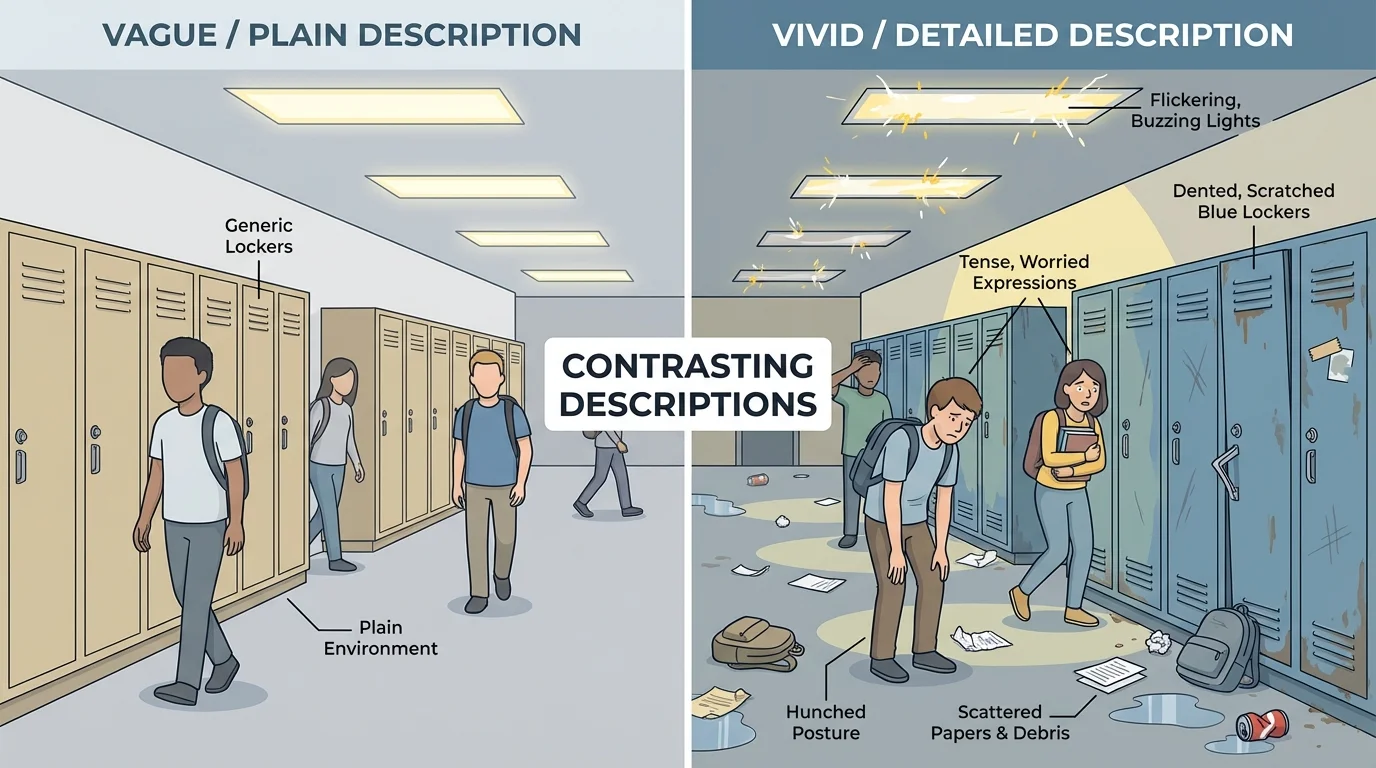
Look at how precision changes a sentence:
Weak: "The weather was bad."
Stronger: "Cold rain needled through his sweatshirt while wind shoved dead leaves across the parking lot."
The stronger version does not simply label the weather. It creates physical experience. Readers can feel the discomfort.
Before-and-after word choice
Step 1: Start with a general sentence.
"The cafeteria was noisy."
Step 2: Replace general words with precise nouns and verbs.
"Lunch trays slammed onto tables, sneakers squeaked across the tile, and voices bounced off the cinder-block walls."
Step 3: Add one detail that suggests meaning.
"Lunch trays slammed onto tables, sneakers squeaked across the tile, and voices bounced off the cinder-block walls while Jonah scanned the room for an empty seat."
The revision creates a setting and also introduces a social tension.
As the comparison in [Figure 1] makes clear, a vivid scene usually depends less on adding more words than on choosing better ones. Good description is selective and accurate.
A common mistake in narrative writing is piling on details that do not matter. If every object in a bedroom is described, readers may become overwhelmed and still learn nothing important. Telling details are details that pull extra weight. They reveal something beyond themselves.
For example, if a character's backpack is described as "stitched with debate team pins, a bus pass tucked into the side pocket, and a zipper held together by a twist of fishing line," readers learn several things at once: the character is involved, resourceful, possibly stressed, and maybe short on money. That is more powerful than a long list of random items.
Telling details often reveal:
Writers should ask, "What detail tells the reader something important?" In a storm scene, the most useful detail might not be the exact number of raindrops but the way floodwater creeps over the front step while a family argues inside. That detail connects setting to action and emotion.
Professional screenwriters and novelists often keep notebooks of specific details they notice in everyday life: the sound of a train brake, the smell of wet concrete, the way someone taps a foot under stress. Small observations become memorable writing later.
Telling details are especially useful in narratives with multiple plot lines. If one storyline centers on family tension and another on an upcoming championship game, the chosen details in each thread should reinforce that thread's emotional stakes. A trophy case might gleam in one scene, while a cracked dinner plate matters in another.
Sensory language makes a narrative feel lived-in rather than distant, and [Figure 2] illustrates how one setting can expand when several senses are layered together. Many student writers rely heavily on sight, but readers experience the world through more than what they see.
Sight includes color, shape, movement, light, shadow, and distance. Sound includes volume, rhythm, echo, silence, and interruptions. Smell is often powerful because it triggers memory quickly. Taste can make a moment physical and immediate. Touch includes texture, temperature, pressure, and pain. Writers can also include the sense of movement or body position, such as swaying, stumbling, trembling, or bracing.
Consider a rainy city street. A weak description might say, "It was raining in the city." A vivid description might say, "Bus tires hissed through puddles, the air smelled like wet asphalt and metal, and rainwater slipped down the back of her collar." The scene now includes sound, smell, and touch.
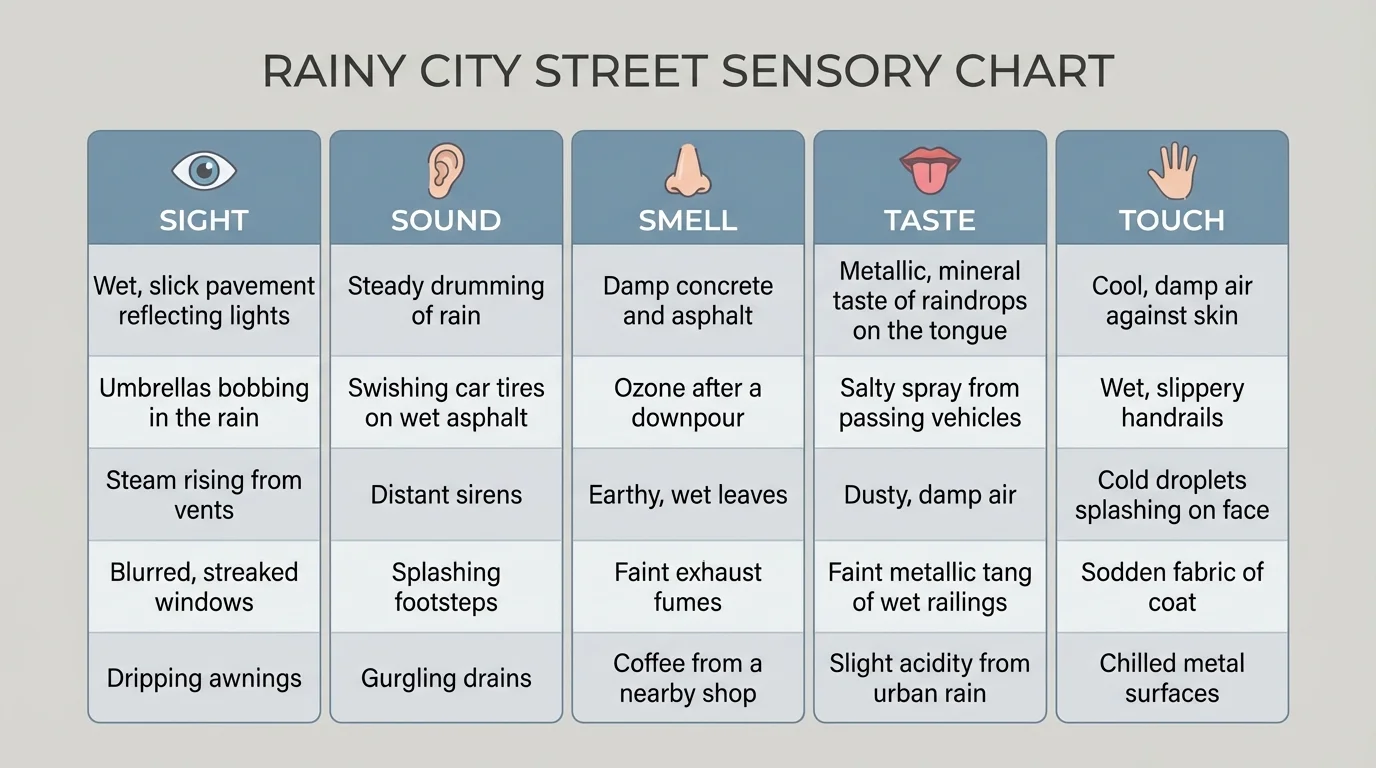
Not every scene needs all five senses. In fact, forcing every sense into every paragraph can sound artificial. The goal is not to check off a list. The goal is to choose the sensations that best fit the moment. A hospital waiting room may emphasize disinfectant smell, humming lights, and dry mouth from anxiety. A basketball game may emphasize squeaking shoes, pounding footsteps, bright lights, sweat, and the sting of cold air when the gym doors open.
How sensory language creates immersion
Readers engage more deeply when language activates memory and physical experience. Sensory details make scenes feel specific rather than generic. They also shape emotion: a "sweet, yeasty smell from the bakery" creates a different feeling from "the sour stink of spoiled milk in the sink." The senses help translate emotion into concrete experience.
Later in a narrative, the sensory pattern in [Figure 2] remains useful because a writer can return to a setting and alter the details to show change. The same street might sound lively at noon but hollow at midnight. That shift helps track mood and plot development.
Setting is not just where a story happens. It includes the physical environment, time, social context, and atmosphere surrounding events. Strong setting writing lets readers understand both location and feeling.
Mood grows out of detail choices. A forest can feel peaceful or threatening depending on what is emphasized. "Sunlight spilled through pine branches and warmed the moss" creates calm. "Branches scraped together overhead while something unseen snapped in the brush" creates tension. The place is similar, but the selected details lead readers toward different emotional responses.
Specific settings often become more believable when writers include details tied to real environments: cracked sidewalk gum in a shopping district, the beep of ID scanners at a hospital entrance, dust lifting from dry bleachers before a game. These details ground a narrative in a recognizable world.
Writers should also consider the point of view. A setting is never neutral because characters notice different things. A tired student entering school at dawn may focus on buzzing lights and the bitter taste of coffee. A varsity athlete may notice polished floors, banners, and the smell of fresh tape in the training room. The setting changes depending on who perceives it.
Characterization is the process by which a writer reveals who a character is. Instead of telling readers that a character is anxious, confident, secretive, or arrogant, strong narratives often let readers infer those qualities.
[Figure 3] Indirect characterization can come from clothing, possessions, gestures, habits, and reactions. A student who lines up pencils by size before a test appears different from one who chews a hoodie string and bounces a knee. Neither detail directly states personality, but both reveal it.

Description becomes even more effective when it connects to action. A character who "said he was calm" is less convincing than a character whose "jaw tightened so hard a muscle jumped near his ear." The body often tells the truth before dialogue does.
Dialogue can also carry vivid detail. Compare "I'm fine" with "I'm fine," she said, shredding the corner of her parking ticket into paper threads. The action adds tension and complexity. Readers understand that the spoken words and the emotional reality do not match.
From label to vivid characterization
Step 1: Start with a flat statement.
"Mr. Alvarez was strict."
Step 2: Replace the label with observable details.
"Mr. Alvarez paused at each row, straightening crooked papers with two precise taps before moving on."
Step 3: Add a detail that reveals how others respond.
"Mr. Alvarez paused at each row, straightening crooked papers with two precise taps before moving on, and the room fell silent each time his shoes stopped beside a desk."
The revision does not say "strict," but readers feel it.
The contrast in [Figure 3] reminds us that objects and posture are not random decoration. They are evidence. When chosen carefully, they build believable people.
In a narrative, description should work together with action. During important events, vivid details can slow time and heighten significance. During transitions, fewer details may keep the story moving. This balance matters even more when a narrative includes multiple plot lines, because readers need clear signals about what matters in each thread.
Suppose one plot line follows a runner preparing for a championship and another follows her brother waiting for medical test results. The runner's scenes may emphasize burning lungs, the rubber smell of the track, and the starter pistol's crack. Her brother's scenes may emphasize paper gowns, a clock's relentless ticking, and a vending machine humming in an empty hallway. Each set of details belongs to its own storyline, yet both can echo a shared mood of pressure and uncertainty.
Description can also support pacing. In a suspenseful moment, short, sharp details often increase tension: "Keys. Locked door. Footsteps." In a reflective moment, longer sentences and layered imagery may slow the pace: "The lake held the evening light in long copper bands while insects stitched circles across the surface." Effective narrative writers match detail to the speed and emotional intensity of the scene.
"The difference between the almost right word and the right word is really a large matter."
— Mark Twain
Writers can also use repeated details across plot lines to create connections. A siren heard in one scene and later in another may link separate events. A red scarf, a voicemail tone, or the smell of chlorine may become a motif that helps unify the narrative.
Some writers fear being too plain, so they overload their sentences. This creates a problem sometimes called purple prose: language so elaborate that it distracts from meaning. Description becomes weaker, not stronger, when every noun has three adjectives and every moment sounds dramatic.
Good writing is vivid, but it is also controlled. If a scene is emotionally intense, simple details may be more powerful than exaggerated ones. "His mother's coffee sat untouched, a pale skin forming on top" can express grief more effectively than a paragraph of emotional explanation. Precision beats excess.
One useful guideline is to ask whether each detail earns its place. Does it reveal character, sharpen setting, intensify mood, clarify action, or support a larger pattern? If not, it may need to be cut. The goal is not maximum description. The goal is meaningful description.
| Weak approach | Stronger approach |
|---|---|
| Uses vague words like "nice," "bad," "thing," or "went" | Uses exact nouns and active verbs |
| Adds many random details | Chooses telling details with purpose |
| Relies on visual description only | Blends multiple senses when appropriate |
| Tells emotions directly | Shows emotions through action and image |
| Overloads every sentence | Varies detail according to pacing and focus |
Table 1. Comparison of less effective descriptive habits and stronger narrative choices.
Vivid writing often appears during revision rather than in a first draft. A first draft may capture events, but revision sharpens how those events feel. Writers can improve imagery by replacing generic words, cutting filler, and adding details that matter.
Helpful revision questions include: What exactly does the place look or sound like? What detail best reveals the character's emotional state? Which object or motion symbolizes the conflict? Where should the description slow down, and where should it move faster?
Earlier writing instruction often emphasizes plot, point of view, and structure. Those elements still matter here. Vivid detail does not replace a clear sequence of events; it strengthens that sequence by making key moments more immediate and memorable.
Consider this revision:
Draft: "Nina was nervous before the speech."
Revision: "Nina rubbed her note cards so hard the corners bent, then swallowed against a throat gone dry as her name echoed through the auditorium."
The revision creates a physical experience, suggests setting, and invites readers to infer emotion.
Another revision might strengthen setting and plot at the same time:
Draft: "They entered the house."
Revision: "They stepped into a house that smelled of old smoke and lemon cleaner, where one lamp burned in the back room and the floorboards answered each step with a warning creak."
Now the house feels significant. The description hints that what happens inside may matter.
Strong narrative writers revise by listening for dullness. If a sentence gives information but leaves no image, it may need more specificity. If it gives too many images at once, it may need trimming. The best descriptive writing is vivid enough to be memorable and clear enough to be readable.
