A reader who takes every sentence literally can completely miss the point of a text. If a narrator says, "What a brilliant plan," right after a disaster, the sentence may look like praise. But in many works of literature, the real meaning is criticism, frustration, or ridicule. Skilled readers learn to notice the gap between the surface of the language and the deeper attitude beneath it. That gap is often where point of view becomes most revealing.
To analyze point of view well, you must do more than identify who is speaking. You must ask what that voice believes, how trustworthy it is, and whether the words are sincere. In complex literature, the most important meaning is not always stated directly. Writers often depend on readers to recognize tone, contradiction, exaggeration, and context.
In everyday life, people do not always say exactly what they mean. A friend might say, "Great timing," when you arrive late. A coach might call a sloppy play "beautiful" to show disappointment. Literature uses the same human habit, but with greater purpose and precision. Authors design these moments to shape characterization, reveal conflict, and influence the reader's judgment.
This matters because point of view is not just a technical label like first person or third person. Point of view also includes attitude, perspective, bias, and emotional stance. A sentence may sound positive at the literal level while actually expressing contempt. If you miss that shift, you may misunderstand the speaker, the scene, and even the author's larger message.
Readers may already know the difference between explicit and implicit meaning. Explicit meaning is stated directly in the words of the text. Implicit meaning must be inferred from clues. This lesson pushes that skill further by asking how a writer can make explicit language point toward an opposite or more complex implicit meaning.
Good interpretation requires patience. As [Figure 1] suggests, instead of asking only, "What do these words say?" ask, "Why are these words chosen here, in this moment, by this speaker, and with what effect?"
When readers analyze complex language, it helps to separate three layers: the words directly on the page, the clues those words provide, and the meaning the reader infers from them. The first layer is the literal statement. The second layer includes tone, context, exaggeration, contradiction, and situation. The third layer is the intended meaning.
Suppose a character looks at a cafeteria lunch consisting of burnt pizza and warm milk and says, "A feast fit for royalty." The literal statement is praise. But the surrounding clues make that praise impossible to accept as sincere. The unpleasant details create a clash between description and comment. From that clash, the reader infers mockery.
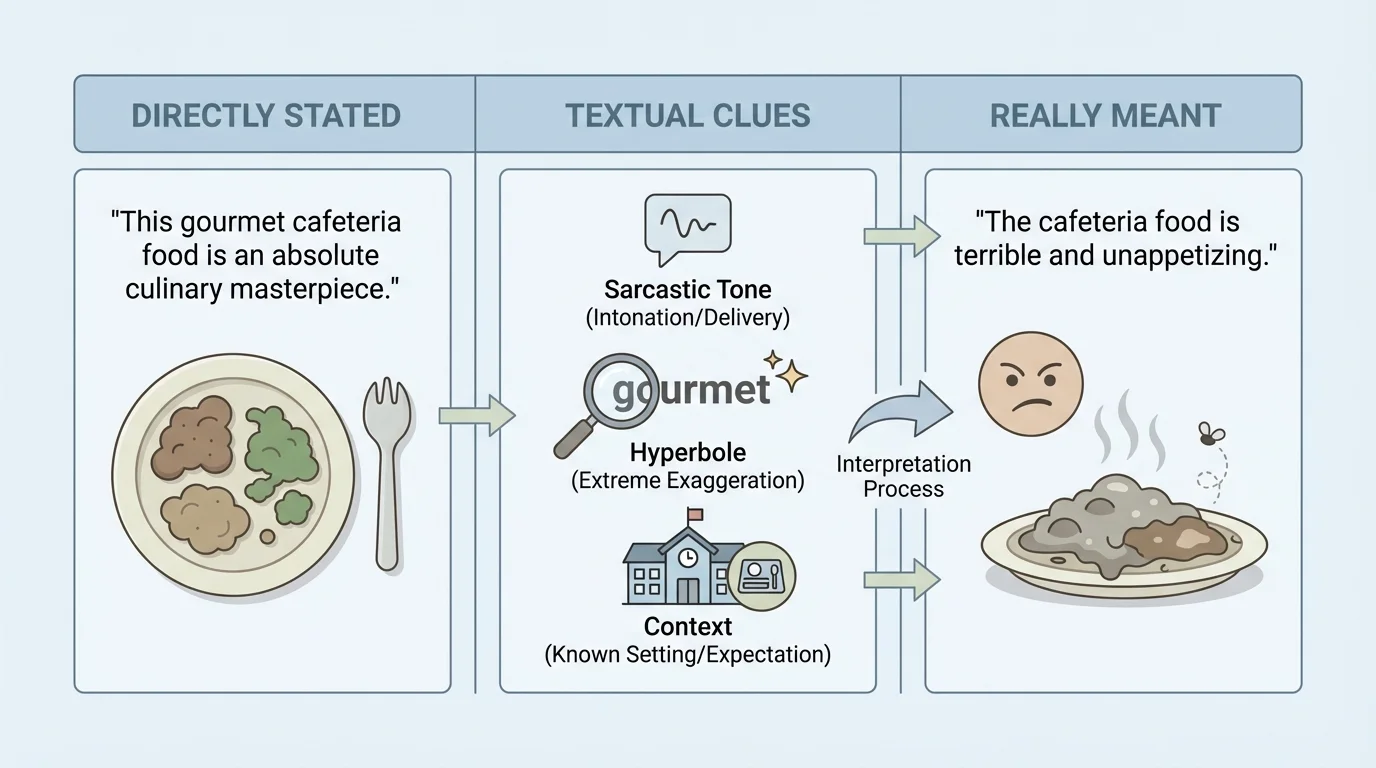
This distinction is essential because texts often depend on subtext, meaning that what matters most is suggested rather than openly declared. Readers should not invent meanings without evidence, but they should also not stay trapped at the literal level when the text clearly points elsewhere.
The difference can be expressed simply: directly stated means what the sentence says; really meant means what the sentence communicates in context. In literature, those are sometimes the same. In satire, sarcasm, irony, and understatement, they are often not.
Literal meaning is the direct, surface meaning of the words as written. Intended meaning is the idea, attitude, or judgment the writer or speaker actually communicates. Inference is the conclusion a reader draws from textual evidence rather than from direct statement alone.
As you continue reading, remember that interpretation is strongest when it moves in order: quote the words, identify the clues, then explain the implied meaning.
A major challenge in literature is that the speaker, the narrator, and the author are not always the same. A sarcastic character may voice opinions the author wants us to question. A naïve narrator may describe events without understanding them fully. An author may use a ridiculous speaker to expose the speaker's blindness.
This means point of view is layered. First, there is the viewpoint of the person speaking inside the text. Second, there is the author's shaping perspective, which may support, complicate, or undermine that voice. If a narrator praises greed in a way that sounds absurd, the author may actually be criticizing greed through that praise.
For this reason, literary analysis often asks, "Whose point of view is expressed here, and how do we know whether it is sincere?" The answer depends on craft. You must pay attention to diction, tone, contradiction, selection of details, and the reactions of other characters.
Some of the sharpest criticism in literature appears in passages that sound polite or admiring on the surface. That indirectness can make the critique more powerful because readers must recognize it for themselves.
As [Figure 2] will help show, once you start looking for this layered attitude, many texts become richer. What first seems simple praise or mild description may turn out to be judgment, protest, or dark humor.
Several literary devices regularly create a gap between surface wording and actual meaning. These devices matter because they shape how readers interpret point of view. The same sentence can mean very different things depending on whether it is satirical, sarcastic, ironic, or understated.
Satire uses humor, exaggeration, ridicule, or absurdity to expose human weakness or social problems. A satirical text may appear to praise a policy or institution while actually attacking it. For example, an essay that "recommends" giving students homework during all holidays may really be criticizing excessive academic pressure.
Sarcasm is a sharp, cutting form of verbal irony in which a speaker says one thing and means the opposite, usually to mock or criticize. If a character slips in mud and another says, "A graceful entrance," the literal statement is positive, but the intended meaning is negative.
Irony is a broader term for a contrast between appearance and reality. Verbal irony happens when words mean the opposite of what they say. Dramatic irony happens when readers know something a character does not. Situational irony happens when the outcome sharply contrasts with expectations.
Understatement deliberately presents something serious or extreme as if it were small or ordinary. After a house is destroyed in a storm, a character might say, "We've had better days." The calm wording does not match the severity of the situation, and that mismatch reveals attitude.
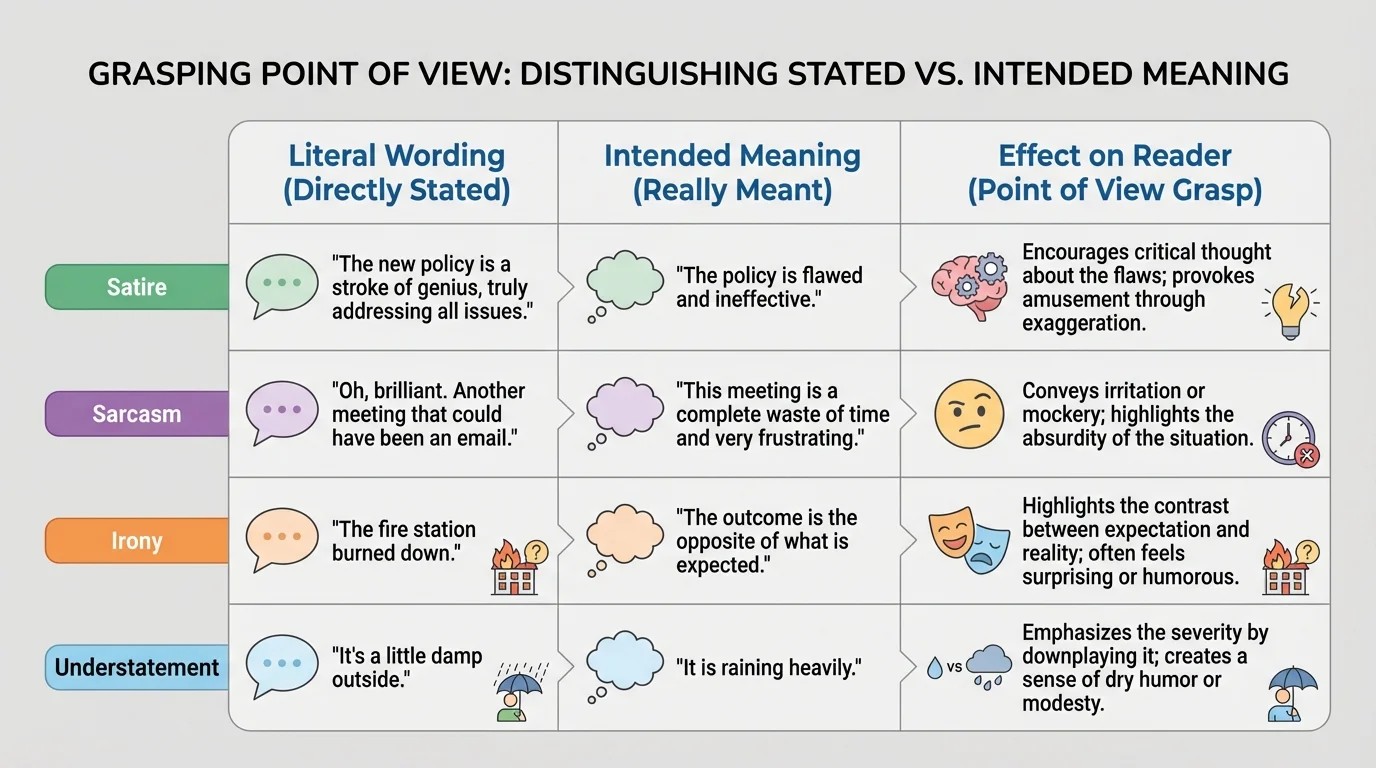
These devices are different, but they share a key feature: they force readers to move beyond literal wording. The better you become at recognizing the gap, the more accurately you can interpret tone and point of view.
| Device | What the text seems to say | What it often really means | Typical effect |
|---|---|---|---|
| Satire | Support or praise | Criticism of a person, habit, or system | Exposes flaws through humor or absurdity |
| Sarcasm | Compliment | Mockery or disapproval | Creates sharp tone |
| Verbal irony | One statement | Its opposite or a more complex attitude | Reveals tension between words and meaning |
| Understatement | Mild description | Recognition of something major | Can create humor, restraint, or shock |
Table 1. Comparison of common devices that separate literal wording from intended meaning.
Notice that none of these devices can be identified from a single sentence alone in every case. Context is what makes the interpretation convincing.
Readers need evidence for any claim about hidden meaning. The first clue is tone, the attitude conveyed through word choice and style. A sentence that uses extreme praise in a bitter scene probably is not genuine praise. The second clue is contradiction: if the comment does not fit the facts, readers should suspect irony or sarcasm.
A third clue is exaggeration. Satire often pushes an idea to an absurd level to expose its flaws. If a writer proposes something obviously unreasonable in a calm, serious voice, the seriousness itself may be part of the joke. A fourth clue is underreaction, when a speaker responds too mildly to something severe. That gap can reveal emotional control, denial, or dry humor.
A fifth clue is context. Historical setting, genre, and audience matter. A satirical essay from a time of political unrest may imitate formal argument in order to criticize power. A dramatic scene may use understatement to show courage under pressure. A line that sounds sincere in one context may be ironic in another.
How readers evaluate an interpretation
A strong interpretation does not depend on a feeling alone. It asks whether the supposed meaning fits the whole passage. If a line is sarcastic, do surrounding details support that reading? If a narrator is unreliable, do events contradict the narrator's claims? The best analysis checks whether the interpretation explains more of the text, not less.
Another important clue is diction, the specific words chosen. As [Figure 3] will illustrate in the next example, formal, exaggerated, or unexpectedly cheerful diction in a negative scene often signals a gap between statement and meaning. That is why even short passages can reveal complex point of view.
Consider this invented editorial: "To improve student focus, the school should remove lunch entirely. Hunger will keep minds sharp, and fainting in fourth period will build character." From the start, the editorial's apparent support for cruel policy is not sincere because its contradictions are obvious. The voice imitates the structure of a serious proposal, but the content becomes absurd.
What is directly stated? The editorial seems to recommend eliminating lunch and praises suffering as beneficial. What clues reveal the real meaning? First, the proposal is extreme and unreasonable. Second, the claim that fainting "builds character" treats obvious harm as virtue. Third, the calm, logical tone clashes with the cruelty of the idea. These clues indicate satire.
What is really meant? The writer is criticizing policies that ignore student well-being in the name of performance or discipline. The point of view is not "students should suffer"; it is "systems that demand suffering in the name of success are inhumane and absurd."
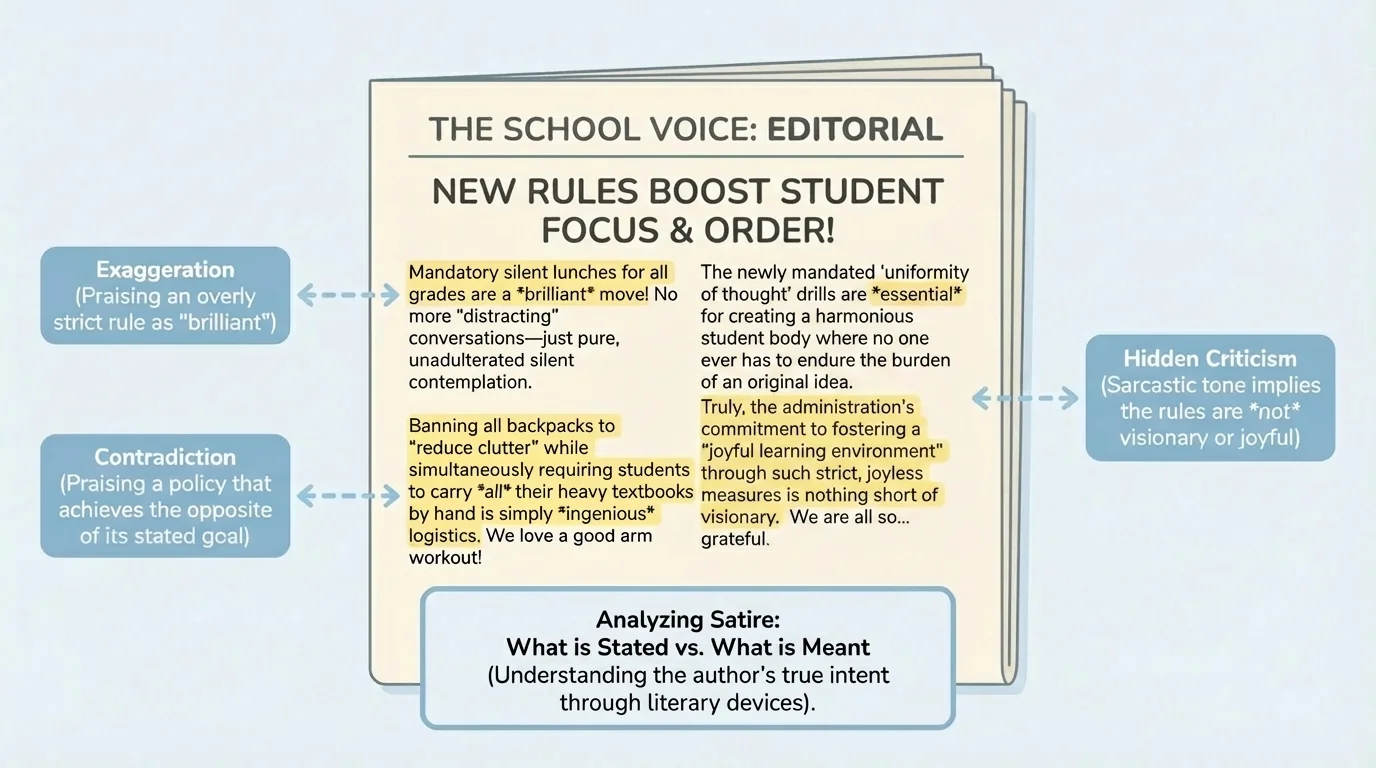
This case also shows why readers must distinguish between speaker and author. The speaker inside the editorial pretends to support a harmful idea. The author uses that false support to attack it. If you only quote the literal claim, you misread the entire text.
Case analysis model
Use this sequence when analyzing a satirical or ironic passage.
Step 1: State the literal claim.
The editorial appears to argue that removing lunch improves academic focus.
Step 2: Identify textual clues.
The proposal is absurd, the logic is exaggerated, and the tone treats harm as if it were obviously beneficial.
Step 3: Infer the intended meaning.
The writer criticizes harsh systems that value productivity more than human needs.
Step 4: Connect to point of view.
The text presents a viewpoint that is deliberately false on the surface in order to reveal the author's critical perspective underneath.
That pattern works in many texts, including essays, fiction, drama, and even speeches that imitate a viewpoint they want readers to reject.
Now consider a different kind of example from narrative fiction: after a boat strikes rocks and begins to sink, a composed captain says, "This may delay our arrival." The statement is not false, but it is radically incomplete. The captain uses understatement. The calm language suggests discipline, denial, or dark humor, depending on the wider scene.
In drama, irony often emerges from what the audience knows. A character may trust someone the audience already recognizes as dangerous. The character's words may be sincere, but the scene becomes ironic because the audience hears them differently. In that case, the point of view revealed is not hidden in the words alone; it is created by the gap between the character's understanding and the audience's knowledge.
Suppose a character says, "I am perfectly safe with him," while readers already know that betrayal is coming. The direct statement expresses trust. The deeper meaning of the scene, however, is vulnerability and dramatic tension. Point of view here depends on knowledge distribution: who knows what, and when.
Earlier, [Figure 2] distinguishes irony from understatement, and this difference matters. Understatement shrinks the scale of reality. Dramatic irony separates what the character believes from what the audience understands. Both require readers to see beyond the literal words.
"Words are often less direct than the truths they carry."
— Guiding principle for literary interpretation
These techniques often make a text more powerful because they trust readers to participate in meaning-making rather than receiving everything as plain explanation.
One common mistake is assuming that any positive wording must be sincere. Another is treating every unusual phrase as sarcasm even when the context does not support that reading. Strong readers avoid both extremes. They neither stay trapped at the literal level nor invent hidden meanings without evidence.
A second mistake is confusing the narrator with the author. In some novels, the narrator is biased, immature, selfish, or uninformed. The author may intentionally create that flawed voice to expose its limits. If a narrator praises something obviously harmful, ask whether the text invites readers to trust that judgment or question it.
A third mistake is ignoring genre. Satire works differently from tragedy, and comedy works differently from memoir. Historical context also matters. A modest sentence in a war narrative may be understatement; the same sentence in a casual conversation may simply be restraint.
Understatement is often culturally valued in serious contexts because it can signal self-control. In literature, that restraint can make suffering feel even more intense.
As [Figure 4] summarizes, to avoid misreading, gather several pieces of evidence before making a claim: word choice, contrast, scene details, character reaction, and the larger pattern of the work.
When you turn interpretation into analysis, move step by step: begin with the quotation, identify the literal meaning, point to the clue that complicates it, infer the intended meaning, and then explain what that reveals about point of view. This process keeps your claim grounded in the text.
For example, instead of writing, "The author uses irony," write something fuller: "By calling the disastrous policy 'a triumph of efficiency,' the speaker uses verbal irony to criticize leaders who value appearance over human consequences." That sentence identifies the words, the device, the intended meaning, and the perspective expressed.
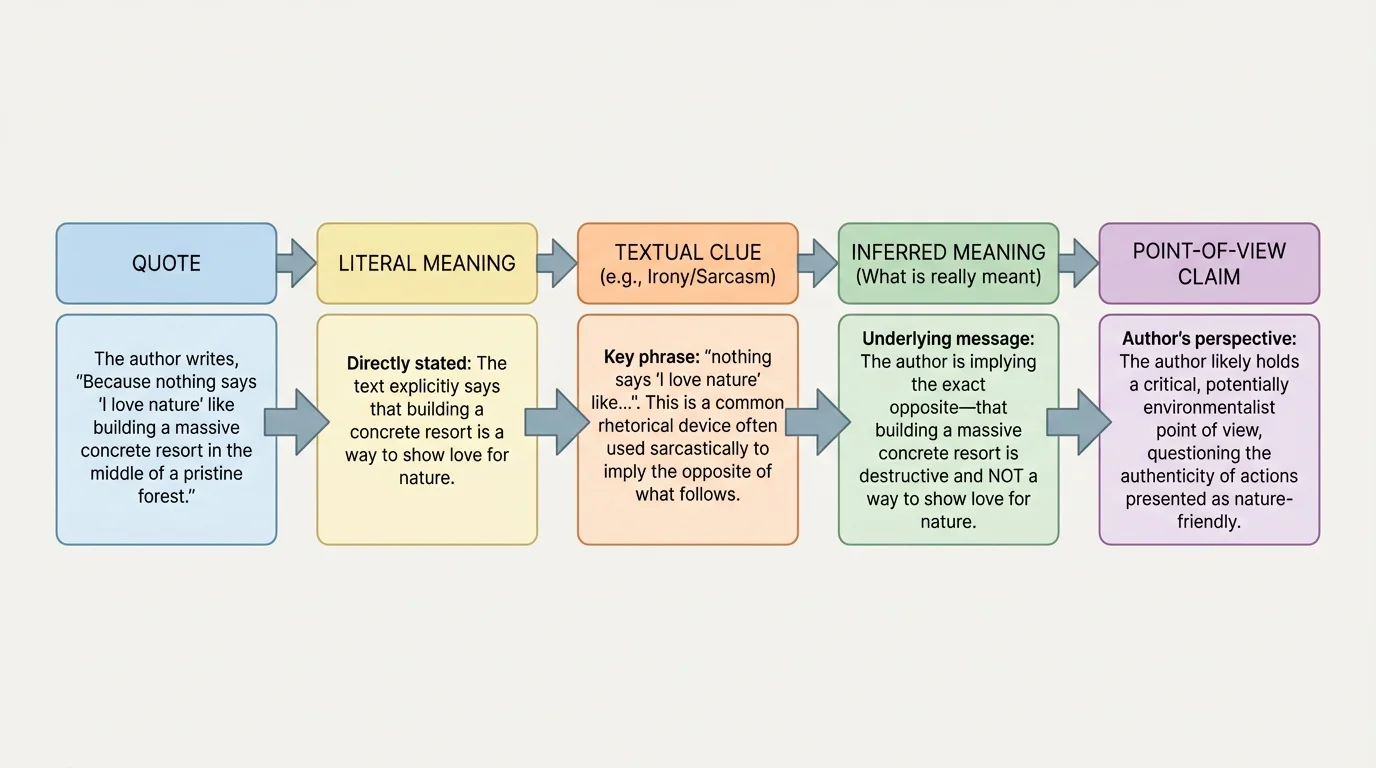
Notice how the claim does not stop at naming a device. It explains why the device matters. Literary analysis becomes stronger when it connects craft to attitude. Ask: What does this gap between statement and meaning reveal about the speaker, narrator, or author?
As seen earlier in [Figure 1], separating the direct statement from the inferred meaning helps prevent vague interpretation. And the sequence in [Figure 4] turns that distinction into a clear argument supported by evidence.
In longer essays, it often helps to use sentence frames such as these: "Although the speaker literally says ___, the context suggests ___." "The exaggerated praise reveals not admiration but ___." "This understatement emphasizes ___ by refusing to describe it directly." These frames support precise reasoning without oversimplifying the text.
Ultimately, analyzing point of view in complex literature means listening for tension. When the words and the reality of the scene do not match, that tension is rarely accidental. It is a signal from the writer that the real meaning lies beneath the surface.
