A reader usually decides very quickly whether a story feels alive. Sometimes it happens in a single sentence: a phone vibrates with bad news, a runner hears the starter pistol too early, a quiet street suddenly fills with sirens. What makes those openings powerful is not just action. It is the sense that something matters. Strong narratives do more than begin; they orient the reader. They establish what is happening, who is involved, how events are being seen, and why the moment deserves attention.
Narrative writing depends on choice. A writer chooses where to begin, whose eyes the reader looks through, which details appear first, and how one experience leads to the next. When those choices are deliberate, the story feels focused and meaningful. When they are weak or random, even an interesting idea can feel flat or confusing. For that reason, the beginning of a narrative is not just an introduction. It is the foundation for everything that follows.
Narrative is writing that presents a sequence of events or experiences, real or imagined, in a way that creates meaning for the reader. Point of view is the perspective from which the story is told. A narrator is the voice that tells the story, whether that voice is a character inside the story or an outside storyteller. Tone is the writer's or narrator's attitude toward the subject, revealed through word choice, detail, and style.
At this level, effective narrative writing usually aims for more than "telling what happened." It shapes experience. It guides the reader toward a particular feeling, insight, or outcome. A story about a missed bus can become a story about grief, responsibility, rebellion, or chance, depending on how the writer frames the opening and arranges the events.
The opening of a narrative performs several jobs at once. It grabs attention, but it also gives direction. Readers need orientation: Where are we? What kind of situation are we entering? What emotional atmosphere surrounds it? Who is speaking, and can we trust that voice? If the opening handles these questions well, the reader feels grounded enough to follow complexity later.
A strong beginning also creates an implicit promise. If the first paragraph introduces tension, readers expect development. If it introduces a mystery, readers expect discovery. If it begins with a charged observation, readers expect that observation to connect to a larger meaning. Openings and endings are closely linked because the beginning quietly prepares the destination.
Many memorable novels and short stories begin not with explanation, but with disturbance. A normal day goes wrong, a strange detail stands out, or a voice says something unexpectedly revealing. That disturbance signals that the reader has entered a moment worth following.
This is why vague openings often fail. A line such as "It was a nice day and everything seemed normal" gives almost no direction. It may be true, but it does not create urgency, perspective, or significance. In contrast, "By noon, everyone in the cafeteria knew I had lied" immediately raises questions. It sets a problem, hints at consequences, and invites the reader to continue.
Most effective narrative openings begin with a narrative hook that presents a problem, a situation, or an observation. [Figure 1] shows three common approaches. Each method can work well, but each creates a different kind of momentum.
A problem-based opening presents conflict immediately. The conflict may be external, such as a lost championship game, a power outage during surgery, or a wildfire approaching town. It may also be internal, such as guilt, fear, jealousy, or indecision. What matters is that the reader senses instability. Something is wrong, unresolved, or at risk.
A situation-based opening places the reader inside a meaningful context. For example, a writer might begin on the morning of a court hearing, during the first shift at a new job, or at the final rehearsal before a concert. This kind of opening may not reveal the central conflict right away, but it establishes the circumstances from which conflict will grow.
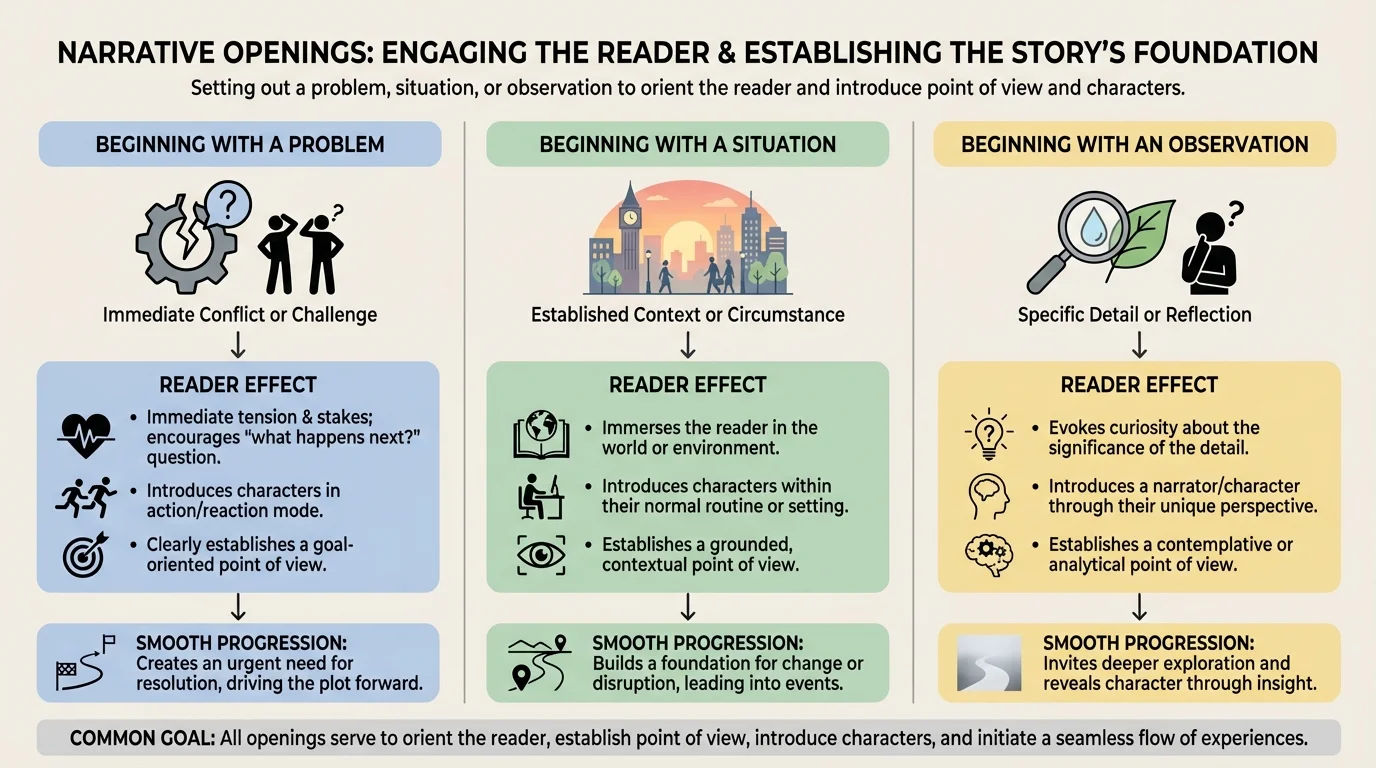
An observation-based opening begins with something noticed and interpreted. The observation might be physical, social, or emotional: "My grandfather had stopped winding the clock weeks before he died." That sentence does not announce a full plot, but it invites the reader into a pattern of thought. It suggests memory, symbolism, and change. Observation-based openings often work especially well in reflective or literary narratives.
These three methods are not separate formulas. A single opening can combine them. A narrator may observe something strange while standing in a tense situation that contains a growing problem. What matters most is that the opening gives the reader a clear entry point.
Comparing weak and strong openings
Topic: a student discovers that someone has posted a private video online.
Step 1: Weak opening
"I woke up and checked my phone. Then I got dressed for school."
This begins too far from the meaningful moment. It includes action, but not significance.
Step 2: Stronger problem-based opening
"The video had already reached 2,000 views by the time I unlocked my phone."
This opening introduces conflict immediately and creates questions about who posted it, what the video shows, and what will happen next.
Step 3: Stronger observation-based opening
"It was the silence in first period that told me something had gone wrong."
This opening uses observation to create tension before the full problem is revealed.
As the comparison in [Figure 1] makes clear, different openings produce different reader expectations. A problem-driven start usually feels urgent; a situation-based start feels immersive; an observation-based start often feels thoughtful or suspenseful.
Introducing an event is not enough. The writer also needs to suggest significance: why this moment matters. Significance can come from stakes, emotion, symbolism, or consequence. If a character misses a bus, the event matters more if missing that bus means losing a scholarship interview, arriving too late to say goodbye, or breaking a promise.
Writers often reveal significance through carefully chosen details rather than direct explanation. Consider these two sentences: "My brother dropped the trophy" and "My brother dropped the trophy our mother had polished every spring since Dad left." The second version gives the object emotional weight. A detail becomes significant when it points beyond itself.
Significance can also emerge through contrast. A peaceful setting may matter because it is about to be disrupted. A joke may matter because it covers fear. A casual conversation may matter because the reader senses the characters do not know what is coming. Effective narrative writing often creates this layered effect: the surface event and the deeper meaning operate at the same time.
How writers create stakes
Stakes answer the question, "What could be gained, lost, changed, or understood?" They may be public, such as reputation or safety, or private, such as trust, identity, or self-respect. Strong narratives usually make stakes visible early, even if the full consequences are revealed later.
For older students, significance often becomes more powerful when it is connected to theme. A scene about a broken curfew may also be about freedom. A scene about deleting a message may also be about honesty. The more clearly a writer understands what a moment represents, the more purposeful the details become.
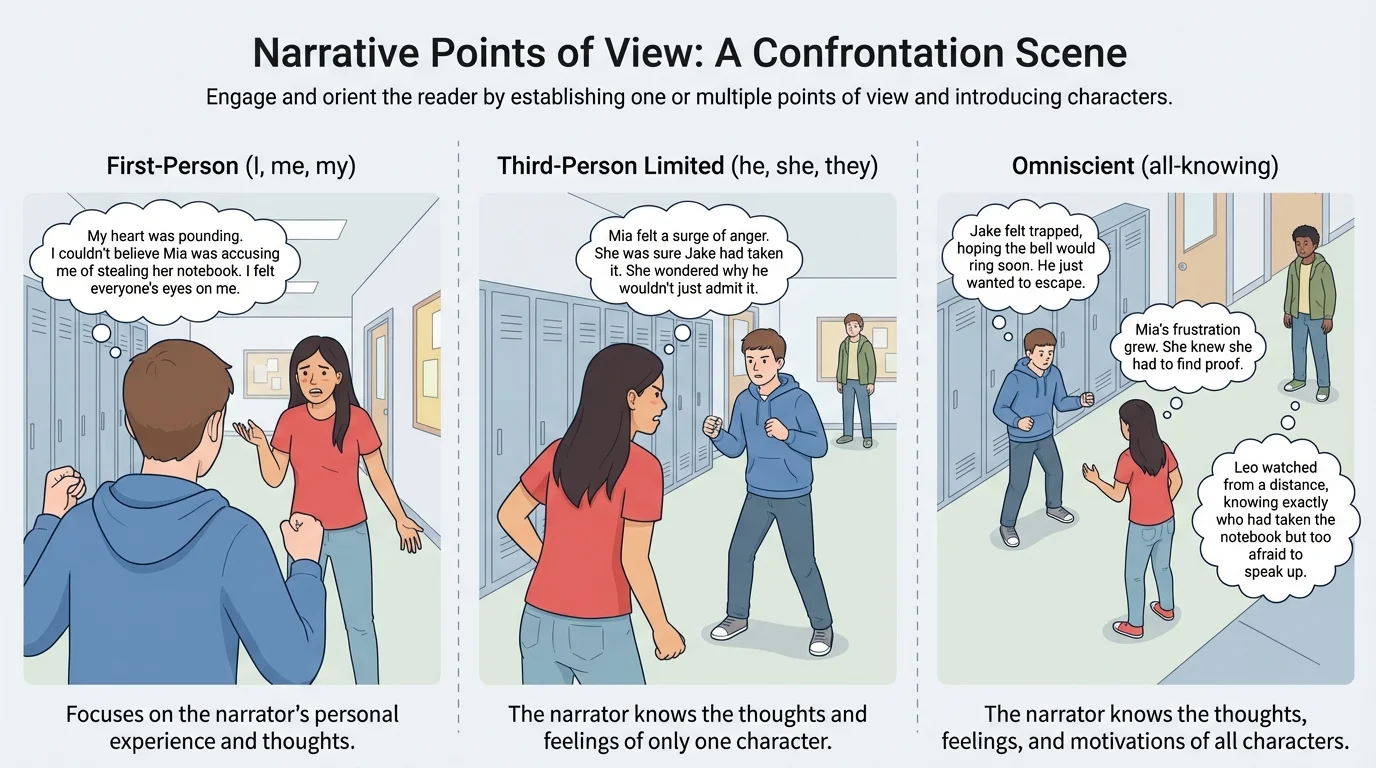
Point of view controls what the reader sees, knows, and feels. [Figure 2] illustrates how the same event changes depending on perspective. It is not a small technical choice. It shapes the entire narrative experience.
First-person point of view uses "I" or "we." It creates immediacy and voice because the narrator speaks directly from inside the experience. This perspective is especially effective when the writer wants readers close to a character's thoughts, biases, and emotional reactions. However, first-person narration is limited to what that narrator knows, remembers, or chooses to reveal.
Third-person limited uses "he," "she," or "they," but stays close to one character's thoughts and perceptions. It offers some flexibility of language while preserving focus. Readers understand events through one character's experience, but the narrator can sound more distinct from that character than in first person.
Third-person omniscient allows the narrator to move among multiple characters' thoughts and perspectives. This can create breadth and complexity, but it requires control. If the narrative shifts carelessly from one mind to another, readers may feel disoriented rather than enriched.
Each point of view has strengths. First person can sound intimate and urgent: "I knew before I turned around that the coach had seen me leave." Third-person limited can create close suspense: "Marcus heard the whistle behind him and kept walking, pretending not to recognize it." Omniscient can build dramatic irony by revealing what one character does not know.
The key is consistency. Sudden, unplanned shifts in perspective can weaken clarity. If a story begins firmly inside one character's mind, jumping into another character's thoughts without clear purpose often feels like a mistake. As the comparison in [Figure 2] emphasizes, perspective changes not only information but also emotional effect.
Point of view also influences reliability. A narrator may be accurate, confused, defensive, or incomplete. A teenager telling a story about an argument with a parent might genuinely believe one version of events, while a reader notices details that suggest another. This is where point of view becomes artistically powerful: it does not only report experience; it interprets it.
A strong narrative does not dump a full biography into the first paragraph. Instead, it introduces the narrator and characters through selective detail, action, and voice. Readers do not need every fact immediately. They need the right facts.
Voice matters. A narrator who says, "I keep a list of every promise I make because broken promises are inherited in my family," reveals personality, history, and tone in one sentence. Good introductions often accomplish several things at once: they identify who is speaking, suggest what that person values or fears, and establish how the story will sound.
Characters also become vivid through desire and tension. A reader becomes interested not simply because a character exists, but because the character wants something, resists something, or misunderstands something. A shy student asked to lead a protest, a surgeon operating on a former mentor, or a musician returning to a hometown she avoided for years: each character enters with built-in motion.
Efficient character introduction
Instead of writing, "Jordan was sixteen years old, tall, smart, nervous, and lived with his aunt," a more effective narrative sentence might be, "Jordan checked the debate note cards in his pocket for the fourth time before unlocking his aunt's car."
This version reveals anxiety, setting, relationship, and situation through action. It lets readers infer character rather than receiving a list.
Dialogue can help, but only if it does more than fill space. A line of speech should reveal relationship, conflict, attitude, or setting. For example, "You wore that jacket to court?" tells the reader more than a neutral greeting would. It introduces character through tension and implication.
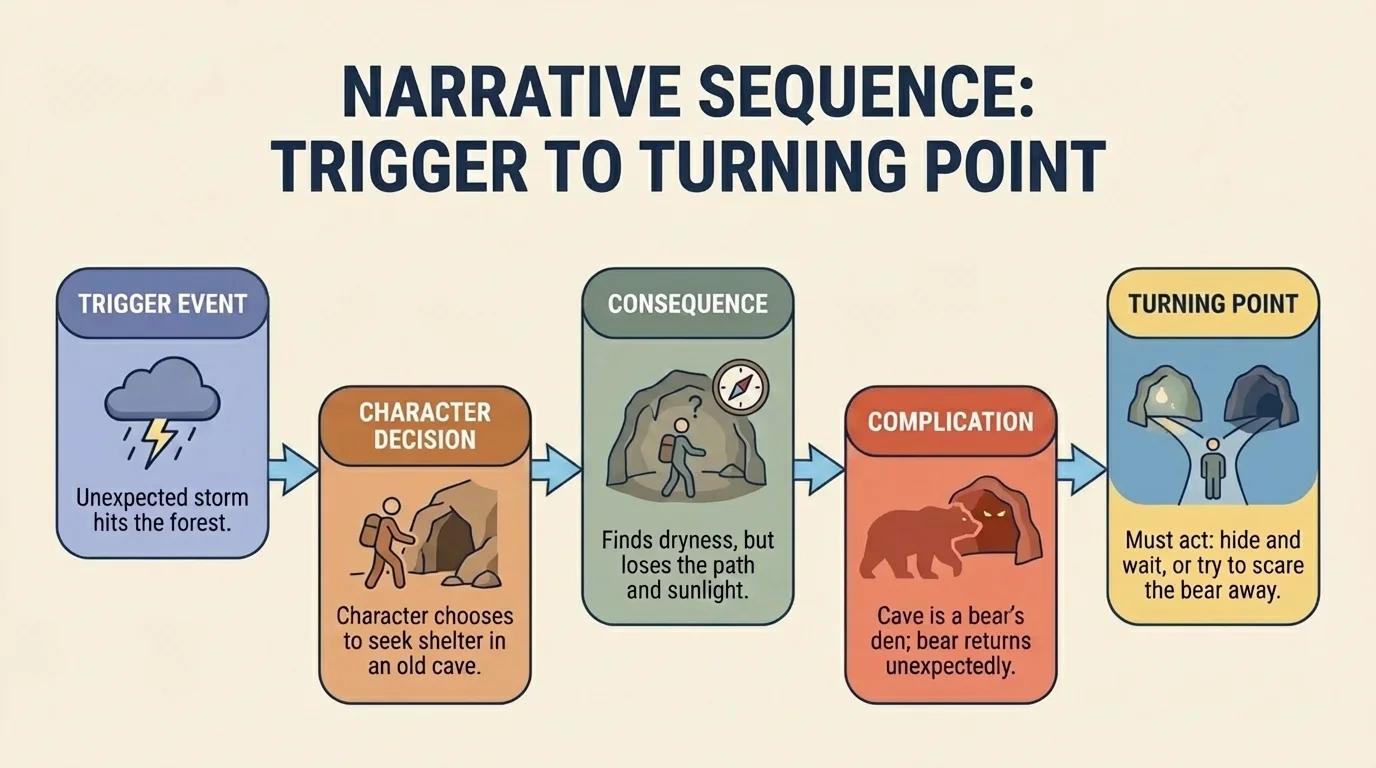
A strong narrative moves with progression, meaning that experiences and events unfold in a clear, purposeful order. [Figure 3] shows that readers follow stories most easily when each event grows from what came before it through cause and effect.
Chronological order is common because it is easy to follow, but "smooth progression" does not mean "strictly one thing after another." Writers may begin in the middle of action, flash back to earlier events, or compress time. What matters is that the sequence remains understandable and intentional.
One important principle is causality. Events should feel linked, not random. If a character quits a team, what led to that choice? If two friends stop speaking, what specific moment created the break? If a narrator finally tells the truth, what pressure made silence impossible? Readers stay engaged when actions have reasons and consequences.
Another principle is the balance between scene and summary. A scene slows down and presents moments in detail, often using dialogue, sensory description, and immediate action. Summary moves more quickly across time, condensing less important material. Skilled narratives use both. They slow down at emotionally important points and speed up through less critical transitions.
Transitions help readers move through time, space, and thought. Some transitions are explicit: "By the end of October," "An hour later," "The next morning." Others are conceptual: "What I did not understand then was...," "Only later did I realize...," or "That was the first time I noticed...." These signals keep the sequence coherent.
Pacing also matters. If every moment is described in equal detail, the narrative may drag. If major events are rushed in a sentence or two, the emotional impact may disappear. Writers need to decide where readers should linger. Usually, turning points, confrontations, discoveries, and irreversible decisions deserve scene-level attention.
The event flow in [Figure 3] demonstrates that a smooth sequence is more than a list of happenings. It is a chain: trigger, response, consequence, complication, choice. That chain is what creates momentum.
From random events to smooth progression
Weak version: "I lost my notes. Then my friend called. Then it rained. Then I failed the presentation."
Step 1: Identify missing links
The events are listed, but the relationships between them are unclear.
Step 2: Add cause and effect
"When I realized my presentation notes were missing, I called Lena, the last person I had studied with. She told me she had left them on the bleachers, so I biked back to school just as the rain started."
Step 3: Continue the sequence logically
"By the time I reached the classroom, soaked and twenty minutes late, Mr. Alvarez had already moved on to the next speaker."
Now the progression feels connected, and the outcome follows from the earlier events.
Time shifts can be effective if they are signaled clearly. A flashback should not feel like accidental confusion. The writer can establish a transition through verb tense, reflective phrasing, or a clear marker such as a photograph, place, or sound that triggers memory. Control over time is one mark of mature narrative writing.
Every opening choice influences the story's eventual tone and outcome. If a narrative begins with sharp, clipped observations and suppressed emotion, the tone may develop into tension or alienation. If it begins with reflective detail and layered memory, the tone may become elegiac, thoughtful, or bittersweet.
Writers build toward an outcome by planting expectations early. A story that opens with a small lie may build toward confession. A story that opens with a warning may build toward disaster or survival. A story that opens with a puzzling image may build toward understanding. The opening does not need to reveal the ending, but it should prepare the emotional and thematic path.
"The beginning is the first promise the writer makes to the reader."
Tone grows from details, syntax, and perspective. Compare these two openings about the same event: "The storm arrived at 6:14, precise as a debt collector" and "By evening, rain had softened the whole neighborhood into shadow." Both introduce weather, but each creates a very different emotional direction. One is tense and threatening; the other is quiet and reflective.
To create unity, later events should fulfill or complicate what the opening implies. If the first paragraph suggests the narrator is ashamed, the progression of scenes should deepen, challenge, or transform that shame. If the opening presents a social injustice, the narrative should continue to engage that issue rather than abandoning it for unrelated events.
One common problem is beginning too early. Writers sometimes start with waking up, traveling, or routine activity before the meaningful moment arrives. Unless the routine itself is significant, it is usually better to begin closer to the tension. Readers do not need every step leading to the story; they need the story itself.
Another problem is overloading the opening with explanation. Background matters, but too much at once can stall momentum. Instead of explaining a family history in a paragraph, a writer can reveal it through specific, strategically placed details over time.
Confusing perspective is another frequent issue. If the narrative voice sounds detached in one paragraph, deeply personal in the next, and then slips into another character's thoughts, the reader may lose trust. A clear point of view creates coherence.
Some narratives also struggle because events are connected only by time, not meaning. "Then this happened, then this happened" is not enough. Strong revision asks: what changed because of this moment? What decision followed? What consequence intensified the conflict? Those questions transform a sequence into a narrative.
Readers do not experience your whole idea at once. They experience one sentence, one paragraph, one event at a time. Clarity and momentum come from making each part lead naturally to the next.
Revision is where much of this work becomes visible. A writer can examine the first page and ask: Have I oriented the reader? Have I suggested significance? Is the point of view clear? Have I introduced a narrator or characters in a way that creates interest? Does each event lead into the next with purpose? Those questions help turn a draft into a shaped narrative.
When these elements work together, a narrative does more than report experience. It creates one. The reader enters a meaningful situation, understands who is present and why it matters, and follows a sequence that feels inevitable without being predictable. That is the craft of an engaging narrative opening and a smooth progression of events.
