A strong piece of writing rarely appears perfectly in one try. Journalists revise breaking-news stories within minutes. Scientists rewrite reports after reviewing data. Novelists may return to the same paragraph again and again. Skilled writers do not just write once—they write routinely, and they learn how to work on both quick pieces and longer projects with care.
Some writing happens in a single sitting: a response to a reading, a short reflection after a lab, notes from a source, or an email to a teacher. Other writing grows over days, weeks, or even months: a research paper, a formal argument, a technical explanation, or a collaborative report. Both kinds matter because school, college, work, and civic life all require people to communicate clearly under different conditions.
Writing over extended time frames gives you time to think deeply, gather evidence, test ideas, reorganize, and revise. Writing over shorter time frames helps you practice fluency, precision, and focus. A writer who can do only one of these is limited. A strong writer can do both.
Extended time frames are longer periods for writing that allow planning, reflection, research, revision, and polishing across multiple sessions.
Shorter time frames are brief writing periods, such as one sitting or a day or two, used for quick responses, focused explanations, or immediate communication.
Audience is the person or group a writer is addressing, and purpose is the reason for writing, such as to explain, argue, analyze, or inform.
Good writers choose their process based on what the writing needs. A one-paragraph science explanation should not be handled exactly like a ten-page literary analysis. The timeline, depth, and structure should fit the task.
[Figure 1] Writing changes depending on subject area. A discipline-specific writing task follows the habits and expectations of a particular field. The same topic can sound very different depending on whether the writer is explaining evidence, telling a story, or informing the public.
For example, suppose the topic is local water quality. In science, a student might write a lab report that describes methods, results, and evidence. In social studies, the student might write an argument about public policy and community impact. In English language arts, the student might write an analytical essay about how an author describes environmental change. In each case, the topic overlaps, but the tone, structure, evidence, and vocabulary shift.
Audience matters too. Writing for a teacher may include subject vocabulary and detailed evidence. Writing for younger students may require simpler language and stronger explanation. Writing for a community newsletter may need a clear, direct style with practical information. Purpose and audience guide decisions about word choice, organization, detail, and formality.
| Situation | Likely Purpose | Audience | Writing Choices |
|---|---|---|---|
| Lab report | Explain findings | Teacher or science readers | Precise terms, clear procedure, evidence-based conclusions |
| History essay | Argue an interpretation | Academic audience | Claims, sources, context, formal tone |
| Reflection journal | Think and respond | Self or teacher | Personal voice, focused ideas, shorter structure |
| Public information post | Inform quickly | General audience | Clear wording, strong organization, accessible examples |
Table 1. Comparison of how purpose and audience affect writing choices.
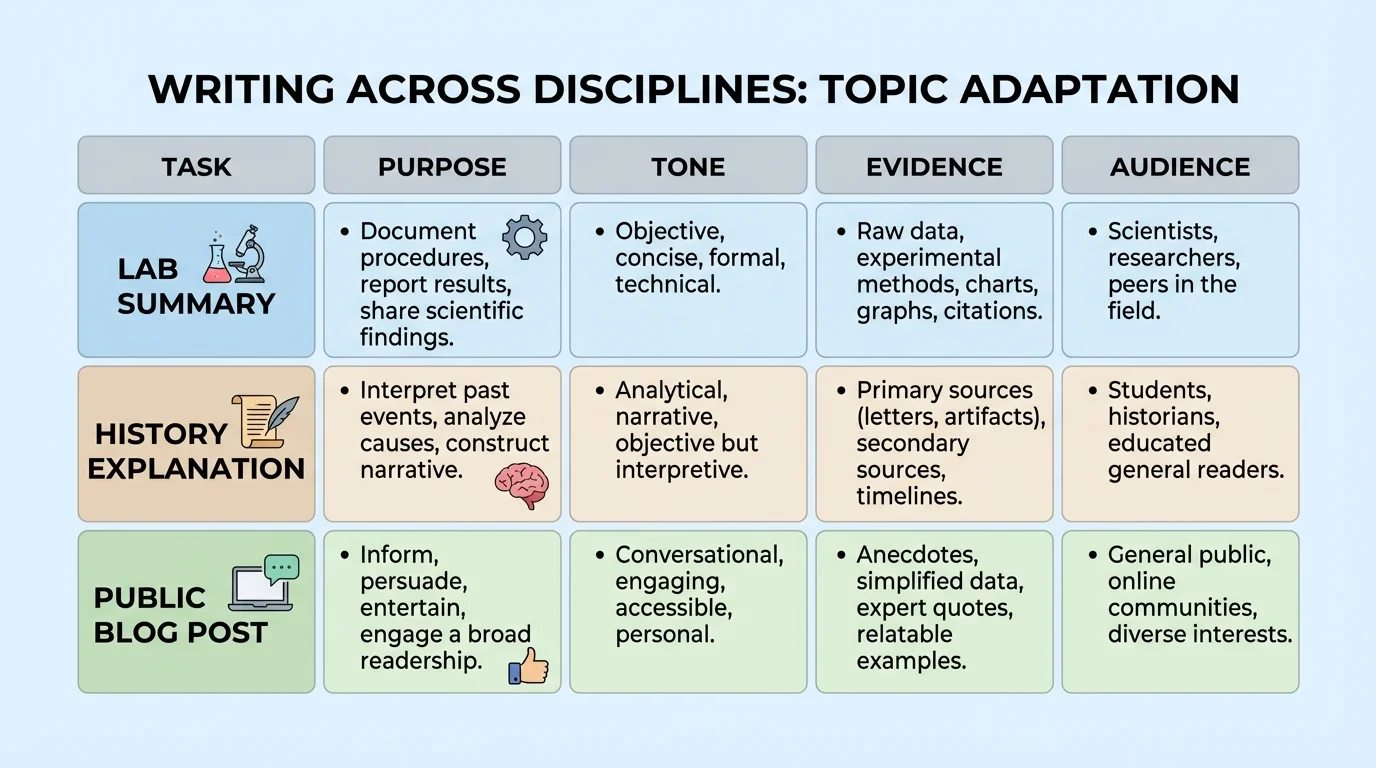
Writers become more effective when they ask simple questions before beginning: What am I trying to do? Who will read this? What kind of evidence or style does this field expect? Those questions help shape the whole piece before the first full draft is even complete.
[Figure 2] Many students first learn writing as a straight path: plan, draft, edit, finish. In reality, recursive writing process means that writing often loops backward and forward. Writers may draft first, then discover they need more research, or revise one section and realize the introduction no longer matches the conclusion.
A recursive process usually includes planning, drafting, getting feedback, reflecting, revising, editing, publishing, and sometimes updating. These are not rigid steps. They are connected actions. A writer may return to earlier parts several times.
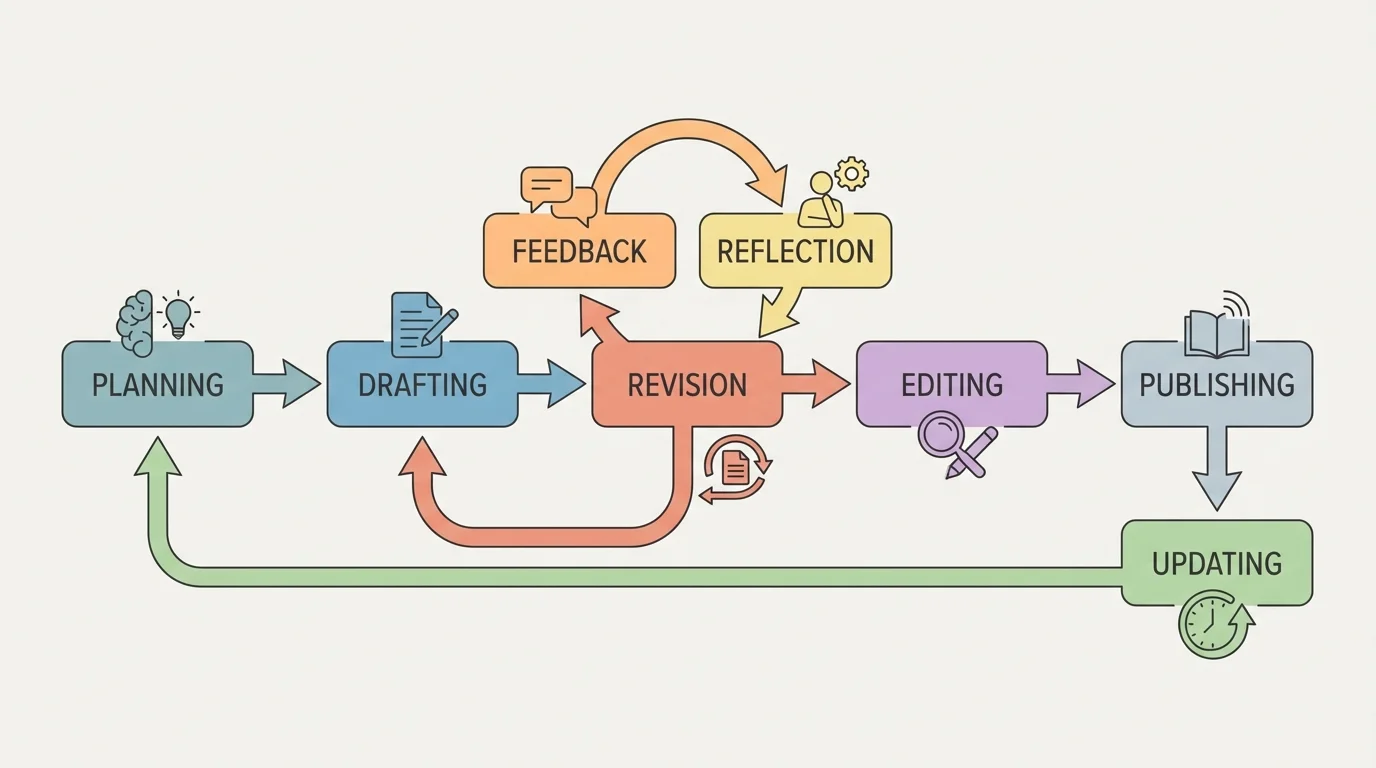
This matters because good writing grows through decisions. Planning helps a writer set goals. Drafting puts ideas into words. Reflection allows the writer to notice what is working and what is not. Revision improves ideas, structure, and development. Editing corrects grammar, spelling, punctuation, and formatting. Publishing means sharing the writing with its audience. Updating means improving the piece later if new information or feedback appears.
Revision is not the same as editing. Editing fixes surface features such as punctuation and sentence correctness. Revision changes the meaning and quality of the writing itself by strengthening ideas, organization, clarity, evidence, and voice.
That difference is important. If a paragraph is confusing, correcting commas will not solve the deeper problem. The writer may need to add evidence, change the order of ideas, or rewrite the paragraph entirely. As students mature, they learn that serious writing often improves most during revision, not just during final proofreading.
[Figure 3] Longer writing projects are built through stages, not bursts of last-minute effort. Extended-time writing usually unfolds across multiple sessions: selecting a topic, researching, taking notes, organizing ideas, drafting, revising, and preparing a final version.
This kind of writing allows for reflection. Reflection means stepping back to think about your choices: Is the claim strong enough? Does the evidence really support the point? Does the organization help the reader understand? Reflection can happen in a notebook, in comments on a digital draft, or during a conference with a teacher or peer.
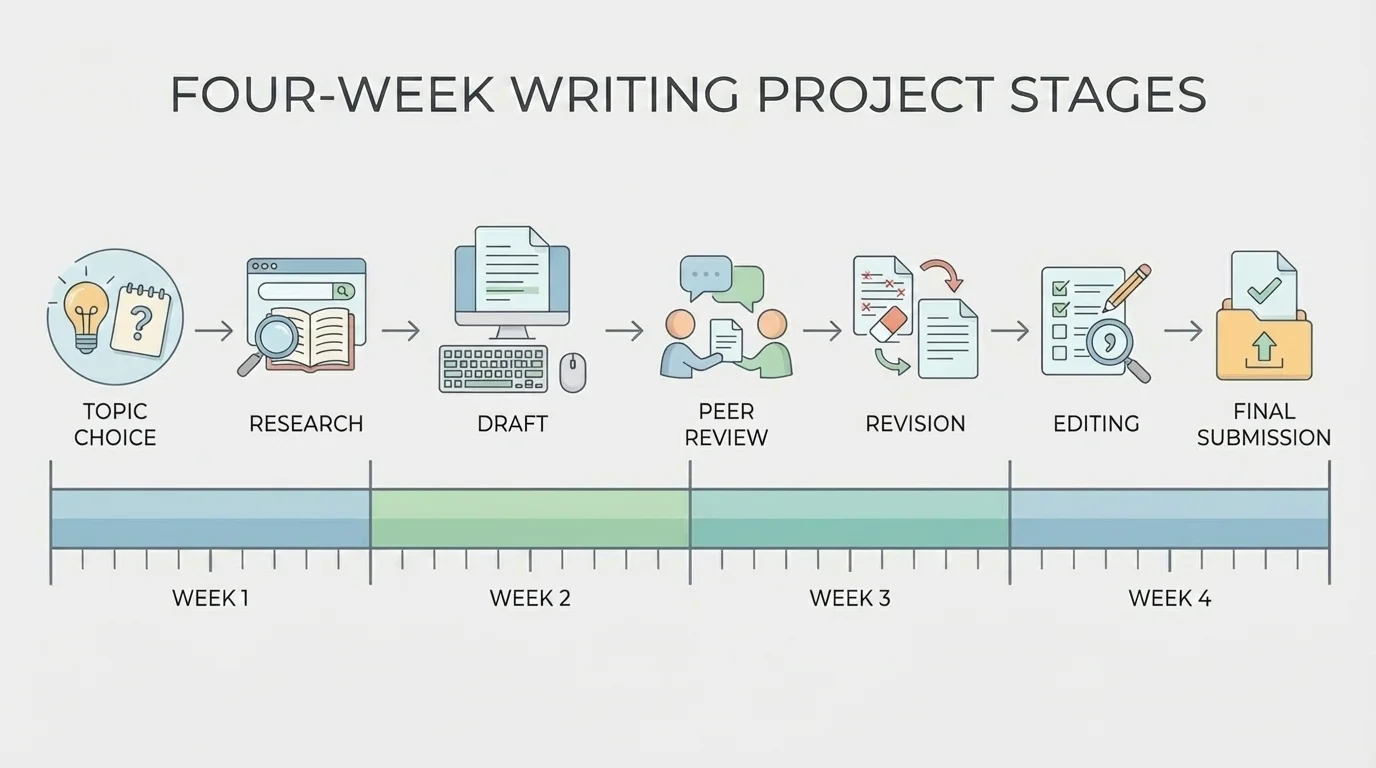
Extended writing is common in many disciplines. In science, students may design an investigation, collect observations, and write a report after analyzing results. In history, they may compare sources before building an argument. In career and technical fields, they may create manuals, proposals, or process explanations. In literature study, they may write essays that develop an interpretation through careful textual evidence.
Because these tasks are larger, they require time management. Writers often break a project into smaller goals: gather sources on day one, draft the introduction on day two, revise body paragraphs later, and edit near the end. This prevents overload and leaves space for meaningful improvement.
Extended-time writing example
A student is assigned a historical argument essay about whether a reform movement changed daily life in a community.
Step 1: The student collects sources and writes notes about laws, speeches, and newspaper reports.
Step 2: The student drafts a claim and outlines body paragraphs using evidence from those sources.
Step 3: After peer comments, the student realizes one paragraph summarizes facts but does not explain why they matter.
Step 4: The student revises by adding analysis, reorganizing the order of ideas, and clarifying the conclusion.
The final essay is stronger because time allowed research, reflection, and substantial revision.
Writers also update long-form work when new information appears. A shared class report, a digital article, or a project portfolio may be revised after publication. That is a real-world skill. Professional writing often continues to change after it is first released.
Not every writing task needs several drafts over many days. Shorter writing tasks train writers to think clearly and express ideas efficiently. These may include exit tickets, quick analytical paragraphs, short-answer responses, notes from reading, brief emails, or one-day summaries of a lab or article.
Shorter writing still involves thinking about purpose and audience. A one-paragraph response should have focus, organization, and clear language. It may not go through as many rounds of revision as a large essay, but the writer still chooses evidence, checks clarity, and makes improvements before submitting.
Quick writing is especially useful for learning. It helps students capture fresh ideas, test a claim, or explain understanding while the material is still active in their minds. In classes across subjects, these short pieces often prepare students for larger assignments.
Many professionals do more short writing than long writing. Doctors write quick patient notes, engineers send concise updates, and researchers draft short summaries before producing formal reports.
A student might write a short science explanation in one sitting, then later use that explanation as part of a larger lab report. A reader might respond to a chapter in a journal, then turn those reflections into a full literary analysis. Short writing and long writing support each other.
Reflection and revision do not happen by accident. Strong writers build habits that help them notice what needs improvement. One useful strategy is rereading with one goal at a time: first for ideas, then for organization, then for sentence clarity, and finally for correctness. Looking at everything at once can make revision shallow.
Another strategy is using feedback wisely. Feedback from teachers, classmates, or even your own notes should lead to decisions. Not every suggestion must be followed, but every serious comment deserves thought. As shown earlier in [Figure 2], feedback is part of an ongoing cycle, not a final stop. Good writers ask, What is this comment telling me about the reader's experience?
Revision example
Draft sentence: Pollution is bad and causes many problems for people.
Step 1: Identify the weakness. The sentence is too general and does not explain what kind of pollution or what problems.
Step 2: Add specificity. The writer names the issue more clearly: Air pollution from vehicle exhaust affects human health.
Step 3: Strengthen with detail. The writer improves it again: Air pollution from heavy vehicle exhaust can worsen asthma and increase breathing problems in crowded cities.
The revised sentence is more precise, informative, and useful to readers.
Writers can also reflect by comparing their draft to a checklist or rubric. If the task requires evidence, explanation, and a clear conclusion, the writer can test each part directly. Reflection turns vague feelings like "this seems weak" into clear questions that can be answered through revision.
Some writing projects are individual, while others are shared. Collaborative writing may happen in a shared document, a group presentation script, a class publication, or a team report. In those settings, writers must do more than write well. They must coordinate, respond respectfully, and keep the whole piece consistent.
Collaboration works best when group members agree on roles, deadlines, and style expectations. One student may gather evidence, another may draft, and another may review organization and formatting. Even then, all members should understand the full piece. Shared writing is not just separate parts pasted together; it should read like one coherent text.
Audience awareness becomes even more important in collaborative work. If one paragraph sounds highly formal and another sounds casual, the writing may confuse readers. As seen earlier in [Figure 1], audience and purpose shape tone, evidence, and style. Group members should make those choices together.
Writing is communication, not just assignment completion. Whether the piece is long or short, individual or shared, the goal is to make ideas understandable to someone else.
Digital tools also make collaborative updating easier. Writers can leave comments, suggest changes, review past drafts, and track revisions. This mirrors how many adults write in workplaces and academic settings.
Writing improves through repeated practice with different kinds of tasks. A routine might include daily quick writes, weekly reflections, periodic conferences, and longer projects that require several drafts. The exact schedule can vary, but the habit of returning to writing regularly matters.
Routine writing builds confidence. Students learn that a first draft is not a final judgment of ability. They also learn to adjust depending on the moment: sometimes the job is to capture an idea quickly; sometimes the job is to develop and refine a complex piece over time.
One of the most mature writing skills is knowing what kind of process a task needs. A short response may need a fast plan and one careful reread. A major research argument may need source collection, multiple drafts, peer review, and substantial revision. Strong writers choose their process intentionally instead of treating every assignment the same way.
"Writing is thinking on paper."
— Common writing principle
When writers work routinely across different time frames, they become more flexible, more thoughtful, and more effective. They learn how to write for school, for work, for public audiences, and for themselves. That is why regular writing practice—with time for reflection and revision when needed—is such an important part of learning.
