Some of the most powerful writing you will ever read is nonfiction. A speech can change a nation. A memoir can reshape how readers understand history. An essay can sound personal and artistic while also making a serious argument about society, identity, justice, memory, or truth. That is what makes literary nonfiction so demanding and so rewarding: it asks you to read for facts, ideas, voice, craft, and human experience all at once.
Literary nonfiction is nonfiction that uses the techniques of literature while remaining grounded in real people, events, experiences, and ideas. It includes essays, memoirs, speeches, personal narratives, biographies, autobiographies, and reflective journalism. Unlike fiction, it does not invent its core reality. Unlike a textbook, it often values style, tone, and personal perspective as much as direct explanation.
When you read literary nonfiction well, you do more than gather information. You trace how a writer shapes experience into meaning. A writer might describe a childhood memory, a political crisis, or a walk through a city street, but beneath that surface may be larger questions about freedom, injustice, belonging, identity, memory, or power. Strong readers learn to notice both the literal meaning and the deeper implications.
Literary nonfiction is writing based on real events, people, or ideas that uses literary techniques such as vivid imagery, purposeful structure, voice, and figurative language to create meaning.
Text complexity refers to how challenging a text is because of its vocabulary, sentence structure, ideas, organization, background knowledge demands, and subtlety of meaning.
By grades 11 and 12, the goal is not simply to survive hard texts. The goal is to read them proficiently. That means understanding what a text says, how it says it, why it says it that way, and how well it succeeds. At the high end of complexity, you may need scaffolding at first, but by the end of grade 12 you should be able to handle that level with confidence and independence.
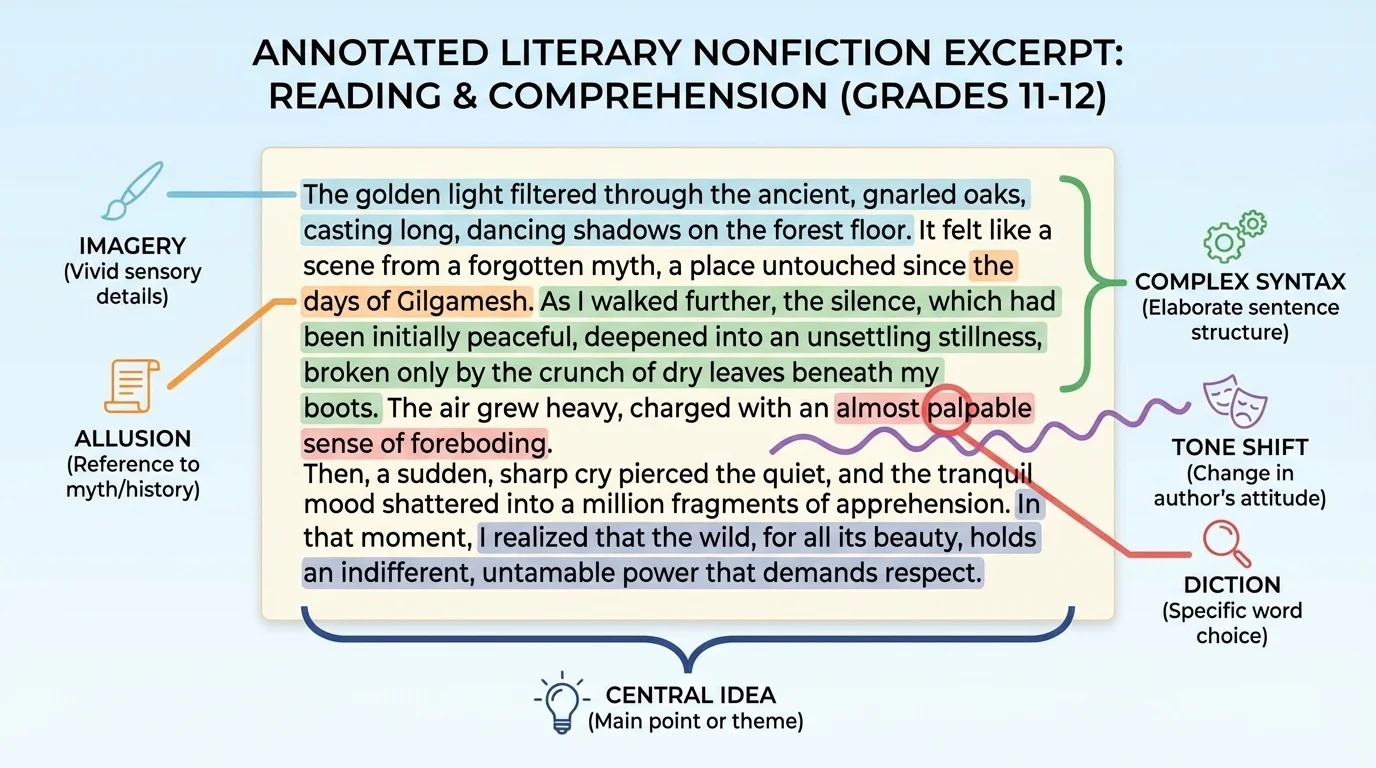
Complex literary nonfiction often feels difficult because several layers operate at once, as [Figure 1] illustrates in a single annotated passage. The writer may use abstract ideas, long or unusual syntax, historical references, ironic tone, shifting perspectives, and carefully chosen details that mean more than they first appear to mean. A reader who looks only for a quick main idea will miss much of the text's richness.
One major challenge is diction, the writer's deliberate choice of words. In literary nonfiction, words are rarely neutral. James Baldwin, for example, often combines elegant, precise language with moral urgency. His diction can make readers feel both the beauty of his prose and the pressure of his argument. Another challenge is syntax, the arrangement of words and sentences. A long, layered sentence may reflect a mind thinking through complexity, while a sudden short sentence may land like a judgment.
Texts also become complex through structure. A writer may begin with an anecdote, move into reflection, introduce social criticism, and end with a broader claim. These shifts are not random. They help shape the reader's emotional and intellectual journey.
Another source of complexity is allusion, a reference to another text, event, person, or idea that the author expects readers to recognize. Frederick Douglass, for instance, often alludes to Christianity, the Constitution, and national ideals in order to expose the contradiction between American principles and American slavery. If a reader misses the allusion, an important layer of meaning disappears.
Writers of literary nonfiction also use juxtaposition, placing contrasting ideas or images close together to produce insight. Joan Didion might set a glamorous image beside a bleak reality, revealing instability beneath a polished surface. Annie Dillard may describe the beauty of nature alongside its violence, forcing the reader to hold opposite truths at once. This is one reason mature readers must resist oversimplifying difficult texts.
George Orwell's essays are often assigned because they look clear on the surface, but their clarity is part of the challenge. A plain style can hide sharp irony, layered political criticism, and carefully controlled rhetorical moves.
When texts combine dense language, subtle tone, cultural references, and layered structure, they move into the upper range of college and career readiness complexity. Reading them well requires patience and technique, not just intelligence.
The first task in any difficult literary nonfiction text is basic comprehension. Before analyzing symbols or evaluating argument, you need to understand the situation. Who is writing? About what? To whom? In what context? What is happening literally? What issue or experience anchors the piece?
A strong first reading focuses on essentials: the central subject, the author's main idea, and important details. In a speech such as Frederick Douglass's What to the Slave Is the Fourth of July?, you need to identify not only the occasion of the speech but also the speaker's central claim: the celebration of liberty is morally hollow in a nation that permits slavery. In a personal essay by Joan Didion, the main point may emerge more gradually through observation and reflection rather than through a direct thesis statement.
This stage also requires attention to pronouns, transitions, and shifts. If a writer moves from "I" to "we," that shift may signal a widening of scope from personal experience to social commentary. If the text turns from description to analysis, the reader must recognize that the purpose has changed. Accurate comprehension depends on tracking these movements carefully.
Literal meaning comes first, but it is not the end. In complex literary nonfiction, first-level comprehension answers the question, "What is the text saying?" Close reading then expands that into "How is the text creating meaning?" and "What should I think about the text's ideas and methods?" Skilled readers move through all three levels.
Paraphrasing can help. After a dense paragraph, restate it in your own words without reducing it too much. If Baldwin writes a long sentence about history and identity, your paraphrase should preserve the relationship between those ideas. Good paraphrasing clarifies meaning; poor paraphrasing flattens it.
Literary nonfiction deserves the same level of craft analysis that strong readers bring to poetry and fiction. The writer is not only delivering content but shaping an experience. That means you should pay attention to imagery, rhythm, repetition, anecdote, pacing, contrast, and voice.
Tone matters especially. Tone is the author's attitude toward the subject and sometimes toward the audience. A writer may sound reflective, skeptical, mournful, urgent, mocking, reverent, or conflicted. In complex texts, tone can shift. A speech may begin ceremonially and turn accusatory. A memoir may move from nostalgia to disillusionment. These shifts often reveal the deeper purpose of the text.
Consider Orwell's essay Shooting an Elephant. On one level, it narrates an incident in colonial Burma. On another, it reveals the psychological corruption of imperialism. Orwell's narrative details create tension, but his reflective commentary transforms the piece from story into political criticism. A proficient reader sees both dimensions at once.
Writers also shape meaning through selection. What details are included, and what details are omitted? If a memoir lingers over one object, one smell, or one line of dialogue, that choice is rarely accidental. Literary nonfiction often makes a concrete detail carry abstract significance. A kitchen table may become a symbol of family history; a border crossing may become a symbol of identity and power.
As you continue reading later sections, the feature map in [Figure 1] remains useful because the same sentence may reveal diction, tone, structure, and argument all at once. The strongest analysis does not isolate one feature mechanically; it explains how several features work together.
Literary nonfiction is not exempt from evaluation just because it is artful. In fact, its power often comes from blending personal voice with public argument, which makes critical reading even more important. You should ask: What is the author's claim? What evidence supports it? What assumptions shape it? How reliable is the speaker or narrator? Where might bias appear?
Rhetoric is the strategic use of language to influence an audience. In literary nonfiction, rhetoric may appear through emotional appeal, anecdote, analogy, vivid imagery, moral reasoning, or patterning of sentences. These moves can be persuasive and meaningful, but they must still be evaluated. A compelling story does not automatically prove a broad claim.
Bias does not always mean dishonesty. Every writer has a perspective. A memoirist writes from memory; an essayist writes from a point of view; a speaker addresses a particular audience for a particular purpose. Skilled readers recognize that perspective while still asking serious questions about fairness, evidence, and complexity.
| Reading Question | What to Look For | Why It Matters |
|---|---|---|
| What is the author claiming? | Direct thesis, implied claim, recurring idea | Identifies the core argument or insight |
| What evidence is used? | Examples, anecdotes, historical references, personal experience, logical reasoning | Shows how the argument is built |
| What assumptions are present? | Unstated beliefs about people, values, history, or society | Reveals the foundation of the argument |
| How does style affect persuasion? | Tone, repetition, imagery, structure, rhythm | Explains why the text influences readers |
| What may be limited or missing? | Counterarguments, alternative perspectives, missing context | Supports critical evaluation rather than passive agreement |
Table 1. Core evaluation questions for analyzing literary nonfiction.
For example, if an author generalizes from a single experience, you should notice both the emotional force and the logical limitation. If a writer uses irony, you must make sure you understand the literal statement and the intended meaning beneath it. Evaluation depends on precise comprehension.
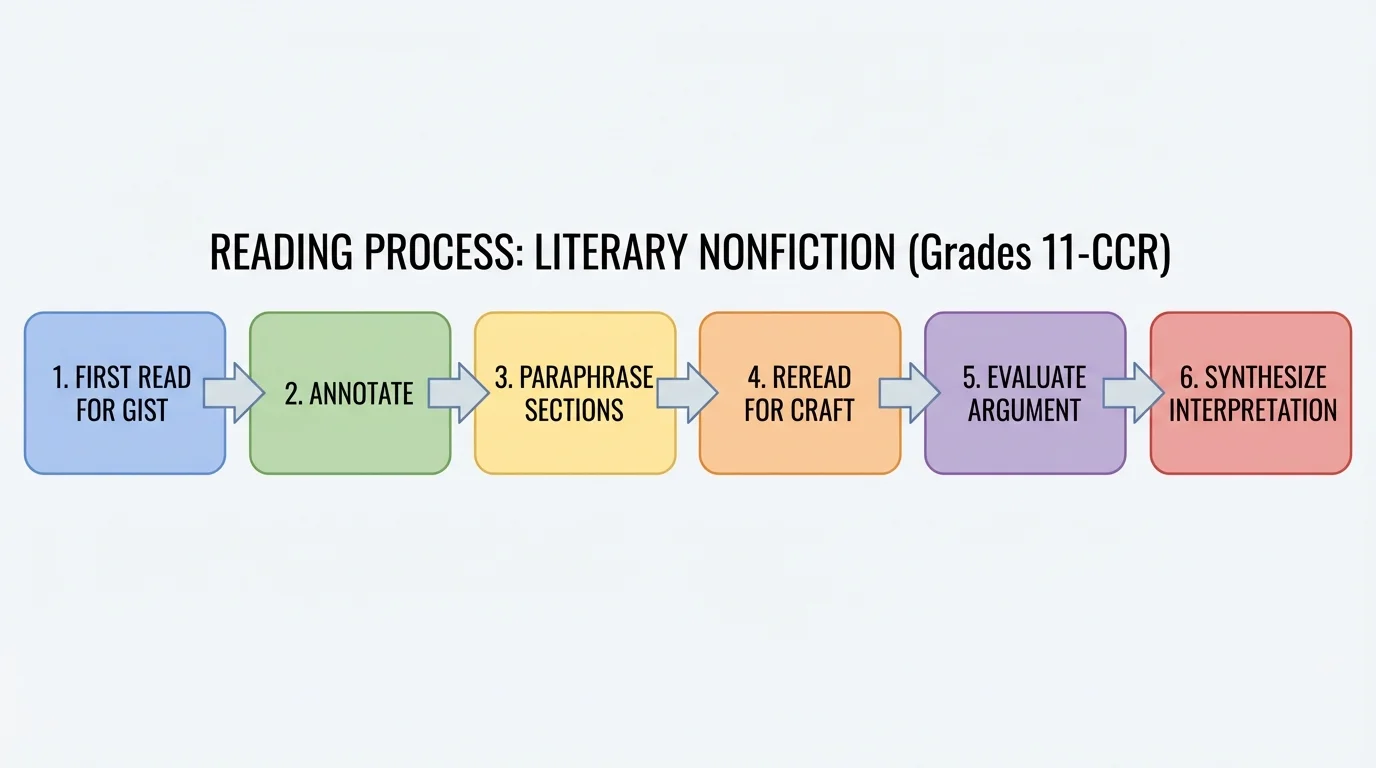
When a text is especially demanding, effective readers use support strategically, and [Figure 2] shows that this support works as a process rather than a single trick. Scaffolding does not lower the quality of thinking. Instead, it helps you enter the text, especially when the language, structure, or context is initially hard to access.
One useful strategy is chunking. Break a long passage into meaningful sections. After each chunk, identify the main point, a key quotation, and one question you still have. This prevents confusion from piling up across several pages.
Another strategy is rereading with a different purpose each time. On a first read, aim for literal understanding. On a second read, trace craft and structure. On a third read, evaluate the argument or implications. Difficult texts are often designed to reward rereading.
Annotation is another essential scaffold. Mark unfamiliar terms, note shifts in tone or subject, underline repeated images or phrases, and write brief paraphrases in the margin. Annotating keeps you active inside the text instead of letting your eyes move across words without engagement.
Background knowledge can also matter. If a text refers to the Harlem Renaissance, the Civil Rights Movement, the Vietnam War, or the American West, a lack of historical context may create barriers. However, strong readers do not stop at "I don't know this." They identify the gap and fill it efficiently through brief research, then return to the text.
Case study: using scaffolding on a difficult passage
Suppose you are reading a dense paragraph from James Baldwin that connects personal identity to national history.
Step 1: Identify the literal topic.
The paragraph discusses how a person's understanding of self is shaped by the history of their country.
Step 2: Break the paragraph into smaller units.
Separate Baldwin's personal observation, his historical claim, and his broader social implication.
Step 3: Clarify difficult language.
Underline abstract terms such as identity, innocence, burden, or inheritance and use context to define them.
Step 4: Trace the craft.
Notice whether repetition, contrast, or sentence rhythm increases the pressure of the argument.
Step 5: Evaluate the idea.
Ask whether Baldwin's reasoning is persuasive, what assumptions he makes, and why his style strengthens the passage.
This process turns confusion into a series of manageable actions.
Eventually, the goal is to need fewer supports. The scaffold is temporary. What begins as guided reading should become self-directed close reading.
Independent proficiency means that when you encounter a difficult essay, memoir, or speech, you do not wait for someone else to explain it first. You have a method. You preview the text, establish context, read attentively, annotate key moments, reread important passages, infer meaning from evidence, and evaluate the author's choices.
This does not mean you instantly understand every line. Independence is not the same as speed. In fact, advanced readers often slow down more, not less, because they know complex writing deserves careful attention. Independence means you can persist productively, make informed interpretations, and support those interpretations with the text itself.
From earlier reading work, you already know how to identify central ideas, summarize, cite textual evidence, and analyze word choice. In advanced literary nonfiction, those same skills still matter, but now they must operate at a deeper level and across more difficult language and structure.
At the high end of complexity, independence also means recognizing ambiguity without giving up. Some passages resist a single simple interpretation. Mature readers learn to hold uncertainty, compare possibilities, and decide which interpretation best fits the evidence.
Consider Frederick Douglass, who often combines moral passion with formal control. In his speeches and autobiographical writing, his style is powerful not only because of what he condemns but because of how carefully he builds the condemnation. He may begin by acknowledging shared national ideals and then reveal, step by step, the hypocrisy beneath them. That structure creates force.
James Baldwin often writes in a voice that is at once personal and historical. He can move from intimate memory to national critique within a few paragraphs. A weak reader may see only autobiography; a strong reader notices how the personal experience becomes evidence in a larger argument about race, identity, and American history.
Joan Didion's essays often demand a different kind of attention. Her style may appear detached or cool, yet that restraint can intensify the unease in her writing. She often presents details without immediately explaining them, requiring readers to infer patterns and meaning. This is where patience and rereading matter.
Annie Dillard, by contrast, may use lyrical description to explore philosophical questions about nature, wonder, cruelty, and perception. Her writing reminds readers that nonfiction can be intellectually rigorous while still sounding poetic. If you read only for surface information, you will miss the point.
"The most difficult texts do not merely tell you something new. They force you to read in a new way."
Across these writers, one principle stays constant: comprehension and interpretation are inseparable. You understand more when you notice craft, and you analyze craft better when you truly understand what the text is saying.
Readers must adjust their strategies depending on genre, and [Figure 3] makes those adjustments visible by comparing the questions different text types invite. Literary nonfiction asks you to track information and artistry together. That makes it different from reading fiction, journalism, or textbook prose.
In fiction, you may focus heavily on plot, character, setting, and symbolism within an invented world. In journalism, you may prioritize timeliness, factual reporting, sourcing, and clarity. In textbook prose, the structure is usually designed to explain directly and efficiently. Literary nonfiction overlaps with all three but is identical to none of them.
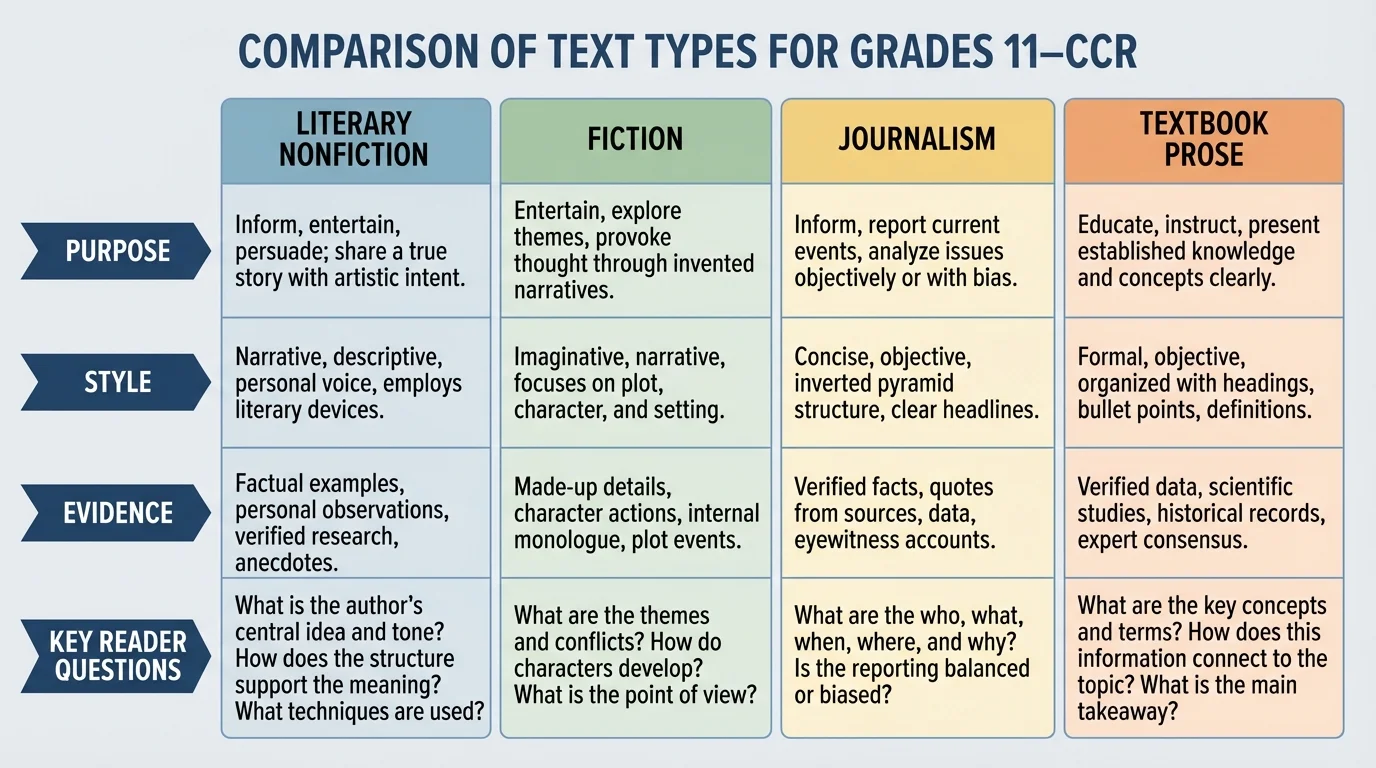
For literary nonfiction, readers should ask questions such as these: How does the writer's style shape the meaning? How do personal experience and public argument interact? What is the relationship between fact, interpretation, and voice? Why does the structure unfold in this order?
The comparison in [Figure 3] also helps explain why students sometimes misread literary nonfiction. If you treat it like a textbook, you may ignore tone and style. If you treat it like fiction alone, you may ignore argument and evidence. Proficient reading requires both lenses at once.
The same idea connects back to the scaffolded process in [Figure 2]: first establish what the text says, then examine how it says it, and finally evaluate what it means and how well it works. This sequence supports understanding without reducing complexity.
Ultimately, reading complex literary nonfiction well is a sign of intellectual maturity. It means you can enter demanding conversations about history, culture, ethics, identity, and public life through texts that do not simplify those issues. It means you can think with precision, read with patience, and respond with evidence-based judgment.
