A strong argument can fail for a surprising reason: not because the evidence is weak, but because the writing sounds careless, emotional, or biased. In school, in college, and in many professional settings, readers judge ideas partly by the way those ideas are presented. A writer who uses precise language, fair reasoning, and a controlled tone appears more credible than a writer who relies on exaggeration, slang, or personal outrage. That is why formal style and objective tone matter so much when you write arguments about serious topics.
When you write an argument, you are doing more than stating an opinion. You are entering a conversation about a text, an issue, or a question that matters. Your goal is not simply to say what you think; your goal is to convince a reader through valid reasoning and sufficient evidence. To do that well, your writing must sound thoughtful, measured, and appropriate for the discipline in which you are working.
Formal style is not about trying to sound fancy. It is about choosing language that matches the seriousness of the subject and the expectations of an academic audience. A formal style helps readers focus on the claim instead of being distracted by casual wording, unsupported reactions, or conversational habits that belong more in texting or speech than in analytical writing.
Objective tone also does not mean you have no position. In argument writing, you absolutely do take a position. However, you present that position through evidence, logic, and fairness. An objective tone avoids sounding hostile, sarcastic, dramatic, or personally offended. Readers are more likely to trust a writer who appears careful and balanced.
Consider the difference between the following two sentences: "This law is obviously terrible and anyone who supports it is clueless" and "The law raises concerns because available evidence suggests it may increase housing costs for low-income residents." Both sentences express criticism, but only the second one sounds credible in an academic setting. The difference lies in word choice, tone, and the use of reasoning.
Formal style uses precise vocabulary, complete sentences, and an academic level of diction appropriate to the subject and audience.
Objective tone presents ideas in a fair, evidence-based, and controlled manner, even when the writer is making a strong claim.
Disciplinary conventions are the accepted ways of writing, using evidence, and organizing ideas in a particular field, such as history, science, or literary analysis.
These qualities matter especially in argument writing because arguments often deal with controversy. When a topic involves politics, ethics, public policy, literature, science, or history, readers may already hold strong beliefs. If your writing sounds emotional or dismissive, readers may stop listening. If it sounds careful and disciplined, they are more likely to consider your evidence.
[Figure 1] Writers use formal style when they choose words that are specific, clear, and appropriate for academic communication. Formal style avoids slang, vague intensifiers such as "super" or "really," and expressions that sound casual or exaggerated.
Formal writing also tends to use complete, well-structured sentences. That does not mean every sentence must be long. In fact, clear formal writing often mixes shorter and longer sentences for control and emphasis. What matters is that the syntax is deliberate and grammatically sound.
Writers working in a formal style usually avoid contractions in many academic contexts, especially in polished essays. For example, "cannot" often sounds more formal than "can't," and "do not" may fit better than "don't." This is not a rigid rule in every setting, but in school argument writing, full forms often support a more academic tone.
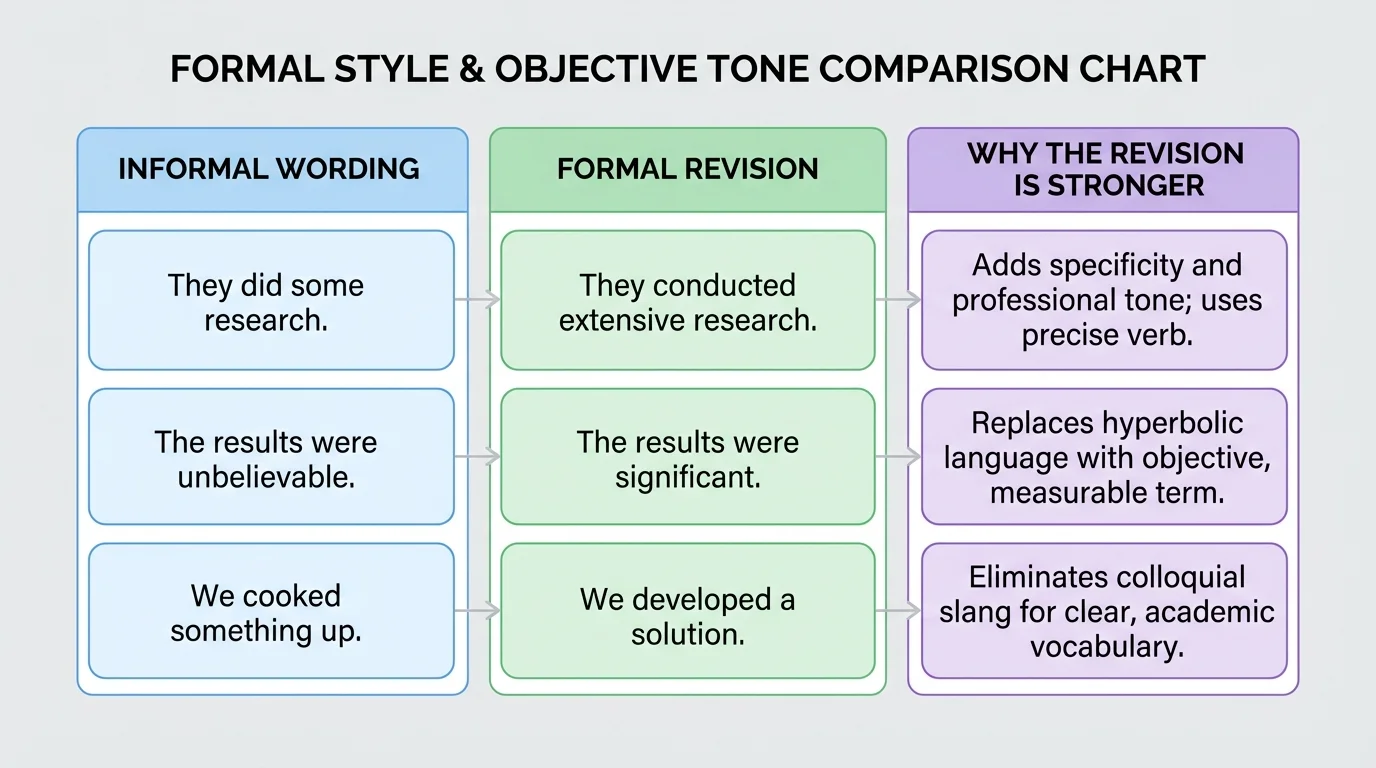
Another feature of formal style is precision. Instead of writing "A lot of people were mad," a stronger sentence might say, "Many residents opposed the proposal during the town council meeting." The second sentence is more informative because it identifies who reacted and how. Formal writing values exactness over broad, fuzzy language.
Formal style also avoids unnecessary filler. Phrases like "I think," "I feel," "in my opinion," or "basically" can weaken an argument if overused. In many academic arguments, the fact that you are writing the essay already signals that the ideas are yours. Rather than saying, "I think the character is selfish," write, "The character's repeated refusal to help others suggests selfishness." The revised version sounds more confident because it points to textual reasoning.
The comparison in [Figure 1] highlights an important truth: sounding formal is often not about using harder words, but about replacing vague or emotional language with accurate language. A sentence can be simple and still be formal if it is precise, controlled, and appropriate to the task.
Many professional writers spend more time revising tone and diction than drafting their first version. Strong arguments are often built not just by adding evidence, but by removing words that sound careless, biased, or inflated.
Formal style does not mean sounding robotic. You can still write with energy and purpose. The best academic prose sounds alive because it is exact, not because it is dramatic. Precision creates authority.
An bias is a preference or assumption that can shape the way someone interprets information. Every reader and writer brings some background beliefs to a topic. Objective tone does not require pretending those beliefs do not exist. Instead, it requires managing them carefully so that evidence, not impulse, leads the writing.
Objective writing relies on support. A claim such as "Social media harms teens" is too broad on its own. An objective writer asks: What kind of harm? According to whom? Based on what evidence? A stronger sentence would be, "Several studies suggest that heavy social media use is associated with increased anxiety in some teenagers, though the relationship is complex." This sentence is more objective because it narrows the claim and acknowledges complexity.
Objective tone often includes words that signal appropriate caution. Terms such as "suggests," "indicates," "may," "likely," or "appears" are not weak when they reflect the limits of the evidence. In academic writing, certainty should match proof. If the evidence is limited, an honest writer should not sound absolute.
Objectivity is controlled judgment, not the absence of judgment. A strong argument still takes a clear position, but it does so by interpreting evidence fairly. Objective writing avoids pretending every side is equally strong, yet it also avoids twisting evidence to make one side seem stronger than it is.
It is also important to separate objective tone from passive or lifeless writing. Objective does not mean dull. You can write, "The evidence strongly supports the conclusion that the policy reduced traffic injuries," and still sound objective because the sentence rests on evidence rather than insult, exaggeration, or emotional pressure.
[Figure 2] Different fields ask different questions, value different evidence, and follow different conventions. A formal, objective argument in literary analysis does not sound exactly like one in history or science, even though all three require clear claims and evidence.
In disciplinary conventions for literary analysis, writers often make interpretive claims about theme, character, symbolism, or language. Evidence usually comes from the text itself through quotations and close reading. The tone remains formal, but the writing may include more interpretive verbs such as "reveals," "suggests," or "emphasizes."
In history, arguments often focus on cause and effect, change over time, significance, or the interpretation of sources. Evidence may include primary sources, secondary scholarship, and historical context. Historical writing often stresses qualification because historians recognize that events are shaped by multiple factors.
In science, writers usually emphasize observation, data, method, and reproducibility. Claims are often narrower and more cautious. Scientific writing values precision, technical vocabulary, and careful distinction between results and interpretations.
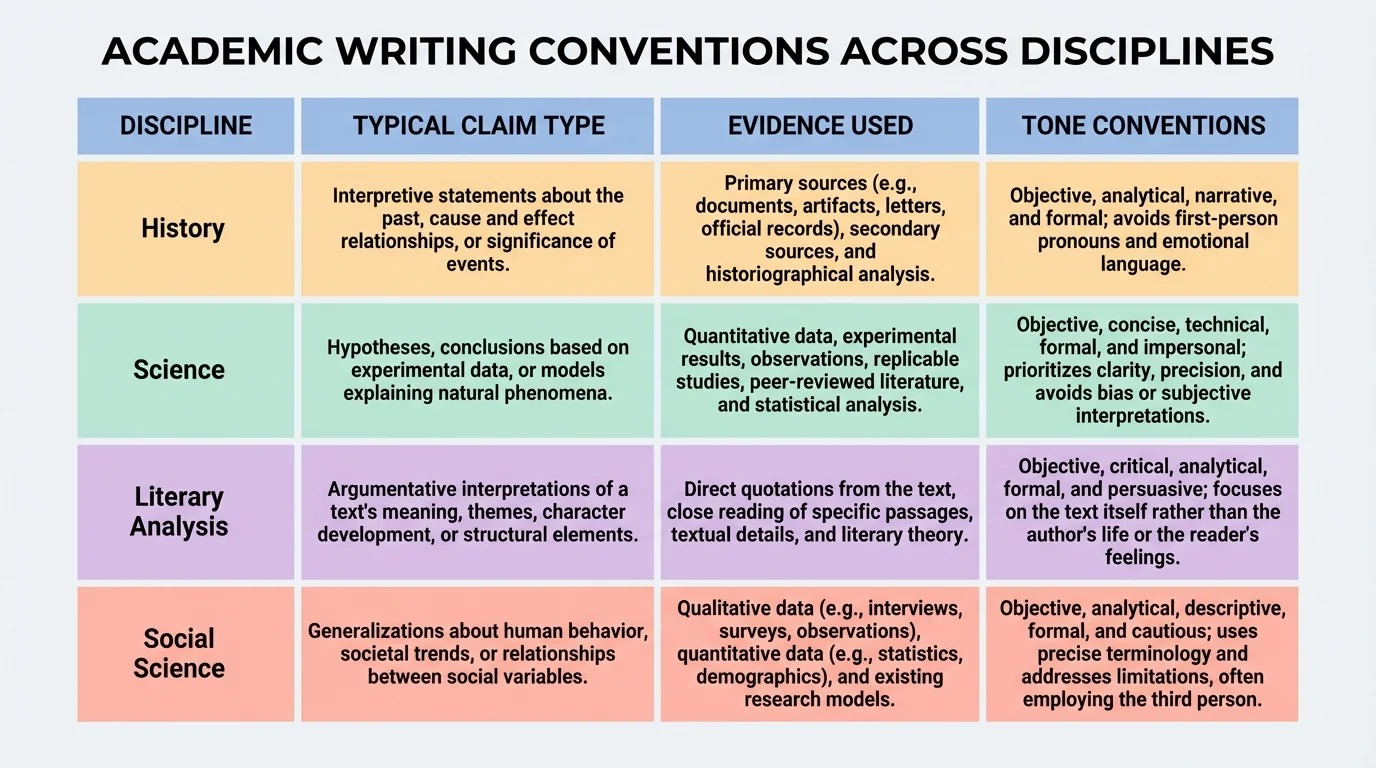
In social science and public policy writing, writers may blend statistics, case studies, surveys, and theory. Here, formal style often depends on clearly defining terms, explaining methods, and distinguishing between correlation and causation.
Looking again at [Figure 2], notice that formality does not erase the identity of a discipline. Instead, formality works together with disciplinary expectations. A science report that sounds poetic may feel out of place. A literary essay that only lists data without interpretation may also miss the mark. Good writers adapt their tone and style to the field they are writing in.
| Discipline | Common Type of Claim | Common Evidence | Tone Features |
|---|---|---|---|
| Literary analysis | Interpretation of meaning or technique | Quotations, imagery, structure, diction | Analytical, precise, interpretive |
| History | Cause, consequence, significance | Primary sources, dates, historical context, scholarship | Contextual, qualified, evidence-driven |
| Science | Explanation of results or patterns | Data, observations, methods, experiments | Technical, cautious, exact |
| Social science | Analysis of behavior, systems, or trends | Studies, surveys, statistics, case evidence | Defined terms, measured claims, analytical |
Table 1. Comparison of how different disciplines shape claims, evidence, and tone.
A strong argument usually includes a clear claim, supporting reasons, and relevant evidence. Formal style and objective tone strengthen each part of that structure. When the claim is narrow and defensible, the argument begins with control. When the reasons are logical, the essay develops coherence. When the evidence is sufficient and relevant, the writing gains authority.
A weak claim might say, "School uniforms are bad." A stronger claim would say, "Mandatory school uniform policies may improve visual order on campus, but they do not reliably address the deeper causes of student distraction or conflict." The revised claim is more formal because it is more specific. It is also more objective because it avoids absolute language and signals a reasoned judgment.
Evidence should be introduced and explained carefully. Do not drop in a quotation or statistic and assume it proves the point by itself. The writer must connect the evidence to the claim. For example, after citing survey data, explain what the numbers suggest, what they do not prove, and why they matter to the argument.
Sentence revision example
Original sentence: "The novel is basically about how society is messed up and unfair."
Step 1: Remove vague and casual wording.
Words like "basically" and "messed up" are imprecise and informal.
Step 2: Name the subject more specifically.
Replace "society" with the system or value the novel critiques.
Step 3: State the interpretive claim in academic language.
Revised sentence: "The novel critiques a social system that rewards wealth while ignoring moral responsibility."
The revised version is stronger because it is specific, analytical, and formal.
Writers also need to distinguish between evidence and assumption. If you write, "Everyone knows this policy failed," you are relying on a sweeping claim rather than proof. Formal argument writing avoids such shortcuts.
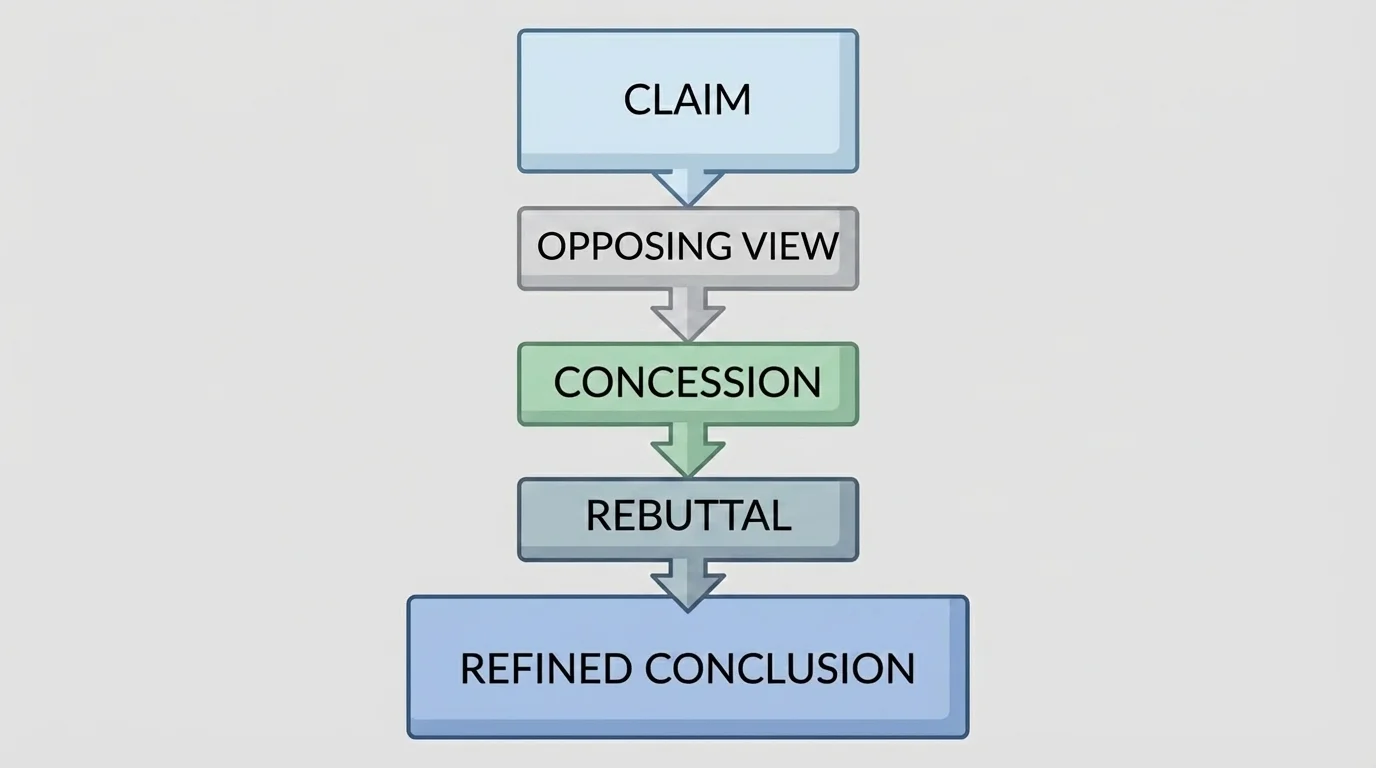
[Figure 3] Strong argument writing anticipates how readers may respond through the movement from claim to counterargument to rebuttal. Readers bring values, beliefs, and prior experiences to every issue. If your audience is likely to disagree with you, a dismissive tone will probably harden resistance. A respectful, evidence-based approach is more effective.
This is where counterargument becomes essential. A counterargument presents an opposing or alternative view that a thoughtful reader might hold. Including one does not weaken your essay. In fact, it often strengthens your credibility by showing that you understand the complexity of the issue.
One useful move is the concession. A concession acknowledges that an opposing point has some merit or that the issue has real complexity. For example, a writer might say, "Supporters of later school start times correctly note that sleep is linked to student health." This sentence grants a valid point without giving up the overall argument.
After a concession, the writer often offers a rebuttal, which responds with reasoning or evidence. For example: "However, district budgets, transportation schedules, and after-school responsibilities make implementation more complicated than advocates sometimes suggest." This remains objective because it answers with explanation rather than ridicule.
When you address audience values, word choice matters. Compare "People who disagree are ignorant" with "Some critics remain unconvinced because they prioritize short-term cost over long-term community benefit." The second sentence still identifies disagreement, but it does so in a way that invites analysis instead of hostility.
Later in a full essay, the sequence displayed in [Figure 3] helps keep disagreement productive. Rather than attacking the audience, the writer recognizes a concern, considers it seriously, and then responds with evidence. That pattern often makes arguments more persuasive because it reflects intellectual maturity.
"The aim of argument is not victory, but progress in understanding."
Even when the topic is controversial, your writing should show respect for persons and rigor toward ideas. That balance is one of the clearest signs of an objective tone.
Several habits can weaken an otherwise strong paper. One is loaded language, or wording designed to provoke emotion more than thought. Words such as "disgusting," "pathetic," or "evil" may express strong feelings, but they usually need careful justification in academic writing. Without that justification, they can make the writer seem reactive rather than analytical.
Another problem is overgeneralization. Words like "everyone," "no one," "always," and "never" often signal claims that are too broad to defend. A more formal and objective writer narrows the statement: "Many students," "in several cases," "often," or "under these conditions."
A third issue is excessive first-person framing. In some assignments, using "I" may be acceptable, especially when reflecting. But in formal argument writing, repeating "I believe" or "I feel" can keep the focus on the writer instead of the evidence. Often, the sentence becomes stronger when the evidence takes center stage.
Arguments need more than a position. They need reasoning that connects evidence to the claim. Tone and style do not replace logic; they help readers see the logic clearly and trust the writer's judgment.
Informal punctuation habits can also hurt formality. Multiple exclamation points, rhetorical fragments, or dramatic questions may work in conversation or online posts, but they rarely strengthen an academic essay. Controlled punctuation supports controlled thinking.
Revision is where many strong arguments are truly made. During revision, read your draft as if you were the audience. Ask whether the writing sounds precise, fair, and appropriate to the subject. Look for places where a sentence sounds casual, emotional, vague, or overly certain.
One effective strategy is to circle verbs and adjectives. Are they accurate, or are they exaggerated? "Proves" may need to become "suggests." "Amazing" may need to become "significant." "Destroyed" may need to become "weakened" if the evidence is more limited.
Another strategy is to test whether each paragraph contains a defensible claim and relevant support. If a paragraph relies on reaction words without evidence, revise it so that the analysis, not the emotion, leads. If a paragraph includes a quotation, add commentary that explains how the quotation supports the point.
Revision moves
Original: "Obviously, the article is wrong, and the author clearly does not understand teenagers."
Step 1: Remove dismissive language.
Words such as "obviously" and "clearly" can sound condescending when the evidence has not yet been explained.
Step 2: Focus on the argument, not the person.
Academic writing critiques ideas and evidence more effectively than personal competence.
Step 3: Replace insult with analysis.
Revised sentence: "The article simplifies adolescent behavior by treating teenagers as a single, uniform group."
The revision sounds more formal, more objective, and more persuasive.
Reading aloud can also help. A sentence that sounds like a social media post often needs revision for an academic paper. If the wording sounds like something said in frustration, reshape it into something that can be defended with evidence.
Consider how formal style and objective tone appear differently across disciplines. In literary analysis, a writer might argue, "Through repeated images of cold and confinement, the poem presents isolation as both physical and emotional." This sentence is interpretive, but it remains formal because it is precise and text-based.
In history, a writer might say, "Although economic pressures contributed to the uprising, political exclusion and regional tensions also played major roles." This sounds objective because it avoids reducing a complex event to a single cause.
In science, a writer might state, "The data indicate a consistent increase in growth rate under higher light exposure, though additional trials are needed to confirm the pattern." That sentence is careful, evidence-based, and appropriately qualified.
Across all of these fields, the common standard remains the same: serious claims require serious language. The strongest writers adjust their methods to the discipline while preserving precision, fairness, and logical control.
