A single word can change the meaning of an entire argument. In a news article, the word sanction can mean a penalty or official approval. In a biology text, culture may refer not to society, but to a prepared growth medium for cells. In legal writing, the difference between two near-synonyms can determine whether a statement sounds precise, vague, biased, or even incorrect. Strong readers do not guess when a word matters. They verify.
That is where reference materials become essential. Skilled readers in grades 11 and 12 are expected to handle complex informational, argumentative, and narrative texts. Those texts often contain unfamiliar words, technical vocabulary, multiple-meaning terms, and formal or discipline-specific language. To understand them accurately, you need to know how to consult the right source at the right moment.
When readers meet an unfamiliar word, they often rely first on context clues. That is useful, but it is not always enough. Context can suggest a general direction without giving a precise meaning. For example, if an editorial says a policy is ambiguous, context may suggest that the policy is unclear. But a reference source can confirm the exact meaning, show pronunciation, identify the word as an adjective, and reveal whether it has additional meanings in law or logic.
Reference skills matter because advanced reading demands precision. In literary analysis, the difference between melancholy and depression affects tone. In science, the word theory has a more precise meaning than it often does in everyday conversation. In history, a word like revolution may refer to political change, industrial transformation, or orbital motion depending on context. If you choose the wrong meaning, you may misunderstand the whole passage.
Reference materials are sources designed to provide verified information quickly and accurately. They include general dictionaries, subject-specific glossaries, thesauruses, usage guides, encyclopedias, and digital databases. Each type is built to answer a different kind of question about language.
Good readers are flexible. They do not use one tool for every problem. Instead, they ask: Do I need the pronunciation? the precise meaning in this subject? a synonym with the same tone? the word's grammatical role? its historical origin? or guidance about whether it is considered standard in formal writing?
A general dictionary is the most familiar reference tool. It usually gives pronunciation, definitions, parts of speech, common inflected forms, etymology, and example usage. It is useful when you need broad, reliable information about a word used in standard English.
A glossary is more specialized. It appears in textbooks, academic articles, or professional fields and defines terms as they are used in a particular subject. If you are reading chemistry, economics, philosophy, or computer science, a glossary may be more helpful than a general dictionary because it focuses on discipline-specific meaning.
A thesaurus gives synonyms and sometimes antonyms. It is useful when you want to compare shades of meaning, but it should never be treated as a list of interchangeable words. Two words may be similar without being equivalent in tone, formality, or usage.
Other reference materials include usage guides, which explain disputed or commonly confused expressions; pronunciation dictionaries, which focus on spoken form; and etymological dictionaries, which trace word origins and changes over time. Digital platforms often combine several of these functions in one place, but you still need to know what kind of information you are actually looking at.
A dictionary entry is more like a map of language information than a single definition. If you know how to read that map, you can answer several important questions at once: How is the word pronounced? What part of speech is it? Which meaning fits this sentence? Is the usage formal, informal, technical, regional, or obsolete?
A typical entry begins with the headword, the main word listed in bold. Near it, you often find a pronunciation guide. Then comes the part of speech, such as noun, verb, adjective, or adverb. After that, most dictionaries list numbered definitions in order of commonness or historical development, depending on the dictionary's system. Many entries also include example sentences, origin information, and usage labels such as informal, archaic, slang, or chiefly British.
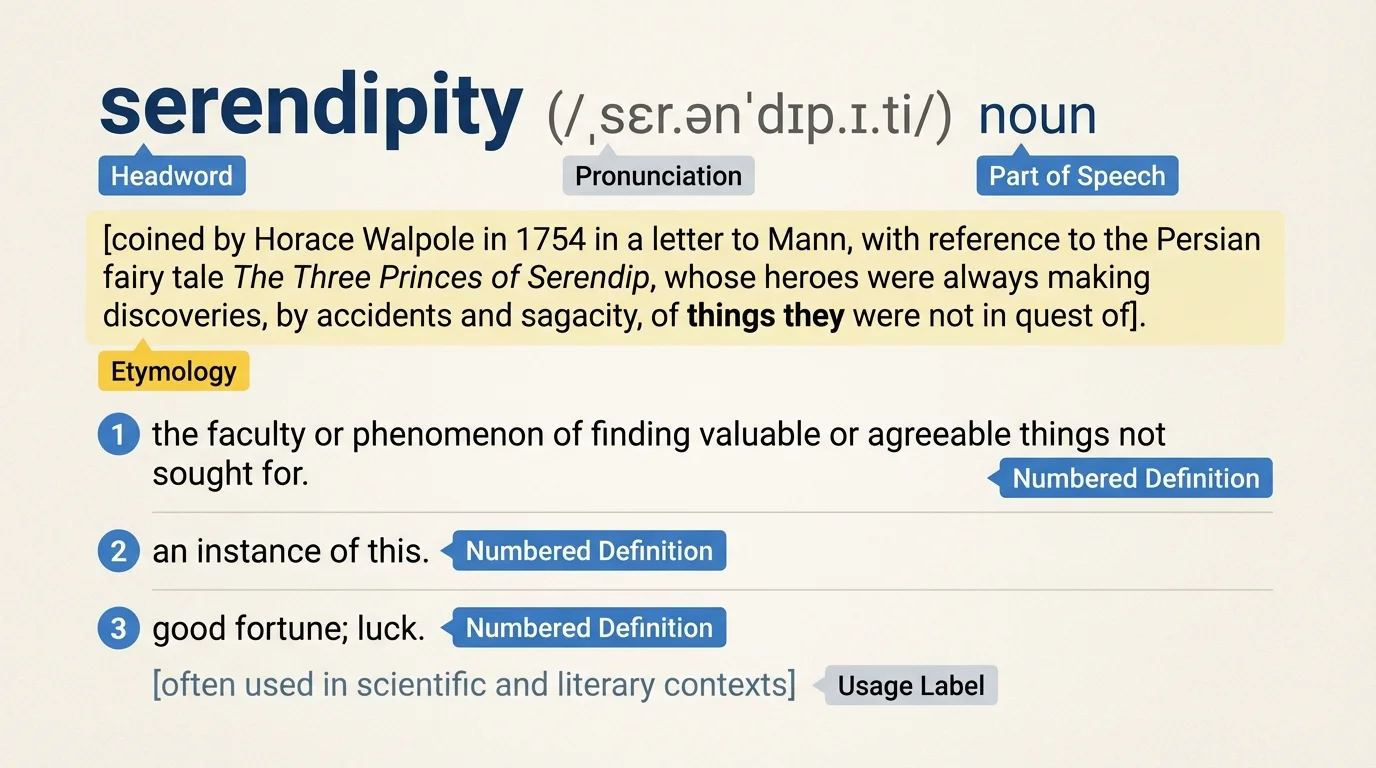
Numbered definitions are especially important when a word has multiple meanings. Consider the word draft. In one text, it can mean a preliminary version of an essay. In another, it can refer to military conscription. In another, it can mean a current of air. A reader who stops at the first definition may be completely wrong. You must compare the sentence you are reading to all relevant meanings in the entry.
Dictionaries also help with grammatical function. The word record can be a noun or a verb, and its stress changes depending on that role. Seeing the part of speech lets you connect meaning to syntax. That matters in complex sentences, especially when academic writing uses nouns and verbs that look identical.
Using a dictionary entry to clarify meaning
Suppose you read this sentence in a political article: "The committee decided to table the motion."
Step 1: Identify the problem.
The word table is familiar as a noun, but here it is used as a verb.
Step 2: Check the part of speech and definitions.
A dictionary shows table as a verb with different meanings depending on regional usage.
Step 3: Use context and usage labels.
In some varieties of English, table means to present something for discussion. In others, especially in American usage, it may mean to postpone discussion.
Step 4: Infer the precise meaning from the source.
If the article is from a British parliamentary source, the meaning is likely "to present." If it is from an American procedural context, the meaning may be "to postpone."
The dictionary does not replace context; it works with context to produce an accurate reading.
Later, when you compare similar entries, the structure shown in [Figure 1] remains useful because it reminds you to read beyond the first definition and examine labels, examples, and word class.
The best source depends on the question. If you need a standard meaning or pronunciation, start with a dictionary. If the text belongs to a specialized field, check a glossary or subject dictionary. If you are revising writing and need a more precise synonym, consult a thesaurus. If you are unsure whether a form is accepted in formal English, use a usage guide.
For example, suppose you encounter the word bond in three different classes. In chemistry, a glossary may explain the connection between atoms, such as a covalent bond like \(\mathrm{O-H}\). In economics, a glossary defines a bond as a debt security. In literature, bond may mean an emotional tie. A general dictionary may include all of these, but a specialized source provides the precision needed for the subject at hand.
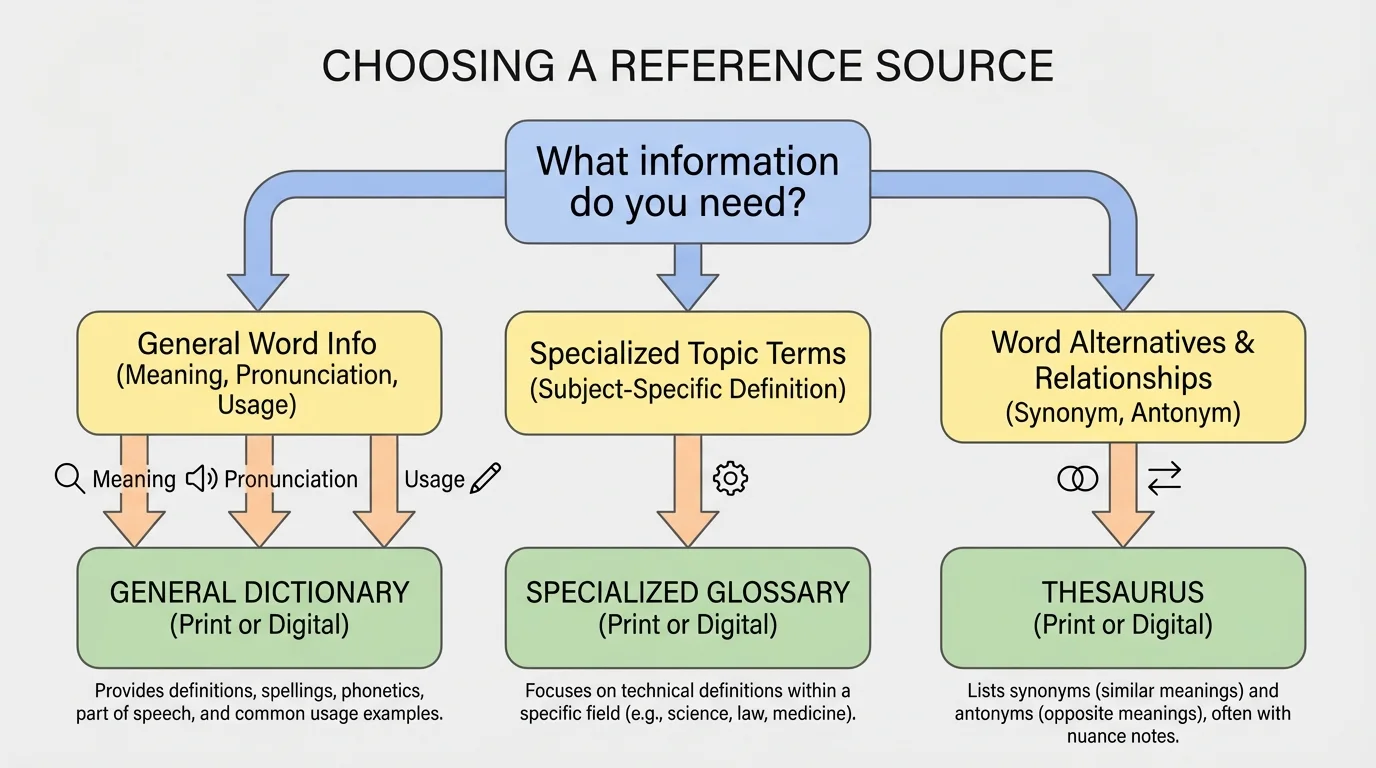
A thesaurus is powerful but risky when misused. If you look up important, you may find significant, momentous, consequential, and eminent. These are not interchangeable in every sentence. An eminent scientist makes sense; an eminent problem does not. Always confirm connotation, grammatical fit, and standard usage with a dictionary after consulting a thesaurus.
Usage guides become especially helpful with words that trigger debate or confusion, such as fewer versus less, affect versus effect, or whether a phrase sounds too informal for academic writing. These guides often explain both current practice and formal expectations, helping you recognize what is common, what is accepted, and what may still be contested.
Many students assume dictionaries are only for meaning, but pronunciation matters too. When you encounter an unfamiliar word in reading, you may later need to say it in discussion or presentation. A dictionary can tell you whether the stress falls on the first or second syllable, whether there are accepted variants, and whether the pronunciation differs between British and American English.
Some dictionaries use respelling systems, while others use the International Phonetic Alphabet, or IPA. You do not need to become a linguist to use IPA effectively. At a practical level, you should learn to recognize stress marks, syllable divisions, and common vowel symbols. If a word appears with more than one pronunciation, the dictionary may indicate that both are accepted or that one is preferred in a certain region.
Standard usage and why it matters
Standard usage refers to forms of language widely accepted in formal speaking and writing. It does not mean that other forms are "bad"; it means that some forms are expected in academic, professional, and public contexts. Reference materials help you determine whether a word is formal, informal, dialectal, nonstandard, archaic, or field-specific.
Usage labels help prevent mistakes in tone. If a dictionary marks a word as slang, using it in a lab report or formal essay may weaken credibility. If a word is labeled obsolete, it may appear in older literature but sound unnatural in present-day analytical writing. If a definition is marked technical, it may be accurate in a field-specific context but confusing to general readers.
Pronunciation and usage also intersect with credibility. Saying a key term confidently and correctly in class discussion suggests that you not only recognized the word, but understood it deeply enough to use it appropriately.
Reference materials are most useful when combined with context. A word does not enter a sentence as an isolated object; it functions within a larger idea, tone, discipline, and purpose. That means the right definition is the one that matches the sentence, not simply the first one listed.
This is where denotation and connotation matter. Denotation is a word's core dictionary meaning. Connotation is the emotional, cultural, or tonal association attached to it. Two words can share a denotation but differ in connotation. Thin and scrawny may point toward similar physical description, yet one is more neutral and the other more negative.
Multiple-meaning words require special care. Consider charge. In physics, it can refer to an electrical property. In finance, it may mean a cost. In law, it may be a formal accusation. In ordinary action, it can mean to rush forward. The surrounding words, subject matter, and sentence structure help you select the correct meaning, while the reference source confirms it.
Context and precise meaning
Read the sentence: "The speaker's tone undermined the credibility of the argument."
Step 1: Reject unrelated meanings.
A dictionary may list meanings related to sound, muscle firmness, color quality, or attitude.
Step 2: Examine the context.
The sentence discusses a speaker and an argument, so the relevant meaning concerns attitude or manner of expression.
Step 3: Refine understanding.
Here, tone means the speaker's attitude as revealed in language and delivery, not merely the sound of a voice.
This level of precision supports stronger analysis because it connects word meaning to the author's purpose.
Cross-checking can also help. If a dictionary definition seems broad, a glossary or usage guide may sharpen it. For a literary term like irony, a classroom glossary or literary handbook may provide a more accurate analytical definition than a general dictionary alone.
Etymology is the study of a word's origin and historical development. Dictionaries often trace where a word came from, such as Latin, Greek, French, Old English, or another source. This information can reveal how meanings evolved over time.
Word history is more than a curiosity. It can help you notice relationships among terms. If you learn that benevolent comes from roots connected to "well" and "wishing," you gain a clue to its meaning. If you notice that biology, biography, and biodegradable all contain a root related to life, you begin to build a network of understanding rather than memorizing isolated definitions.
Still, etymology must be used carefully. A word's origin does not always match its current meaning. The history can illuminate a word, but present context determines how it functions now. This is especially important with words whose meanings have shifted dramatically over centuries.
The word nice once had meanings closer to "foolish" or "ignorant" in its early history. Over time, its meaning shifted so much that in modern English it usually suggests pleasantness or kindness.
Etymology is most useful when it helps you recognize patterns, decode unfamiliar academic vocabulary, and appreciate that language changes. It should deepen your reading, not trap you in outdated meanings.
Strong readers switch formats strategically. Print and digital reference materials can both be excellent, but they serve different needs. Print sources often emphasize editorial authority and stable editions. Digital sources offer speed, portability, audio pronunciation, hyperlinks, and search functions.
A print dictionary can be useful when you want to slow down and examine an entry closely without distraction. It also makes nearby words visible, which can help you notice patterns in prefixes, roots, and related forms. Some students understand reference structure better after working with a physical book because the organization is more concrete.
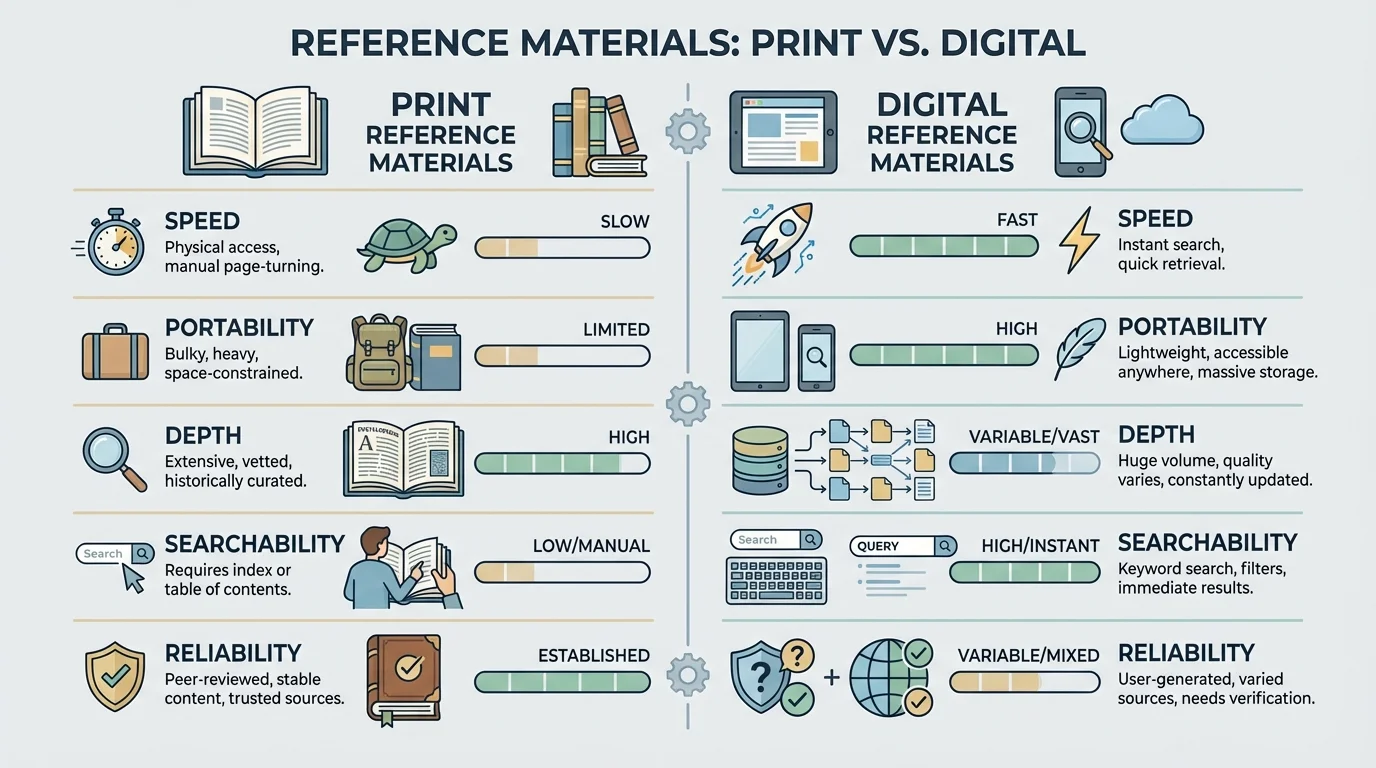
Digital tools are valuable when time matters. If you are reading an online article, you can quickly check pronunciation, hear audio, compare meanings, and move to a specialized glossary in seconds. However, speed can create carelessness. Not every website is equally reliable. You should prefer reputable dictionaries, academic glossaries, university resources, and established style guides over anonymous or crowd-edited sources when precision matters.
The comparison also highlights an important point: format does not replace judgment. A digital dictionary from a respected publisher may be far more trustworthy than a weak print source, and a well-edited print reference may be more reliable than a random website. Credibility depends on source quality, not just medium.
| Reference Tool | Best Use | Main Strength | Main Caution |
|---|---|---|---|
| General dictionary | Meaning, pronunciation, part of speech | Broad coverage | May be too general for technical fields |
| Glossary | Subject-specific terms | Precise disciplinary meaning | Usually narrow in scope |
| Thesaurus | Comparing word choices | Shows semantic range | Synonyms are not always interchangeable |
| Usage guide | Formal correctness and disputed usage | Explains conventions and expectations | Some advice may reflect style preferences |
| Etymological dictionary | Word origin and history | Reveals development of meaning | Origin does not determine current use |
Table 1. Comparison of common reference tools, their strengths, and their limits.
When you meet an unfamiliar or uncertain word, use a clear process. First, read the sentence and surrounding lines for context. Second, identify what kind of problem you have: meaning, pronunciation, usage, grammar, or subject-specific definition. Third, choose the source that matches the problem. Fourth, compare the entry to the context of the passage. Fifth, if necessary, confirm with a second source.
This process is especially useful in advanced academic reading, where one word may carry conceptual weight. In philosophy, a word like valid has a technical meaning different from its ordinary everyday use. In science, organic may refer to carbon-based compounds rather than grocery labels. In rhetoric, appeal refers to persuasive strategy, not simply attraction.
Applying a reference strategy to a difficult text
Suppose a history passage states that a treaty created a precarious peace.
Step 1: Use context.
The passage suggests the peace exists, but may not be stable.
Step 2: Consult a dictionary.
The dictionary defines precarious as uncertain, insecure, or dependent on chance.
Step 3: Refine interpretation.
The phrase means the peace is fragile and could collapse easily.
Step 4: Connect meaning to argument.
If the peace is precarious, the author is emphasizing instability rather than resolution.
Now the word supports a richer understanding of the passage's claim.
Notice that the goal is not merely to "know the word." The goal is to understand how the word functions in the author's larger meaning.
One common mistake is accepting the first definition without checking context. Another is using a thesaurus to replace a word without verifying tone, grammar, and standard usage. A third is assuming everyday meaning and academic meaning are the same. A fourth is trusting any search result that appears quickly, even if its authority is unclear.
Another mistake is confusing familiarity with understanding. You may recognize a word visually and still misunderstand it in a specialized setting. The word motive in a detective story differs from motif in literary analysis, even though the terms look and sound somewhat similar. Reference materials help protect you from these false assumptions.
Context clues remain important. They help you predict meaning before consulting a source and help you choose among multiple definitions afterward. Reference skills do not replace close reading; they strengthen it.
Finally, avoid treating reference tools as mechanical answer machines. They are interpretive aids. You still need judgment, especially when texts are complex, authors are subtle, or words carry layered meanings. The most skilled readers move back and forth between the text and the reference source until the meaning becomes precise.
