A politician says a nation is "bleeding," a poet writes that silence is "louder than thunder," and a journalist describes a market crash as "a free fall." None of those phrases are literally true, yet each can shape how readers think, feel, and understand a text. That is the power of figurative language: it lets writers compress emotion, sharpen ideas, and make abstract concepts vivid. For skilled readers, the challenge is not simply spotting a figure of speech. The real work is interpreting what it means in context and explaining why the writer chose it.
At an advanced level, reading figurative language means asking several questions at once. What does the phrase mean literally? Why does the literal meaning not fully fit? What implied meaning emerges instead? How does that implied meaning affect tone, emphasis, credibility, theme, or audience response? When you answer those questions, you move from identification to analysis.
Figures of speech are not decorations added on top of meaning. In strong writing, they create meaning. A single hyperbole can reveal a speaker's emotional intensity. A paradox can force readers to think through a complicated truth. A metaphor can organize an entire argument. Even in informational texts, figurative language can clarify difficult ideas by comparing them to familiar experiences.
Readers in grades 11 and 12 are expected to do more than say, "This is hyperbole," or, "This is a paradox." Strong analysis explains the figure's function. In a narrative, figurative language may deepen characterization or shape mood. In an argument, it may intensify a claim, influence the audience, or simplify a complex issue. In an informational text, it may help readers visualize a process or grasp an unfamiliar concept.
Literal meaning is the direct, ordinary meaning of words. Figurative meaning is the implied meaning created when words depart from literal truth. Context includes the surrounding words, the speaker, the situation, the genre, the audience, and the larger purpose of the text. Connotation refers to the emotional or cultural associations a word carries beyond its dictionary definition.
When interpreting figurative language, context matters because the same phrase can function differently in different settings. "I'm drowning" in a casual conversation usually means "I am overwhelmed," but in a survival narrative it may be literal. Meaning depends on clues around the phrase and on what the text is trying to accomplish.
The central interpretive move is this: when the literal meaning seems impossible, exaggerated, self-contradictory, or otherwise unfitting, readers look for a deeper meaning that better matches the surrounding text. That process requires precision. You should not assume every vivid phrase is symbolic or profound. Instead, you test your interpretation against evidence from the language, tone, and situation.
For example, if a character says, "This hallway goes on forever," the literal claim is false. But the exaggeration may suggest boredom, anxiety, dread, or a child's distorted sense of time. The correct interpretation depends on whether the scene is comic, suspenseful, or emotionally tense.
A hyperbole is a deliberate exaggeration used for emphasis or effect. Readers recognize it because, as [Figure 1] shows, hyperbole works by creating a gap between literal possibility and emotional truth. The statement is not meant to be factually accurate; it is meant to reveal intensity, urgency, humor, admiration, frustration, or scale.
Consider the sentence, "I waited a million years for the reply." No careful reader believes the speaker literally waited that long. The hyperbole communicates impatience and emotional strain. In another context, "This backpack weighs a ton" expresses discomfort or complaint. Hyperbole often sounds casual in speech, but in literature and rhetoric it can be highly strategic.
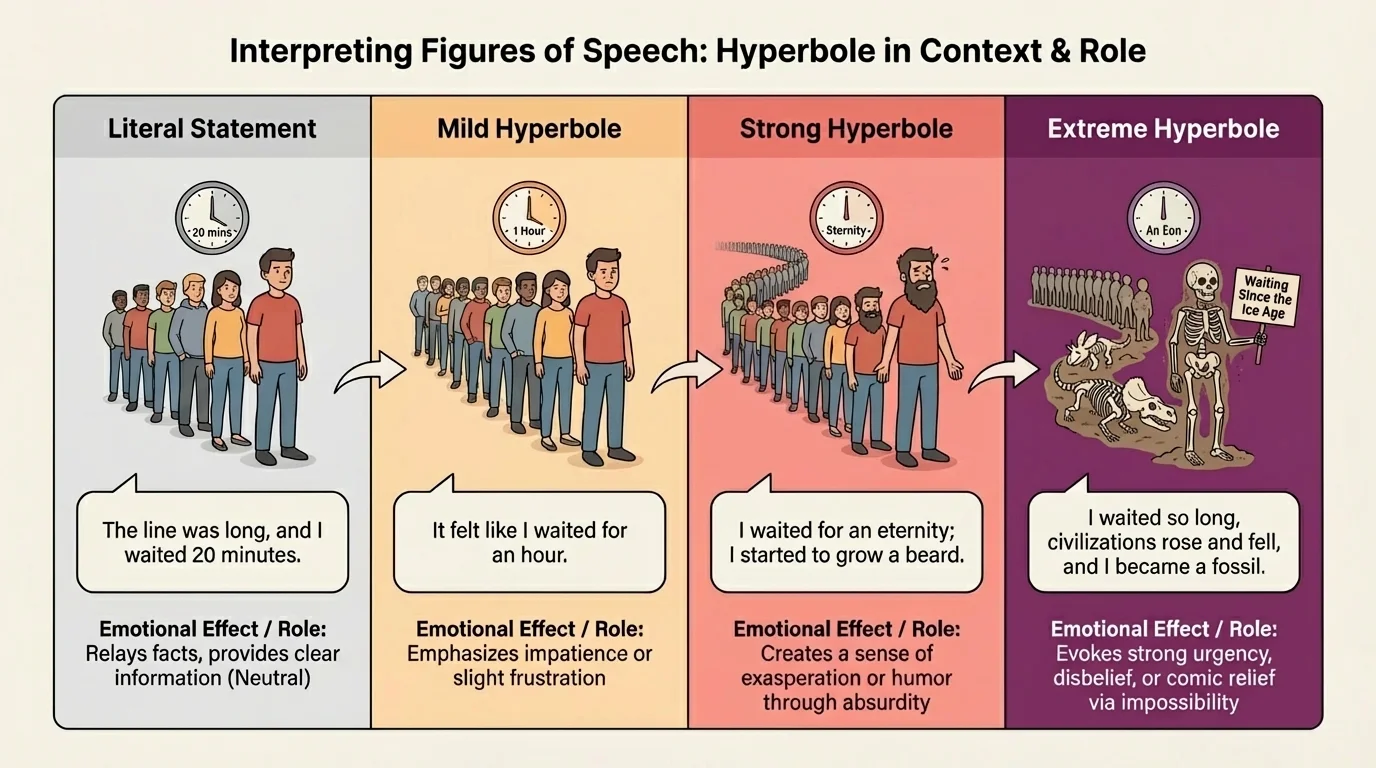
In narrative writing, hyperbole can reveal a character's perspective. A dramatic teenager who says, "Everyone in school hates me," may not be reporting facts; the exaggeration exposes insecurity, social anxiety, or self-centered thinking. In satire, hyperbole often exposes the absurdity of social behavior or public policy by pushing reality to an extreme.
In argumentative writing, hyperbole can be effective but risky. A speaker who claims, "This decision will destroy our future," may generate urgency, but if the claim is obviously overstated, the writer can lose credibility. Readers should ask whether the exaggeration strengthens the argument by emphasizing stakes or weakens it by substituting emotion for evidence.
In informational writing, hyperbole appears less often because accuracy matters, but it may still appear in introductions, headlines, or popular science writing to grab attention. A phrase such as "an explosion of data" is figurative; it conveys rapid growth, not an actual blast. The key is to notice whether the text invites precision or vividness at that moment.
Analyzing hyperbole in context
Passage: "By the time the final buzzer sounded, the crowd had shaken the whole city awake."
Step 1: Identify the figure of speech.
The phrase "shaken the whole city awake" is hyperbole because a crowd cannot literally shake an entire city awake.
Step 2: Interpret the meaning in context.
The line suggests overwhelming noise, excitement, and collective energy after an important game.
Step 3: Analyze the role in the text.
The hyperbole enlarges the moment, making the event feel historic and emotionally charged. It also helps readers experience the scene from the perspective of someone swept up in the excitement.
When you analyze hyperbole, avoid saying only that it "adds detail." A stronger claim explains what kind of emphasis it creates and why that emphasis matters. Later, when comparing text types, we can return to the visual logic in [Figure 1]: hyperbole always depends on readers noticing both exaggeration and intended emotional truth at the same time.
A paradox is a statement that seems self-contradictory or impossible at first, yet expresses a deeper truth when examined carefully. As [Figure 2] illustrates, paradox operates by forcing two apparently opposing ideas into the same space until readers recognize the insight behind the tension.
Take the phrase, "Less is more." On the surface, it clashes with logic: how can less become more? But in design, writing, or architecture, the phrase suggests that restraint can create stronger impact than excess. Another example is, "The only constant is change." The statement appears unstable, yet it expresses the idea that change itself is the one reliable feature of life.
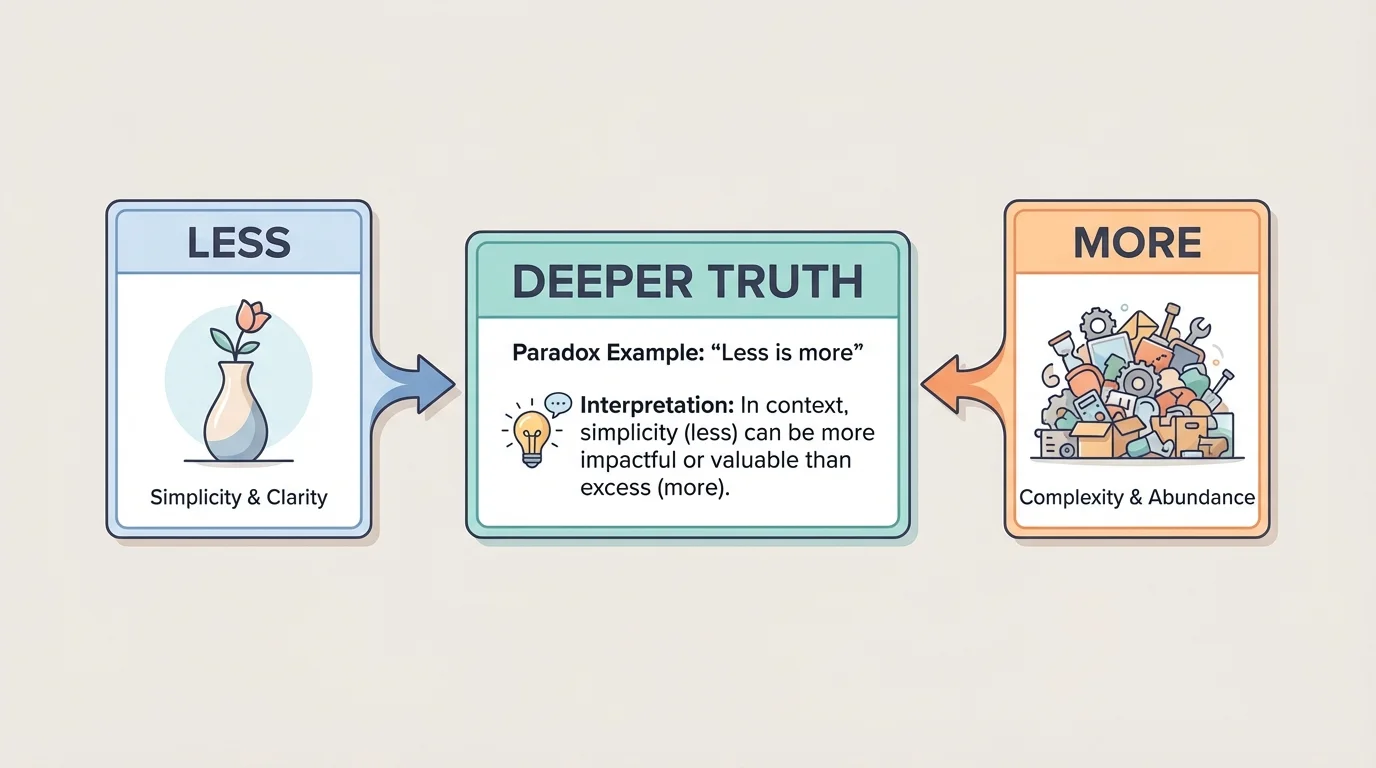
Paradox is especially common in poetry, philosophy, and reflective prose because it captures experiences that do not fit simple either-or logic. Human life often contains such tensions: freedom can require discipline, vulnerability can create strength, and silence can communicate more powerfully than speech.
It is important to distinguish paradox from contradiction. A contradiction simply cancels itself out: "The door is fully open and fully closed at the same moment" has no deeper implied truth in ordinary usage. A paradox initially appears contradictory but becomes meaningful when interpreted at a more abstract level.
Paradox can shape theme. If a memoir states, "I had to lose my home to find it," the line may suggest that physical displacement led the speaker to a stronger sense of identity or belonging. In an argument, paradox can challenge readers' assumptions. A writer might claim, "To protect privacy, we must reveal how surveillance works," joining two ideas that seem opposed but support a complex claim.
Why paradox deepens meaning
Paradox slows readers down. Instead of delivering a straightforward statement, it creates friction between ideas. That friction encourages interpretation, making the reader actively participate in meaning-making. Because of this, paradox often appears in texts that explore moral complexity, identity, power, faith, memory, or change.
When analyzing paradox, do not stop at "this sounds contradictory." The essential next step is to explain the insight produced by the apparent contradiction. Strong readers ask: What tension does the statement hold together? Why is a simple statement not enough here?
Although hyperbole and paradox are central examples, they rarely appear alone. Writers often combine them with other devices, and readers must distinguish among these related forms.
A metaphor makes an implicit comparison by saying one thing is another. "Time is a thief" does not mean time commits crimes literally; it suggests that time steals moments, youth, or opportunities. A simile makes a comparison using words such as like or as, as in "her voice was like glass," implying clarity, fragility, or coldness depending on context.
Personification gives human traits to nonhuman things: "The wind argued at the windows." This can create an atmosphere, emotional intensity, or symbolic meaning. Understatement does the opposite of hyperbole by deliberately presenting something as smaller or less serious than it is, often for irony or control: saying "It's a bit warm" during extreme heat can sound humorous, detached, or sharply critical.
An oxymoron joins two apparently opposite terms, such as "deafening silence" or "living death." Unlike a full paradox, an oxymoron is usually a shorter phrase rather than a complete thought. Irony involves a gap between appearance and reality, expectation and outcome, or stated meaning and intended meaning. A speaker who says "Wonderful timing" after a disaster may mean the opposite of the literal words.
Symbolism occurs when an object, image, or action carries significance beyond its literal presence. An allusion is an indirect reference to a well-known text, event, person, or idea. If a speech describes a difficult reform as "crossing the Rubicon," the phrase alludes to Julius Caesar and suggests a decisive, irreversible step.
| Figure of speech | Basic pattern | Typical effect |
|---|---|---|
| Hyperbole | Extreme exaggeration | Emphasis, humor, urgency, intensity |
| Paradox | Apparent contradiction with deeper truth | Complexity, reflection, insight |
| Metaphor | Implicit comparison | Vivid understanding, conceptual framing |
| Simile | Comparison using like or as | Clarity, imagery, tone |
| Personification | Human qualities assigned to nonhuman things | Mood, animation, emotional connection |
| Understatement | Intentional minimization | Irony, restraint, wit, criticism |
| Oxymoron | Paired opposites | Tension, compression of complexity |
| Irony | Gap between surface and reality | Critique, humor, complexity |
Table 1. A comparison of common figures of speech and their typical effects in texts.
To interpret figurative language accurately, readers must examine multiple layers of context, as [Figure 3] shows: the speaker, the audience, the tone, the genre, the historical moment, and the writer's purpose all influence meaning. A phrase never exists by itself. It belongs to a situation.
First, consider the speaker. If a sarcastic narrator says, "What a paradise," while describing pollution and noise, the phrase likely signals irony rather than praise. If a grieving character says, "The house is empty," the statement may be literally true, but in context it may also imply emotional emptiness and loss.
Second, consider tone and audience. A campaign speech may use dramatic metaphors to mobilize support, while a scientific article uses figurative comparisons mainly to clarify difficult concepts. The same phrase can feel inspiring in one context and manipulative in another.
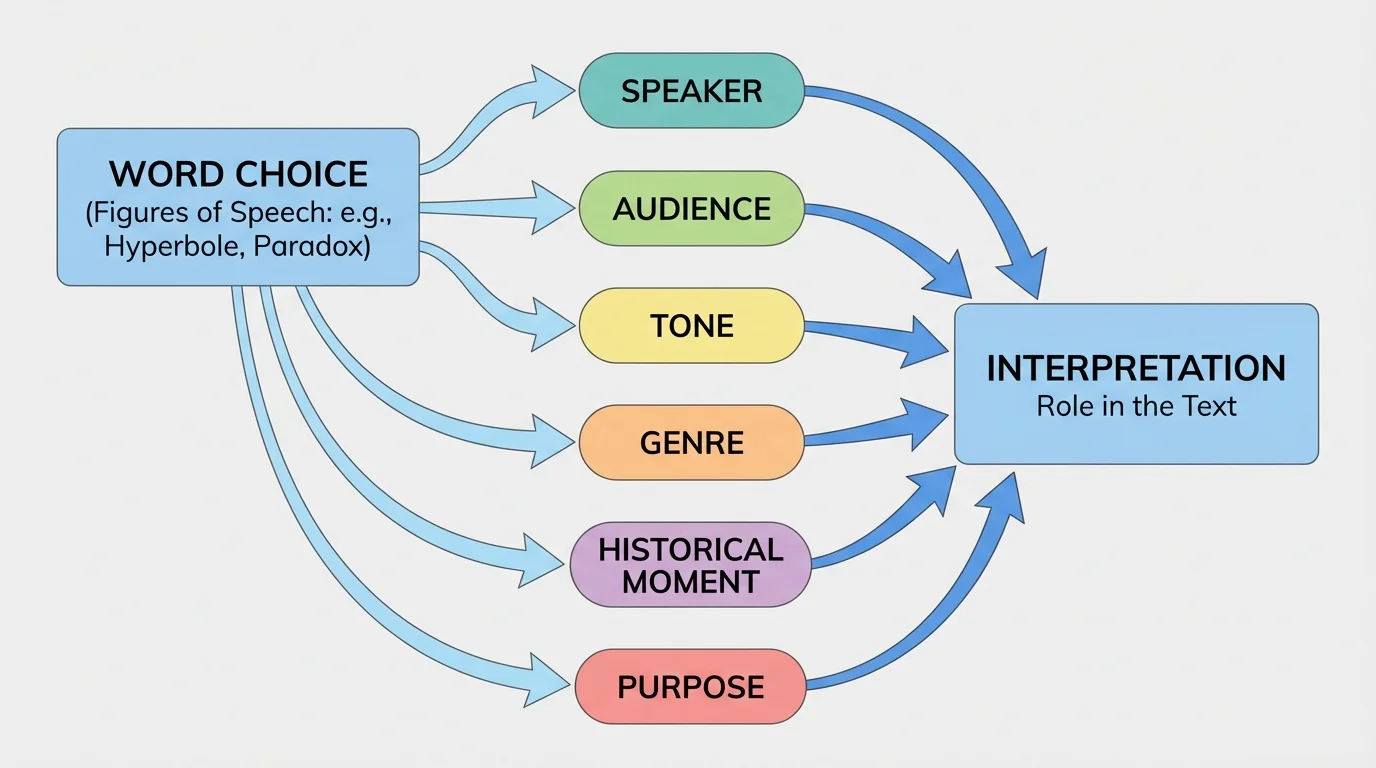
Third, consider the genre. In poetry and literary fiction, readers often expect condensed language and layered meaning. In informational prose, figurative language tends to be more controlled and explanatory. In journalism, it may appear in headlines or leads to shape a reader's immediate impression.
Fourth, consider the historical and cultural setting. A phrase that seems ordinary today may carry stronger meaning in another era or community. Allusions especially depend on shared background knowledge. Without that knowledge, a reader may miss the force of the figurative language.
Finally, consider the surrounding details. If a paradox appears near a turning point in a text, it may signal a thematic shift. If a metaphor repeats across several paragraphs, it may be organizing the entire piece. The interpretive work is cumulative: each clue narrows the range of possible meanings.
Many of the most memorable public phrases in history survive because of figurative compression. Statements such as "iron curtain" or "market bubble" become powerful partly because a figurative phrase can frame how entire events are understood.
Context also helps prevent overreading. Not every image is symbolic, and not every exaggeration is profound. Good analysis is disciplined. It connects claims to evidence and chooses interpretations that fit the language and purpose of the whole text.
[Figure 4] shows that the same figure of speech can perform different functions depending on the type of text. Readers should always ask not only what a figure means, but also what kind of work it is doing in this genre.
In narrative texts, figures of speech often reveal character, establish mood, develop setting, or reinforce theme. If a narrator describes a city as "a machine chewing people into shadows," the metaphor shapes setting, conveys emotional attitude, and suggests a larger theme about dehumanization.
In argumentative texts, figures of speech can frame issues, appeal to emotion, simplify complexity, or make claims memorable. A writer who calls misinformation "a wildfire" suggests speed, danger, and spread. That metaphor does more than decorate the prose; it guides how the audience understands the problem and what kind of response seems necessary.
In informational texts, figures of speech usually help explain difficult content. A biology writer might say that a cell membrane acts "like a security gate," using a simile to make the concept easier to visualize. The goal is not primarily emotional intensity, but clarity through analogy.
| Text type | Common roles of figurative language | Questions to ask |
|---|---|---|
| Narrative | Builds mood, reveals character, develops theme, intensifies imagery | What does this reveal about perspective or emotion? |
| Argumentative | Frames issues, persuades audience, sharpens claims, adds urgency | How does this influence the audience's judgment? |
| Informational | Clarifies ideas, makes concepts accessible, organizes explanation | How does this comparison help understanding? |
Table 2. A comparison of how figurative language functions across major text types.
This distinction matters because interpretation without genre awareness can go wrong. A metaphor in a poem may invite multiple layers of meaning, while a metaphor in a textbook usually serves a narrower explanatory purpose.
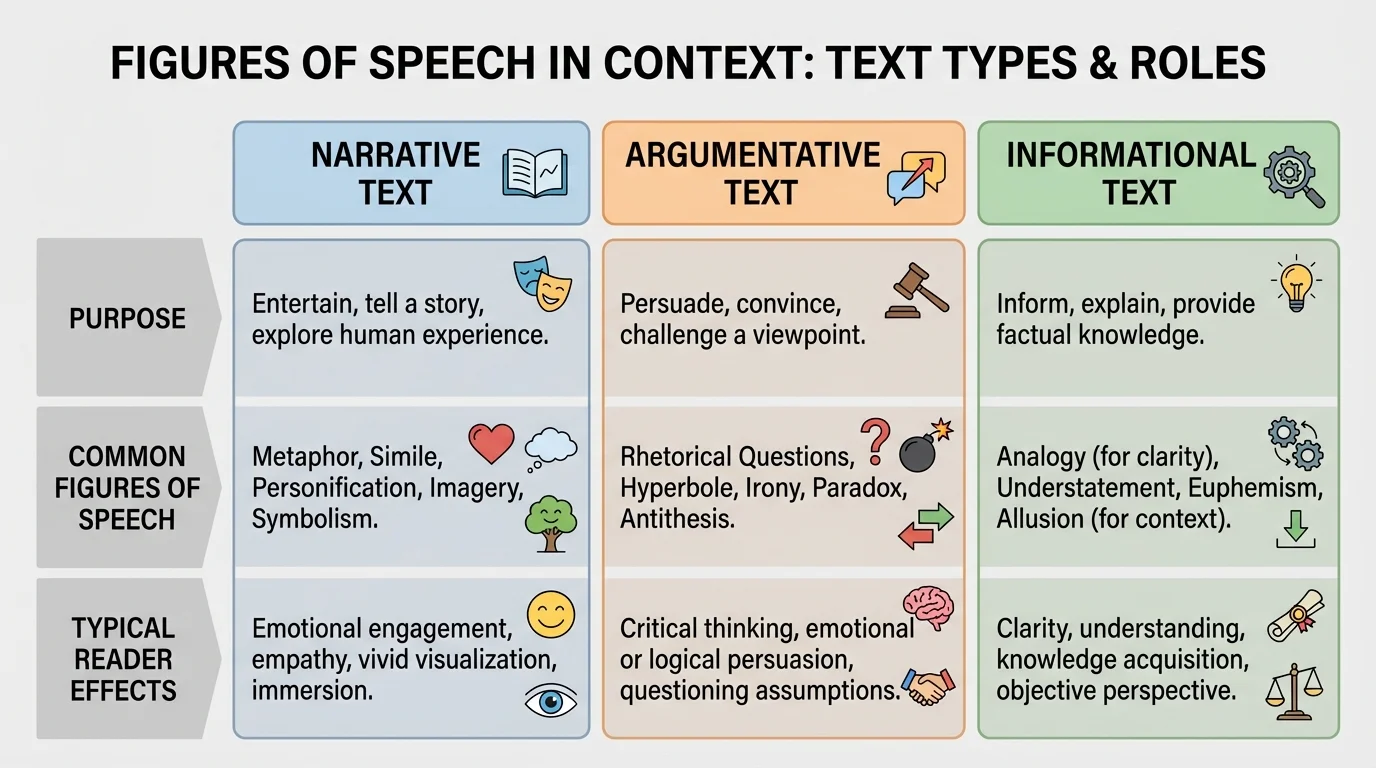
Notice how this framework helps refine analysis. Instead of saying figurative language "makes the text interesting," you can identify the specific effect appropriate to the text type: emotional immersion in narrative, persuasion in argument, or conceptual clarity in information.
When you encounter a figure of speech, use a disciplined process. Start by identifying the exact words that seem nonliteral. Then test the literal meaning. If the literal reading does not make full sense, ask what comparison, exaggeration, tension, or implied association the language creates.
Next, connect the figure to the immediate context. Who says it? About what situation? In what tone? Then move outward to the larger role in the text. Does it shape characterization? Reinforce a theme? Influence the audience? Clarify a concept? A complete analysis usually moves from phrase to paragraph to whole text.
Close-reading method
Passage: "We built walls to keep danger out, and discovered we had locked ourselves in."
Step 1: Identify the figurative tension.
The sentence is paradoxical. Building walls for safety should protect freedom, yet the sentence suggests the opposite result.
Step 2: Interpret the implied meaning.
The line suggests that excessive self-protection can become isolation. Measures meant to create security may reduce openness, growth, or human connection.
Step 3: Analyze the role in the text.
If this appears in an essay about technology, politics, or personal relationships, the paradox condenses the author's central warning into a memorable statement.
This method also helps with quotations in literary analysis. Instead of dropping a quotation into an essay and labeling it, explain the sequence of meaning: literal impossibility, inferred idea, and textual role. That sequence demonstrates genuine understanding.
Consider this narrative line: "By winter, grief had moved into the house and taken my father's chair." The personification suggests that grief is no longer a passing feeling; it has become a permanent presence. The image also connects emotion to domestic space, showing how loss reshapes everyday life. The role of the figure is not merely to create imagery, but to transform grief into something almost physical and invasive.
Now consider an argumentative sentence: "A society that worships speed eventually outruns its own judgment." This line uses metaphor and paradox together. A society cannot literally outrun judgment, but the statement suggests that obsession with rapid action can weaken reflection and responsibility. The role of the figurative language is to criticize values and sharpen the author's claim in memorable form.
Finally, consider an informational sentence: "The brain's synapses act like a city's intersections, directing traffic through countless routes." Here the simile offers a structural analogy. It helps readers visualize complexity by linking an unfamiliar biological process to an everyday system. The figurative language mainly serves explanation, not emotional intensity.
From identification to analysis
Passage: "The proposal arrived wrapped in the language of reform, but inside it carried the machinery of control."
Step 1: Identify the figure.
The sentence uses metaphor. "Wrapped" and "machinery" are not literal here.
Step 2: Interpret the meaning.
The proposal appears positive on the surface, but the author believes its real effect is restrictive or authoritarian.
Step 3: Analyze the role.
The metaphor creates suspicion and sharpens critique. It also contrasts appearance with reality, encouraging readers to question political language rather than accept it at face value.
These examples show that the strongest interpretations are specific. They name the figure, explain the nonliteral meaning, and connect that meaning to a larger purpose. That is the difference between recognition and analysis.
One common mistake is to confuse the figure with its effect. Saying "this is a metaphor" identifies the device, but it does not explain what the metaphor does. Another mistake is forcing symbolic meaning without evidence. If the text uses a comparison once for clarity, it may not support an elaborate thematic claim.
A stronger analytical sentence often follows this pattern: the writer uses device to convey idea or feeling, which advances a larger purpose. For example: "The paradox 'less is more' emphasizes the value of restraint, reinforcing the essay's argument that quality matters more than excess." That sentence links form, meaning, and purpose.
It also helps to choose precise verbs. Figurative language can amplify, reframe, compress, complicate, intensify, clarify, satirize, humanize, or destabilize. Those verbs lead to sharper analysis than vague phrases such as "makes it better" or "adds interest."
As you refine your reading, remember that figurative language often works on multiple levels at once. A metaphor may create imagery, reveal a speaker's attitude, and contribute to theme simultaneously. A paradox may sound elegant, but its real power lies in how it forces readers to think beyond simple categories. And as the contextual model in [Figure 3] reminds us, no interpretation is complete unless it accounts for the situation in which the words appear.
"Language can never do the work of experience directly; it can only make us see experience differently."
The most advanced readers treat figurative language as evidence of thought. Writers choose nonliteral language because literal language alone would not fully express the idea, feeling, or perspective they want to convey. To interpret a figure of speech well is to recognize that gap and explain how the text turns it into meaning.
