Have you ever wondered how a whole class can become a team of discoverers? One child may notice a tiny seed sprouting, another may remember a fact from a book, and another may ask a smart question no one else thought of. When students work together on research and writing, they build something bigger than one person could do alone.
Shared research means two or more people learn about one topic together. A class might study frogs, the moon, penguins, or how plants grow. Everyone helps gather facts, look closely, talk about what they learn, and create a piece of writing together.
In a shared writing project, the class or group makes one product together. That product might be a report, a poster, a science journal page, a set of labels, or a class book. Sometimes the teacher writes the words students say. Sometimes students help write parts on their own. The important idea is that everyone helps think, learn, and create.
Research is finding out information to answer questions. Observation is looking carefully and noticing details. A report is writing that gives facts about a topic.
Research is not just guessing. It means using facts from things we read, hear, see, and notice. Good researchers ask, "How do we know?" Then they look for answers in trusted places.
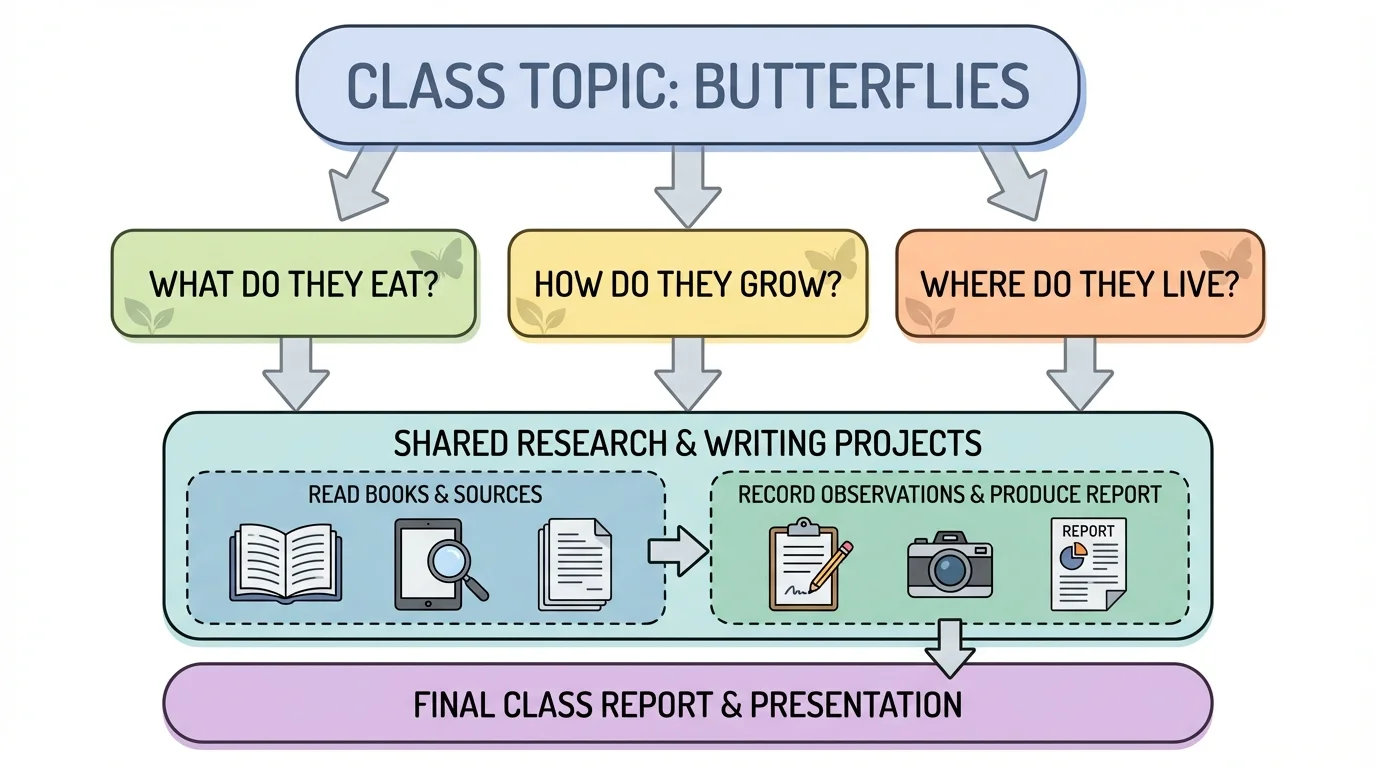
A research project usually starts with a topic. A topic is the main subject being studied. If the class chooses butterflies, everyone will gather information about butterflies, not about many unrelated things. Staying on one topic helps the group learn deeply.
Next come the questions. Good questions help the class know what to look for. A class studying butterflies may ask: What do butterflies eat? How do they grow? Where do they live? How are butterflies different from moths? The process of turning one big idea into smaller questions is shown in [Figure 1].
Questions help guide reading, watching, listening, and observing. Instead of collecting random facts, students look for facts that answer the class questions. That makes the research more organized and more useful.
Sometimes a class begins with a broad question and then makes it smaller. "What is weather?" may become "How do we know if a day is windy?" Smaller questions are often easier for young researchers to answer clearly.
Scientists often begin their work with questions too. A simple question such as why a plant bends toward light can lead to careful observations and new learning.
When students ask their own questions, they become more curious and more careful. They have a reason to listen for important facts.
Good research uses more than one resource. A resource is a place where information comes from. As [Figure 2] shows, resources can include books, photographs, teacher read-alouds, child-safe articles, and direct observation.
Books are very useful because they can give facts, pictures, labels, and details. One book may explain what frogs eat, while another may show where frogs live. Reading more than one book helps students learn more and check whether facts match.
Pictures and diagrams are also resources. A labeled picture of a plant can help students notice the roots, stem, leaves, and flower. Listening to a teacher read an article or watching a short educational video can add more information too.
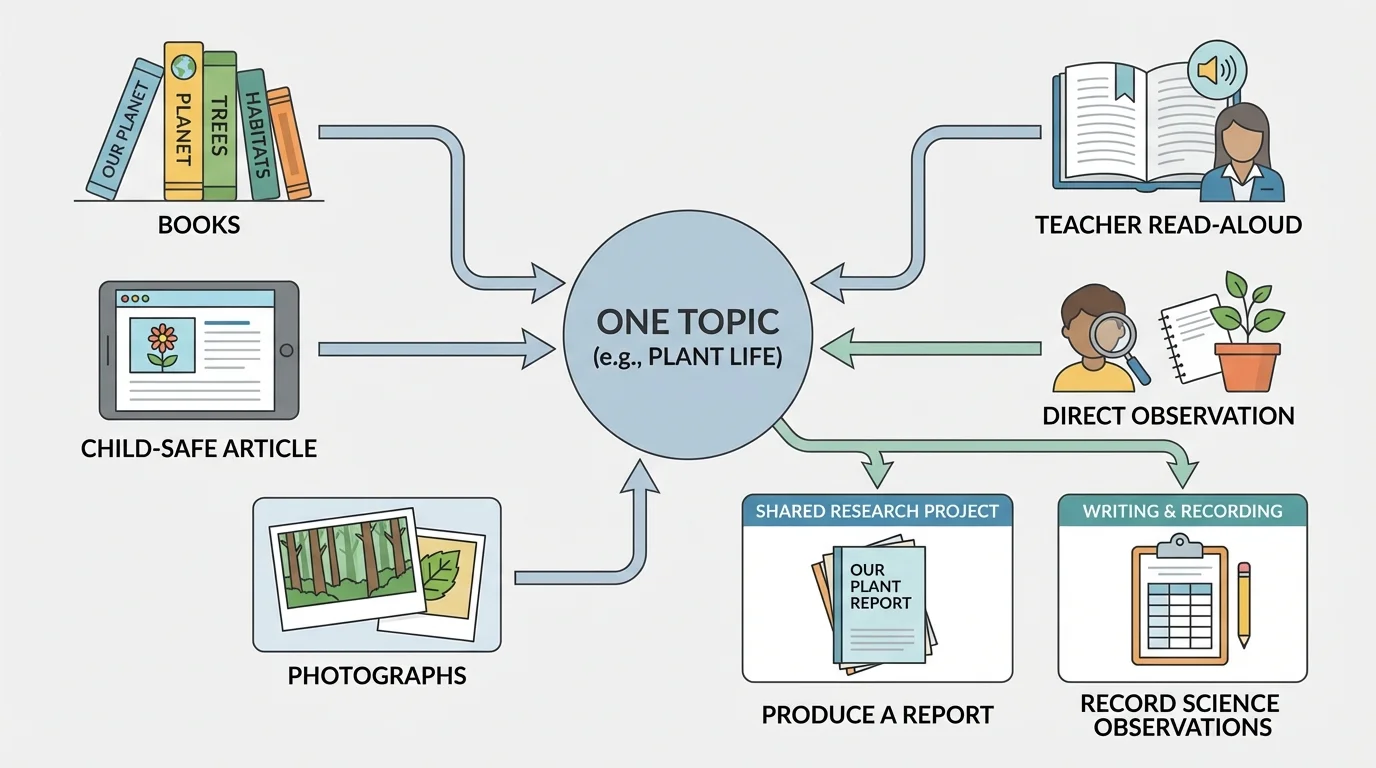
Sometimes the best resource is direct observation. If students are learning about weather, they can look outside and notice clouds, wind, sunlight, or rain. If they are learning about worms in soil, they may observe worms carefully and record what they see.
Using several resources matters because one resource may not answer every question. Later, when students compare facts from different places, they can become more confident that the information is true. This is like checking your work with more than one clue.
| Resource | What it can help us learn |
|---|---|
| Book | Facts, pictures, labels, and details |
| Photo or diagram | What something looks like |
| Teacher read-aloud | Important information heard together |
| Short article | New facts about one topic |
| Observation | What we notice with our own eyes |
Table 1. Different resources students can use during shared research.
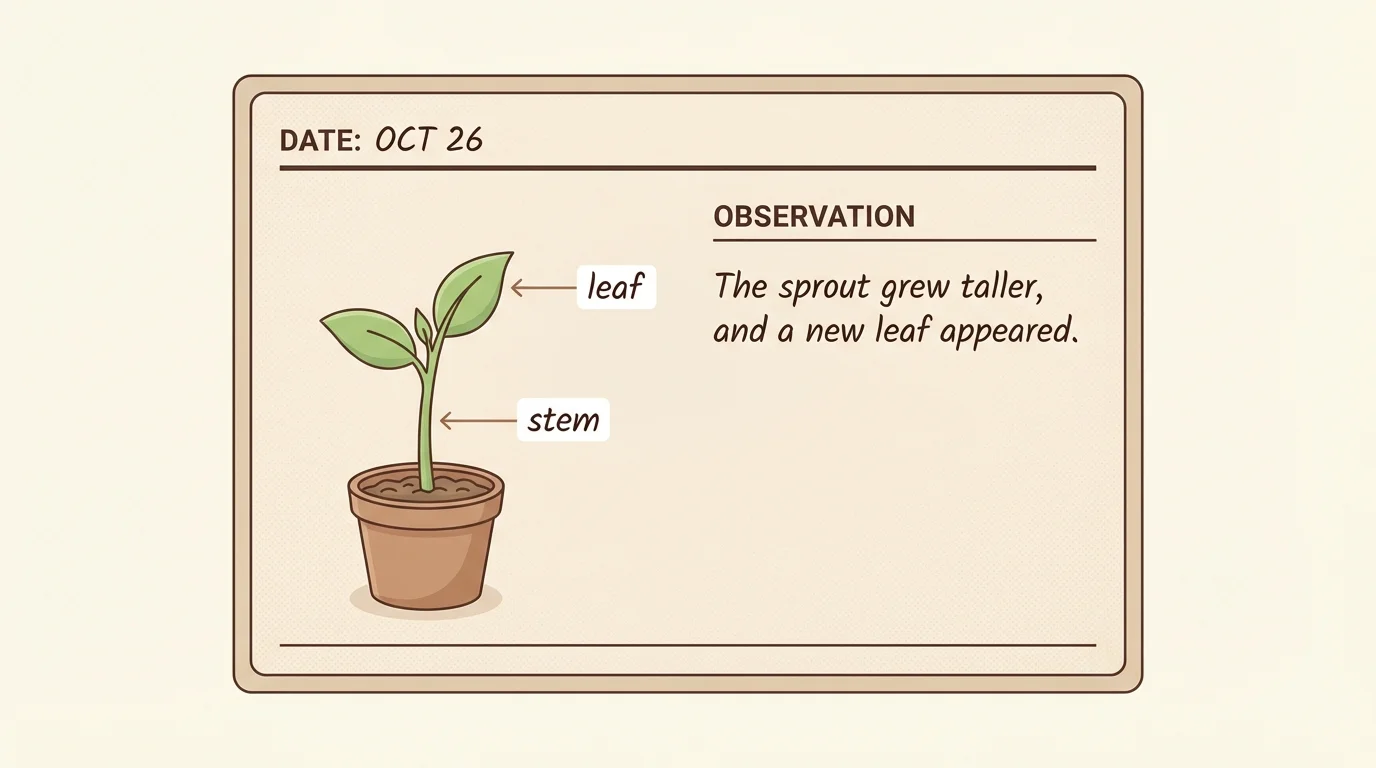
When researchers learn something important, they need to keep it. They do this by taking notes or making records. As shown in [Figure 3], an observation record may include the date, a drawing, labels, and a short sentence. A science notebook page helps students save what they see over time.
For example, if students watch seeds grow, they might write: "Day 1: seed in soil." "Day 4: tiny sprout." "Day 8: two leaves." They can also draw each stage. These notes help students notice changes over time.
Notes should be short and clear. Students do not need to copy every word from a book. They can write important facts such as "Frogs begin life as eggs" or "Penguins use flippers to swim." Drawings, labels, and word lists are helpful too.
Observing over time means looking more than once. When students return to the same plant, caterpillar, or weather chart each day, they can notice changes that are easy to miss in one quick look.
Careful observation is especially important in science. If a class is recording weather, they may notice that dark clouds often come before rain. If they are watching a plant, they may see that it gets taller after several days of sunlight and water. Looking closely helps students gather real evidence, not just opinions.
Later in the project, the class can look back at records and compare what happened first, next, and last. That is one reason observation pages are so useful.
After gathering facts, students sort them. They decide which facts answer each question. If the class question is "What do butterflies eat?" then facts about nectar, flowers, or fruit belong together.
Sorting helps the group notice patterns. A pattern is something that repeats or goes together in a meaningful way. Students may discover that many animals need food, water, and shelter. They may notice that young plants and adult plants do not look exactly the same.
This is also the time to choose the strongest facts. Strong facts are facts that match the topic and come from reading, viewing, or observing. Interesting but unrelated facts can be left out so the writing stays clear.
Example: Sorting facts about frogs
Step 1: Ask the class question.
The question is: "How do frogs grow?"
Step 2: Gather facts from notes.
Students have these notes: "Frogs start as eggs." "Tadpoles hatch from eggs." "Tadpoles grow legs." "Adult frogs can jump."
Step 3: Put the facts in order.
The class orders the facts from beginning to end: eggs, tadpoles, tadpoles with legs, adult frogs.
Now the class is ready to write about frog growth in a clear order.
As students compare notes, they practice listening and explaining. They may say, "I found that fact in a book," or "We saw this happen in our plant cups." Those statements show where the information came from.
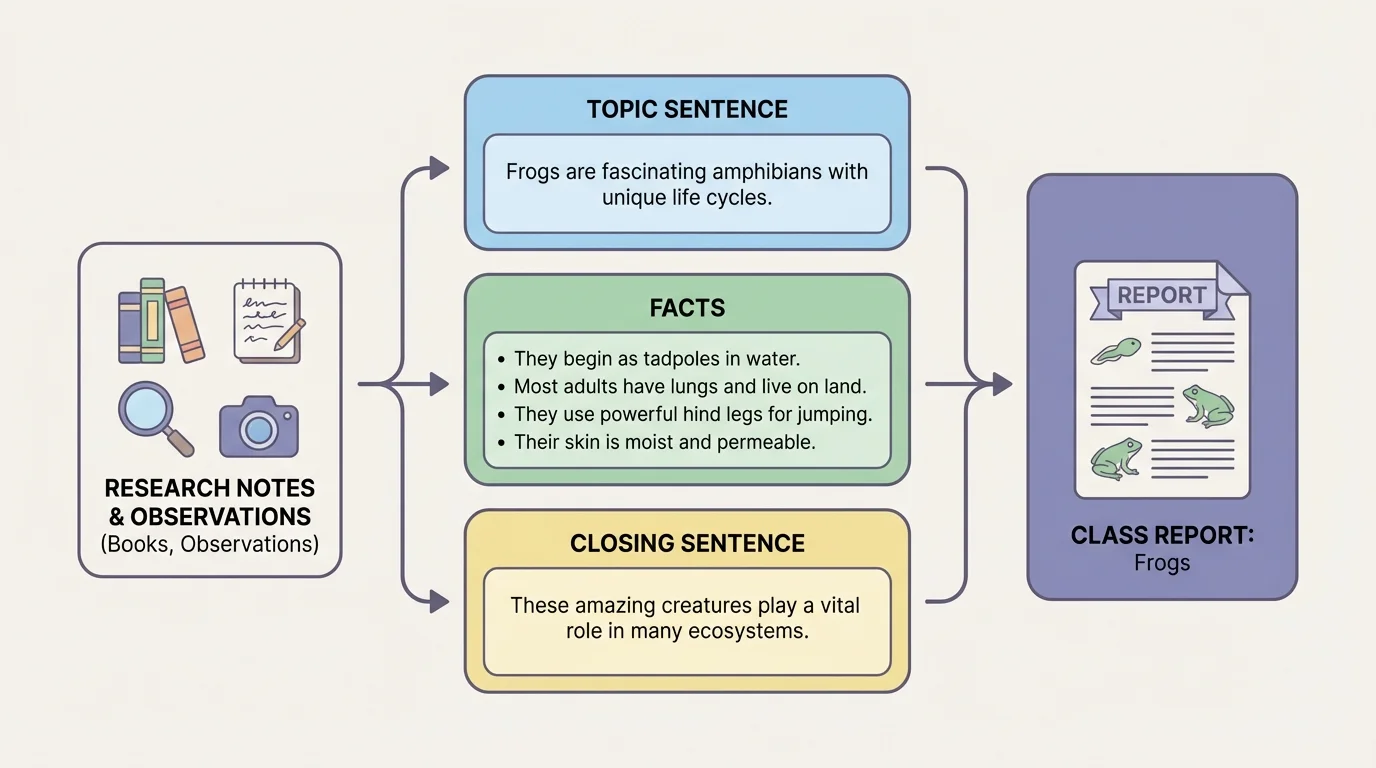
When the research is ready, the group turns information into writing. A report tells facts in a clear way. As [Figure 4] illustrates, students can move from notes to a beginning, a middle with facts, and an ending.
The beginning tells the topic. It may say, "Frogs are animals that live in water and on land." The middle gives facts that answer the research questions. The ending may remind the reader of the main idea.
A shared writing project can take different forms. It might be a class report, a poster with labels, a science chart, or a class book with one page from each student. Even though the forms look different, they all use gathered information to teach others.
Sometimes the teacher helps by writing students' ideas as they speak. This lets the class focus on organizing facts and choosing strong words. At other times, students help write sentences, labels, or captions themselves.
Writers should use facts from the research, not made-up ideas. For example, if the class observed that a bean plant grew taller after a week, they can write that observation. If one child guesses something that was not read or seen, the class can check the resources again.
That is why earlier notes and sources matter. Just as the class learned from different resources in [Figure 2], good shared writing is strongest when it is built on gathered evidence.
Research projects are not only about reading and writing. They also need speaking and listening. Students take turns sharing facts, asking questions, and responding to others kindly.
Good teamwork means listening when someone else has an idea. It also means being ready to explain your own thinking. A student might say, "I think this fact belongs in the section about food because it tells what butterflies eat."
Sometimes group members disagree. That is normal. They can solve the problem by looking back at the notes, the book, the picture, or the observation record. Evidence helps the group make smart choices.
When you read informational text, you already look for the main topic and important details. Shared research uses those same skills, but now you also gather information from several places and build writing together.
Taking turns, staying on topic, and using evidence are important habits. These habits help in science, reading, social studies, and many other subjects.
Many topics work well for young researchers. A class can read several books about one animal, such as penguins or bees, and then make a report. A class can also study a science topic such as shadows, weather, rocks, or plant growth.
Suppose students study weather. They may read a weather book, look at cloud pictures, watch the sky each day, and record sunny, rainy, or windy conditions. Their writing may explain how weather can change from day to day.
Suppose students study plants. They may plant seeds, water them, and observe them for several days. The observation page in [Figure 3] remains useful because it helps students see small changes that become important over time.
Example: A class project about bees
Step 1: Choose questions.
The class asks: "Where do bees live?" and "Why are bees important?"
Step 2: Gather information.
Students listen to two books, study photographs, and learn that bees help flowers by moving pollen.
Step 3: Create shared writing.
The class makes a poster with the title "Bees Help Plants," adds facts, and includes labeled pictures.
The finished project teaches others while showing what the class learned together.
These projects connect school learning to the real world. Gardeners watch plants grow. Meteorologists study weather. Animal scientists observe living things. Students begin learning those same habits in simple, careful ways.
Before a project is finished, the class checks it. They ask: Did we answer our questions? Did we stay on topic? Are the facts clear? Did we use information from our books, pictures, and observations?
Checking also means looking for missing parts. Maybe the report has facts about what frogs eat but not where they live. Maybe a plant observation page has a drawing but no date. The group can fix those problems before sharing the work.
Writers also think about the reader. Clear sentences, labels, and neat organization help others understand. A shared project is successful when it teaches true information in a way others can follow easily.
"Ask, observe, record, and share."
— A strong habit for every young researcher
When students work together on research and writing, they learn much more than facts about one topic. They learn how to wonder, how to search for answers, how to listen, and how to build knowledge with others.
