Have you ever tried to convince someone of something? Maybe you said, "We should play outside because the weather is sunny," or "I need my jacket because it is cold." When you say because, you are giving a reason. Authors do this too. In informational texts, authors make points and then give reasons to help readers understand and believe those points.
A point is an important idea the author wants the reader to understand. Sometimes a point tells what the author thinks is true. Sometimes it tells what is important. Sometimes it explains why something matters.
For example, in a text about trees, an author might make the point, "Trees are important for people and animals." That is the author's idea. It is not just any detail from the text. It is one of the bigger ideas the author wants readers to remember.
Points can be stated in different ways. An author might write the point clearly in one sentence, or the reader may need to figure it out by reading several sentences. Good readers ask, "What does the author want me to understand here?"
Point means an idea the author wants to make clear. Reason means why the author thinks that point is true, important, or worth believing. A reason supports a point by helping it make sense and by showing why it matters.
When you read, it helps to tell the difference between a big idea and a small detail. A point is bigger than one tiny fact. A detail might tell one part of the story, but the point is what the author is trying to show with those details.
A reason tells why a point makes sense. If the author says, "Trees are important for people and animals," the reasons might be, "Trees give animals homes," "Trees give shade," and "Trees help clean the air." Each reason helps support the point.
Reasons answer questions such as: "Why is that true?" "Why does that matter?" or "How do you know?" If the point is the author's message, the reasons are the support holding it up.
Sometimes a reason is followed by examples. For instance, the author may say that trees give animals homes and then name squirrels, birds, and insects. Those named animals are details and examples. The reason is the larger support: trees give animals homes.
[Figure 1] A point and its reasons work like a stool with legs. The point is the top, and the reasons are the legs that hold it up. Without reasons, the point may feel weak. With clear reasons, the author's thinking becomes easier to follow.
Look at this example. Point: "Recess is important at school." Reasons: "It helps children move their bodies," "It gives students a break from sitting," and "It helps children practice sharing and teamwork." Each reason supports the same point.
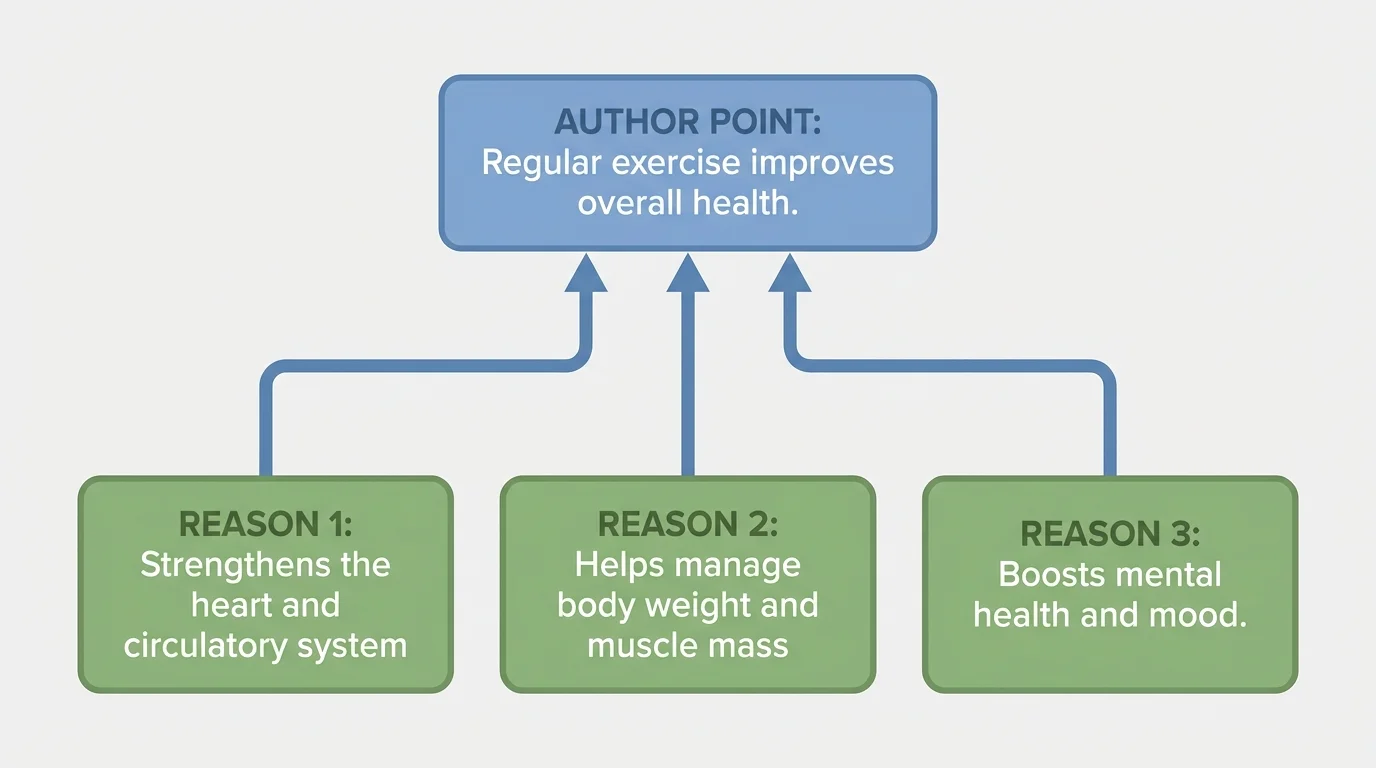
Authors use reasons to help readers understand not only what they think, but also why they think it. When you can name both the point and the reasons, you understand the text more deeply.
How support works
When a reader says, "This reason supports that point," the reader is connecting two parts of the text. The point is the main idea the author wants to make. The reason gives support for that exact idea. If a sentence does not help explain or prove the point, it is not a supporting reason for that point.
Sometimes one point has many reasons. Sometimes one paragraph gives only one strong reason. As you keep reading, more reasons may appear. That means readers should keep collecting support as they move through the text.
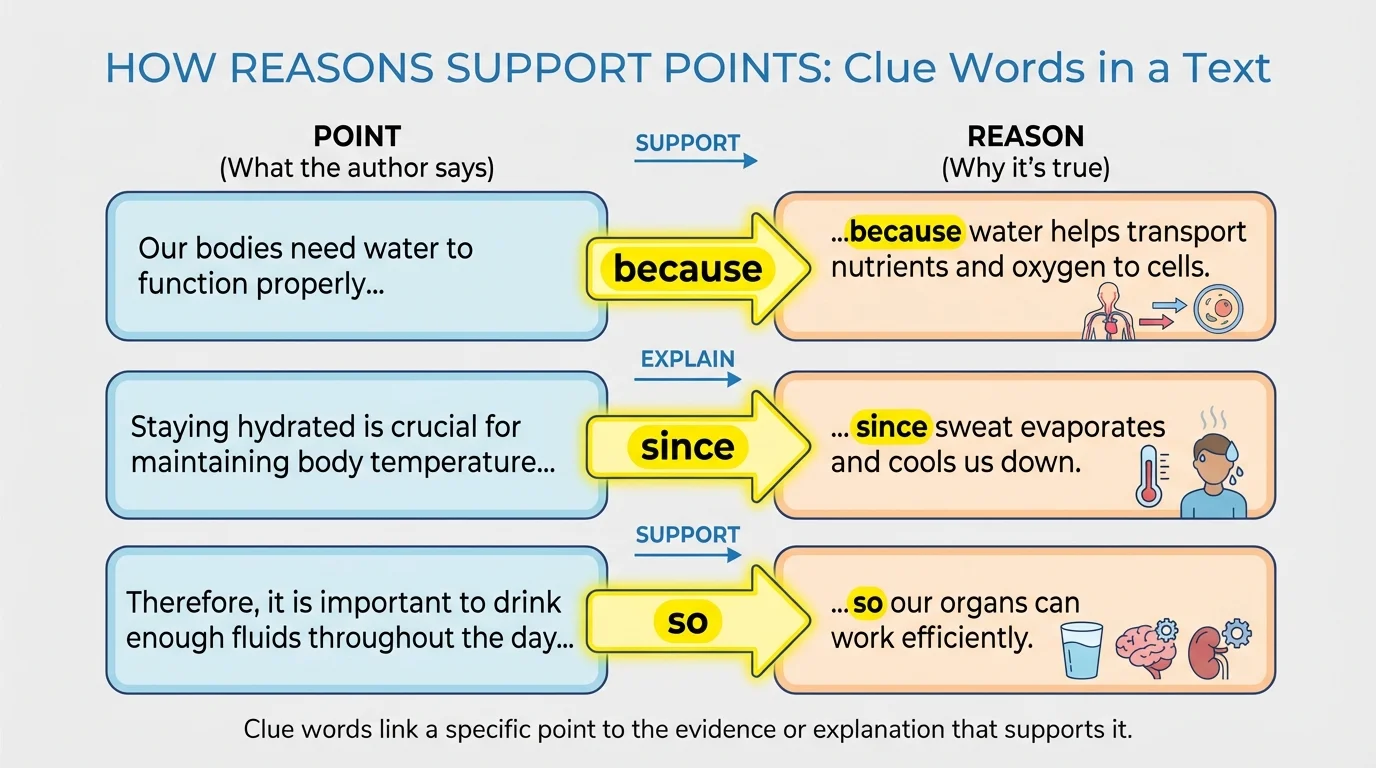
[Figure 2] Readers can often find a reason by looking for clue words. Words like because, since, so, this is why, and for example may help show that a reason is coming.
Here is an example: "Drinking water is healthy because it helps your body work well." The point is "Drinking water is healthy." The reason is "it helps your body work well."
Another example is: "Bees are helpful since they pollinate many plants." The point is "Bees are helpful." The reason is "they pollinate many plants."
Not every reason has a clue word right in front of it. Sometimes the author writes the point in one sentence and the reason in the next sentence. You may need to stop and ask, "What sentence explains or supports the author's idea?"
Suppose a text says, "School gardens are valuable. Students learn where food comes from. They also practice caring for living things." The point is "School gardens are valuable." The reasons are "Students learn where food comes from" and "They also practice caring for living things."
Some informational texts give reasons in almost every paragraph. That means strong readers are often doing detective work, looking for the author's big idea and the support that goes with it.
As you read, it can help to listen for questions in your mind: "What is the author saying?" and "Why does the author say that?" The answer to the second question often leads you to the reason.
[Figure 3] Some texts include more than one idea, so readers must match each reason to the exact point it supports. A reason should fit one specific point, not just any sentence nearby.
Imagine a text with these two points: "Exercise helps the body" and "Exercise helps the mind." A reason for the first point could be "It makes muscles stronger." A reason for the second point could be "It can help people feel calmer." Both are about exercise, but they support different points.
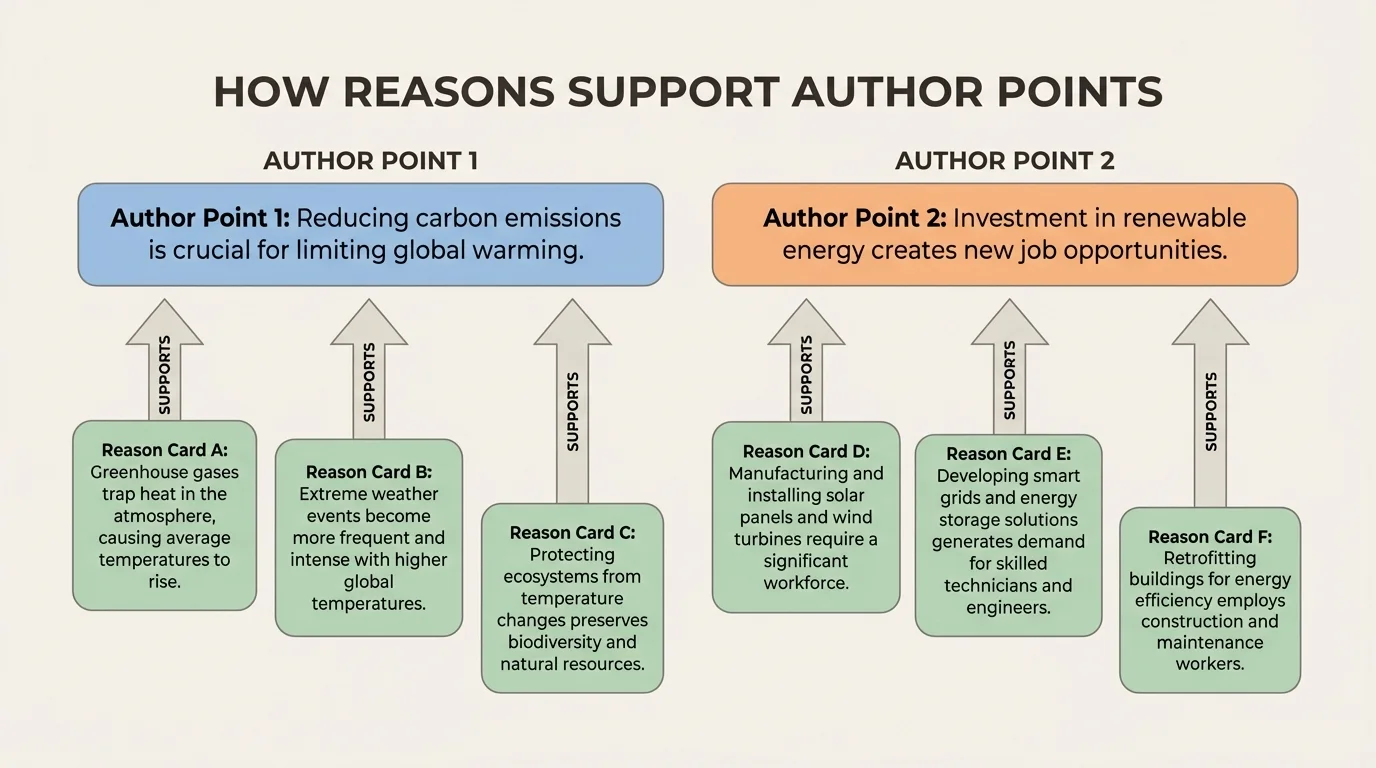
This is why careful readers do not just collect facts. They connect each fact or reason to the right idea. If you mix them up, you may misunderstand what the author is trying to explain.
Example: matching reasons
Read this short set of ideas: "Pets can help families. Pets can also need a lot of care."
Step 1: Find one point.
The first point is "Pets can help families."
Step 2: Look for a reason that fits.
A matching reason is "They can keep people company."
Step 3: Find the other point.
The second point is "Pets can also need a lot of care."
Step 4: Match a reason to that point.
A matching reason is "They need food, water, and daily attention."
Each reason supports a different point, even though both points are about pets.
Later, when you explain your thinking, you can say, "This reason supports the point that exercise helps the mind," or "This reason supports the point that pets need care." Saying the exact point makes your answer clear.
Not all reasons are equally strong. A strong reason clearly connects to the point. A weak reason may be off-topic, too small, or confusing.
If the point is "Reading every day helps children learn," a strong reason is "It helps them practice words and understand new ideas." A weak reason is "Books can be many colors." The second sentence may be true, but it does not really support the point.
Good readers ask, "Does this reason really help prove or explain the point?" If the answer is yes, the reason is helpful. If the answer is no, it may just be an extra detail.
Remember that informational texts are written to teach about a topic. That means authors often organize facts to make points and then support those points with reasons and examples.
As we saw earlier in [Figure 1], a point can have more than one supporting reason. When several strong reasons all fit the same point, the author's message becomes stronger and clearer.
Here is a simple informational example: "Rainforests are important places. They are home to many animals. They also help the Earth by affecting air and weather." The point is "Rainforests are important places." The reasons are "They are home to many animals" and "They also help the Earth by affecting air and weather."
Another example: "Breakfast can help students at school. It gives them energy in the morning. It can also help them focus." The point is "Breakfast can help students at school." The reasons are "It gives them energy in the morning" and "It can also help them focus."
One more example says, "Libraries are valuable in a community. People can borrow books. They can also use computers and find information." The point is "Libraries are valuable in a community." The reasons tell why the author believes that point.
Example: finding the point and reasons in a paragraph
Paragraph: "Bicycles are a smart way to travel. They do not need gasoline. Riding bikes also gives people exercise."
Step 1: Name the point.
The point is "Bicycles are a smart way to travel."
Step 2: Find the first reason.
The first reason is "They do not need gasoline."
Step 3: Find the second reason.
The second reason is "Riding bikes also gives people exercise."
Both reasons support the same point.
When you practice with texts like these, you start to notice patterns. Many nonfiction writers state a point and then add one or more reasons right after it. The clue words in [Figure 2] can help, but even without those words, readers can still find support by asking what each sentence is doing.
When you explain your reading, use clear words. You might say, "The author's point is ___." Then say, "One reason is ___." You can also say, "This reason supports the point because ___."
These sentence frames can help: "The author wants readers to understand that ___." "The reason that supports this point is ___." "Another reason is ___." "This reason fits because it explains why the point is true or important."
Using the word because in your explanation often helps you connect the reason to the point. That is important because reading is not only about finding words on a page. It is about understanding how ideas fit together.
Longer texts may have several points. One section might explain why an animal is special. Another section might explain how it survives. Each section can have its own point and reasons.
For example, a text about polar bears may make one point: "Polar bears are built for cold places." Reasons could include "They have thick fur" and "They have a layer of fat." Later, the same text may make a different point: "Polar bears need sea ice to hunt." The reasons for that point would be different.
This is why matching matters so much, just like the sorting in [Figure 3]. Readers need to keep track of which reasons go with which points. When you do that, the whole text makes much more sense.
As you read informational texts, think like a detective and a builder at the same time. Detect the point. Find the reasons. Then build the connection between them. That is how strong readers understand what an author is really saying.
