Have you ever heard someone tell a story and then just stop? It can feel a little strange, like a song that never gets to the last note. Writing works the same way. When you write your opinion, you need a strong ending so your reader knows your ideas are finished. That ending is called a conclusion.
A conclusion is the ending part of a piece of writing. In opinion writing, the conclusion tells the reader, one more time, what the writer thinks. It helps the whole piece feel complete.
If your opinion piece says, "I think dogs make the best pets," your conclusion should remind the reader of that idea at the end. A conclusion is not a new beginning. It is the part that closes the writing.
Conclusion means the final statement or final section of writing that wraps up the writer's ideas. In an opinion piece, it should connect back to the writer's opinion.
Readers like endings that sound finished. A good conclusion helps them think, "Now I understand what the writer believes."
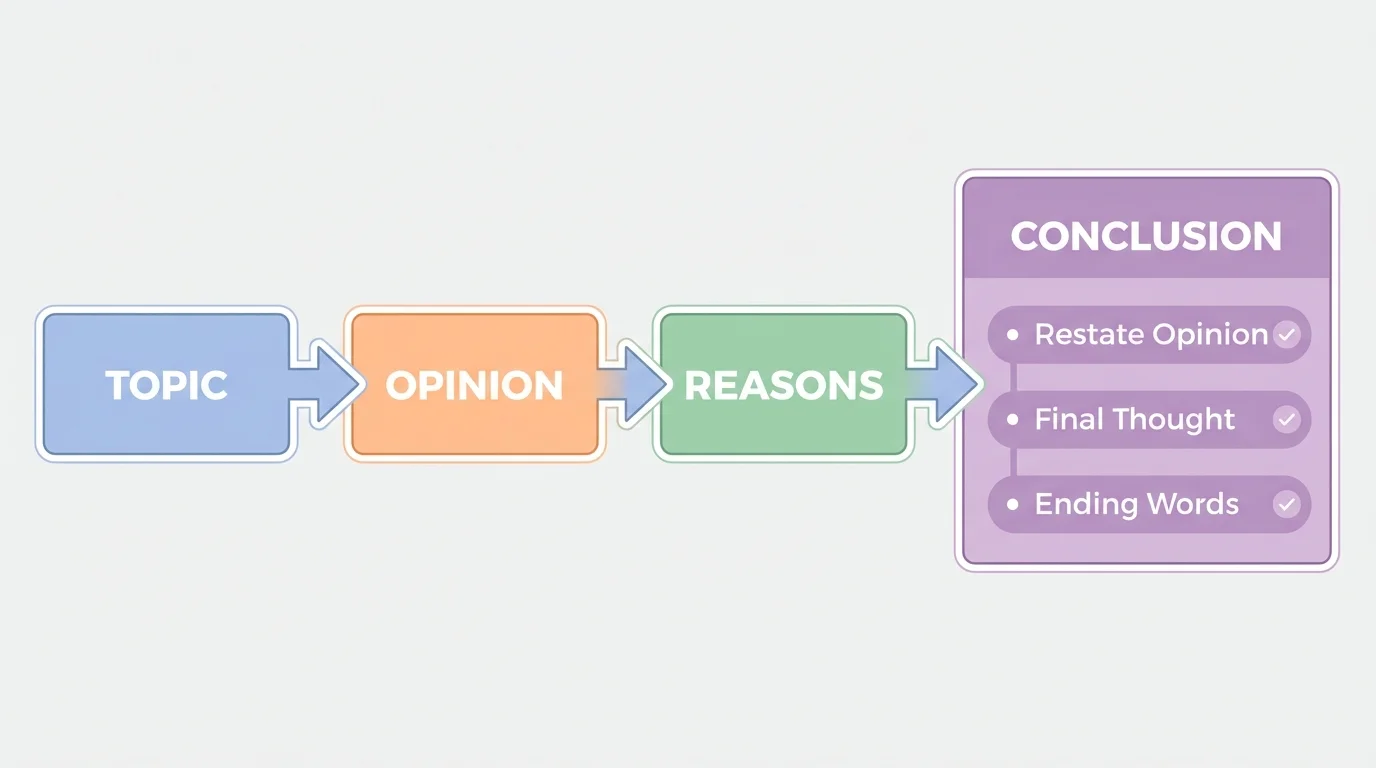
An opinion piece has important parts. It usually has a topic, an opinion, reasons, and a conclusion. The ending matters because it helps the reader remember the main idea. Without it, the writing may seem unfinished.
Think of building with blocks. First, you make the base. Then you add more blocks on top. At the end, you place the last block that completes the tower. A conclusion is like that last block. It brings the writing to a good stopping place.
A strong ending can also make your opinion sound more confident. When a writer ends clearly, the reader can tell the writer knows what they want to say.
Many books, speeches, and letters use endings that repeat the main idea in a fresh way. That helps the audience remember the message.
When you write for school, a conclusion shows that you can finish your thinking in an organized way.
A good conclusion brings the whole opinion piece together. It usually does three jobs: it reminds the reader of the opinion, gives a final thought, and sounds finished.
You do not need a long ending. Even one or two sentences can be enough if they are clear. The most important thing is that the ending matches the opinion and the reasons from the rest of the piece.
For example, read this short opinion idea:
"I think school gardens are a great idea because students learn about plants, get fresh air, and help the school look beautiful."
A fitting conclusion could be: "For all these reasons, a school garden is a wonderful project for students."
Notice what the writer does. The writer does not add a brand-new reason. The writer goes back to the opinion and wraps it up neatly.
The job of closure
Closure means the feeling that something is complete. In writing, closure happens when the ending matches the beginning and leaves the reader with a finished thought.
When you read the ending, it should sound like the last puzzle piece has clicked into place.
Writers can end in more than one clear way. The best kind of ending depends on what the writer wants the reader to remember.
One kind of conclusion is a restate ending. This means saying the opinion again in a new way. If the opinion is "Cats are great pets," the conclusion might be, "That is why cats are such wonderful animals to have at home."
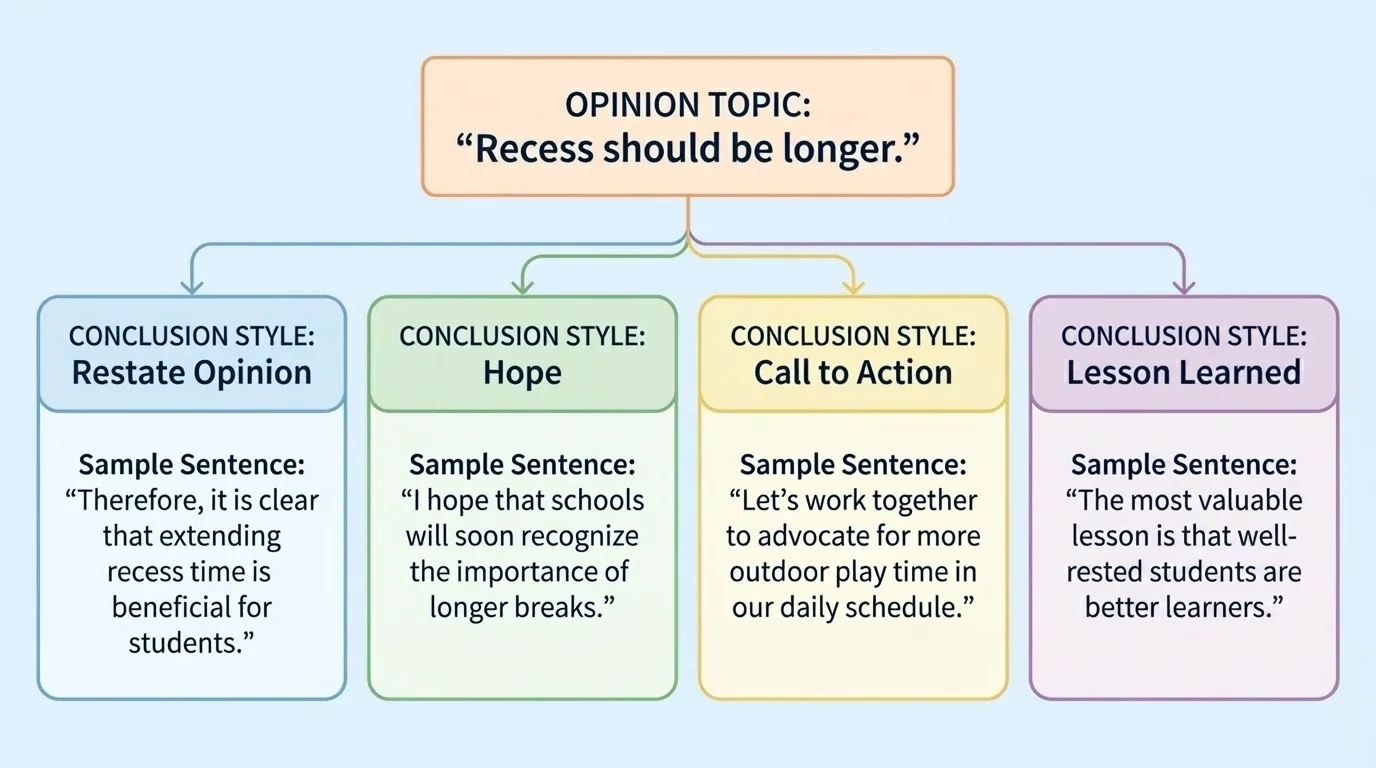
Another kind is a hope or wish ending. Example: "I hope more schools will add extra recess time." This ending tells what the writer hopes will happen.
A third kind is a call to action. That means the writer tells the reader to do something. Example: "Please choose books for our classroom library."
A fourth kind is a lesson-learned ending. Example: "This shows that sharing books helps everyone enjoy reading."
All of these endings can work if they fit the opinion and sound complete.
Some endings sound too short, too messy, or confusing. Strong endings sound clear and connected.
Look at this weak ending: "So yeah." This does not remind the reader of the opinion. It does not sound complete.
Now look at a stronger ending: "For these reasons, our class should have more time to read each day." This ending clearly wraps up the opinion.
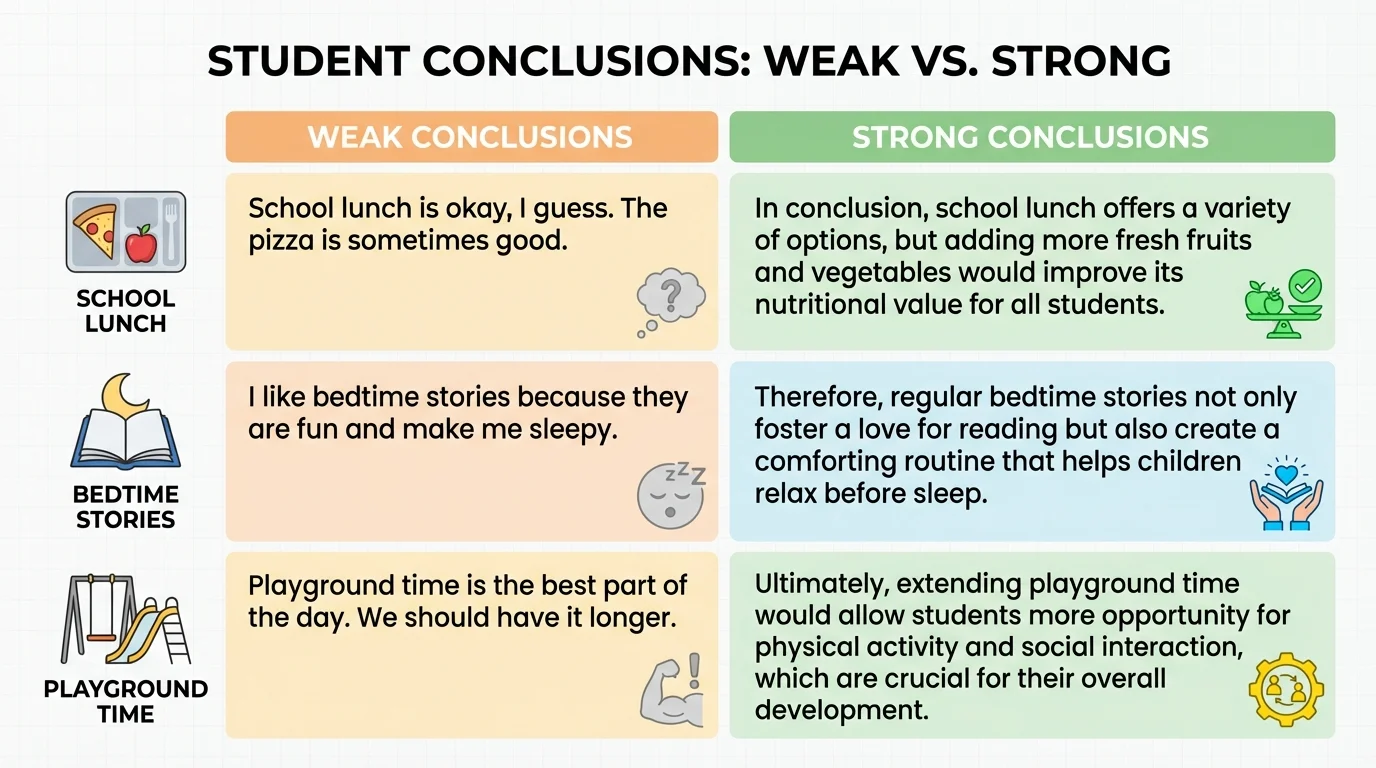
Here is another weak ending: "Also, my friend likes it and I saw a bird and my shoes are blue." This ending goes off-topic. A conclusion should stay focused.
A stronger version would be: "That is why a nature walk is a fun and helpful class activity." This sounds neat and connected to the opinion.
Later, when you check your writing, you can use the idea from [Figure 3] to ask yourself whether your ending is strong or weak.
Remember that an opinion piece tells what you think and gives reasons. The conclusion comes after those reasons, not before them.
A strong ending does not have to be fancy. It has to be clear.
Some words and phrases help readers know the writing is ending. These are called concluding words or ending words.
Here are some helpful conclusion words and phrases:
You do not need to use the same ending words every time. Try choosing words that fit your piece.
| Beginning of Conclusion | Example |
|---|---|
| For these reasons | For these reasons, bikes are a smart way to travel. |
| That is why | That is why rainy days can be fun. |
| All in all | All in all, our class pet teaches us responsibility. |
| Clearly | Clearly, drawing is a great way to share ideas. |
Table 1. Examples of conclusion words and short concluding statements.
These words are helpful, but they do not make a conclusion strong all by themselves. The sentence must still match the opinion and reasons.
When you are ready to finish your opinion writing, you can follow a simple plan.
How to build a conclusion
Step 1: Think about your opinion.
Ask yourself, "What do I want my reader to remember most?"
Step 2: Say the opinion again in a fresh way.
Do not copy the exact same sentence from the beginning if you can say it a little differently.
Step 3: Add a final thought.
You can share a hope, a feeling, a reminder, or a call to action.
Step 4: Make it sound finished.
Read the ending aloud. It should sound like a real last sentence.
This process helps you stay on topic. It also helps you avoid ending too suddenly.
As shown earlier in [Figure 1], the conclusion works best when it gathers the opinion and reasons into one final idea.
Here are some examples of opinion statements with matching conclusions.
Opinion: "I think recess should be longer because kids need exercise and time to play with friends."
Conclusion: "For these reasons, longer recess would help students feel healthy and happy."
Opinion: "My favorite book is Charlotte's Web because it is funny, sweet, and full of friendship."
Conclusion: "That is why Charlotte's Web is such a special book to read."
Opinion: "We should plant more trees because they give shade, clean the air, and make places beautiful."
Conclusion: "All in all, planting more trees is a smart way to help our community."
Full example: from opinion to conclusion
A student writes: "I think our classroom should have a reading corner because it would be quiet, cozy, and full of good books."
Step 1: Find the opinion.
The opinion is that the classroom should have a reading corner.
Step 2: Notice the reasons.
The reasons are that it would be quiet, cozy, and full of books.
Step 3: Write the ending.
"For all these reasons, a reading corner would make our classroom even better."
This conclusion matches the opinion and sounds complete.
You can also hear how the ending feels smooth. It does not jump to a different topic. It stays connected to the writing.
One common mistake is adding a brand-new reason in the conclusion. If your whole piece is almost done, the ending is not the best place for new ideas.
Another mistake is repeating the opinion in exactly the same words with nothing new added. A little change can make the ending sound more interesting.
A third mistake is stopping with no conclusion at all. If a piece says, "I think music class is important because it teaches rhythm and creativity," and then just ends, the reader is left waiting.
Writers also need to stay focused. The comparison in [Figure 2] reminds us that different ending styles can work, but each one still has to fit the topic.
When you revise, ask these questions:
"A strong ending helps the reader remember your big idea."
If you can answer yes to those questions, your conclusion is doing its job.
