Have you ever read a sentence and thought, "Wait... what did that mean?" That happens to all readers, even grown-ups. Strong readers do not just keep going when they feel confused. They stop, think, and use reading tools to help themselves understand. These tools are called comprehension strategies, and they help readers build meaning from a story or an informational text.
Comprehension means understanding what you read. Reading is not only saying words out loud. Reading also means thinking about the words, the ideas, the characters, and the events. Good readers pay attention to their own thinking. This is called self-monitoring. When readers self-monitor, they notice whether the text makes sense.
Sometimes reading feels easy. Sometimes a word is tricky, an idea is confusing, or something important is hidden between the lines. Good readers use strategies to help. They may reread, look for context clues, predict, ask questions, clarify, and connect the text to what they already know.
Self-monitoring comprehension strategies are tools readers use to check their understanding and fix confusion. These strategies include rereading, checking context clues, predicting, questioning, clarifying, and using background knowledge.
When readers use these strategies, they do more than remember small details. They understand key ideas, notice important actions, and figure out what the author wants them to know.
[Figure 1] shows one helpful strategy: rereading. If a sentence or paragraph does not make sense, a reader can go back and read it again. The second reading is often clearer because the reader slows down and pays closer attention.
Rereading can help in different ways. A reader might notice a word that was skipped. A reader might hear how the sentence sounds and understand it better. A reader might also connect the confusing part to a detail from an earlier sentence.
For example, read this: "Lina put on her boots and grabbed her shovel. Soon her hands were deep in the snow." If a reader forgets the first sentence, the second one may seem surprising. Rereading helps the reader connect the clues: boots, shovel, and snow all fit together.
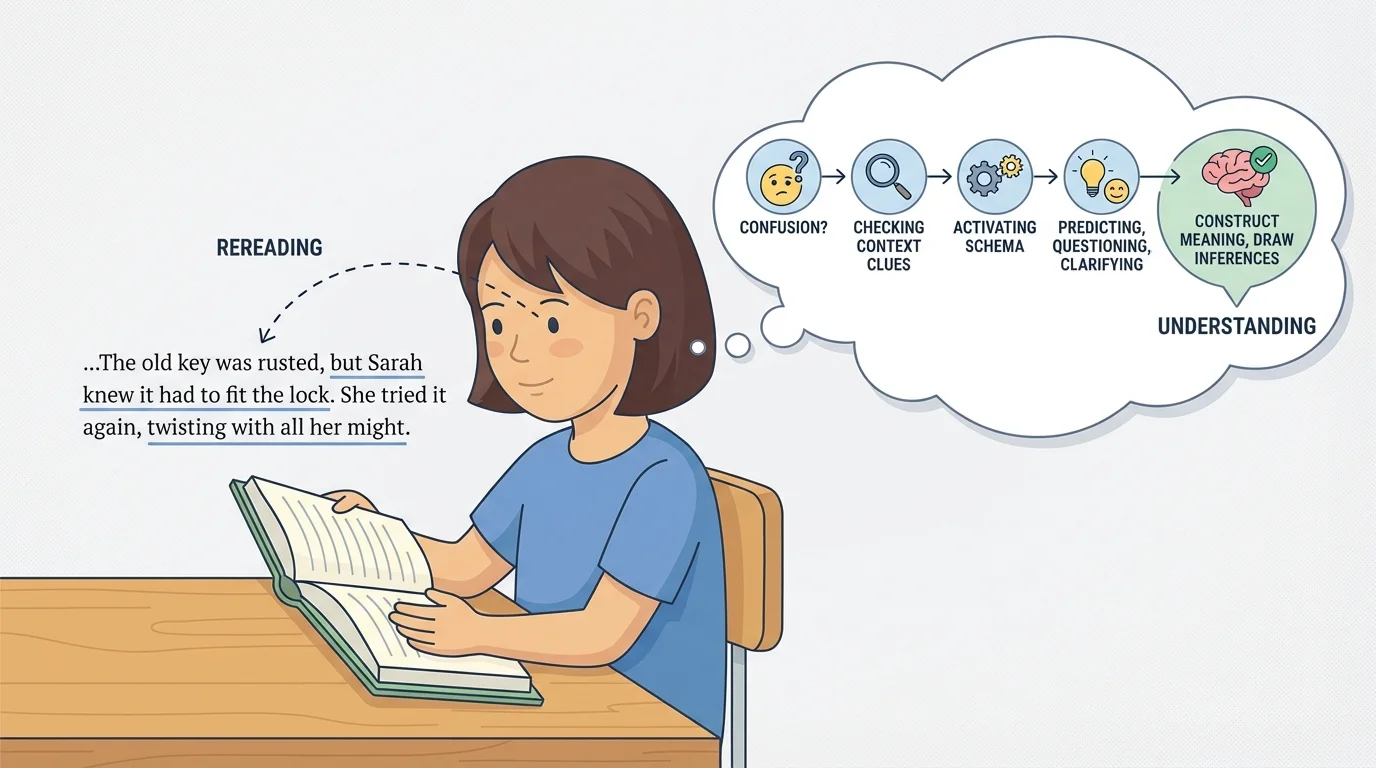
Rereading is not starting over because you failed. It is what smart readers do when they want stronger understanding. Later, when you are making inferences, the careful looking we saw in [Figure 1] helps you notice clues you missed the first time.
[Figure 2] shows how a reader can use nearby clues to figure out meaning. Sometimes a reader knows most of the words in a text but gets stuck on one. Nearby words can help. These hints are called context clues.
Suppose a story says, "The enormous pumpkin took two children to carry." A reader may not know the word enormous. But the sentence says it took two children to carry the pumpkin. That clue tells us the pumpkin is very big.
Pictures can help too. If the page shows a giant pumpkin next to the children, the picture gives another clue. Readers use words, pictures, and ideas around the unknown part to unlock meaning.
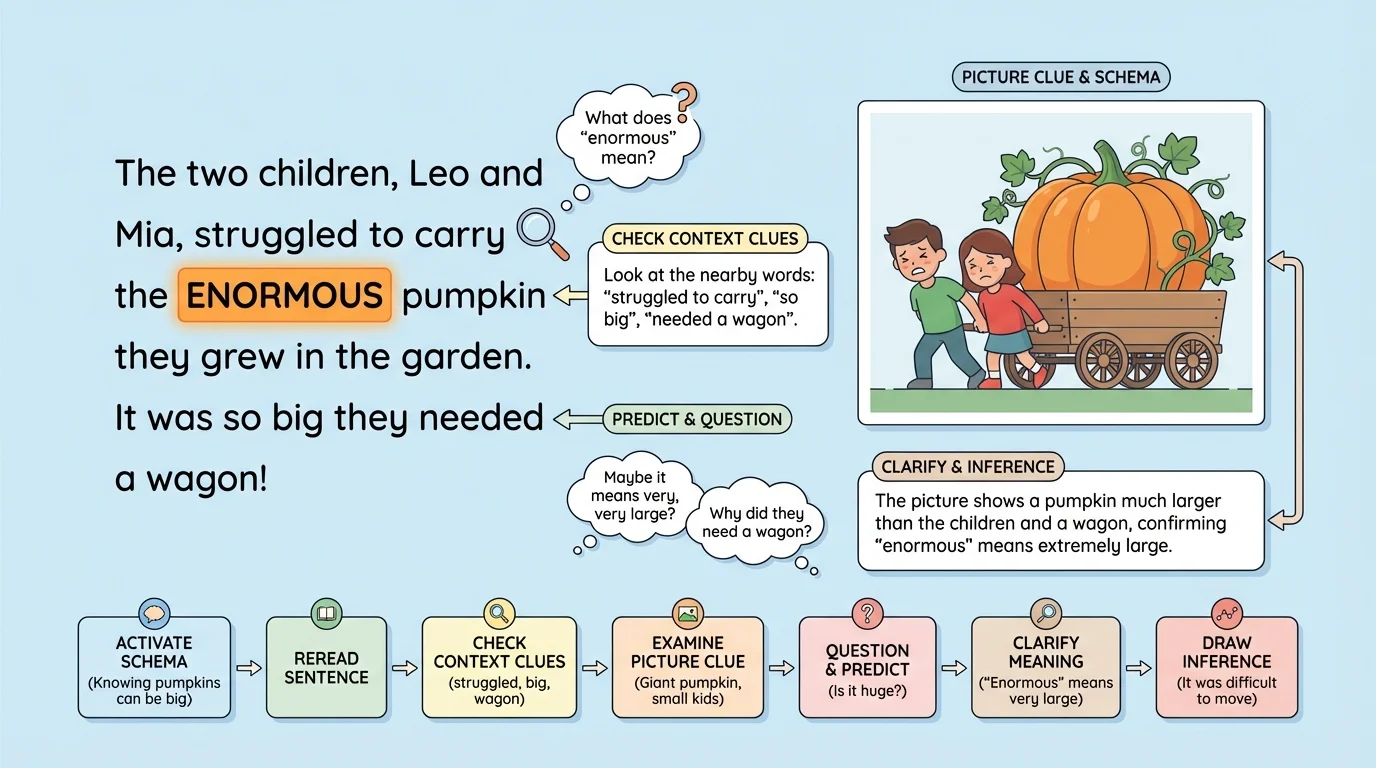
Context clues do not only help with hard words. They also help readers understand what is happening. If a character is shivering, wearing a coat, and blowing warm air into their hands, the context clues tell us the weather is cold.
Example: Using context clues
Step 1: Read the tricky sentence.
"The puppy was timid. He hid behind the chair when the doorbell rang."
Step 2: Look at the clue nearby.
The puppy hides behind the chair.
Step 3: Think about what that action means.
A puppy that hides may feel scared or shy.
So timid means shy or easily scared.
When readers use context clues, they keep the story moving and understand more on their own.
Predicting means making a smart guess about what may happen next. A prediction is not a wild guess. It is based on clues from the text and what the reader already knows.
Before reading, a reader can predict by looking at the title and pictures. During reading, a reader can predict by paying attention to the setting, the problem, and what characters do. If a story says dark clouds are rolling in and the wind is blowing hard, a reader may predict that a storm is coming.
Predictions help readers stay active. The reader keeps checking, "Was my prediction right? Do I need to change it?" Changing a prediction is a good thing because it means the reader is paying attention to new information.
Your brain loves to guess what comes next. That is one reason stories are exciting. Readers keep reading to see whether their predictions match the text.
If a character packs a lunch, puts on hiking shoes, and fills a water bottle, a reader may predict that the character is going on a hike. Then the next page might show the character climbing a trail, which confirms the prediction.
Good readers do not sit quietly in their minds. They think and ask questions. Questioning helps readers focus on important parts of the text.
Readers can ask questions before reading: "What will this be about?" They can ask questions during reading: "Why did the character do that?" "What does this word mean?" They can ask questions after reading: "What was the big idea?" "What lesson did I learn?"
Questions help readers dig deeper. If a story says a girl hides a letter in her pocket, a reader may ask, "Why doesn't she want anyone to see it?" That question makes the reader pay close attention to later details.
Some questions are answered right away. Some are answered later. Some make readers think beyond the page. All of these help build understanding.
Sometimes a reader notices confusion and needs to clean it up. This strategy is called clarifying. Clarifying means stopping and figuring out a confusing word, sentence, or idea.
A reader can clarify by rereading, reading more slowly, looking at pictures, asking a question, or using context clues. A reader can also think, "What part is confusing me?" Naming the confusing part is helpful. Maybe it is one word. Maybe it is a whole event in the story.
For example, if a reader says, "I do not understand why the bear went back to the cave," the reader can look back for clues. Maybe the text said the sky turned gray and snow began to fall. That detail helps clarify why the bear returned.
Clarifying means fixing understanding on purpose. Strong readers do not pretend to understand. They stop, notice the problem, and choose a strategy that helps. Clarifying keeps small confusion from turning into big confusion.
Clarifying is important in stories and in nonfiction. In a book about animals, a reader might clarify what a habitat is by looking at the sentence, picture, and surrounding facts.
Readers understand more when they connect a text to what they already know. This is called background knowledge or schema. Background knowledge includes things you have learned, seen, done, or heard before.
If you read about a child building a sandcastle, you may understand the scene quickly if you have been to a beach. If you read about planting seeds, your background knowledge may help you understand why the character waters the soil and waits for sunlight.
Background knowledge helps readers picture the text, understand actions, and notice important details. But readers also need to stay open to new ideas. If a text gives new information, readers should use the text clues too, not only what they already think.
You already know how to make connections between your life and a story. Background knowledge is the information in your mind that helps those connections make sense.
For example, if a story says, "The crowd stood and clapped when Maya crossed the finish line," background knowledge about races helps readers understand that Maya probably finished something important, even if the text does not explain every detail.
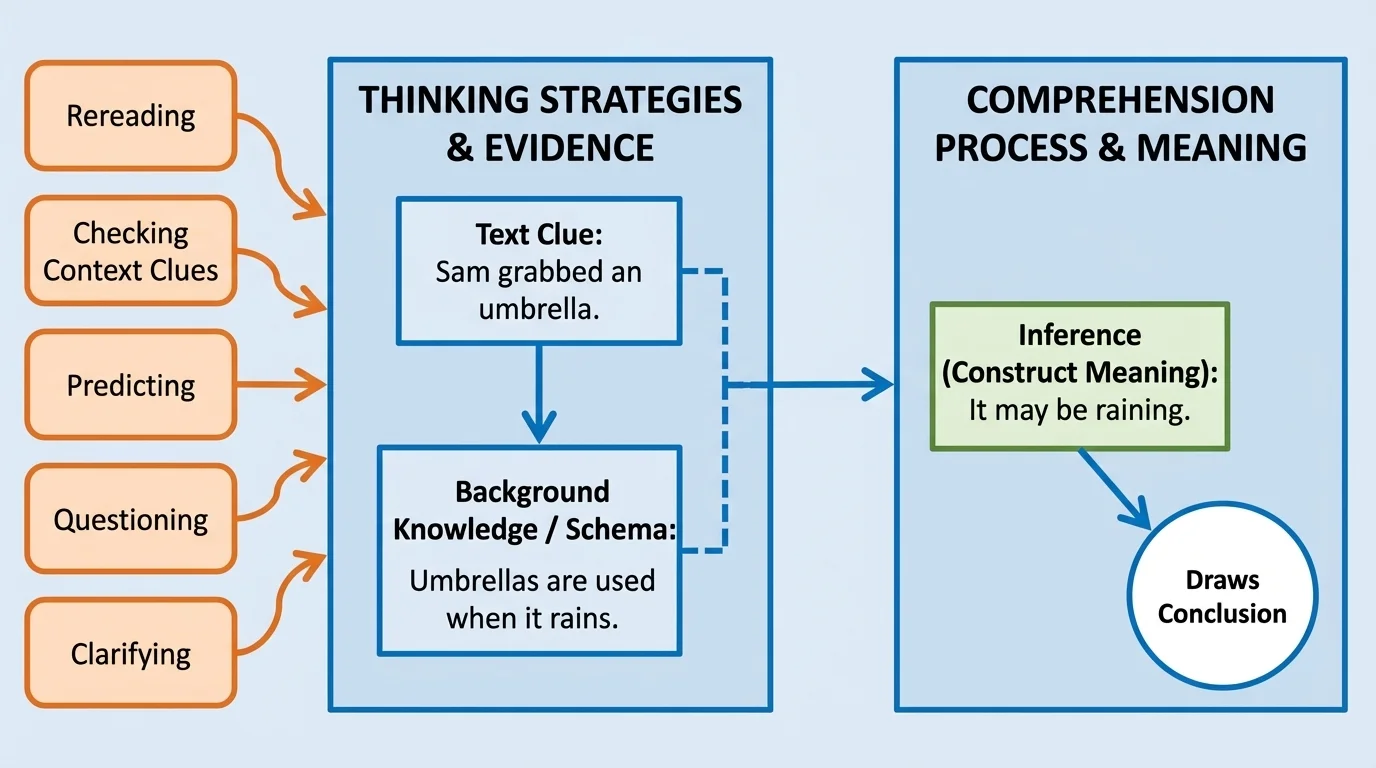
[Figure 3] shows how text clues and background knowledge work together. Sometimes the author does not say everything directly. Readers must use clues from the text and what they already know to figure out an idea. This is called an inference.
For example, a story says, "Sam grabbed an umbrella and ran to the bus stop. His shoes splashed through puddles." The author does not say, "It was raining," but readers can infer that it is raining. The clues are umbrella and puddles. Background knowledge tells us umbrellas and puddles often go with rain.
Readers also make inferences about feelings. If a character looks at the floor, speaks in a tiny voice, and hides behind a parent, a reader may infer that the character feels nervous or shy. The text gives clues, but the reader must do the thinking work.
Making inferences is easier when readers use many strategies together. A reader may reread to find clues, use context clues to understand a word, ask questions, and connect the text to background knowledge. The thinking path in [Figure 3] helps show that inferences come from both the text and the reader's mind.
Example: Drawing an inference
Step 1: Read the clues in the text.
"Tara's hands shook as she stepped onto the stage. She took a deep breath before speaking."
Step 2: Use background knowledge.
People whose hands shake and who take deep breaths before speaking may feel nervous.
Step 3: Infer the hidden idea.
Tara is probably nervous about being on stage.
The author does not say the feeling directly, but the clues help the reader figure it out.
Inferences help readers understand characters, settings, problems, and main ideas in a deeper way.
Readers self-monitor before, during, and after reading. Before reading, they think about the title, pictures, and what they already know. During reading, they check whether the words and ideas make sense. After reading, they think back and ask whether they understood the most important parts.
Self-monitoring is like being a detective and a coach at the same time. The detective looks for clues. The coach says, "Stop and fix it if it does not make sense." That kind of thinking helps readers become stronger and more independent.
When a text is easy, readers may use only one or two strategies. When a text is tricky, they may use many. For example, a reader might notice confusion, reread, check context clues, ask a question, and then make an inference. These strategies work together.
The more students practice these habits while reading stories, poems, and informational books, the more naturally they understand key ideas and details. Strong reading is not only about saying words correctly. It is about building meaning all the way through the text.
