Have you ever noticed that one small word can turn into many bigger words? The word play can become playing, player, playful, and even replay. It is almost like words are building blocks. When readers learn how these blocks fit together, they can unlock many new words without memorizing every single one.
A base word is a word that can stand on its own. You already know many base words, such as jump, help, kind, and paint. A base word can grow into a word family, as [Figure 1] shows, by adding word parts to the beginning or the end.
These added word parts are called affixes. Some affixes go at the front. Some go at the end. When we add them, the new word is connected to the base word we already know. If you know help, you can understand helpful. If you know read, you can understand reread.
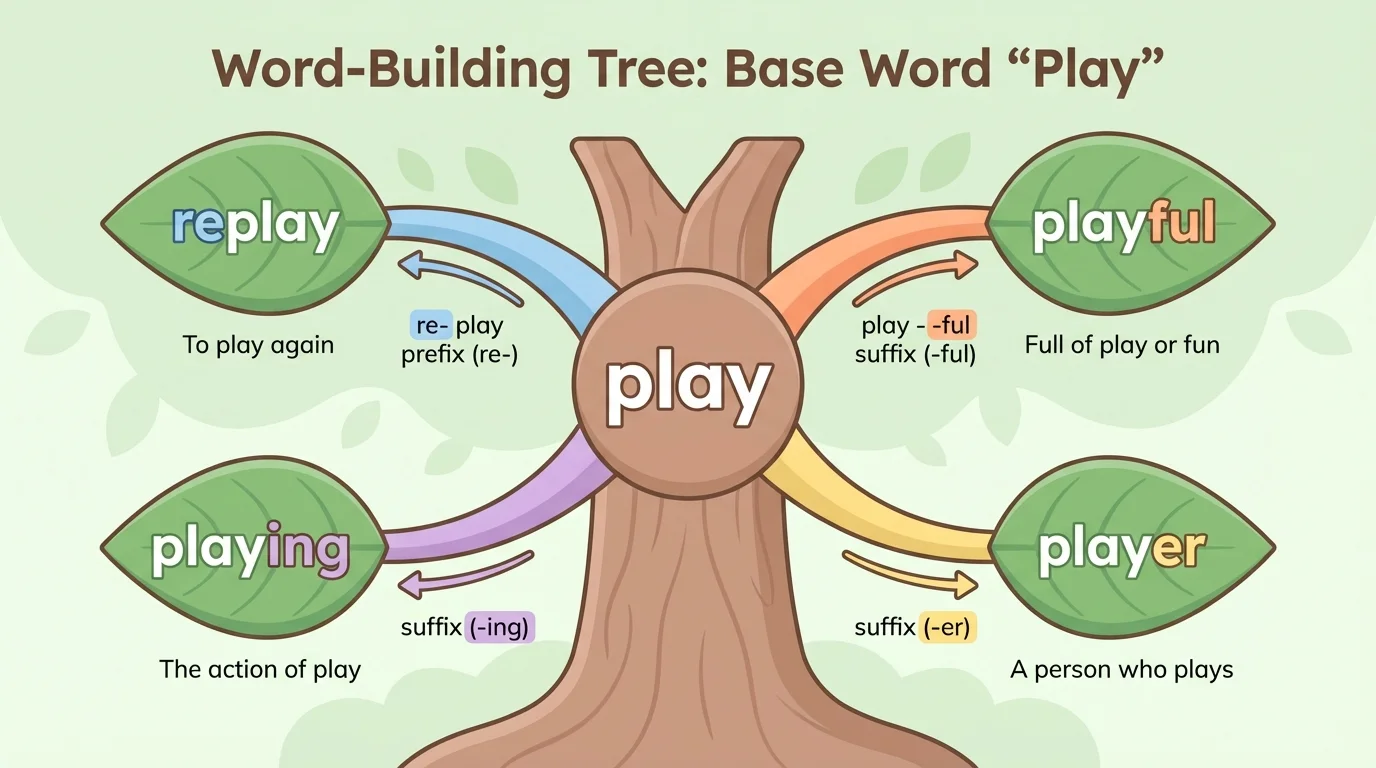
Learning affixes helps in two big ways. First, it helps you decode, or read, a longer word. Second, it helps you understand the word's meaning. Instead of seeing a long word as one hard chunk, you can break it into smaller parts you know.
Base word means the main word that carries the core meaning.
Affix means a word part added to a base word.
Prefix means an affix added to the beginning of a word.
Suffix means an affix added to the end of a word.
For example, in unkind, the base word is kind. In kindness, the base word is still kind. The new words are different, but they stay connected to the same idea.
A prefix is added to the front of a word, and [Figure 2] illustrates how that front part changes meaning while the base word stays the same. Prefixes often give us clues right away.
Here are some common prefixes for young readers:
| Prefix | Meaning | Example |
|---|---|---|
| un- | not | unhappy = not happy |
| re- | again | redo = do again |
| pre- | before | preview = view before |
| mis- | wrongly | misread = read wrongly |
Table 1. Common prefixes, their meanings, and examples.
If you see the word untie, you may know the base word tie. The prefix un- helps you understand that untie means to open or loosen what was tied. If you see repaint, the prefix re- tells you the painting happens again.
Prefixes do not always change how a word sounds very much, but they do change meaning. That is why it is important to look at the beginning of the word carefully. A reader who skips the prefix might miss the whole meaning.
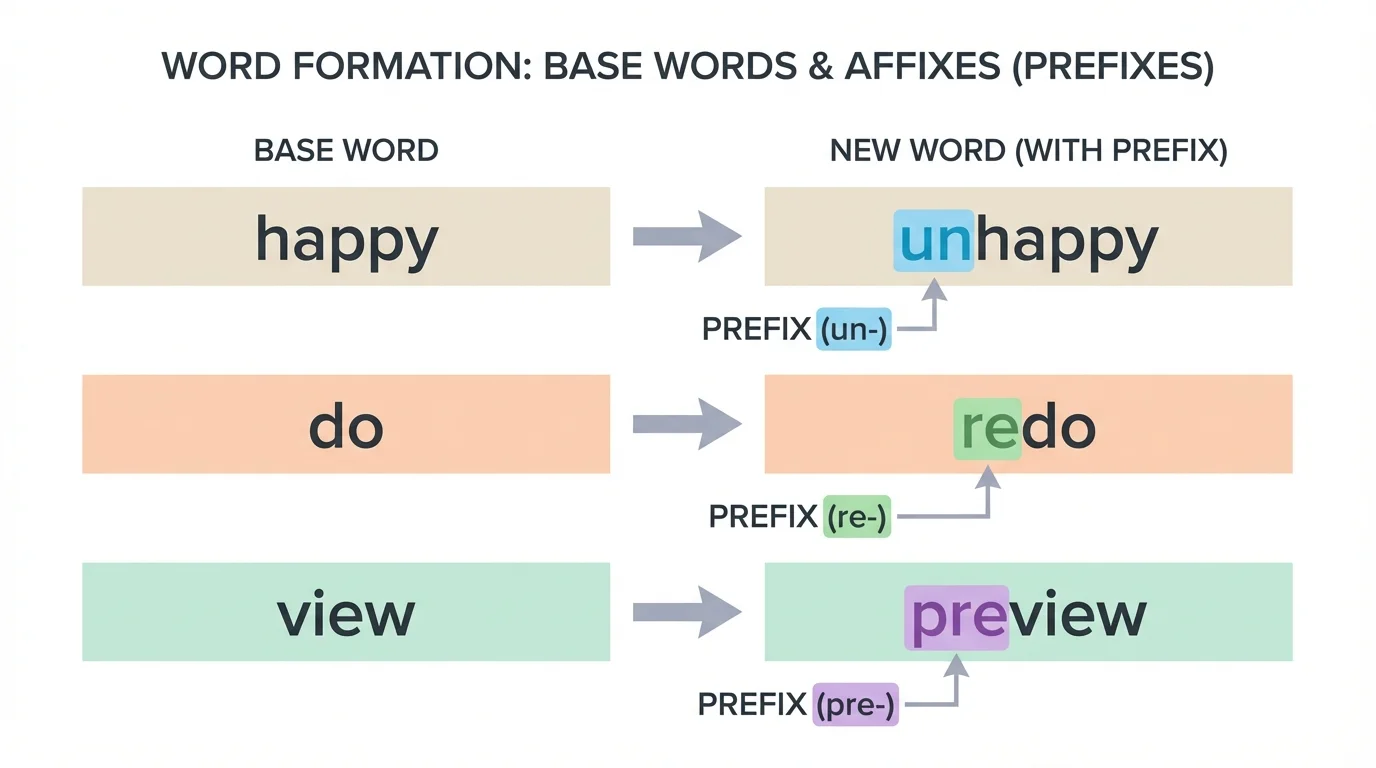
Sometimes a prefix can make a word mean the opposite, like fair and unfair. Sometimes it can show time, like heat and preheat. When you know common prefixes, you can solve many word mysteries quickly.
One short prefix can change a word's meaning in a big way. The word lock means to close something tightly, but unlock means to open it.
Later, when you read directions, science books, or stories, these prefixes keep appearing. That is why learning them now helps you become a stronger reader.
A suffix is added to the end of a word, and [Figure 3] shows how endings can change meaning or tell more about the word's job in a sentence.
Here are some common suffixes:
| Suffix | Meaning or Job | Example |
|---|---|---|
| -ful | full of | helpful = full of help |
| -less | without | hopeless = without hope |
| -er | person or thing that does something | teacher = a person who teaches |
| -est | most | fastest = fastest of all |
| -ing | happening now | jumping = jumping now |
| -ed | already happened | jumped = already happened |
Table 2. Common suffixes, their meanings or jobs, and examples.
If you know the word care, then careful and careless become easier to understand. Those two words are connected to the same base word, but their suffixes lead to very different meanings. This is why suffixes are so important.
Suffixes can also help you understand time. In a story, walk means the action in general, walking means it is happening now, and walked means it already happened. That tiny ending gives the reader an important clue.
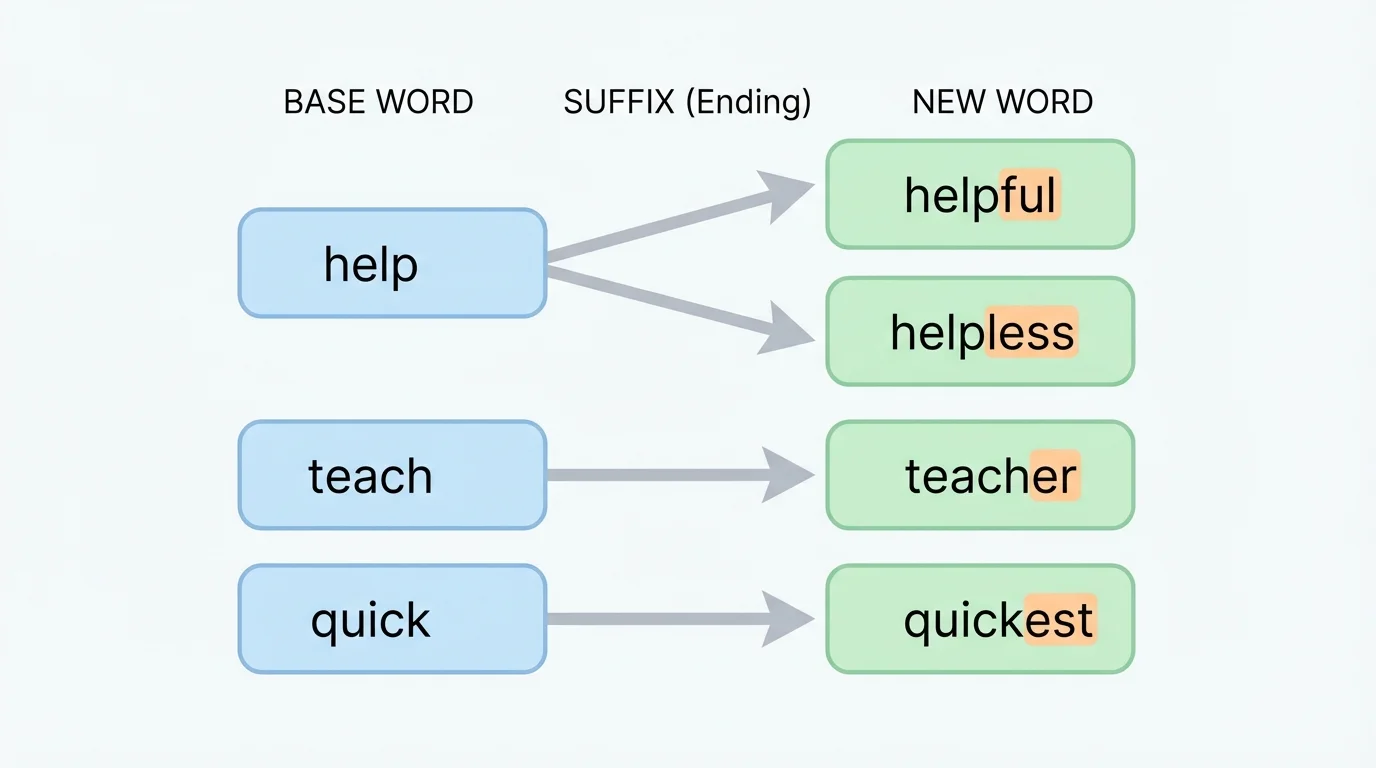
Some suffixes can turn one kind of word into another kind. For example, teach is an action word, but teacher names a person. Knowing that helps you understand how the word is being used in a sentence.
How suffixes change meaning
A suffix can add a new idea to the base word, such as time, comparison, or a person who does the action. That means readers should check the end of a word carefully, not just the beginning.
Think about the words small, smaller, and smallest. The base word stays the same, but the suffix tells how the words compare. That is another way suffixes give useful meaning.
When you come to a long word you do not know, stop and look for familiar parts. You might see a base word in the middle, a prefix at the front, or a suffix at the end. Breaking the word apart helps you read it piece by piece.
Take the word rereading. You can split it into re- + read + -ing. The prefix re- means again. The base word read tells the main action. The suffix -ing shows it is happening now. Put the parts together, and rereading means reading again right now.
This is a powerful reading strategy. Even if you have never seen the whole word before, you can still make a smart guess. Word parts act like clues hidden inside the word.
Using word parts to figure out meaning
Look at the word previewed.
Step 1: Find the base word.
The base word is view.
Step 2: Look at the prefix.
Pre- means before.
Step 3: Look at the suffix.
-ed tells us it already happened.
Step 4: Put the meanings together.
Previewed means someone looked at something before, and that action already happened.
As you become a stronger reader, you will notice that this same strategy works in many subjects. In reading class, it helps with story words. In science, it helps with new topic words. In social studies, it helps with words in captions, maps, and articles.
One exciting thing about morphology is that one base word can grow into many related words. This idea is called a word family. When you know one member of the family, you can often understand the others more easily.
Look at the base word read. It can become reader, reading, reread, and readable. Each new word connects to the idea of reading, but each one adds a new shade of meaning.
Look at the base word help. It can become helper, helpful, helpless, and helping. As we saw earlier in [Figure 3], changing the ending can change the whole meaning, even when the base word stays the same.
This is useful because your brain does not have to start over with every new word. Instead, it connects the new word to one you already know. That makes reading faster and smarter.
Remember that good readers do not always know every word right away. They look for clues in the word and clues in the sentence.
When you spot a familiar base word, you are already partway to understanding the new word. The affix gives the extra clue you need.
Sometimes adding an affix changes the spelling a little, and [Figure 4] highlights some common patterns. The base word is still there, but one or two letters may change when the new ending is added.
Here are a few patterns young readers often see. A word ending in silent e may drop the e before -ing. For example, make becomes making. Some short words double the last consonant before -ing or -ed. For example, run becomes running. A word may keep the base word almost the same when adding -ed, as when jump becomes jumped.
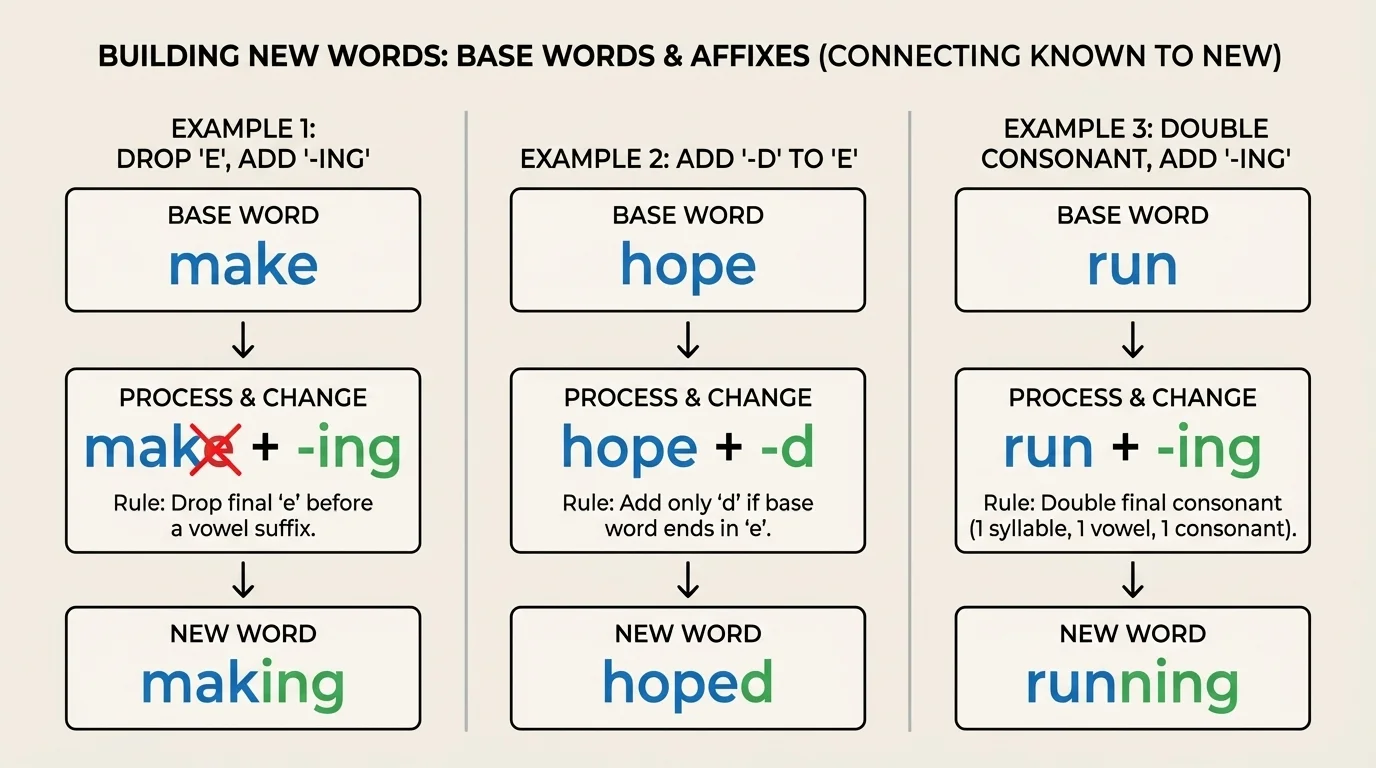
These spelling changes may look tricky at first, but they follow patterns. If you know the base word and the suffix, you can often still figure out the new word. For example, even though making does not look exactly like make, you can still spot the base word.
It is helpful to read slowly and check both meaning and spelling. If a word looks a little different, ask yourself, "What base word do I see?" Then look for the affix.
Later, when you write, these patterns also help your spelling. Reading and spelling work together. The more you notice word parts, the stronger both skills become.
Some words can have more than one meaning. The word play can mean a game-like action, or it can mean a show on a stage. Affixes and context help readers decide which meaning makes sense.
For example, player usually means a person who plays a game or an instrument. playful describes someone acting silly or full of fun. The base word is the same, but the suffix changes the meaning in a helpful way.
Context means the other words and sentences around the word. If you read, "The kitten was playful," you know playful describes the kitten. If you read, "We need one more player for soccer," the meaning is clear because of the word soccer.
Using affixes and context together
Read this sentence: "Mila reread the note because she missed a detail."
Step 1: Find the base word.
The base word is read.
Step 2: Check the prefix.
Re- means again.
Step 3: Use the sentence.
The sentence says Mila missed a detail, so it makes sense that she read the note again.
That is why strong readers use more than one clue. They look inside the word and around the word. Together, these clues help them understand new and tricky words.
Affixes are not just for spelling lists. They appear in library books, recipe steps, classroom directions, game rules, posters, and signs. When you read unsafe on a sign, the prefix un- gives a quick warning. When you read reheat on food directions, the prefix re- tells you to heat it again.
In school, you may see words such as helper, careful, misprint, or pretest. In each case, knowing the base word helps. Then the affix adds the new meaning. This is the same idea we saw in [Figure 2], where the beginning of the word changes the message, and in [Figure 4], where spelling patterns still point back to the base word.
The more you practice noticing word parts, the more words become familiar. Reading begins to feel less like guessing and more like solving a puzzle with clues that fit together.
"Big words are often made of small parts you already know."
That idea can give you confidence. You do not need to know every word right away. You can use the parts of the word, the spelling pattern, and the sentence to build meaning.
