Have you ever heard a story so good that it made you want to tell one of your own? That is one way writers learn. They read stories, listen closely, and notice what makes those stories work. Then they try some of those same writing moves in their own pieces. Good writers are not just readers. They are also careful observers.
A mentor text is a story that shows us how writing works. It is like a friendly guide. A mentor text might teach us how to start a story, how to show a character's feelings, or how to end with a strong final thought. When we study a mentor text, we ask, "What did this author do that helped me understand and enjoy the story?"
For second-grade writers, mentor texts are often short narratives about real or imagined events. They may tell about losing a tooth, finding a frog, missing the bus, or meeting a dragon in the backyard. Even when the stories are different, we can still learn from them. We can notice patterns that help make a narrative clear and interesting.
Narrative is writing that tells a story. It includes events, characters, and a beginning, middle, and end. A narrative can be about something real that happened or something imagined.
When you use a mentor text, you are not copying the author's exact story. You are learning from the author's choices. One author may begin with action. Another may begin with a feeling. Another may begin with dialogue. These choices give you ideas for your own writing.
[Figure 1] A clear structure helps the reader follow what happens, and narratives usually move in order from start to finish. A narrative usually has a beginning, a middle, and an end. The beginning introduces the characters and setting. The middle tells what happens. The end gives the reader a feeling that the story is finished.
The events in a story should happen in sequence. That means they are told in order. If a girl hears thunder, runs inside, and then shuts the window, those events make sense in that order. Sequence words such as first, next, then, and finally can help the reader follow the action.
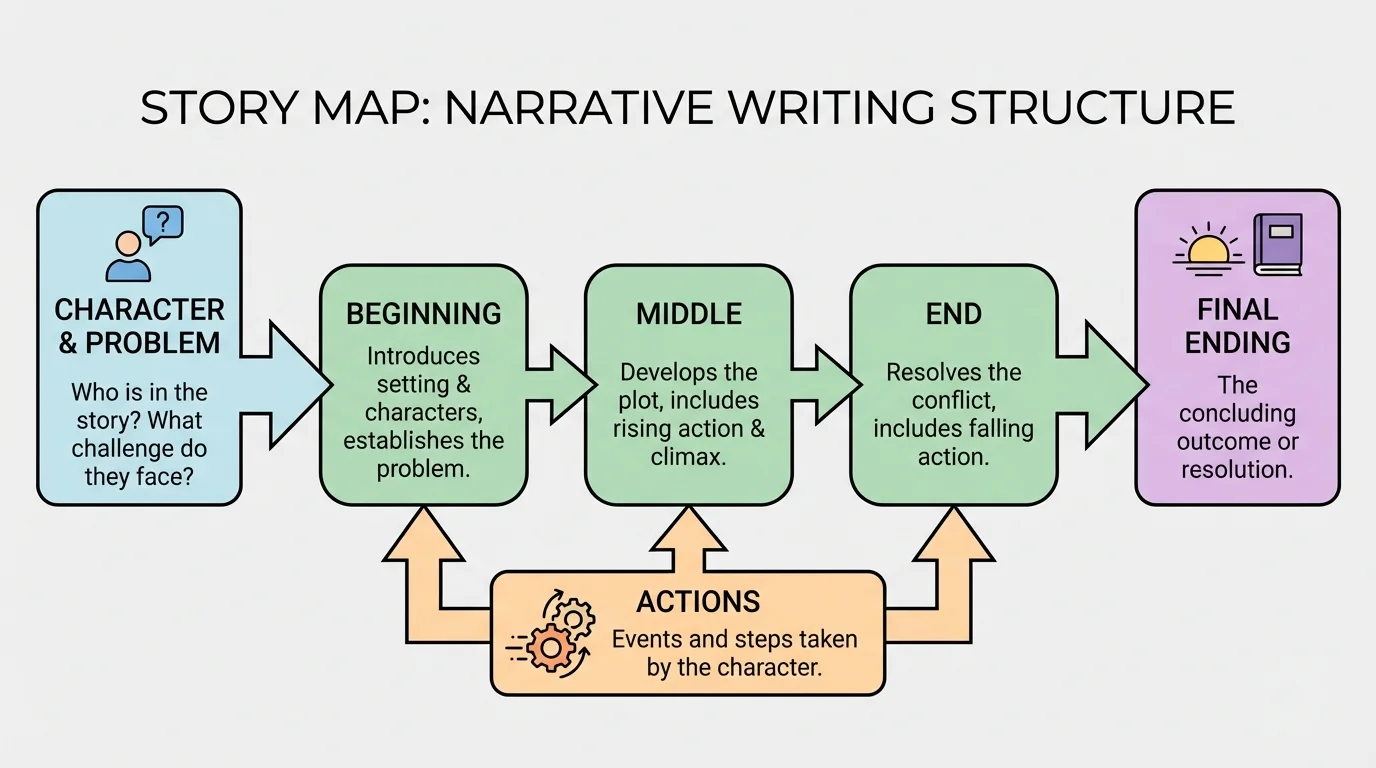
A strong beginning often answers important questions. Who is in the story? Where does the story take place? What is happening at the start?
The middle is where the story grows. Something happens, and the character reacts. Maybe the bowl slips. Maybe a duck grabs the food. Maybe Maya gets splashed. The middle should not feel like a list of random things. Each event should connect to the one before it.
The end should bring closure. Closure means the story feels complete. It does not have to be long. It can be a final action, a feeling, or a thought. For example: Grandpa laughed, and I laughed too. We went back to the house smelling like pond water, but I knew I would never forget fish-feeding day. That ending helps the reader feel that the story is truly over.
When you look back at [Figure 1], you can see that structure is not just three parts with labels. It is a path the reader follows through the story. If one part is missing, the story may feel confusing or unfinished.
Authors also teach us craft, which means the special ways they make writing vivid and powerful. Craft is what helps a story sound alive instead of flat.
[Figure 2] One craft move is writing about a small moment. Instead of telling about a whole vacation in one paragraph, a writer may zoom in on one exciting part, such as the moment a wave knocked over a sand castle. Small moments let the writer add actions, feelings, and details.
Another craft move is using dialogue. Dialogue is the exact words characters say. Instead of writing, Mom told me to hurry, a writer can say, "Hurry up!" Mom called from the doorway. Dialogue helps the reader hear the story.
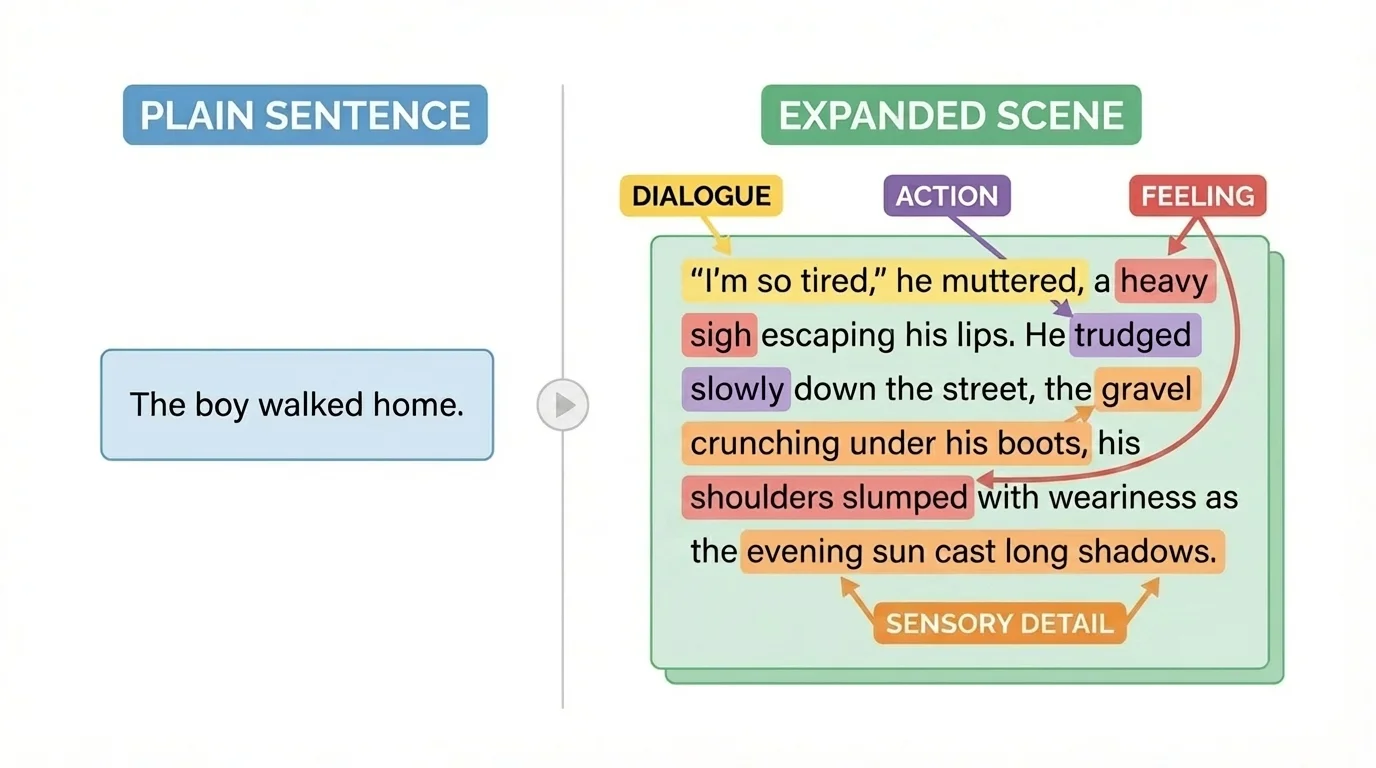
Writers also add actions and feelings. Compare these two versions. I was scared of the dog. That tells a feeling. But this version shows more: The dog barked, and I jumped behind Dad's leg. My hands squeezed his coat. The second version helps the reader picture the scene and understand the feeling.
Sensory details are details that help the reader imagine what someone sees, hears, smells, tastes, or feels. In a storm story, a writer might describe the rumbling sky, the cold raindrops, and the muddy smell after the rain. Sensory details make writing stronger because they help the reader step into the story.
Example of a plain sentence becoming a crafted sentence
Plain sentence: I opened the lunchbox.
Step 1: Add action.
I tugged open the lunchbox.
Step 2: Add what the character notices.
I tugged open the lunchbox and saw my sandwich squished under two shiny apples.
Step 3: Add feeling or thought.
I tugged open the lunchbox and saw my sandwich squished under two shiny apples. "Oh no," I whispered. My favorite lunch was a soggy mess.
The story becomes more interesting because the writer uses action, detail, dialogue, and feeling.
Mentor texts can also teach us about strong verbs. Instead of saying a character went, a writer may say the character raced, tiptoed, dragged, or marched. Strong verbs paint a clearer picture in the reader's mind.
Later, when you think again about [Figure 2], notice how the richer version does not change the whole event. It changes how the event is told. That is the power of craft.
Reading a mentor text once is a good start. Reading it again like a writer is even better. The second time, you can notice the author's choices. Where does the story begin? How does the author move from one event to the next? What words help you feel the character's emotions?
Writers often ask themselves simple questions when studying a mentor text: How did this author start? How did the author make the middle exciting? How did the ending feel complete? These questions help turn reading into learning for writing.
Professional authors often reread stories they admire before they begin writing. They study strong examples the same way athletes watch skilled players and musicians study excellent music.
You can also notice patterns. Maybe several stories begin with action. Maybe many endings include a feeling, a lesson, or a final image. These patterns become tools you can keep in your writer's toolbox.
Learning from a mentor text does not mean taking someone else's sentences. It means borrowing the pattern or the idea of a writing move. For example, if a mentor text starts with sound words like Crash! Bang!, you might decide to begin your own story with a sound too. But your event, characters, and wording should be your own.
Here are some ways to use ideas without copying: start with action, use dialogue to show a problem, add sensory details in the middle, and end with a feeling or thought. These are writing moves, not stolen lines.
| What to borrow | What not to copy |
|---|---|
| A kind of beginning | The exact first sentence |
| A way to show feelings | The same character and plot |
| A pattern for an ending | Whole paragraphs from the story |
| A way to use dialogue | Another author's exact words |
Table 1. This table shows the difference between learning from an author's techniques and copying the author's original writing.
This matters because your narrative should sound like your own voice. Mentor texts help you grow, but your own ideas make the story special.
[Figure 3] When you are ready to write, it helps to move from noticing to planning with a simple writing plan. First, think of a real or imagined event. Then choose one small moment from that event. Finally, decide which mentor-text moves you want to try.
Suppose your mentor text began with a surprising action and used dialogue in the middle. You might plan a story about dropping a cupcake at a birthday party. Your beginning could start with the accident. Your middle could include what your friends said. Your ending could show how you felt when someone shared another cupcake with you.
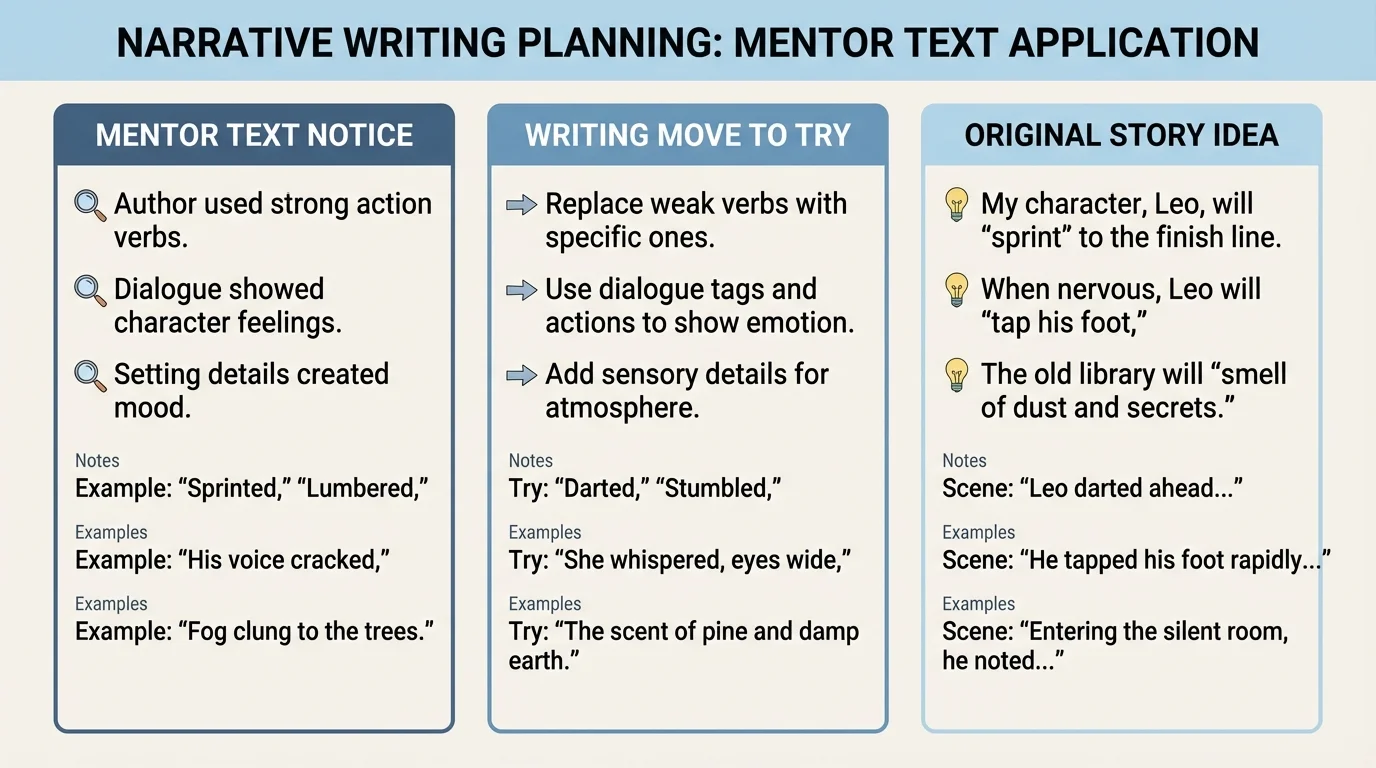
A plan for that story might sound like this: Beginning: I tripped near the table. Middle: My cupcake fell, frosting splatted, friends gasped, and one friend spoke. End: I felt sad, then relieved when a friend shared. This plan keeps the events in order.
From mentor text to original story means taking a writing move you noticed and using it in a brand-new piece. You may borrow a strong way to begin, a way to show emotion, or a kind of ending, but the characters, setting, and events should come from your own imagination or your own life.
You can also think back to [Figure 1] while planning. Ask yourself whether your story has a clear start, connected middle events, and an ending that feels complete. Then think back to [Figure 2] and ask whether your scene includes dialogue, action, or sensory details.
Good writers do not stop after the first draft. They reread and revise. Revising means making the writing better. A mentor text can help during revision too. You can compare your story to what you learned from the model.
Ask yourself questions such as these: Does my beginning help the reader know who, where, or what is happening? Do my events go in order? Did I zoom in on a small moment? Did I include details, dialogue, or feelings? Does my ending give closure?
When you revise, you are not just fixing mistakes. You are making choices to help your reader understand the story more clearly and enjoy it more fully.
For example, a first draft might say: I went outside. It rained. I got wet. I came back in. That tells the events, but it does not use much craft. A revised draft might say: I pushed open the screen door and stepped onto the porch. Plop! A cold raindrop landed on my nose. "Get back in here!" my brother shouted. I ran inside, laughing and dripping on the floor. The revised version has clearer action, sound, dialogue, and feeling.
Mentor texts are helpful because they remind you what strong writing can look and sound like. They help you make your own narrative clearer, richer, and more complete.
"Writers learn to write by reading, noticing, and trying."
Each time you study a strong story, you collect another useful idea. Over time, those ideas help you tell events in sequence, build scenes with detail, and end with a satisfying close. That is how mentor texts help writers grow.
