A tiny clue word can change everything. If a text says a plant grew after rain fell, that tells you about time. If it says the plant grew because rain fell, that tells you about cause and effect. Strong readers notice these clues, because informational texts are full of connected events, ideas, and steps.
When you read nonfiction, you do more than collect facts. You figure out how those facts fit together. A history text may tell what happened first, next, and last. A science text may explain why one change leads to another. A set of directions may show the exact order of actions. Understanding these relationships helps you understand the whole text better.
A relationship in a text is the connection between two or more parts. The parts might be events in history, ideas in science, or steps in a procedure. Readers ask questions like these: What happened first? What happened later? What caused this? What effect did it have? What step must come before the next one?
If you know the relationships in a text, you can retell it more clearly. Instead of saying, "There was a storm and a flood and people moved," you can say, "First, a storm brought heavy rain. Next, the river rose. Because the water spilled over the banks, many people moved to safer places." That answer shows time, sequence, and cause/effect.
Time tells when something happens. Sequence tells the order in which things happen. Cause and effect explains that one thing happens because of another thing. The cause is why something happened, and the effect is what happened because of that cause.
These ideas often work together. In many texts, something happens first in time, and then it causes something else. For example, a text might explain that people built a bridge. After the bridge was built, more traders crossed the river. Because travel became easier, the town grew. A similar chain of events appears in [Figure 1].
Authors use special clue words to show order. These are often called signal words. They help readers follow what comes first and what comes later. Some common time and sequence words are before, after, first, next, then, later, finally, at last, meanwhile, and during.
Look at how these words help in a sentence: "First, the class planted seeds. Next, they watered the soil. Then, they put the cups by the window. Finally, they watched the seeds sprout." The signal words make the order easy to follow.
Sometimes the order is not shown with numbers. Instead, the author uses dates, times, or phrases like in the morning, years later, or during the winter. In a history text, dates are especially important. In a science text, stages may show order. In directions, order may be shown with numbered steps.
| Type of clue | Examples | What it helps you see |
|---|---|---|
| Time words | before, after, during, later | When something happens |
| Sequence words | first, next, then, finally | The order of events or steps |
| Cause/effect words | because, so, since, therefore, as a result | Why something happened and what happened next |
Table 1. Common clue words that help readers identify time, sequence, and cause/effect.
Some texts do not just tell the order. They also explain why things happen. This is called cause and effect. A cause is the reason. An effect is the result.
Here is a simple example: "The road became icy because the temperature dropped." The cause is that the temperature dropped. The effect is that the road became icy. Another example is: "The baby birds chirped loudly, so the parent bird brought food." The chirping happened first, and it also helped cause the parent bird's action.
One cause can lead to many effects, and one effect can have many causes.
A storm can knock down trees, flood streets, and cut electricity. Those are many effects from one cause. A bad harvest can happen because of drought, insects, or plant disease. That is one effect with many possible causes. Good readers stay alert for both kinds of relationships.
Authors use clue words such as because, since, so, therefore, as a result, and for this reason. Sometimes the clue words are hidden, and you have to think carefully. If a text says, "The pond dried up. Soon many frogs left the area," the author does not say because, but the relationship is still there.
History texts tell about people and events from the past. To understand them, readers track what happened over time. You should notice dates, years, and time words. You should also notice what event led to another event.
Suppose a text says: "In 1872, lightning struck a dry barn. Soon a fire spread across the town. Next, neighbors formed a bucket brigade to carry water. After the fire ended, families rebuilt their homes. Because wood buildings had burned quickly, many new buildings were made of stone." This passage has both sequence and cause/effect. The lightning strike came first. The fire spread after that. Rebuilding happened later. People rebuilt with stone because wood burned quickly.
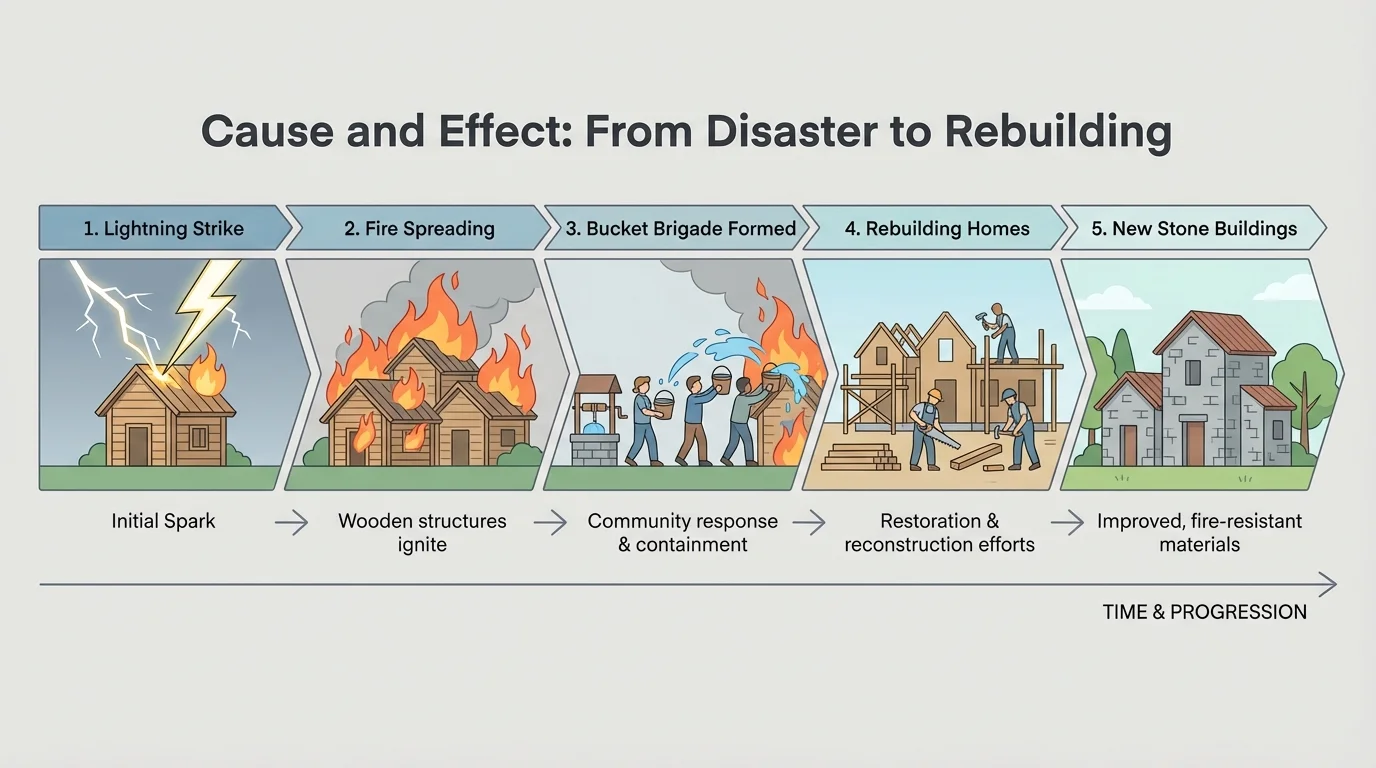
When you describe relationships in history, use words that match the text. You might say, "First, lightning struck the barn. As a result, a fire spread through the town. After the fire, people rebuilt. Because the wooden buildings burned quickly, many people chose stone for new buildings."
History often includes key figures too. If a leader made a decision, that decision may have caused later events. If explorers traveled to a new place, their arrival may have changed trade, travel, or settlement. A timeline helps readers see order, but the words in the passage explain the reasons behind the events.
Many historians use two kinds of sources. A primary source comes from the time being studied, such as a diary or letter. A secondary source is written later, such as a textbook or article that explains the event.
As you think again about this example, notice that history is not just a list of dates. It is a chain of connected actions and results. That is why readers must ask both "What happened next?" and "Why did it happen?"
Science texts often explain change over time, such as a plant growing from a seed. These texts may describe a cycle, a life process, or an experiment. Readers need to identify the stages in order and understand what causes each change.
For example, a text might explain: "First, a seed absorbs water. Next, the outer coat softens. Then a root begins to grow downward. After that, a shoot pushes upward toward the light. Because the young plant receives sunlight, it can make food and continue growing." This passage shows sequence with words like first, next, and after that. It also shows cause and effect: water helps start growth, and sunlight helps the plant continue growing.
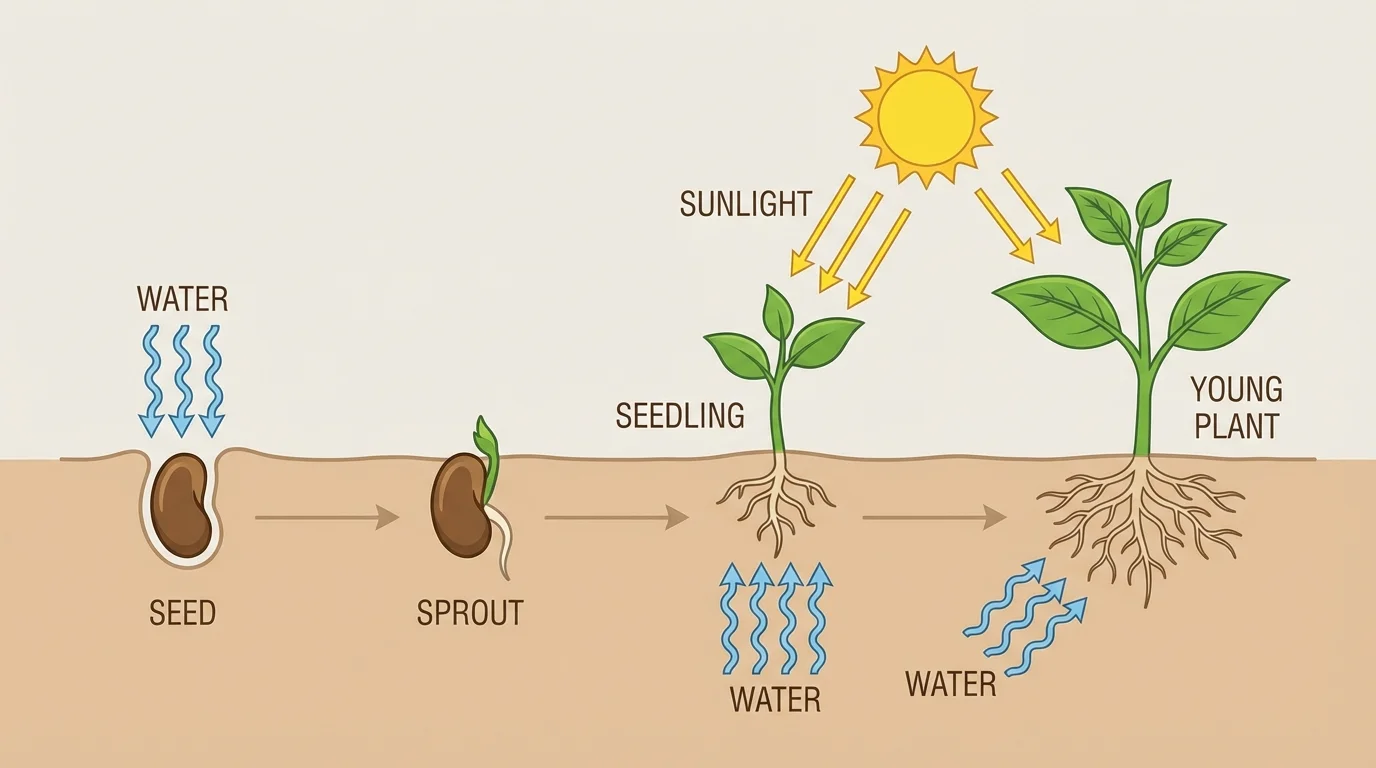
Science texts also connect ideas, not just events. A book may explain that the Sun warms Earth's surface. Because the surface warms, water evaporates. Later, the water cools and forms clouds. Eventually, rain falls. This is a set of connected ideas with a clear order and clear causes.
Sometimes the process repeats in a cycle. In a cycle, the ending leads back to the beginning. Even in a cycle, sequence still matters. Water evaporates before it forms clouds, and clouds form before rain falls. Cause and effect also matter. Heating causes evaporation, and cooling causes condensation.
Science text example
Read this sentence pair: "The class put one plant in sunlight and one in a dark closet. After a week, the plant in sunlight was greener and taller."
Step 1: Find the time clue.
The phrase after a week tells when the change was noticed.
Step 2: Find the cause.
The plant in sunlight received light, while the other plant did not.
Step 3: Find the effect.
The plant in sunlight became greener and taller.
A clear description is: "After one week, the plant in sunlight grew better because it received light."
Later, when a science text becomes more detailed, it may include several causes at once. A plant may need water, air, space, and sunlight. If one of these is missing, the effect may be weaker growth. That is why careful readers connect every stage and every reason. The same need for order appears in [Figure 3], which shows a technical procedure.
A technical procedure is a set of directions for doing something. It might explain how to plant a tree, make a sandwich, log in to a computer, or fold paper. In procedures, the order is especially important because one step often prepares for the next step.
Suppose a text says: "First, fold the paper in half lengthwise. Next, open it and fold the top corners to the center line. Then fold the slanted edges inward. Finally, fold the airplane in half and bend down the wings." If you skip the first fold, the center line is missing. Because the center line is missing, the top corners may not match. As a result, the airplane may fly crookedly.
This is why procedure texts often use numbered steps. The numbers show sequence clearly. The words first, next, then, and finally do the same job. Sometimes a procedure also includes warning words such as be sure or do not. These tell what might happen if a step is done incorrectly.
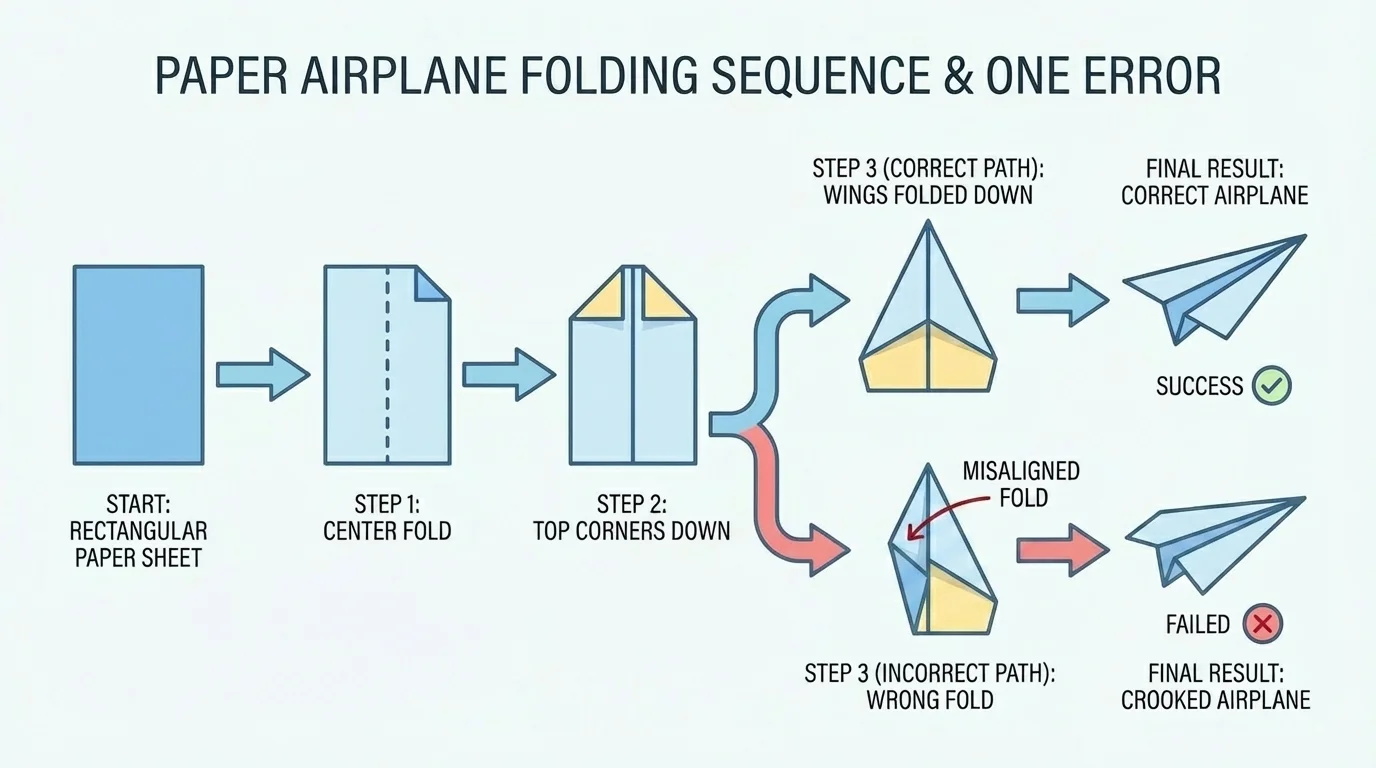
When you describe a procedure, you should explain both the order and the reason for the order. You might say, "First, the paper is folded to make a center line. Next, the corners are folded toward that line. Those early folds matter because they shape the airplane for the later steps."
Think again about this procedure. The later steps depend on the earlier ones. That is a relationship too. In technical texts, sequence and cause/effect often work together very tightly.
When you answer questions about a text, try to use complete ideas. Good answers often include a signal word from the text and the names of the connected events, ideas, or steps.
You can use sentence frames like these:
Here is a clear example from history: "After settlers built a road, more wagons traveled through the area. Because travel became easier, the town grew." Here is one from science: "First, the ice melted. Then the water heated. Because the water became hot, some of it turned into vapor." Here is one from directions: "First, wash the fruit. Next, cut it. Washing must happen before cutting so the fruit is clean."
When you read for key ideas and details, always look back at the text. The best explanation uses information the author gives, not a guess. Signal words, dates, headings, labels, and repeated ideas all help you find the relationship.
Sometimes you will need to put information from more than one sentence together. One sentence may tell the cause, and another may tell the effect. One paragraph may describe the first step, while the next paragraph explains the result. Strong readers connect ideas across the text.
Informational texts often include helpful features. Headings tell what a section is about. Captions explain pictures. Labels on a diagram can show parts or stages. Timelines show order. Flowcharts show steps. Maps can show movement from one place to another in history.
A text feature does not replace the words in the paragraph, but it provides support. For example, the seed-growth diagram in [Figure 2] makes the order of change easy to see. The timeline in [Figure 1] helps you notice how one town event follows another. A flowchart like [Figure 3] helps you see that one step must be finished before the next one begins.
When you use text features, ask the same questions you ask about paragraphs: What comes first? What comes next? What caused the change? What happened because of that cause?
Not every text has one simple chain. Sometimes an event has several effects. Sometimes several causes work together. Sometimes a process repeats. Sometimes two things happen at the same time. Readers need flexible thinking.
For example, a passage may say that a volcano erupted, ash blocked sunlight, and people moved away. But it may also say that hot lava destroyed roads and smoke made breathing difficult. In that case, the eruption caused many effects. Another passage may explain that fish in a lake died because the water became too warm and too dirty. Then two causes led to one effect.
Words like meanwhile and at the same time show that events happen together. Words like over time and eventually show a longer process. These clues help you explain relationships more accurately.
"Readers who notice connections do more than remember facts. They understand how a text works."
Once you begin looking for time, sequence, and cause/effect, informational texts become easier to understand. Instead of seeing many separate facts, you begin to see patterns: one action leading to another, one idea supporting the next, and one step preparing for what follows.
