Have you ever read something and thought, "I'm not sure I agree with that"? That moment is an important reading skill. Good readers do more than understand the words on the page. They also notice what the writer believes and compare it with their own ideas. When you can tell the difference between your thinking and the author's thinking, you become a stronger, smarter reader.
A point of view is the way someone thinks or feels about a topic. In reading, there are often two points of view to notice. One is the author's point of view, which is what the writer believes, feels, or wants readers to understand. The other is reader point of view, which is what you think, feel, or believe.
Sometimes your point of view matches the author's. Sometimes it does not. Sometimes it matches only a little. The important thing is to keep the two separate. If a text says that school uniforms are helpful, that does not automatically mean you think they are helpful. It means the author thinks they are helpful.
Author's point of view is the author's opinion, belief, or attitude about a topic.
Reader's point of view is the opinion, belief, or attitude the reader has about that same topic.
Informational texts often teach facts, but they can also show a point of view. A writer might choose facts and examples to show that something is useful, important, safe, unfair, or exciting. That is why readers need to pay attention not only to the topic, but also to how the topic is presented.
As [Figure 1] shows, readers can place the author's ideas next to their own ideas and compare them clearly. This helps you say, "The author believes this," and then, "I believe this." Keeping those ideas in separate spaces is the key to understanding point of view.
Your own point of view comes from your life. Your family, your school, your hobbies, and your experiences all shape your thinking. If you love gardening, you may react positively to a text about planting flowers at school. If you are allergic to pollen, you may feel differently. Both reactions are part of your own point of view.
The author's point of view comes from the text itself. You do not guess it from your feelings alone. You look for clues in the words the author chooses, the facts the author includes, and the examples the author gives.
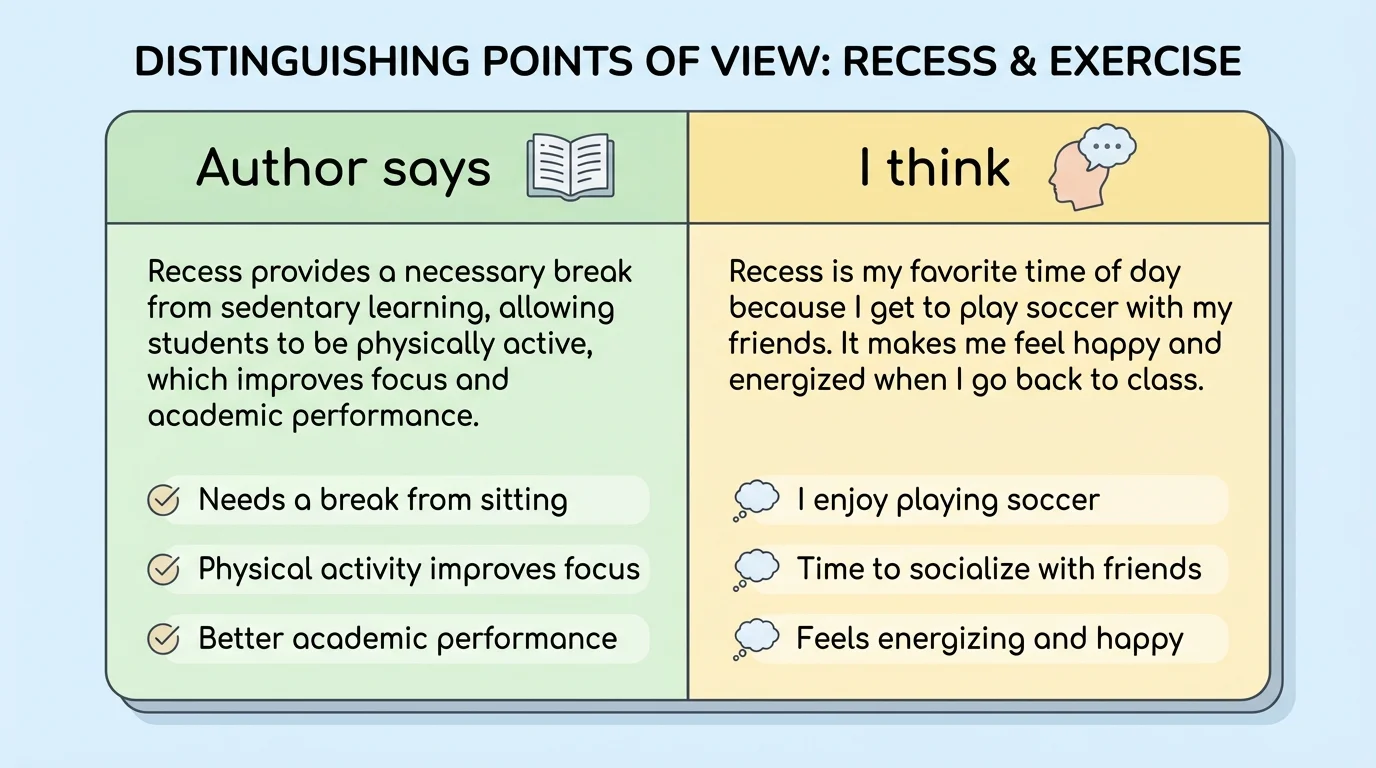
Suppose a text says, "Daily recess helps children focus better in class." The author seems to believe recess is important. You might agree because you feel calmer after moving around. Or you might disagree because you think quiet reading time helps you focus more. Your response is your point of view, but the sentence still shows the author's point of view.
This is a very important idea: your opinion is not the same as the author's opinion. Even if you agree, they are still two different points of view. Good readers can name both.
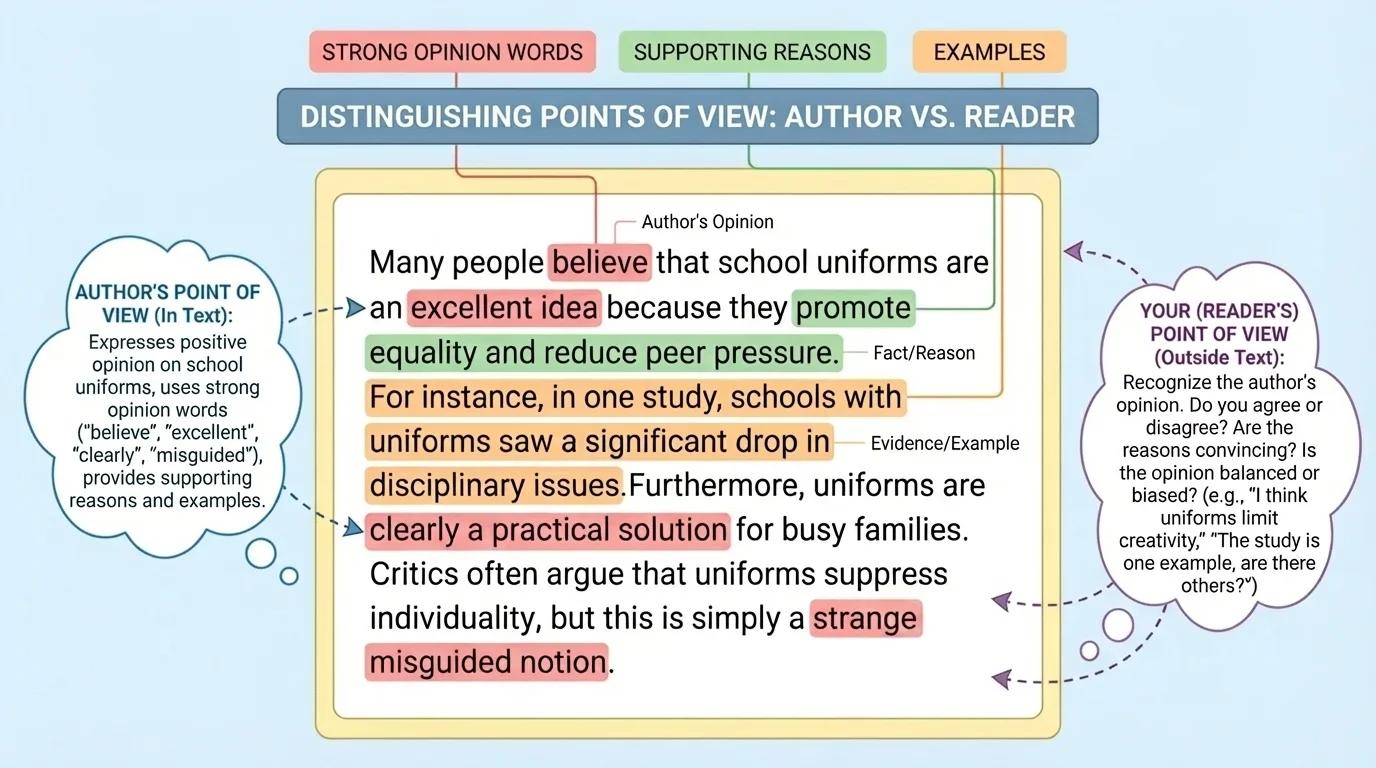
Authors do not always say, "Here is my opinion." Instead, they leave text evidence that helps you figure it out. As [Figure 2] illustrates, strong words, carefully chosen reasons, and examples all help reveal what the author thinks.
One clue is word choice. If an author writes that biking to school is a smart and healthy choice, those words show approval. If the author writes that traffic near schools is dangerous and crowded, those words may show worry or concern.
Another clue is the reasons the author gives. If the author lists many reasons for one side of an issue, that can show the author's point of view. For example, a writer may explain that recycling saves resources, reduces trash, and keeps parks cleaner. Those reasons suggest the author supports recycling.
Examples matter too. An author may include stories, facts, or details that help push a certain idea. If a text only shares positive stories about class pets, the author may want readers to see class pets as a good idea. If it only shares problems, the author may want readers to see class pets as a bad idea.
The tone of a text also helps. Tone is the feeling or attitude behind the words. A cheerful tone may show excitement. A serious tone may show concern. A proud tone may show strong support. Even in informational writing, tone can help readers understand the author's point of view.
How authors reveal a point of view
Authors reveal their point of view by choosing certain words, giving specific reasons, and selecting examples that support what they want readers to think. Readers do not need to guess wildly. They can point to parts of the text and say, "This clue shows the author's view."
When you state the author's point of view, it helps to use words like the author thinks, the author believes, or the author seems to feel. Those sentence starters remind you to focus on the writer's ideas, not your own.
One useful strategy is to stop after reading and ask two questions: What does the author think? and What do I think? Asking both questions helps you separate the two points of view.
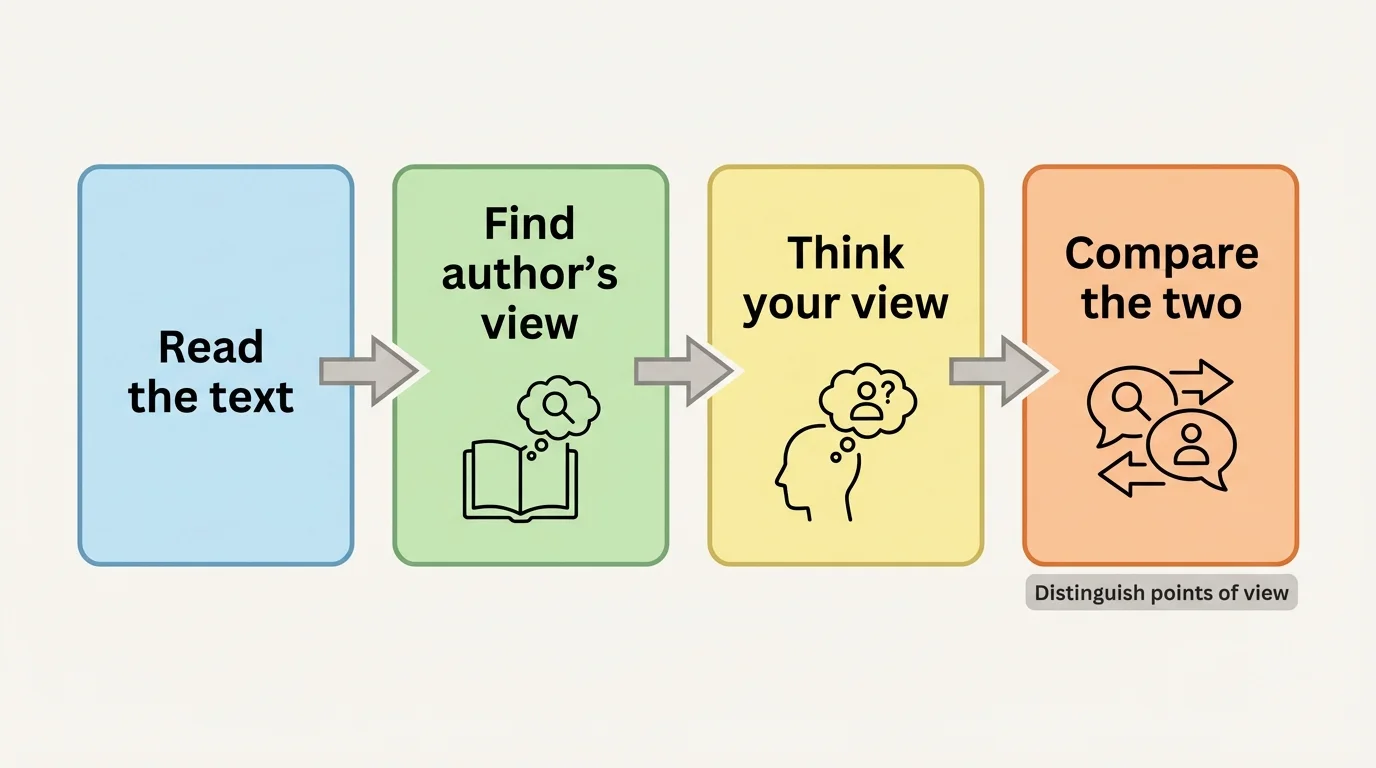
First, identify the topic. What is the text about? It might be about school lunches, animal habitats, recycling, or weather safety. Next, look for clues that show the author's thinking. Then think about your own ideas. Finally, compare them.
You can use simple sentence frames to help: "The author believes ______." "I believe ______." "We agree because ______." or "We disagree because ______." These frames make your thinking clear.
Be careful not to confuse facts with opinions. A fact can often be checked. For example, "Bees help pollinate flowers" is a fact. But "Bees are the most important insects" shows a point of view. Authors may use facts to support their point of view, but the point of view itself is what the author believes about the topic.
Remember that informational texts can include both facts and opinions. A strong reader can learn facts from a text while also noticing the author's attitude about the topic.
When you read carefully, you become better at saying not just what the text is about, but also how the author feels about it and how you feel about it. That is a big step in reading with understanding.
Now let's examine some examples. The compare-and-think process helps readers move from reading the text to naming the author's point of view and then their own.
Example 1: A text about recycling
Text: "Recycling bins in every classroom can help schools reduce waste. When students recycle paper and plastic, the school sends less trash to the landfill and keeps useful materials in use."
Step 1: Find the topic.
The topic is recycling at school.
Step 2: Find the author's point of view.
The author believes recycling bins in classrooms are a good idea.
Step 3: Think about your point of view.
You might agree and think classroom bins make recycling easier. Or you might think students need better reminders to use them correctly.
Step 4: Compare the two points of view.
You and the author may both support recycling, but you may have different reasons.
In this example, the author's point of view is positive. As [Figure 3] shows, the words help, reduce waste, and keeps useful materials in use are clues. They show support for recycling. Your own point of view may be similar or different, but it must be stated separately.
Here is another example. Text: "A school garden gives students a chance to learn outside. It can also provide fresh vegetables for taste tests and teach responsibility." The author seems to believe school gardens are valuable. If you love planting seeds, you may strongly agree. If you worry that gardens take a lot of work, you may partly agree but still have concerns.
Notice how agreement can have different levels. You do not always fully agree or fully disagree. You might agree with the author's main idea but not every reason. As we saw earlier in [Figure 1], placing the two viewpoints side by side helps you explain those differences clearly.
Example 2: A text about class pets
Text: "Class pets can teach students how to care for living things. Watching a turtle or fish each day can help children become more responsible."
Step 1: Identify the author's point of view.
The author thinks class pets are helpful for learning responsibility.
Step 2: Identify your point of view.
You may agree because animals are interesting. You may disagree because pets need careful care on weekends and holidays.
Step 3: Explain the difference.
The author focuses on benefits. You might focus on the challenges.
This example teaches an important lesson: your point of view may notice something the author does not talk about much. That does not mean the author is wrong. It means you are thinking deeply and comparing ideas.
Example 3: A text about reading before bed
Text: "Reading before bed is a peaceful habit that helps children relax. Unlike screens, books can make bedtime calmer and quieter."
Step 1: Look for clue words.
Words like peaceful, relax, calmer, and quieter show approval.
Step 2: State the author's point of view.
The author believes reading before bed is a good habit.
Step 3: State your point of view.
You might agree because bedtime stories help you settle down. Or you might prefer quiet music instead.
Again, the key is to say whose idea is whose. The author says one thing. You say another. Strong readers can tell them apart.
Sometimes students think that if they agree with the author, then there is only one point of view. But that is not true. If the author believes exercise is important and you believe exercise is important, there are still two points of view. They just happen to match.
When you disagree, be respectful and use the text. You can say, "The author believes school starts too early, but I think early starts work well for some families." That response clearly shows both points of view.
When you partly agree, your answer may sound like this: "The author believes school gardens are helpful, and I agree. But I think they need a plan for watering during breaks." This shows careful thinking. It also shows that readers can build on what authors say instead of simply copying it.
Two people can read the same article and come away with different ideas because they bring different experiences, interests, and questions to the text.
That is one reason reading and discussion are so interesting. A text can teach everyone the same topic, but each reader may respond in a slightly different way.
Distinguishing your point of view from the author's helps you in school and in everyday life. It helps when you read articles, instructions, websites, posters, and books. It helps you decide whether you agree with what you read and why.
This skill also makes you a better writer. When you write, you can be clear about your own point of view and support it with reasons. You also learn to understand that readers may have different thoughts, just as you may have different thoughts from an author.
When you talk with classmates about a text, this skill helps you explain your ideas better. Instead of saying only, "I liked it," you can say, "The author believes reusable water bottles are better for the environment, and I agree because they create less trash." That is a strong, thoughtful response.
Later, when you read longer articles and more difficult texts, this skill becomes even more important. You will need to notice not just what information is given, but also how the author wants readers to think about that information. The clue words and reasons we noticed in [Figure 2] still matter when texts become more complex.
| Question to Ask | What It Helps You Find |
|---|---|
| What is this text about? | The topic |
| What words show how the author feels? | The author's point of view |
| What reasons or examples does the author give? | Clues supporting the author's point of view |
| What do I think about this topic? | Your point of view |
| How are our ideas the same or different? | A comparison of both points of view |
Table 1. Questions readers can ask to separate their own point of view from the author's point of view.
Whenever you read, remember this simple idea: the author has a voice, and you have a voice too. Reading well means listening carefully to the author while also thinking for yourself.
