Have you ever asked two people about the same soccer game and gotten two different stories? One person might talk about the winning goal, while another talks about the great defense. Both are talking about the same event, but they focus on different parts. Reading works the same way. Two texts can be about the same subject, yet each one may teach you something a little different.
When readers compare two texts, they do more than just read one after the other. They think carefully about what both texts are saying. They notice what is the same, what is different, and what each text helps them understand. This makes reading deeper and more effective.
If you read two texts about storms, one text may explain how storms form, and the other may describe how people stay safe. If you only read one, you learn part of the picture. If you compare both, you build a fuller understanding of the topic.
Why comparing texts is useful
Comparing texts helps readers gather information from more than one source. It also helps them check ideas, notice new facts, and understand that authors can choose different details even when writing about the same topic.
Strong readers ask questions such as: What are both texts mostly about? What is important in each one? Which details match? Which details are different? These questions help readers move beyond simple retelling.
To compare means to tell how things are alike. To contrast means to tell how things are different. When you compare and contrast texts, you look at both kinds of information.
A topic is the subject of a text. The topic of a text about penguins is penguins. The topic of a text about recycling is recycling. When two texts have the same topic, they are both about the same subject, even if they do not say the exact same things.
The main idea is the most important point a text wants to teach. Some texts have one big main idea, while longer texts may include several important points in different parts. A key detail is an important piece of information that supports the main idea.
Compare means to tell how things are alike.
Contrast means to tell how things are different.
Most important points are the biggest ideas the author wants readers to learn.
Key details are important facts, examples, or explanations that support those ideas.
Not every detail in a text is equally important. For example, if a text says that bees help flowers grow by moving pollen, that is an important detail. If the text says a photo shows a bee on a yellow flower, that may be interesting, but it is probably not one of the most important points.
The first step in comparing two texts is to find the shared topic. Ask yourself, What are both texts about? Keep your answer broad enough to fit both texts. If one text is about how turtles hatch and another is about what sea turtles eat, the shared topic might be sea turtles.
Next, find the important point in each text. Ask, What does this text mostly teach me about the topic? One text may teach that sea turtles begin life on beaches. Another may teach that sea turtles face dangers in the ocean. They have the same topic but a different focus.
Sometimes the title, headings, first sentence, or last sentence can help you find the main idea. Pictures and captions can help too, but the words in the text are still the most important clues.
Remember that informational texts are written to teach readers about real topics. They often include headings, captions, diagrams, photographs, and bold words to help explain important ideas.
When you compare two texts, do not just say, "They are both about animals." That answer may be too broad. Try to be more exact. "They are both about how bees help plants" is clearer and stronger.
After you know the topic and the main point of each text, look for details that matter. Important details answer questions such as how, why, and what kind. They support the author's big idea.
A informational text may include many facts, but not all facts are key details. Key details connect directly to the main idea. If the main idea is that bees are helpful pollinators, then details about pollen, flowers, and fruit growth are key details.
As you read, you can think in three groups: details only in Text A, details only in Text B, and details found in both texts. This simple habit makes comparing easier.
Some books, articles, and websites on the same topic can even disagree a little because authors choose different facts to include or explain ideas in different ways. That is one reason comparing texts is such a powerful reading skill.
You should pay special attention to repeated words, bold vocabulary, headings, and sentences that explain causes, effects, steps, or reasons. These often point to key details.
Two texts on the same topic can be alike in several ways. They may share the same facts, teach the same main idea, or use some of the same vocabulary. They may both explain why something happens or describe the parts of something.
They can also be different in important ways. One text may go deeper into one part of the topic. One may use examples from nature while the other may use examples from daily life. One may be easier to read because it uses shorter sentences or clearer headings.
Sometimes two texts differ because of their text features. One text might have headings, captions, and labeled pictures. Another might use a chart or a sidebar. These features can help the reader understand, but the reader still needs to compare the words and ideas in the texts.
| What to Compare | Questions to Ask |
|---|---|
| Topic | Are both texts about the same subject? |
| Main idea | What is each text mostly teaching? |
| Key details | Which facts or examples are important in each text? |
| Focus | Does one text focus on a different part of the topic? |
| Text features | Do the texts use headings, captions, pictures, or charts differently? |
| Word choice | Do the authors use some of the same words or different words? |
Table 1. Questions readers can ask when comparing two texts on the same topic.
You do not need to compare everything. Focus on the parts that matter most. A strong comparison talks about important points, not tiny details that do not change understanding.
Readers often organize their thinking with a comparison chart. A chart can help you sort what belongs only to one text and what belongs to both texts. This makes it easier to see patterns and explain your thinking clearly.
You might use a simple two-column chart or a Venn diagram [Figure 1]. On one side, write important details from Text A. On the other side, write important details from Text B. In the middle, write details that both texts share.
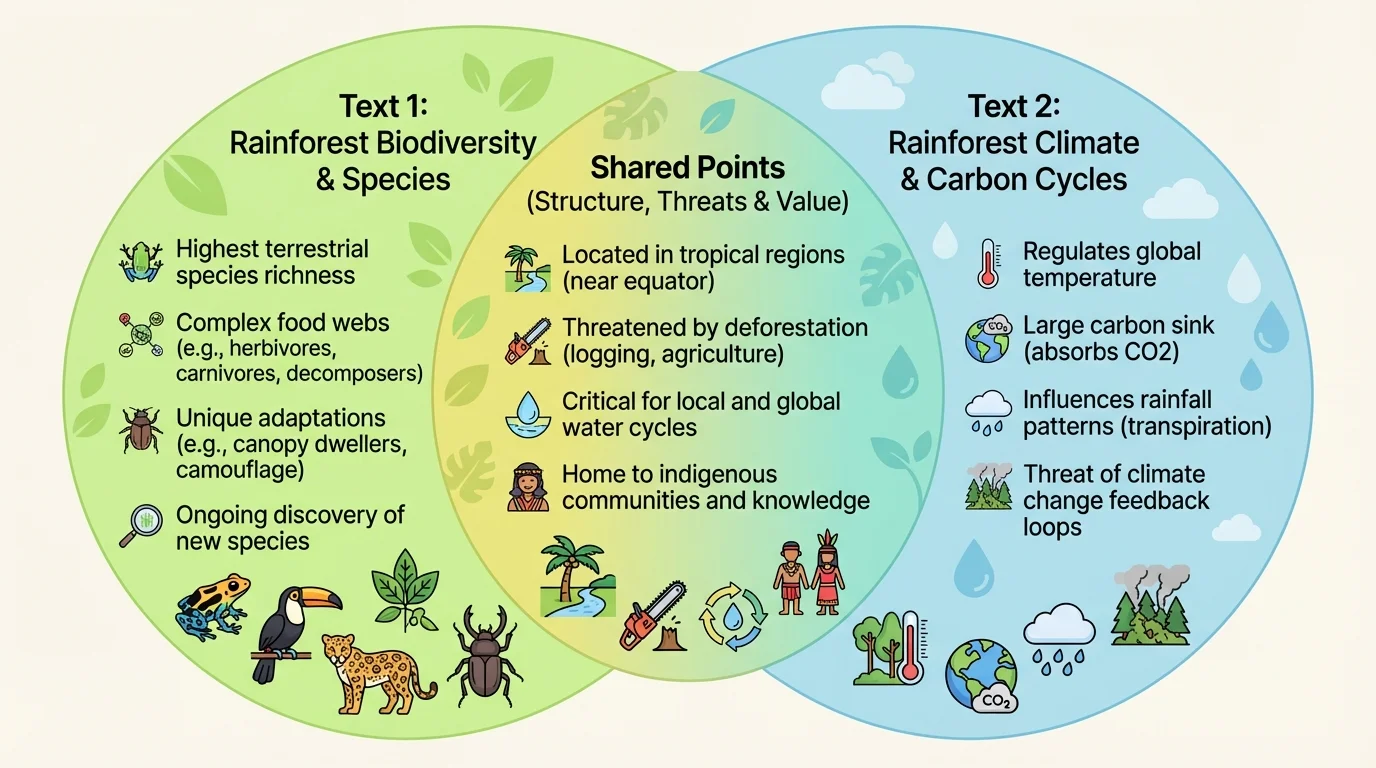
A chart is useful because it slows down your thinking in a good way. Instead of rushing, you stop and decide where each idea belongs. That helps you avoid mixing up the texts.
When using a chart, write short notes, not full sentences. For example, you might write "both explain pollen" or "Text B adds danger to bees." Short notes are easier to review later.
Example of chart notes
Suppose two texts are about rainforests.
Step 1: Find the shared topic
Both texts are about rainforests.
Step 2: Add details from Text A
Text A explains layers of the rainforest and animals living in each layer.
Step 3: Add details from Text B
Text B explains why rainforests are important to Earth and why they should be protected.
Step 4: Add shared ideas
Both texts explain that rainforests are full of living things and receive a lot of rain.
Now the comparison is organized and easy to explain.
Later, when you speak or write about the texts, the chart acts like a map of your thinking. You can return to the organizer in [Figure 1] and quickly see which ideas are shared and which are different.
Read these two short informational texts on the same topic. As [Figure 2] illustrates later, comparing them becomes easier when you identify the topic, main idea, and key details.
Text A: Bees are important insects because they help flowers grow. When a bee lands on a flower, pollen sticks to its body. Then the bee carries some pollen to another flower. This process helps plants make seeds, fruits, and new plants. Many foods people eat depend on pollination.
Text B: Bees need safe places to live. Gardens with many flowers give bees nectar and pollen for food. Some bees live in hives, while others live in the ground or in hollow stems. Without healthy places to live, bees may have trouble surviving.
These texts share a topic, but they do not have the same main idea. That is very common. When two texts are on the same topic, they may still teach different important points.
To compare these bee texts, start by finding the common topic and the most important point in each one. Both texts are about bees, but they shine a light on different parts of that topic.
Text A mainly explains how bees help plants through pollination. Its key details include pollen sticking to the bee's body, bees carrying pollen to other flowers, and pollination helping plants make seeds and fruit.
Text B mainly explains that bees need safe habitats and food sources. Its key details include gardens with flowers, different places where bees live, and the idea that bees may struggle if their habitats are unhealthy.
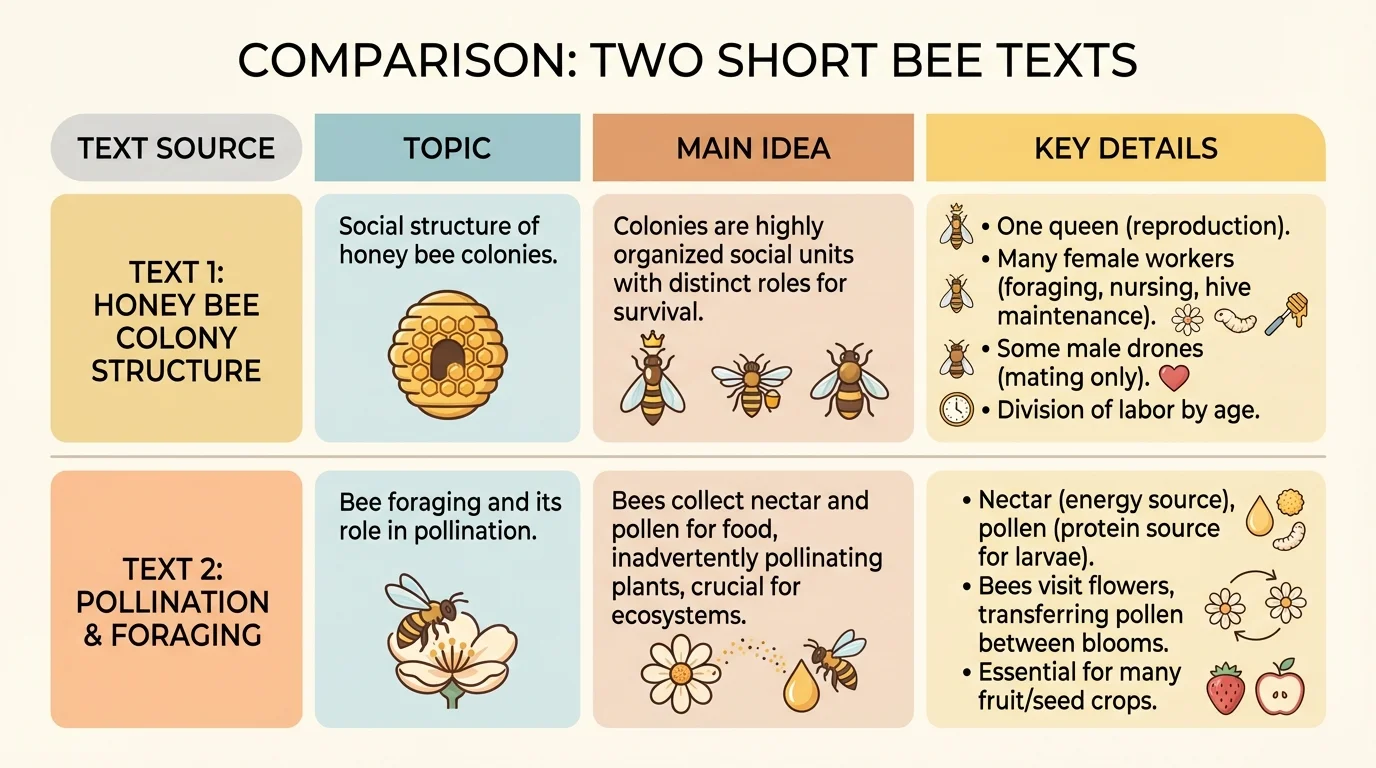
Now compare and contrast. The texts are alike because both are about bees and both teach that bees are important. The texts are different because Text A focuses on what bees do for plants, while Text B focuses on what bees need in order to live.
This is an important idea: two texts can both be true and useful even when they focus on different parts of the same topic. Looking back at the organizer in [Figure 2], you can see that the shared topic stays the same while the key details change from one text to the other.
Strong comparison statement
"Both texts are about bees. Text A explains how bees help plants by moving pollen from flower to flower. Text B explains that bees need flowers and safe places to live. Both texts show that bees are important, but they focus on different ideas."
Notice how that comparison includes the topic, an important point from each text, and at least one similarity and one difference. That is what makes it strong.
When you tell how two texts are alike and different, be clear and complete. You can use sentence starters to help organize your ideas.
Here are some useful frames: Both texts are about... Text A explains..., while Text B explains... One detail both texts include is... A difference is that... These frames help you connect your ideas smoothly.
A strong answer usually does three things. First, it names the shared topic. Second, it tells the important point of each text. Third, it explains similarities and differences using key details from the reading.
"Good readers do not just collect facts. They connect them."
If you only list random facts, your comparison may sound messy. If you only say, "They are the same" or "They are different," your answer is too weak. Use details from both texts so your explanation has proof.
One common mistake is retelling only one text. If the question asks you to compare two texts, you must talk about both. Another mistake is focusing on tiny details that are not very important.
A third mistake is confusing the topic with the main idea. For example, "bees" is a topic, but "bees help plants grow by pollination" is a main idea. Be sure you know the difference.
Some readers also think texts must match exactly if they are on the same topic. That is not true. In fact, differences are often what make the comparison interesting and useful.
Important differences versus small differences
When comparing texts, pay more attention to big differences in ideas and focus than to small differences such as one example, one photo, or one word choice. The goal is to understand what each text teaches most strongly.
If one article says frogs lay eggs in water and another article says frogs use wet places to survive, those ideas connect. The texts are not copies of each other, but they still belong to the same topic and can still be compared well.
Students use this skill in many subjects. In science, you may read one text about the life cycle of butterflies and another about their habitats. In social studies, you may read two texts about the same place but from different times. In health, you may read one text about exercise and another about healthy food.
Outside school, people compare information all the time. A family might read two articles before visiting a national park. One article may explain animals found there, while another explains safety rules and trails. Comparing both texts helps people make better choices.
When you compare two texts, you become a more careful reader. You learn to notice important ideas, sort details, and understand that information can be presented in different ways. That is a skill that helps in every subject and in everyday life.
