Have you ever heard two people read the same page out loud and noticed that one sounds smooth and interesting while the other sounds choppy or confused? The words on the page are the same, but the reading sounds very different. That difference is called fluent reading. When you read aloud with fluency, your voice helps the listener understand the meaning, and it also helps you understand what you are reading.
Reading aloud is more than saying words. Good readers match the print on the page to the meaning in their minds. They read clearly enough to say the right words, smoothly enough to keep the ideas together, and expressively enough to show what the author means. When readers do this, stories sound alive and poems sound musical.
Oral reading also supports comprehension. Comprehension means understanding what you read. If a reader stops too often, guesses many words, or reads in a flat voice with no attention to punctuation, understanding can break apart. But when reading becomes smoother and more natural, the brain can spend more energy thinking about characters, ideas, feelings, and information.
Fluency supports meaning. Fluency is not about reading as fast as possible. It is about reading in a way that sounds like language and helps the reader understand the text. A fluent reader pays attention to words, punctuation, and meaning all at the same time.
Fluent reading grows with practice. It grows when readers know common spelling patterns, recognize meaningful word parts, and notice how words relate to each other. It also grows when readers return to a text more than once and improve each time.
When readers work on fluency, they focus on three big parts: accuracy, rate, and expression. These parts work together, not separately.
[Figure 1] Accuracy means reading the words correctly. A reader looks carefully at the letters and word parts instead of guessing from only the first letter or from a picture. If the text says shimmering, the reader should not say shining, even though the meanings are close. Reading the exact word matters because small word changes can change the meaning.
Rate means reading at a speed that sounds natural. Appropriate rate is not super fast and not painfully slow. If reading is too fast, the meaning can get lost. If it is too slow, the ideas can feel broken into tiny pieces. Good rate helps a sentence stay together as one thought.
Expression means using your voice to match the meaning of the text. A reader changes tone, volume, and pacing based on punctuation and meaning. A question should sound like a question. Exciting dialogue might sound lively. A calm description might sound gentle and smooth.
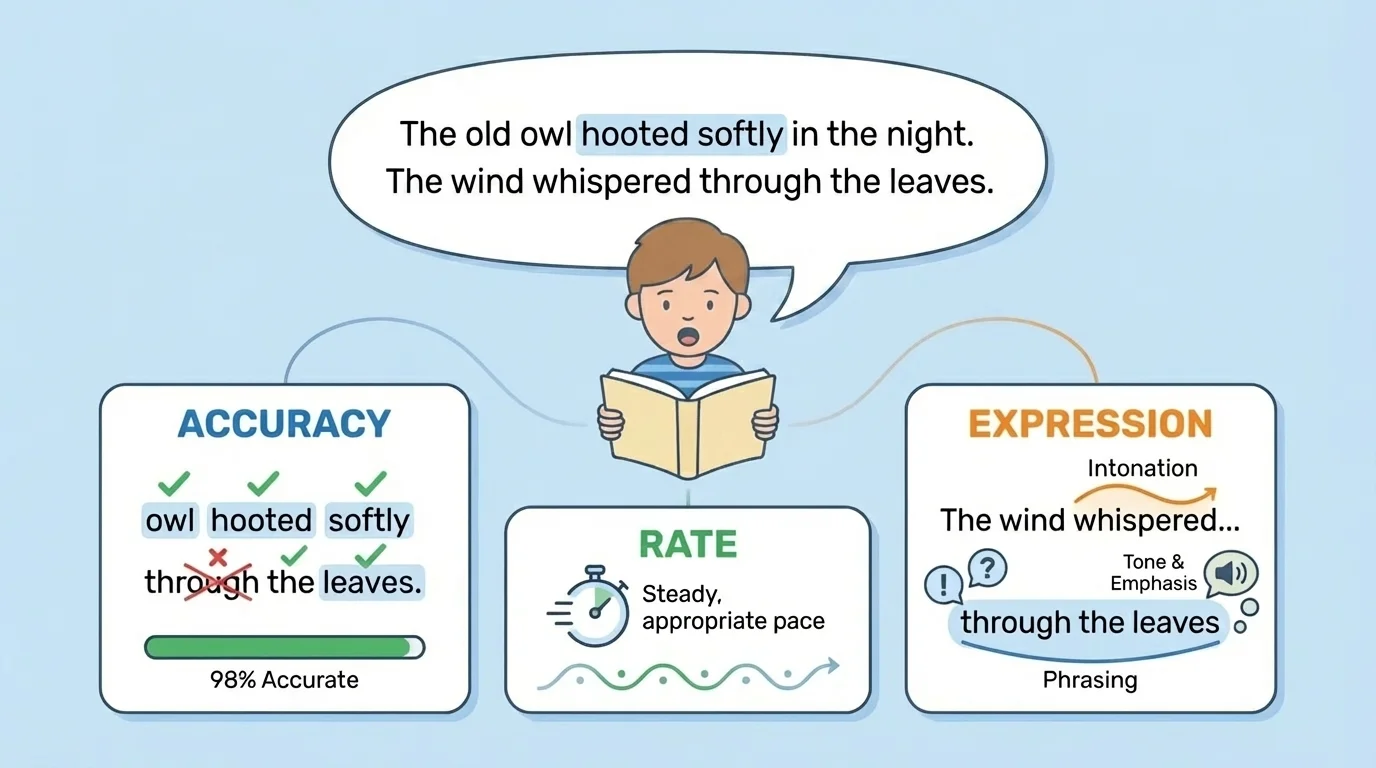
Think about this sentence: "Watch out! The ice is cracking!" If someone reads it in a flat, sleepy voice, the warning does not sound real. If someone reads it with strong expression and a quick, alert tone, the meaning becomes clear right away. Expression helps listeners hear what the author wants them to feel.
Fluency is reading accurately, at an appropriate rate, and with expression. Prose is writing in sentences and paragraphs, like stories or articles. Poetry is writing that often uses rhythm, line breaks, repeated sounds, and carefully chosen words.
These three parts depend on each other. A reader cannot have strong expression without knowing the words correctly. A reader cannot keep a good rate if too many words are hard to decode. That is why learning to look closely at words matters so much.
Sometimes a reader meets a word that is unfamiliar. Instead of stopping for a long time or guessing wildly, a strong reader uses clues inside the word. This is called decoding. Decoding means using letters, spelling patterns, and word parts to figure out a word.
Spelling patterns can help. If you know the pattern in light, you may read bright more easily. If you know train, then rain and brain may look more familiar. Noticing patterns like igh, ai, oa, and tion makes reading smoother.
Word parts can help too. A prefix comes at the beginning of a word, such as un- in unhappy. A suffix comes at the end, such as -ful in helpful. Knowing these parts can help a reader read and understand longer words. For example, if you know hope and the suffix -less, then hopeless becomes easier to read and understand.
Readers also use word relationships. If a sentence says, The tiny ant carried a crumb, the word tiny helps you understand that the ant is very small. Meaning clues from nearby words can support decoding and vocabulary, but they should be used together with looking closely at the letters.
Using word clues while reading aloud
A student sees the sentence: The playful puppy splashed in the puddle.
Step 1: Notice familiar parts.
The reader may know play and the suffix -ful, so playful becomes easier to read.
Step 2: Look for spelling patterns.
The words puppy and puddle both begin with pu-, but the endings are different, so the reader checks the whole word carefully.
Step 3: Read the full sentence smoothly.
Once the words are recognized, the reader can say the sentence with a lively tone because the puppy is doing something playful and fun.
When decoding becomes easier, oral reading becomes smoother. The reader spends less time getting stuck and more time paying attention to meaning.
Prose usually moves through sentences and paragraphs, and punctuation guides how the voice should sound, as [Figure 2] illustrates. In prose, readers try to make their voice sound like natural speech while still paying attention to the author's exact words.
Punctuation matters a lot. A period tells the reader to stop at the end of a complete thought. A comma often signals a short pause. A question mark changes the voice so it sounds like a question. An exclamation mark can signal strong feeling. Quotation marks show dialogue, which means someone is speaking.
Listen to the difference in these two sentences: "We won the game." and "We won the game?" The words are almost the same, but the punctuation changes how the voice should sound. A fluent reader notices that right away.
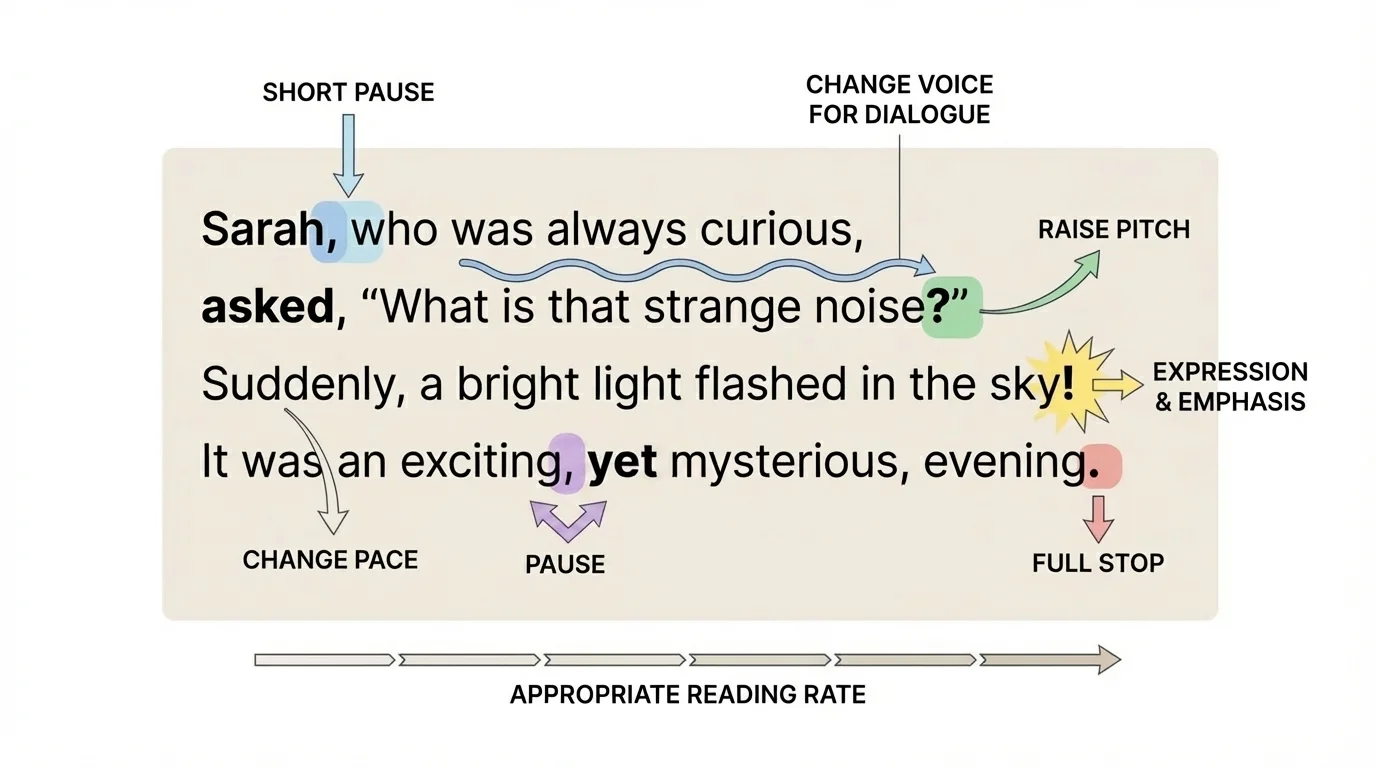
Readers of prose also group words into meaningful phrases. Instead of reading one word at a time, they keep related words together. For example, in the sentence The small brown rabbit dashed under the fence, a fluent reader may naturally group it as The small brown rabbit and dashed under the fence. This keeps the meaning clear.
Dialogue in prose often calls for expression. If a character whispers, the voice may soften. If a character shouts, the voice may become stronger. If a character is worried, the tone may sound tense. This does not mean acting wildly. It means reading in a way that matches the text.
Informational prose also needs expression, but in a different way. A nonfiction passage about volcanoes may not have characters speaking, yet a fluent reader still uses clear phrasing and attention to important words. The voice may sound steady, clear, and interested rather than flat.
Later, when you think again about punctuation and phrase groups, [Figure 2] remains useful because it connects marks on the page to pauses, voice changes, and smooth sentence flow.
[Figure 3] Poetry often sounds different from prose because line breaks, repeated sounds, and rhythm help guide the reader's voice. A poem may be quiet and thoughtful, playful and bouncy, or strong and dramatic.
In poetry, the end of a line is not always the end of a sentence. A reader has to look carefully at punctuation and meaning. Sometimes the voice pauses slightly at a line break. Sometimes it keeps moving because the thought continues onto the next line. This is one reason poetry asks readers to pay close attention.
Poetry often includes rhythm, which is the beat or flow of the words. Some poems sound almost like music. Repeated words, rhyming words, and patterns of stressed syllables can shape how a poem is read aloud.
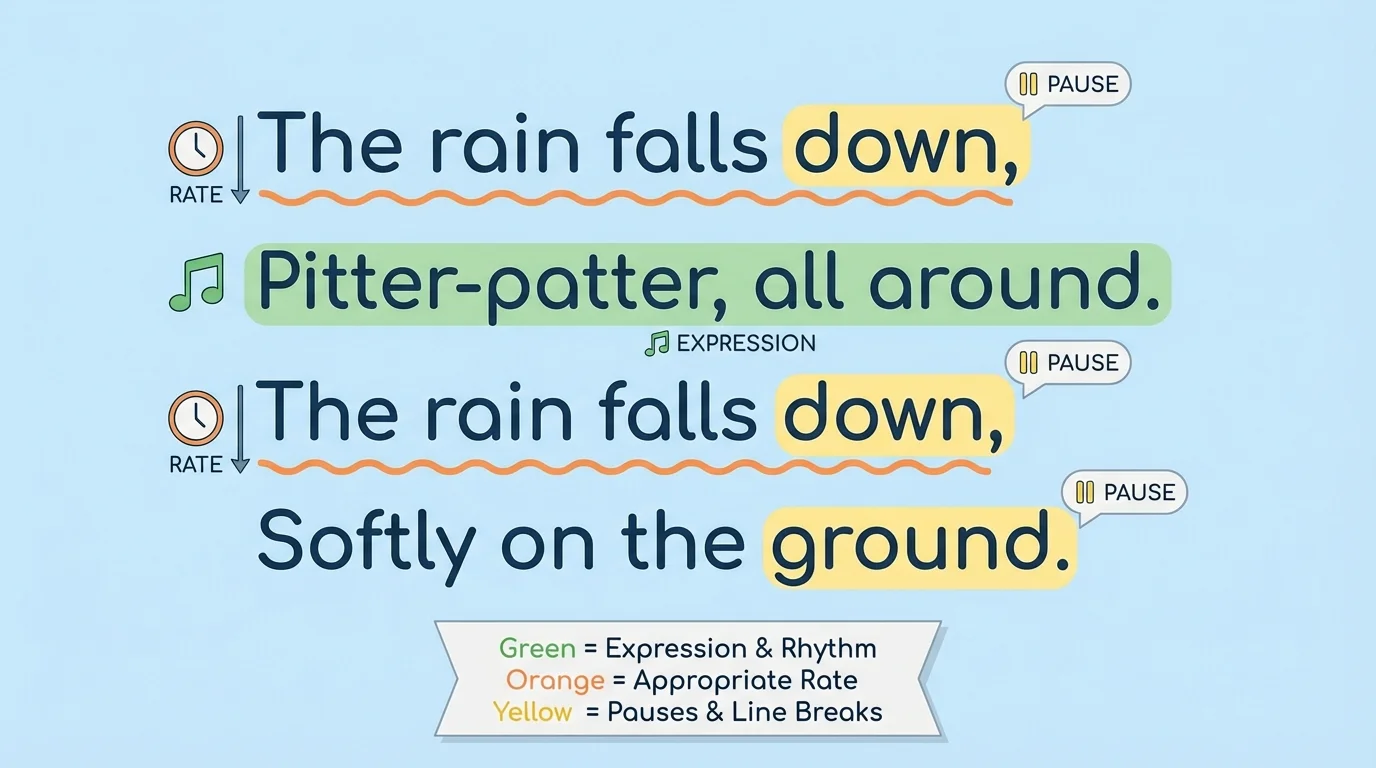
Consider these lines: Drip, drop, drip, drop, / rain taps on the tree. A reader might use a soft, steady voice to match the gentle rain. The repeated words drip, drop create a sound pattern that helps the poem come alive.
Poetry also uses strong images and feelings. If a poem describes a dark, windy night, the voice may sound slower and more serious. If a poem celebrates sunshine and running through grass, the voice may sound brighter and quicker. Expression in poetry should fit the mood.
Some poems are meant to be heard as much as they are read silently. Sound patterns such as rhyme, repetition, and rhythm can help listeners remember the words.
Poetry does not always have to be read slowly. Some poems are energetic and quick. Others are calm and thoughtful. The best choice depends on the poem's meaning. Looking back at [Figure 3], you can see how line breaks and repeated words help shape that choice.
One of the strongest ways to improve fluency is through successive readings. This means reading the same text more than once. The first reading helps the reader get familiar with the words and ideas. The second and third readings often become smoother, more accurate, and more expressive.
[Figure 4] On a first reading, a student may hesitate over a few words or read in a careful but uneven way. On the next reading, some of those hard words feel easier. The reader begins to notice phrasing, punctuation, and mood. By another reading, the voice often sounds more natural because the brain is not working as hard just to figure out each word.
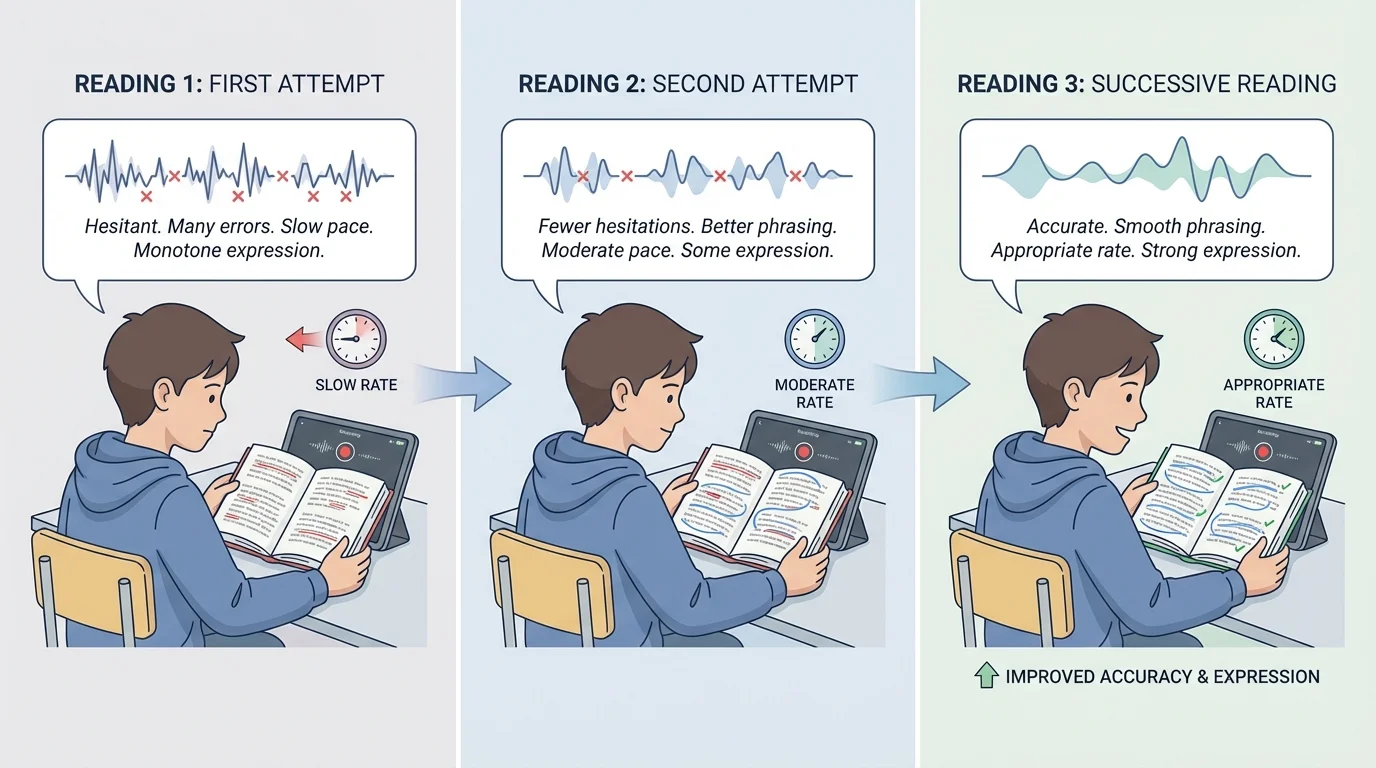
This does not mean readers should memorize the text and race through it. The goal is not to perform without thinking. The goal is to become so comfortable with the words that the meaning can shine through the voice.
Successive readings are helpful for both prose and poetry. In prose, rereading helps a student notice sentence flow, punctuation, and character voice. In poetry, rereading helps the reader hear rhythm, repeated sounds, and emotional tone. The growth from one reading to the next is exactly what [Figure 4] makes clear.
How rereading improves a passage
A student reads: The wind swept across the lake, and the little boat rocked from side to side.
Step 1: First reading.
The student may pause at swept and read the whole sentence slowly.
Step 2: Second reading.
The student recognizes all the words more quickly and groups across the lake and from side to side into meaningful phrases.
Step 3: Third reading.
The student adds expression, making the sentence sound breezy and a little uneasy, which matches the rocking boat.
Each rereading can build confidence. Confidence matters because nervous readers often rush or freeze. When readers feel prepared, they can focus on meaning and voice.
Strong readers pay attention to how they sound. They notice when something does not make sense, when a sentence sounds too flat, or when a guessed word does not match the letters on the page. This kind of self-checking is important because it helps readers fix mistakes on their own.
If you read a sentence and it sounds strange, stop and look again. Ask: Did I read that word correctly? Did I pay attention to the ending? Does my voice match the punctuation? Does this part make sense? These questions help readers become more independent.
You may already know that punctuation marks help organize writing. That knowledge also supports oral reading. Punctuation does not only help with writing sentences; it also tells the reader where to pause, stop, or change tone.
Sometimes a reader says a word that looks similar but is not the same. For example, reading jumped instead of jumping changes both the sound and the meaning. Listening closely helps the reader catch that difference.
Readers can also notice whether their voice matches the text type. A quiet poem about snow should not sound exactly like an exciting scene in an adventure story. Matching voice to meaning is part of mature fluency.
Fluency grows little by little. Readers improve when they practice with texts that are on their level, not far too hard and not too easy. On-level reading gives enough challenge to build skill while still allowing understanding.
Good habits include looking carefully at whole words, noticing spelling patterns, paying attention to prefixes and suffixes, using punctuation, and rereading to improve. Readers also benefit from hearing strong models of oral reading from teachers and classmates because fluent reading has a sound as well as a look.
Fluency is not the same as speed. A person who races through a page with many mistakes is not fluent. A person who reads every word correctly but in a slow, word-by-word robot voice is also not yet fluent. Fluency means accuracy, appropriate rate, and expression working together.
| Part of fluent reading | What it means | What it sounds like |
|---|---|---|
| Accuracy | Reading the correct words | Few mistakes, careful attention to letters and word parts |
| Rate | Reading at a natural speed | Not too fast, not too slow |
| Expression | Using voice to show meaning | Pauses, tone, and feeling that fit the text |
Table 1. The three main parts of fluent oral reading and how each part sounds.
When these parts come together, reading aloud becomes more powerful. Stories sound clearer. Poems sound richer. Most important, understanding grows stronger because the reader is no longer trapped at the level of individual words.
"Read the words, hear the meaning, and let your voice carry the message."
Fluent readers are not born that way. They become fluent by learning how words work, practicing with care, and returning to a text until it sounds right and makes sense. That is why successive readings are so valuable: each time through, the text becomes more familiar, and the meaning becomes easier to express.
