Have you ever asked someone a question and gotten an answer that was just too short? If you ask, "What is a turtle?" and someone says, "An animal," that answer is true, but it does not tell you enough. Good informative writing does more than name a topic. It explains the topic so the reader can understand it better.
When writers develop a topic, they add useful information. They tell what something is, share true facts, and include clear details. This helps the reader learn. Strong writing is like turning on more lights in a room. The clearer the facts and details you add, the easier it is for the reader to understand your idea.
To develop a topic means to explain it fully enough that your reader learns something important. You begin with one main idea. Then you build that idea with information that fits. Instead of writing only one sentence, you add more sentences that teach the reader about the topic.
Develop a topic means to grow one main idea by adding facts, definitions, examples, and details that help the reader understand.
Informative writing is writing that teaches or explains. It gives information clearly and truthfully.
A topic can be about an animal, a place, a person, an object, or an event. No matter what the topic is, the writer should help the reader answer questions such as: What is it? What is it like? How does it work? Why is it important?
For example, if your topic is frogs, you would not stop after saying, "Frogs are animals." You could explain that frogs are amphibians, that they begin life in water, that many frogs have strong back legs for jumping, and that they catch food with their sticky tongues. Now the reader learns much more.
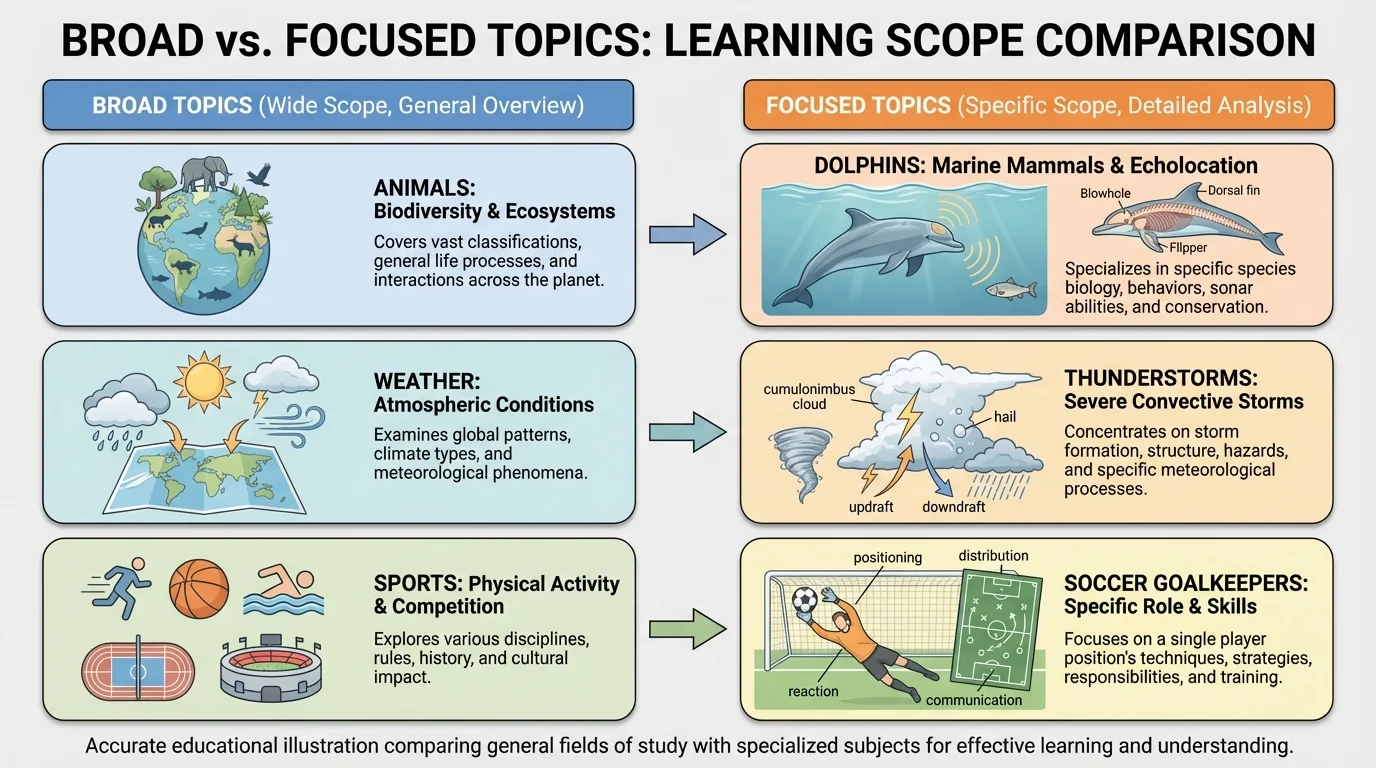
A good piece of writing begins with a clear main idea. Focused topics are easier to explain well, as [Figure 1] shows. If the topic is too big, the writing may become confusing because there is too much to cover.
Look at the difference between broad topics and focused topics. A broad topic might be "animals." That is huge. A focused topic might be "how dolphins communicate" or "why beavers build dams." A focused topic gives the writer a better chance to explain one idea clearly.
A strong beginning often includes a topic sentence. This is a sentence that tells what the paragraph or piece will be about. It points the reader in the right direction.
Here is an example of a clear topic sentence: Sea turtles are amazing reptiles that can live in the ocean for many years. This sentence names the topic and gives the reader the main idea.
Here is a weaker beginning: I like turtles. That sentence shares an opinion, but it does not explain much. Informative writing needs a topic that can be taught with facts and details.
Sometimes readers need help understanding an important word. A definition tells what a word or idea means.
Definitions are especially useful when your topic includes special words. If you are writing about camouflage, your reader might not know that word. You can explain it in a simple way: Camouflage is coloring or patterns that help an animal blend in with its surroundings.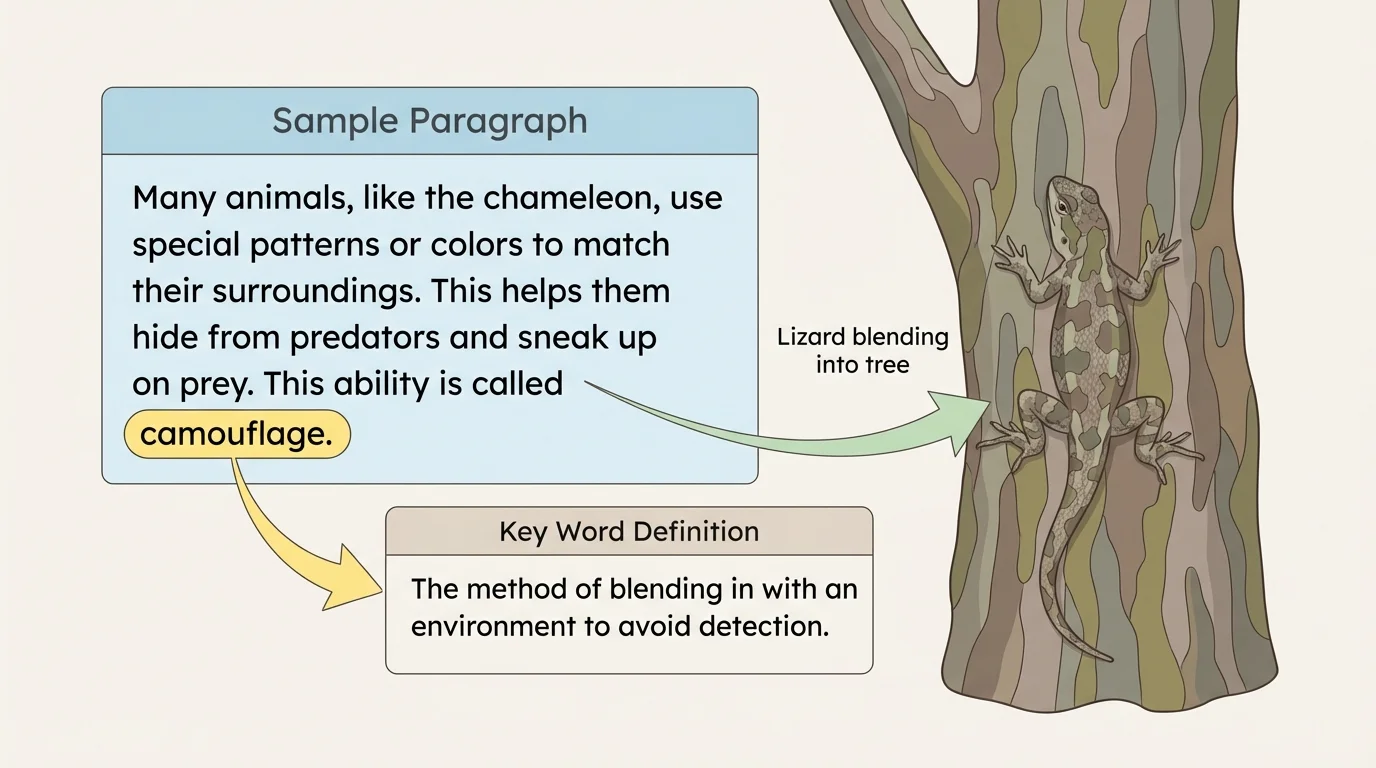
Definitions should be clear and easy to understand. They should use simple words whenever possible. A definition is not meant to sound fancy. It is meant to help the reader learn.
Here is another example: An herbivore is an animal that eats plants. After that sentence, the writer can talk about rabbits, deer, or cows. The definition opens the door for more information.
Some octopuses can change both color and texture to help them blend in. That makes camouflage a powerful survival tool in the ocean.
When you include a definition, make sure it truly matters. Not every word needs to be defined. Choose words that are important to the topic or may be new to your reader.
Facts are statements that are true and can be checked. They are one of the best tools for informative writing. Facts help readers trust what they are reading because the information is real, not made up.
If you are writing about the sun, you might say that the sun is a star. That is a fact. If you are writing about penguins, you might say that penguins are birds, even though they cannot fly. That is also a fact.
Facts answer questions. They can tell what, where, when, how, or why. For example, if your topic is honeybees, you might include facts like these: honeybees live in colonies, they make honey from nectar, and they help pollinate flowers.
Good facts are specific. Compare these two sentences: Sharks are interesting. That is too general. Some sharks can detect movement in the water very well. That second sentence gives actual information.
Writers should choose facts that match the topic sentence. If your paragraph is about how polar bears stay warm, facts about their thick fur and body fat belong in the paragraph. A sentence about what another animal eats may not belong unless it connects clearly.
A detail is a small piece of information that helps explain more. Details make writing vivid and clear. They help the reader picture, understand, and remember the topic.
Details can describe size, color, shape, sound, behavior, or parts. If you are writing about a volcano, you might explain that hot melted rock called lava can flow from an opening in Earth's surface. If you are writing about a guitar, you might mention strings, the wooden body, and the sounds it can make.
Examples are also details. Suppose your topic is birds' beaks. You could explain that hummingbirds have long, thin beaks for drinking nectar, while eagles have strong, curved beaks for tearing food. Those examples help the reader understand the big idea.
Facts and details work together. A fact gives true information. A detail adds more explanation so the reader can understand that fact better. Strong informative writing often uses both. For example, the fact might be that kangaroos carry their babies in a pouch. The detail might explain that the baby, called a joey, stays there while it grows.
Without details, writing can feel empty. Read this sentence: A cheetah is fast. Now read this one: A cheetah has a slim body, long legs, and a flexible spine that help it run very quickly. The second sentence teaches more because it includes details.
Details should be useful, not random. If your topic is how seeds grow, details about soil, water, sunlight, and roots fit well. A sentence about your favorite movie does not fit, even if it is interesting.
Organized writing helps readers follow your thinking from beginning to end, and [Figure 3] shows a simple way to arrange ideas. When ideas are organized, each sentence has a job.
Many informative paragraphs have three parts. First comes the topic sentence. Next come the facts, definitions, and details that explain the topic. Last comes the ending, which reminds the reader of the main idea.
You can think of your writing as building a sandwich. The top slice is the beginning. The middle holds the important information. The bottom slice is the conclusion that holds everything together.
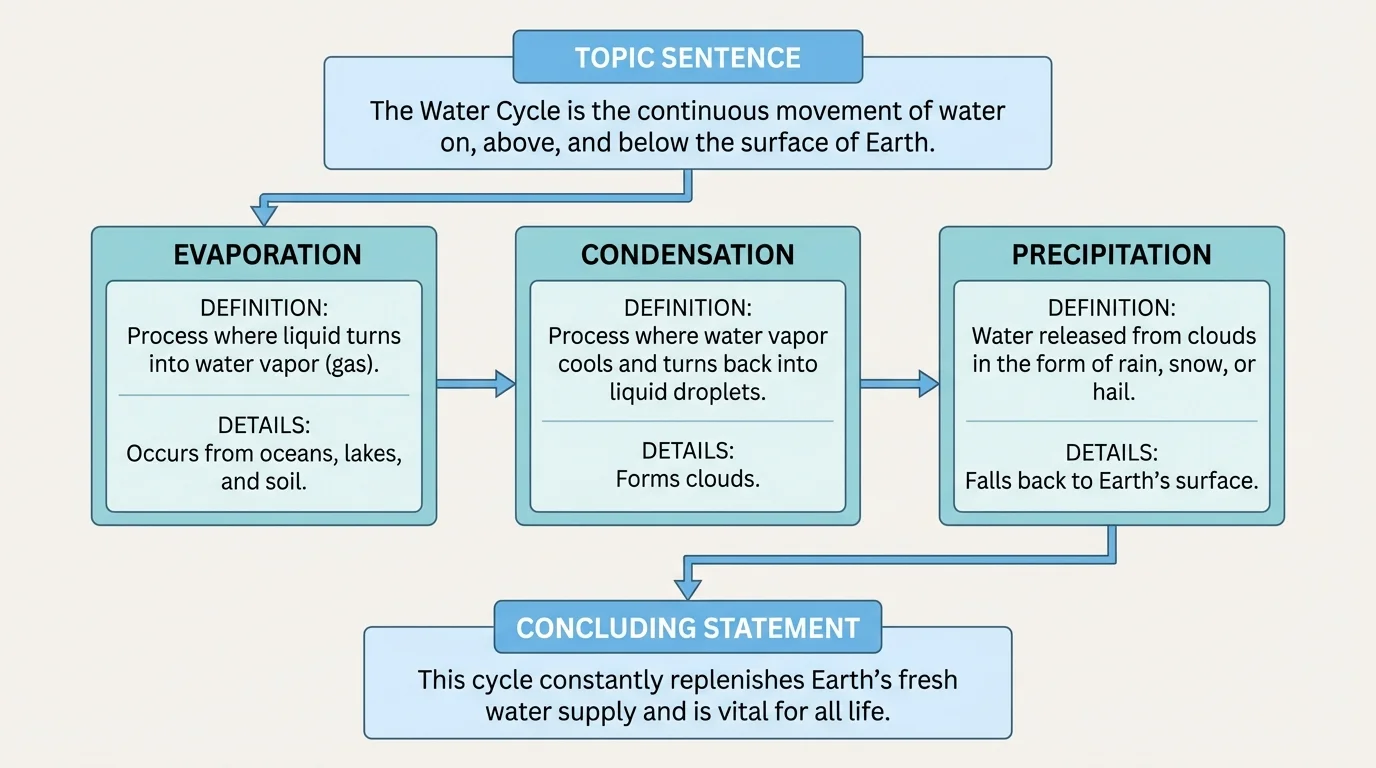
Writers also organize by grouping similar ideas together. If you are writing about dolphins, you might put one group of sentences about how they breathe, another about how they communicate, and another about how they live in groups. This keeps the writing from jumping around.
Transitions can help ideas connect. Words such as also, for example, another, and because help the reader move smoothly from one idea to the next. Later, when you plan your own writing, this pattern can help you check that every part is in the right place.
Staying on topic is a big part of organization. Every fact and every detail should support the main idea. If a sentence does not help explain the topic, it probably does not belong.
A good informative paragraph should not simply stop. It ends with a concluding statement. This is a sentence that wraps up the writing and connects back to the topic.
A concluding statement can remind the reader why the topic matters. If the paragraph is about rain forests, the ending might say: These features make rain forests some of the most important habitats on Earth.
If the paragraph is about bicycles, the ending might be: Because they are useful, healthy, and fun, bicycles are an important way for many people to travel. This sentence does not add a brand-new topic. Instead, it gives the writing a finished feeling.
A weak ending might suddenly change the subject or repeat the exact first sentence. A strong ending sounds connected and complete.
Readers understand writing best when it has a clear beginning, a middle filled with related information, and an ending that ties the ideas together.
As with the rest of the paragraph, the concluding statement should stay focused on the same main idea. It is the last chance to leave the reader with a clear understanding.
Now let's look at how all the parts work together in one paragraph. Notice the topic sentence, the definition, the facts, the details, and the concluding statement.
Example paragraph about coral reefs
Coral reefs are busy ocean habitats filled with many kinds of living things. A habitat is a place where plants and animals live. Coral reefs form in warm, shallow water, and they provide shelter for fish, crabs, and sea turtles. Tiny animals called coral polyps build the reef over time. Reefs are important because they protect shorelines from strong waves and give sea animals places to hide and find food. For these reasons, coral reefs are valuable parts of the ocean world.
This paragraph begins by naming the topic: coral reefs. Then it defines habitat. After that, it gives facts, such as where reefs form and what animals live there. It also gives details about coral polyps and why reefs are important. The last sentence is a concluding statement.
Notice that every sentence fits the topic. The writer does not suddenly start talking about mountain lions or snowstorms. All of the information works together.
One common mistake is using information that is too general. For example, Bears are nice animals does not teach much. A better sentence would be Black bears use their strong sense of smell to find food in forests.
Another mistake is adding details that do not match the topic. If the paragraph is about how plants grow, a sentence about a soccer game does not belong. Writers need to ask, "Does this fact help explain my main idea?"
Some writers repeat the same idea again and again. Repeating can make writing dull. Instead of saying that an owl is quiet in three different ways, add new facts and details, such as how its feathers help it fly silently or how its eyes help it hunt at night.
Another mistake is forgetting the conclusion. When a paragraph ends too suddenly, the writing may feel unfinished. A concluding statement helps the writing sound complete and thoughtful.
Writers also need to make sure their facts are accurate. In informative writing, truth matters. If a writer is not sure about a fact, it is better to check before using it.
| Part of Writing | What It Does | Example |
|---|---|---|
| Topic sentence | Names the main idea | Frogs have body parts that help them live well in wet places. |
| Definition | Explains an important word | An amphibian is an animal that can live part of its life in water and part on land. |
| Fact | Gives true information | Frogs begin life as tadpoles. |
| Detail | Adds description or an example | Many frogs have webbed feet that help them swim. |
| Concluding statement | Ends the writing clearly | These features help frogs survive in their habitats. |
Table 1. The table shows the main parts of informative writing and how each part helps develop a topic.
When you read strong nonfiction books, articles, or reports, you can often spot these same parts. Writers teach by choosing one topic, staying focused, and building understanding sentence by sentence.
That is what makes informative writing powerful. It helps readers learn something new in a clear and organized way.
