Have you ever learned something so interesting that you wanted to tell other people right away? That is what researchers do. They discover information, sort it carefully, and then share it so others can learn too. When you present a brief report, you are not just talking. You are teaching your audience what you found out.
A short research project often begins with a question such as, "How do bees help plants?" or "Why do some animals sleep during the day?" After reading, observing, or gathering facts, the next job is to explain the research findings clearly. A good report helps listeners understand the most important ideas without confusing or overwhelming them.
People share research in school, at work, and in everyday life. A weather reporter shares findings about storms. A scientist shares findings about animals or space. Even a student shares findings after learning about a topic. A report lets other people learn from your work.
When you speak to an audience, your goal is not to say everything you found. Your goal is to say the most important information in a way others can follow. That means choosing facts carefully, putting them in order, and speaking clearly.
Audience means the people who are listening to your report. Evidence is the facts, details, examples, or observations that support what you say. Conclusion is the ending part that tells what your research shows or what you learned overall.
Knowing your audience matters. If you are speaking to classmates, you can use simple words and examples they know. If you use very hard words without explaining them, your audience may miss the meaning. Good speakers think about what listeners need to understand.
A finding is something you learned from your research. It is not just a guess. It comes from facts you gathered from books, articles, videos, observations, or interviews. For example, if you researched frogs, one finding might be that frogs begin life as tadpoles and change as they grow.
Some findings are single facts, but others are ideas that connect several facts. If you studied recycling, you might find that recycling helps reduce waste, saves some materials, and can protect natural resources. Those ideas come from several pieces of evidence working together.
When you report findings, it helps to separate important facts from extra details. If your report is brief, you cannot include every fact. You choose the strongest information that best answers your research question.
Good research comes before good speaking. First, gather information carefully. Next, check that your facts make sense. Then you are ready to share what you learned.
You should also be careful to say facts accurately. If your source says most honeybees live in groups, you should not change that into "all bees live exactly the same way." A good presenter tells what the evidence really shows.
A strong report has parts that fit together in a clear order, as [Figure 1] shows. Even a short presentation usually has a beginning, a middle, and an ending. This structure helps your audience stay with you from the first sentence to the last.
The beginning introduces the topic and may include the main question. For example, you might say, "My topic is sea turtles, and my question was how sea turtles stay safe in the ocean." This opening tells the audience exactly what they are about to hear.
The middle presents the main findings. This is where you share the most useful facts and examples. The ending gives the conclusion and often reminds the audience why the topic matters. A strong ending sounds finished, not sudden.
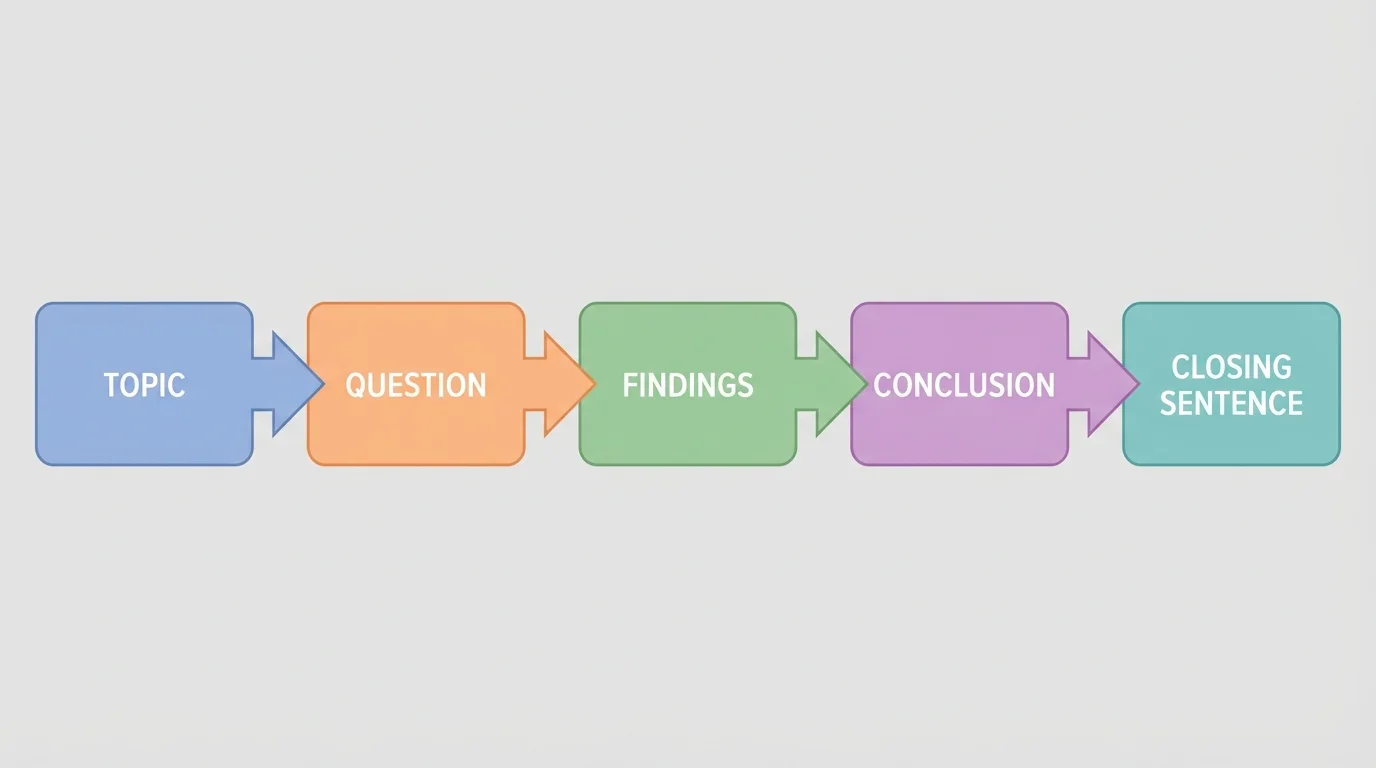
Many student reports follow a simple pattern:
| Part of the report | What it does | Example |
|---|---|---|
| Opening | Names the topic | "I researched penguins." |
| Question | Tells what you wanted to learn | "I wanted to know how penguins stay warm." |
| Findings | Shares the main facts | "They have thick feathers and body fat." |
| Conclusion | Tells what the facts show | "These features help penguins live in cold places." |
| Closing | Ends politely and clearly | "Thank you for listening." |
Table 1. Main parts of a brief research report and what each part does.
Notice that each part has a job. If you skip the opening, the audience may not know your topic. If you skip the conclusion, the report may feel unfinished. That clear order, shown in [Figure 1], makes your ideas easier to understand.
After finding facts, the next step is organizing your information. Organizing means putting ideas in an order that makes sense. You can group facts by time, by type, or by importance.
For example, if your topic is butterflies, you might organize by life stages: egg, caterpillar, chrysalis, and butterfly. If your topic is community helpers, you might organize by jobs, such as firefighters, doctors, and teachers. The best order depends on your topic and your question.
Try to keep your report focused. If your question is about how polar bears survive in the Arctic, your audience mostly needs facts about fur, fat, paws, and hunting. They do not need lots of extra facts about every animal in the Arctic. Staying on topic helps listeners remember the main ideas.
Clear organization helps understanding
Listeners cannot reread your speech the way they can reread a book page. They hear your words once, in order. That is why a report should move smoothly from one idea to the next. Clear transitions such as "First," "Another finding is," and "In conclusion" help the audience follow your thinking.
It also helps to choose only a few strong details. A brief report might include about three main findings. That is often enough for a short presentation. Too many facts can make the report sound crowded.
Presenters often use visuals to help the audience understand, as [Figure 2] illustrates. A visual might be a drawing, a labeled picture, a simple chart, or a small poster. Good visuals match the report and support the main ideas.
Notes are helpful too, but notes should be short. Instead of writing every sentence, write key words or short phrases. That way, you can look down quickly and then keep speaking to the audience. If you read every word from a paper, your voice may sound flat and your eyes may stay down too long.
Suppose your topic is "How plants grow." A note card might say: sunlight, water, soil, roots. A small chart might show the parts of a plant. Those tools remind you what to say and help listeners picture your ideas.
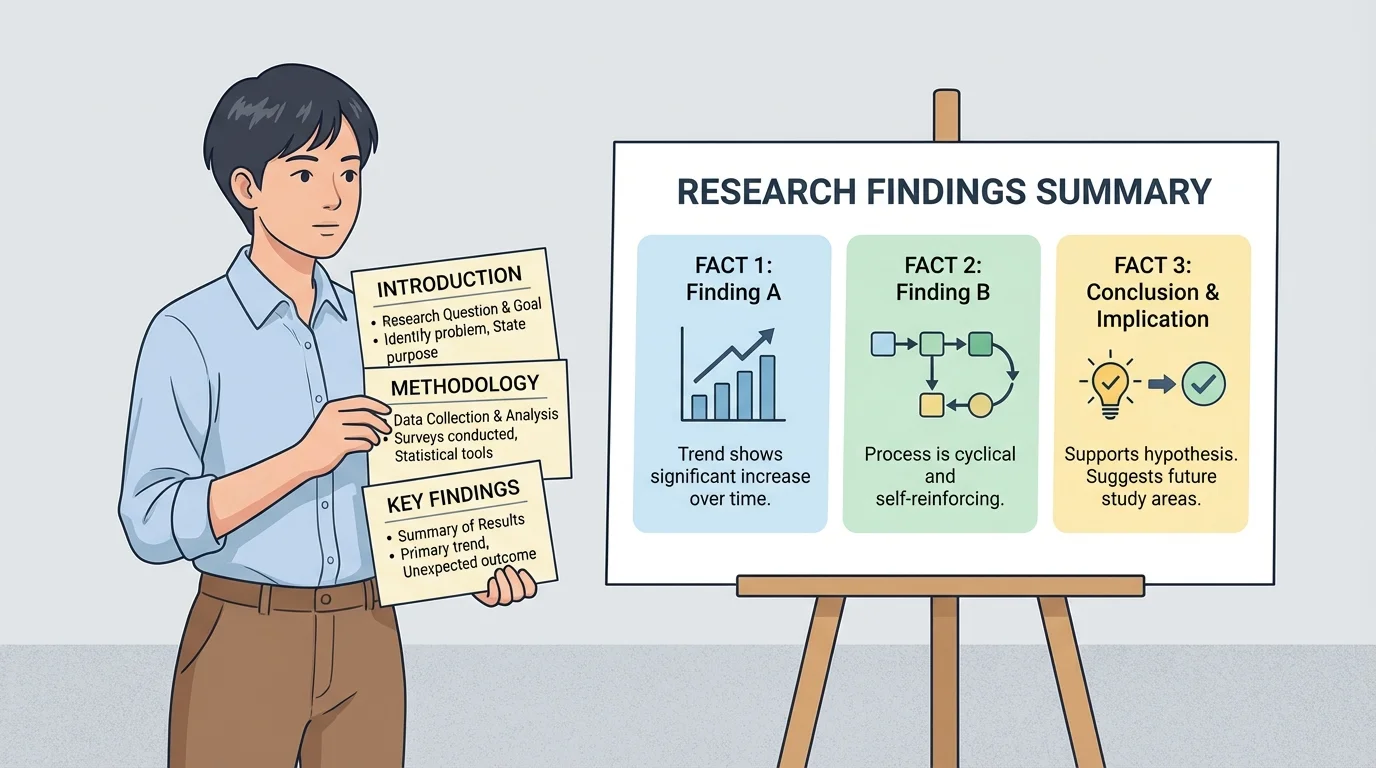
A visual should be easy to understand quickly. If it is crowded with too many words, the audience may stop listening while trying to read everything. A simple visual works better than a busy one. The example in [Figure 2] shows how short notes and a clear poster can support a speaker without taking over the whole report.
Many skilled speakers use notes with only a few words on each card. Short notes help them sound natural because they talk to the audience instead of reading at the audience.
When you use a visual, explain it. Do not just hold it up. You might say, "This picture shows the parts of a plant. The roots take in water, and the leaves help the plant use sunlight." That way, the visual and your words work together.
Your speaking style matters just as much as your facts. Good presenters use a clear voice, look at the audience, and stand in a steady way, as [Figure 3] shows. These speaking skills help listeners pay attention and trust that you are prepared.
Speak loudly enough for the whole room to hear, but do not shout. Say words clearly. If you rush, your audience may miss important information. If you speak too slowly, listeners may lose focus. A calm, steady pace is best.
Eye contact means looking at the audience while you speak. You do not need to stare at one person. Instead, look around the room at different listeners. This makes your report feel friendly and confident.
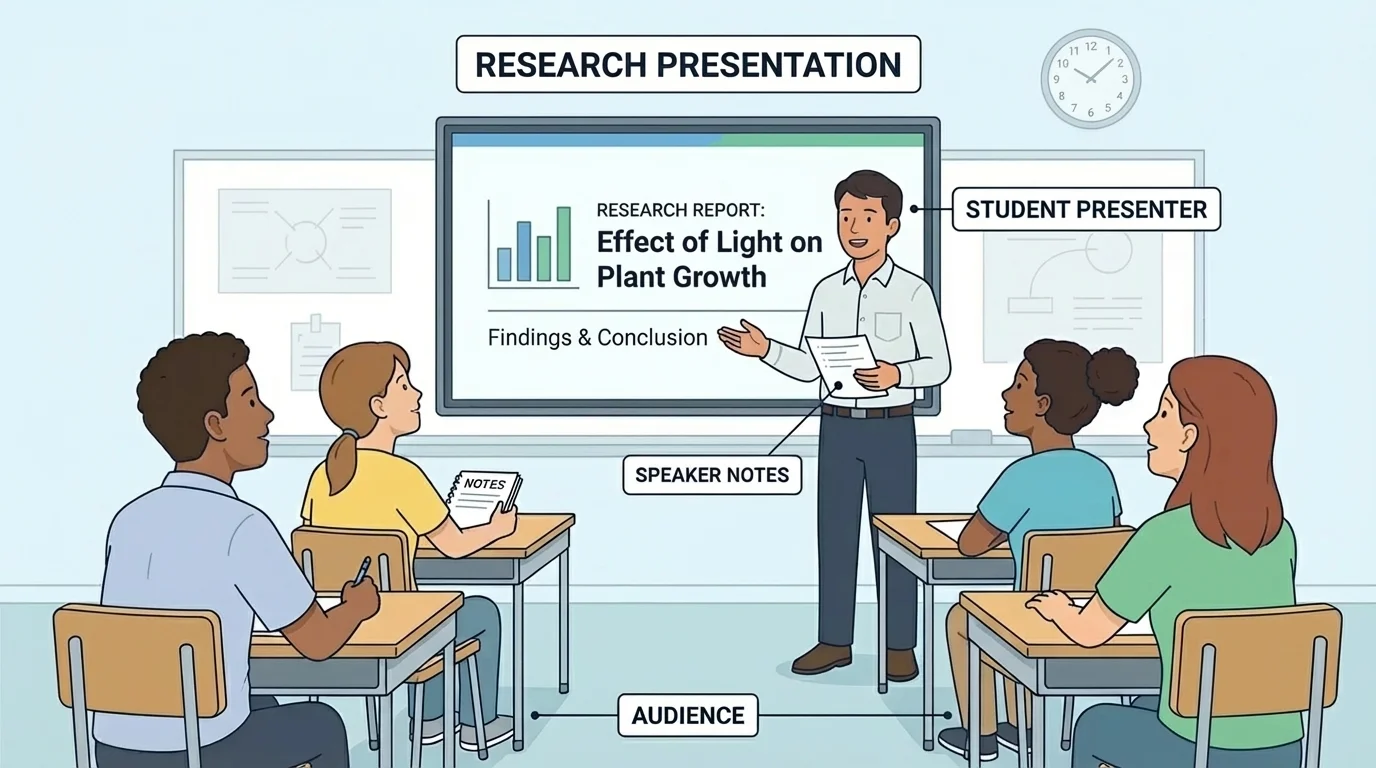
Your posture matters too. Stand up straight, hold your notes low enough so your face can be seen, and keep your body fairly still. Small hand motions can help, but too much movement can distract from your words.
Expressions in your voice can show interest. If you sound excited about what you learned, the audience often becomes more interested too. The speaker in [Figure 3] appears prepared because posture, facial expression, and speaking stance all support the message.
Sample opening lines for a report
Here is one way a student might begin a short presentation about bats.
Step 1: State the topic
"My topic is bats."
Step 2: State the question
"I wanted to learn how bats find food in the dark."
Step 3: Share the first finding
"One finding is that many bats use sound to help them know where things are."
This opening is clear because the audience quickly learns the topic, the question, and the first important fact.
Clear speaking also means using words your audience understands. If your report includes a hard word like echolocation, explain it in simple language. You might say, "Echolocation means using sound waves and echoes to find things."
Many presentations end with questions from the audience. This is part of communication too. A good speaker listens carefully, waits for the person to finish, and then answers politely.
If you know the answer, explain it simply. If you are not sure, it is honest to say, "I am not certain, but I learned..." or "I would need to research that more." You do not need to pretend to know everything. Honest answers show responsibility.
Questions can also help you see which parts of your report were interesting or unclear. If several listeners ask about the same idea, that may mean the topic is important or that it needs clearer explanation next time.
"A speaker's job is not just to talk. It is to help others understand."
Good listeners in the audience also have a job. They pay attention, think about what they hear, and ask respectful questions. Presenting and listening are both parts of sharing research.
Here is a full example of a brief report about bees. Notice how the speaker introduces the topic, shares a few main findings, and ends with a clear conclusion.
"My topic is bees. My question was how bees help plants. I found that bees move pollen from flower to flower while collecting nectar. I also learned that this helps many plants make seeds and fruit. Another finding is that bees are important for gardens and farms. In conclusion, bees help many plants grow and reproduce, so they are an important part of nature. Thank you for listening."
Why this report works
Step 1: It names the topic and question.
The audience knows right away what the report is about.
Step 2: It gives a few important findings.
The speaker includes only strong facts, not too many extra details.
Step 3: It ends with a conclusion.
The ending explains why the facts matter.
This kind of short report is easy for listeners to follow from beginning to end.
If this speaker used a flower diagram or a picture of a bee on a plant, the audience might understand even more clearly. A simple visual, like the kind introduced in [Figure 2], can strengthen a report when it matches the main facts.
One common mistake is including too many facts. When that happens, the audience may forget the main point. The fix is to choose the three or four strongest ideas and leave out extra information.
Another mistake is reading every word. That can make a speaker sound less natural. Short notes help instead. Look at your notes, then look back at the audience. This keeps the report feeling like real communication.
Some speakers talk too softly or too fast. Others forget to explain hard words. Still others end suddenly without a conclusion. These are easy to improve when you remember the report structure from [Figure 1] and the speaking habits shown in [Figure 3].
Finally, some students worry that a report must sound perfect. It does not need to be perfect. It needs to be clear, truthful, and organized. When you know your topic well and share your findings carefully, your audience can learn from you.
