Some pieces of writing take only a few minutes, while others can take days or even weeks. A thank-you note, a science observation, a story draft, and a report about an animal are all writing, but they are not made the same way. Strong writers know that good writing is not just about finishing. It is about choosing the right amount of time, the right words, and the right steps for the job.
Writers do not always sit down and create a perfect piece in one try. Sometimes they write quickly to capture an idea before it disappears. Other times, they slow down to research, think, revise, and improve. Learning how to write routinely means practicing both kinds of writing again and again, so writing becomes a normal and useful part of learning.
Writing has many jobs. Writers may explain, tell a story, persuade, ask a question, record information, or share an opinion. Because these jobs are different, the amount of time a writer needs is different too.
A quick response in class might be written in one sitting. For example, a student may answer the question, "What was the main problem in the chapter?" in a short paragraph. That kind of writing still needs clear sentences, correct punctuation, and words that make sense, but it does not usually need days of planning.
A longer piece, such as a report about frogs, often takes more time. The writer may need to read books, take notes, organize facts, write a draft, and go back to improve it. Longer writing gives the writer time to think more deeply and make the writing stronger.
Shorter time frame means writing done in one sitting or over a day or two. Extended time frame means writing done over several days, with time for research, reflection, revision, and editing.
Both kinds of writing matter. Quick writing helps writers think fast and express ideas clearly. Longer writing helps writers build, shape, and improve ideas over time.
Writers choose different time frames depending on the task, as [Figure 1] shows. Some writing is meant to be finished quickly, while other writing grows in stages. Knowing the difference helps a writer plan wisely instead of using the same approach every time.
A draft is an early version of writing. In a short time frame, a draft may be brief and close to final form. In a longer time frame, a draft is only one step in the process, and the writer expects to make changes later.
Examples of shorter writing include journal entries, answers to reading questions, science observations, written directions, and short opinion paragraphs. These pieces are often focused on one idea. The writer still needs a beginning, middle, and end, but the work is more compact.
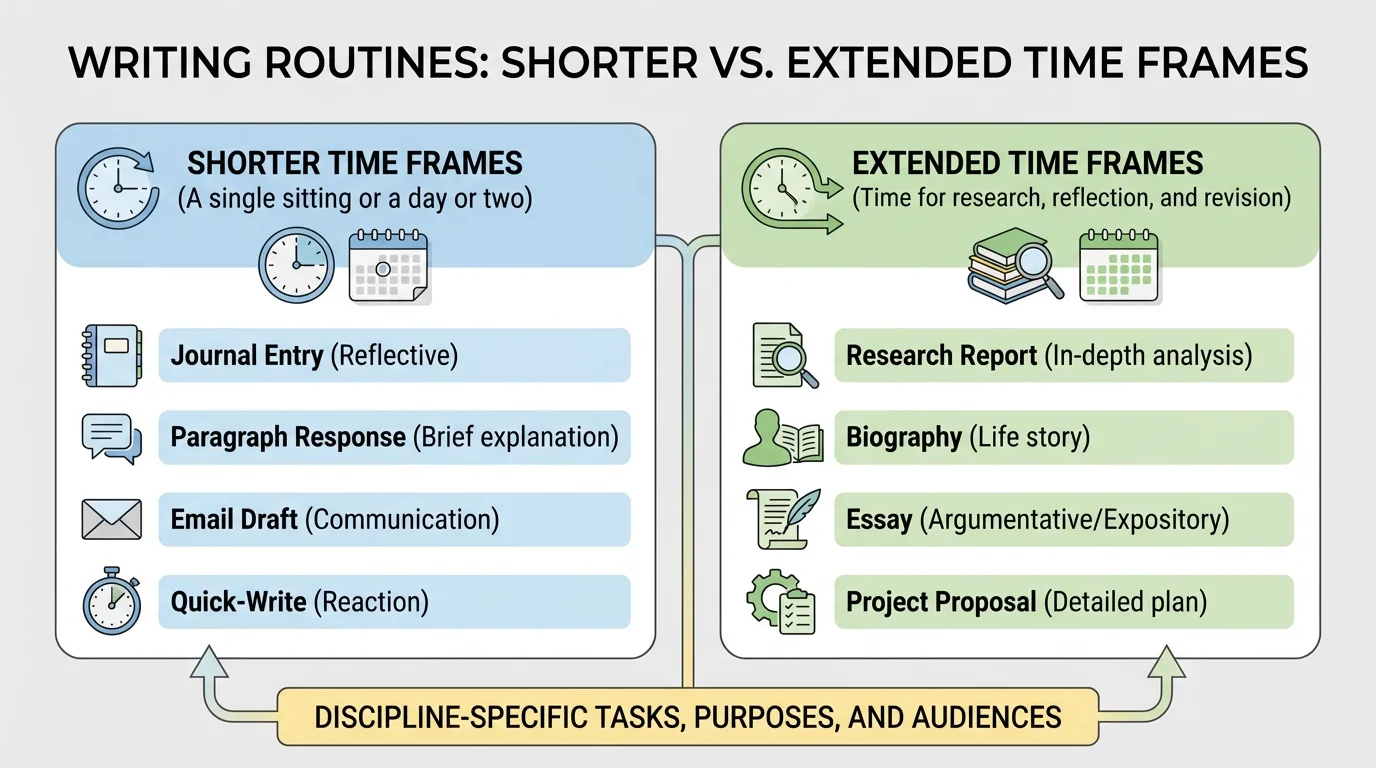
Examples of extended writing include research reports, biographies, stories with several scenes, and longer explanations in social studies or science. These pieces usually need more than one paragraph. The writer may gather facts, sort ideas into groups, and return to the work more than once.
As seen in [Figure 1], the time frame is not about whether the writing is "easy" or "hard." It is about what the piece needs. A short paragraph may be challenging because it must be clear and exact. A long report may take more time because it must include accurate facts and careful organization.
Good writers think about purpose, task, and audience. Purpose means the reason for writing. Audience means the person or group who will read it. Task means the actual assignment or job the writing must do.
A writer changes the writing depending on who will read it, as [Figure 2] illustrates. If a student writes about rainforests for a friend, the writing may sound friendly and casual. If the same student writes for the teacher, the writing may include stronger facts, clearer topic sentences, and more exact vocabulary.
Suppose the topic is recess. A note to a classmate might say, "I like recess because we can run and play games." A letter to the principal might say, "Our class believes recess is important because exercise helps students focus and work better in class." The topic stays similar, but the purpose and audience change the words and details.
Writers also choose details based on the task. A personal narrative tells what happened and how the writer felt. An informational paragraph explains facts. A persuasive piece gives reasons and tries to convince the reader. Each task needs a different structure.
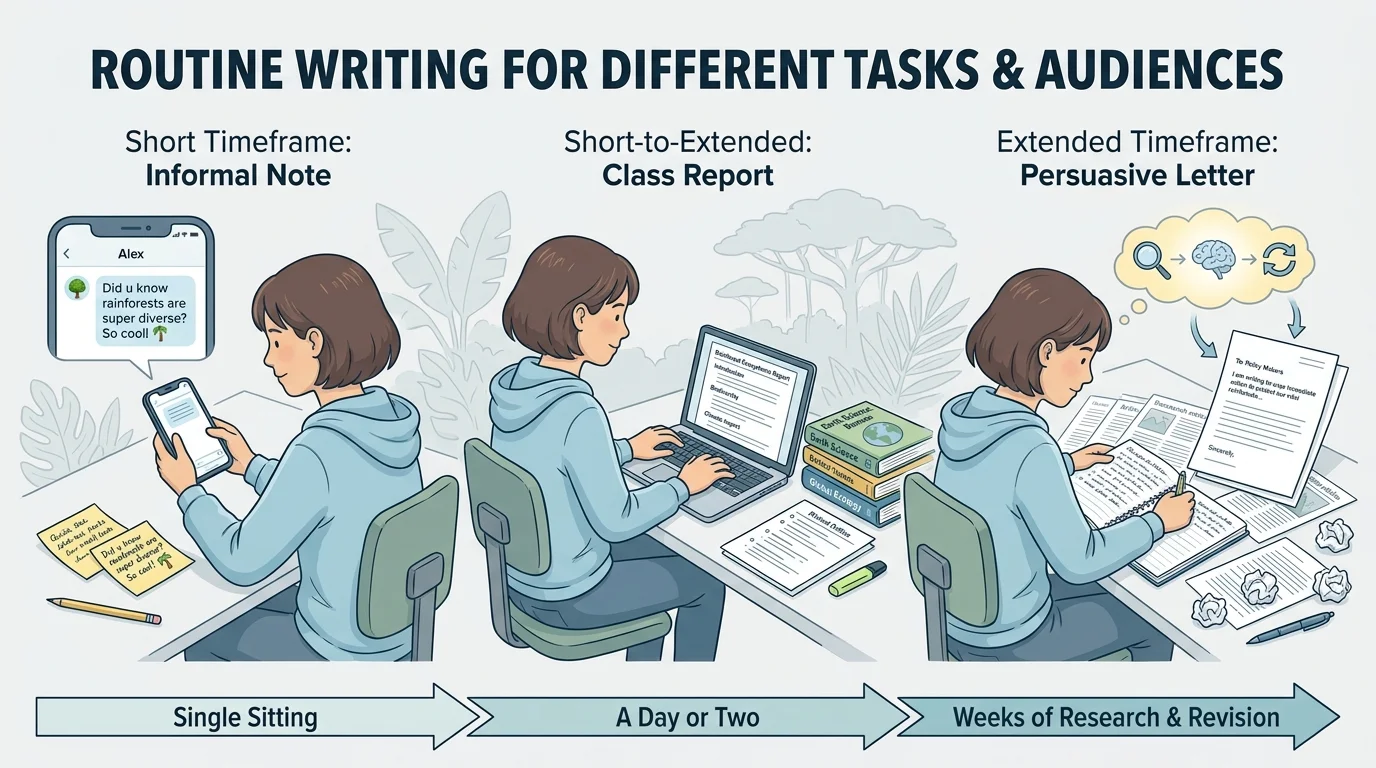
When writers understand purpose and audience, they can decide whether to sound formal or friendly, whether to include facts or feelings, and whether to write briefly or in more detail. This choice makes writing more effective.
Changing writing for different audiences
Topic: school garden
Step 1: For classmates
"The garden has tomatoes, sunflowers, and beans. We water it every week."
Step 2: For families in a newsletter
"Our class garden is growing well. Students are learning how plants need sunlight, water, and care."
Step 3: For the principal in a request letter
"We would like more garden tools because the garden teaches science skills and teamwork."
The audience changes the tone, the details, and the purpose of the writing.
The same idea can be shaped in different ways, which is why writers must always ask, "Who is reading this, and what do I want them to understand?"
Longer writing usually moves through several stages, and [Figure 3] shows how those stages connect. Writers do not simply write once and stop. They plan, gather information, draft, reflect, revise, and edit so the final piece says exactly what they mean.
The first stage is planning. A writer may brainstorm ideas, make a list, draw a web, or create an outline. Planning helps the writer decide what to include and in what order. Without planning, writing can become confusing or repetitive.
The next stage is research when the task needs facts. Research means finding information from trustworthy sources such as books, articles, classroom materials, or teacher-approved websites. A writer takes notes instead of copying whole sentences. Notes help the writer remember important facts in shorter form.
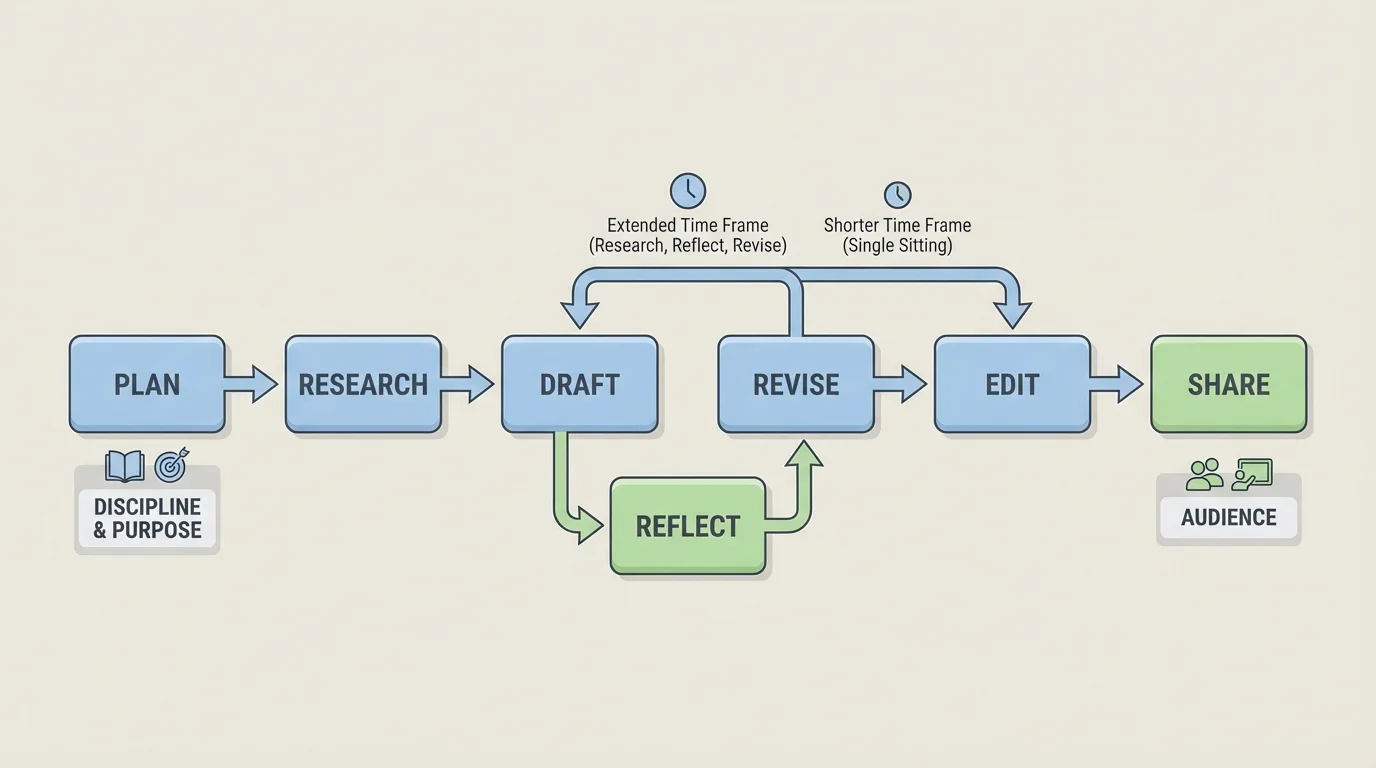
Then the writer creates a first draft. This is the time to get ideas down. The first draft does not have to be perfect. It should focus on the main ideas, examples, and organization.
After drafting comes reflection. Reflection means stopping to think about the writing. The writer may ask: "Did I answer the question? Does this part make sense? What details are missing?" Reflection helps the writer notice problems before making changes.
Next comes revision. Revision means improving the meaning and structure of the writing. Writers may add details, remove repeated ideas, move sentences, change weak words, or improve the order of paragraphs. Revision is not just fixing spelling. It is making the writing stronger.
After revision comes editing. Editing focuses on conventions such as capitalization, punctuation, spelling, grammar, and usage. Editing makes the writing easier for readers to follow. A sentence with missing punctuation can confuse a reader, even if the idea is good.
Finally, the writer shares or publishes the work. That may mean turning it in, reading it aloud, hanging it on a bulletin board, or posting it in a class book. Because the writing will be read by others, taking time to revise and edit matters.
Later, when writers work on reports or stories, they can look back at [Figure 3] and remember that strong writing grows step by step. Skipping planning or revision often leads to writing that feels rushed or unclear.
Revision and editing are not the same. Revision changes the ideas, details, order, or word choice to improve meaning. Editing fixes mistakes in grammar, punctuation, capitalization, and spelling so the writing is correct and clear.
This difference is important. If a writer edits first but never revises, the piece may be neat but still weak. If a writer revises but never edits, the ideas may be strong but hard to read.
Writing does not happen only during language arts. Students write in many subjects, and each subject has its own kinds of tasks. This is part of what it means to write for a range of discipline-specific tasks, purposes, and audiences.
In science, students may record observations, explain an experiment, or describe the life cycle of a plant. Science writing should be accurate, clear, and focused on facts. A student might write, "The plant grew taller after five days because it received sunlight and water."
In social studies, students may explain events, compare places, or write from the point of view of a historical person. This writing often uses facts, dates, and cause-and-effect thinking. The writer needs to organize information carefully.
In math, students may explain how they solved a problem. Even when the answer includes numbers such as \(8 + 7 = 15\), the writing matters too. A strong explanation might say, "I made a ten by taking \(2\) from \(7\), so \(8 + 2 = 10\), and then \(10 + 5 = 15\)." The words help the reader understand the thinking.
In reading, students may write responses about characters, setting, theme, or evidence from the text. These responses may be short or long depending on the assignment. A quick paragraph might answer one question, while a longer response might use several examples from the book.
The same student may need to write quickly in one subject and slowly in another. A science notebook entry may be written in one sitting, while a social studies report may take several days. As shown earlier in [Figure 1], good writers match the time frame to the work they are doing.
Writing is easier to understand when writers use the conventions of standard English. These conventions include grammar, usage, mechanics, and spelling. They are not merely additional features. They help readers understand exactly what the writer means.
Grammar helps sentences make sense. For example, "The dogs run outside" is clearer than "The dogs runs outside." The subject and verb must work together. A reader notices the meaning more easily when grammar is correct.
Usage means choosing the correct form of words. For example, writers need to know the difference between "their," "there," and "they're." These words sound alike, but they have different meanings.
Mechanics includes punctuation and capitalization. Capital letters begin sentences and name special places or people. Periods, question marks, commas, and apostrophes help readers know how to read the sentence. Compare these two examples: "Lets eat Grandma" and "Let's eat, Grandma." One small mark changes the meaning.
Spelling matters because readers can get stuck on a word that is written incorrectly. Correct spelling helps the reader move smoothly through the piece.
Complete sentences need a subject and a predicate. Paragraphs are easier to read when they stay focused on one main idea. Writers learn these skills early on, and they use them during both quick writing and longer projects.
When writers revise and edit, they should check whether each sentence is complete, whether verbs match their subjects, whether pronouns are clear, and whether punctuation helps guide the reader. These choices make meaning clearer for every audience.
| Writing feature | How it helps | Example |
|---|---|---|
| Capitalization | Shows where sentences begin and names important nouns | "Maria visited Colorado." |
| Punctuation | Guides how a sentence is read | "Are you ready?" |
| Correct grammar | Makes ideas sound natural and clear | "He runs fast." |
| Precise word choice | Gives exact meaning | "gigantic" instead of "big" |
| Paragraphing | Groups related ideas together | One paragraph for habitat, one for diet |
Table 1. Ways writing conventions help readers understand a piece more clearly.
When a longer project is being revised, writers often return to ideas from [Figure 3]. First they improve meaning, then they polish conventions. That order helps them focus on the biggest changes first.
Writing improves with practice. Writers who work routinely build habits that make writing easier over time. They learn to start without fear, save ideas, reread their work, and keep going even when writing feels tricky.
One good habit is to keep a list of possible topics. A student might write down memories, questions, favorite places, interesting animals, or things noticed during the day. This makes it easier to begin when a writing task appears.
Another habit is to reread after each paragraph. Rereading helps a writer notice missing words, repeated ideas, and places where the writing sounds strange. A writer can fix small problems before they become bigger ones.
Strong writers also learn to break longer work into smaller parts. Instead of thinking, "I have to finish the whole report today," a writer can think, "Today I will gather facts. Tomorrow I will write the introduction." Breaking work into steps makes extended writing feel manageable.
Professional authors almost never publish their first draft. They revise many times, just like students do when they improve a report, story, or opinion piece.
Writers become stronger when they write often for many reasons: to learn, to explain, to remember, to persuade, and to create. Routine writing practice builds confidence and skill.
One common problem is rushing. A student may finish quickly but forget to explain important ideas. The fix is to pause and ask, "Will my reader understand this?" If the answer is no, the writer needs more detail.
Another problem is weak organization. Ideas may jump around instead of following a clear order. Planning before writing and using topic sentences can help. In longer pieces, separate paragraphs should group related ideas together.
Some writers confuse revising with editing. They may check spelling but never improve the ideas. Remember that revision changes the writing itself. Editing checks the correctness of the final form.
Another problem is forgetting the audience. A piece written for a teacher may need fuller explanations than a note to a friend. Looking back at the idea in [Figure 2], writers can see that the same topic changes depending on who will read it.
Writers may also use vague words such as "good," "nice," or "thing." Better word choice makes writing stronger. Instead of "The animal was nice," a writer could say, "The dolphin was playful and curious." Specific words create a clearer picture.
When writers give themselves time to think, revise, and edit, their writing becomes clearer, more organized, and more powerful. Whether the task is short or long, strong writing comes from careful choices.
