Have you ever heard two people argue about the same thing and noticed that one person sounds much more convincing? It is often not because they speak louder. It is because they give clear reasons and strong evidence. Good listeners learn to notice why a speaker believes something and how the speaker tries to prove it. That skill helps you understand class discussions, speeches, videos, announcements, and even everyday conversations.
When you listen carefully, you do more than hear words. You figure out the speaker's message, the support behind it, and whether that support makes sense. This is an important part of listening and speaking because after you understand a speaker's ideas, you can respond with thoughtful questions instead of random ones.
People speak to share ideas, explain problems, tell stories, and persuade others. When a speaker wants the audience to believe something, the speaker usually gives a main point and then supports it. If you can identify that support, you become a stronger listener. You are less likely to be fooled by weak ideas, and you are more prepared to join a discussion in a smart and respectful way.
For example, suppose a student says, "Our class should plant a garden." That is not the whole argument. A careful listener asks: Why does the student think that? What proof does the student give? Maybe the student says a garden can provide vegetables, help students learn science, and make the schoolyard prettier. Those are reasons. Then maybe the student adds that another nearby school grew tomatoes successfully and that teachers can use the garden during science lessons. That is evidence.
Point is the main idea or claim a speaker wants the audience to understand or believe.
Reason is an explanation that tells why the speaker thinks the point is true or important.
Evidence is the support, example, fact, or detail a speaker uses to back up a reason.
When you identify points, reasons, and evidence, you can tell how a speaker builds an argument. This skill is useful in school when listening to a classmate present, to a teacher explain an idea, or to a guest speaker share information. It also helps outside school when listening to commercials, news, or people trying to convince you of something.
A point is the central idea the speaker wants you to notice. A speaker often has one big point and then supports it with several reasons and pieces of evidence, as [Figure 1] shows. If you miss the point, the rest of the speech may feel confusing because you do not know what all the details are trying to support.
A reason answers the question, "Why does the speaker think this?" Reasons are not random details. They connect directly to the point. If the point is "Recess should be longer," a reason might be "Students need more time to exercise." Another reason might be "A longer break can help students focus better in class afterward."
Evidence answers the question, "What makes that reason believable?" If the reason is that students need more time to exercise, the evidence might be that many students spend part of recess waiting for turns on the playground. If the reason is that a longer break helps focus, the evidence might be a teacher's observation that students work better after enough movement and fresh air.
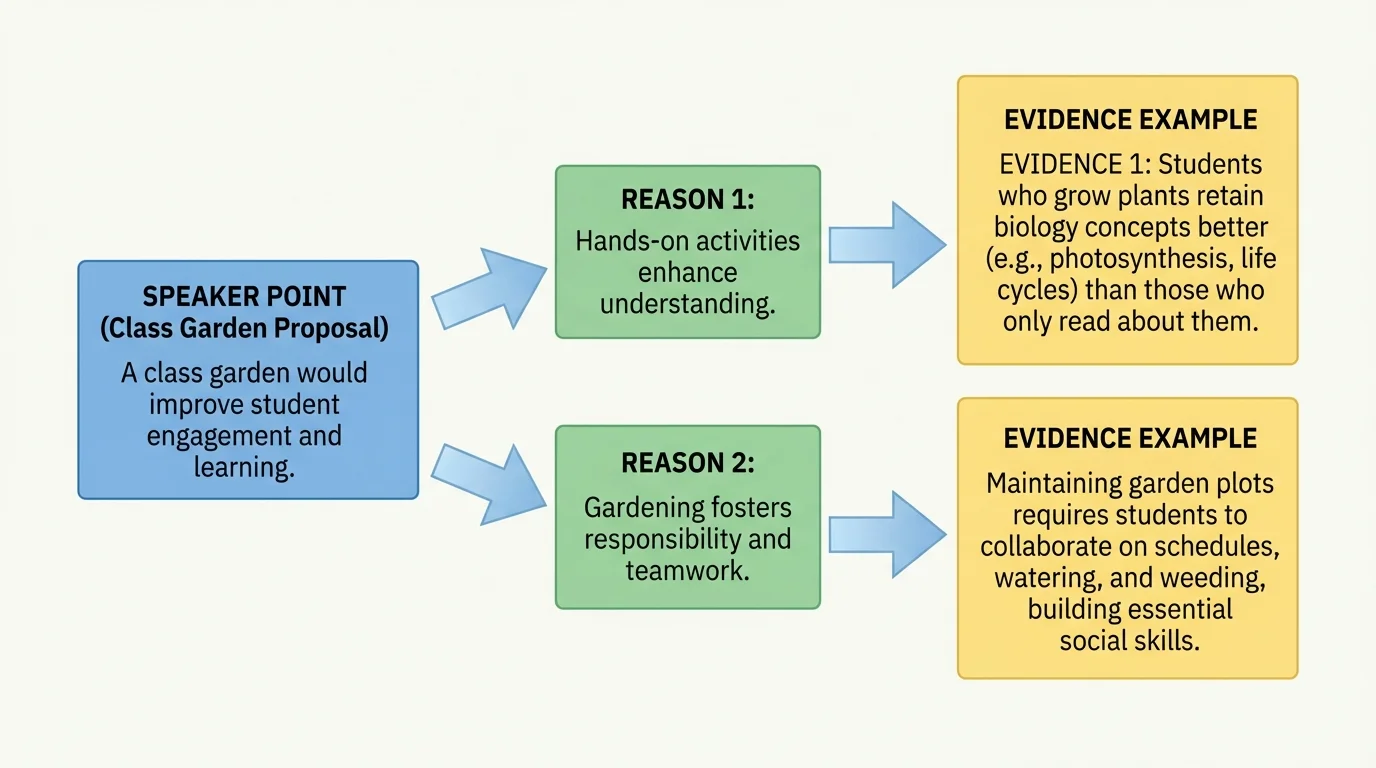
Here is another example. A speaker says, "We should have a reading corner in every classroom." That is the point. One reason is that students can read quietly when they finish work early. Another reason is that easy access to books encourages more reading. Evidence might include the speaker's observation that students often ask for books, or an example from another classroom where a reading corner is used every day.
Sometimes a speaker states the point clearly at the beginning. Sometimes the point is not said directly, so the listener must infer it from the speaker's words. If someone lists many benefits of walking to school safely with an adult or group, the hidden point may be that walking to school is a good choice for some families.
Evidence can come in several forms, and good listeners learn to recognize each type, as [Figure 2] illustrates. Not all evidence sounds the same. Some evidence is a fact, some is an example, and some is a personal experience or observation.
One kind is a fact. A fact is something that can be checked and proven true. If a speaker says, "Our library is open for one extra hour on Tuesdays," that is a fact if it can be confirmed by the schedule. Facts can be strong evidence because they are specific and testable.
Another kind is an example. An example shows what the speaker means. If a student says, "Hands-on projects help us learn," the student might give an example: "When we built a model bridge, I understood how strong shapes work." Examples make ideas easier to picture.
A speaker may also use an observation. An observation is something the speaker has noticed. For instance, "I have noticed that the hallway becomes crowded when everyone leaves at once." Observations can be useful, especially when the speaker directly saw or experienced the situation.
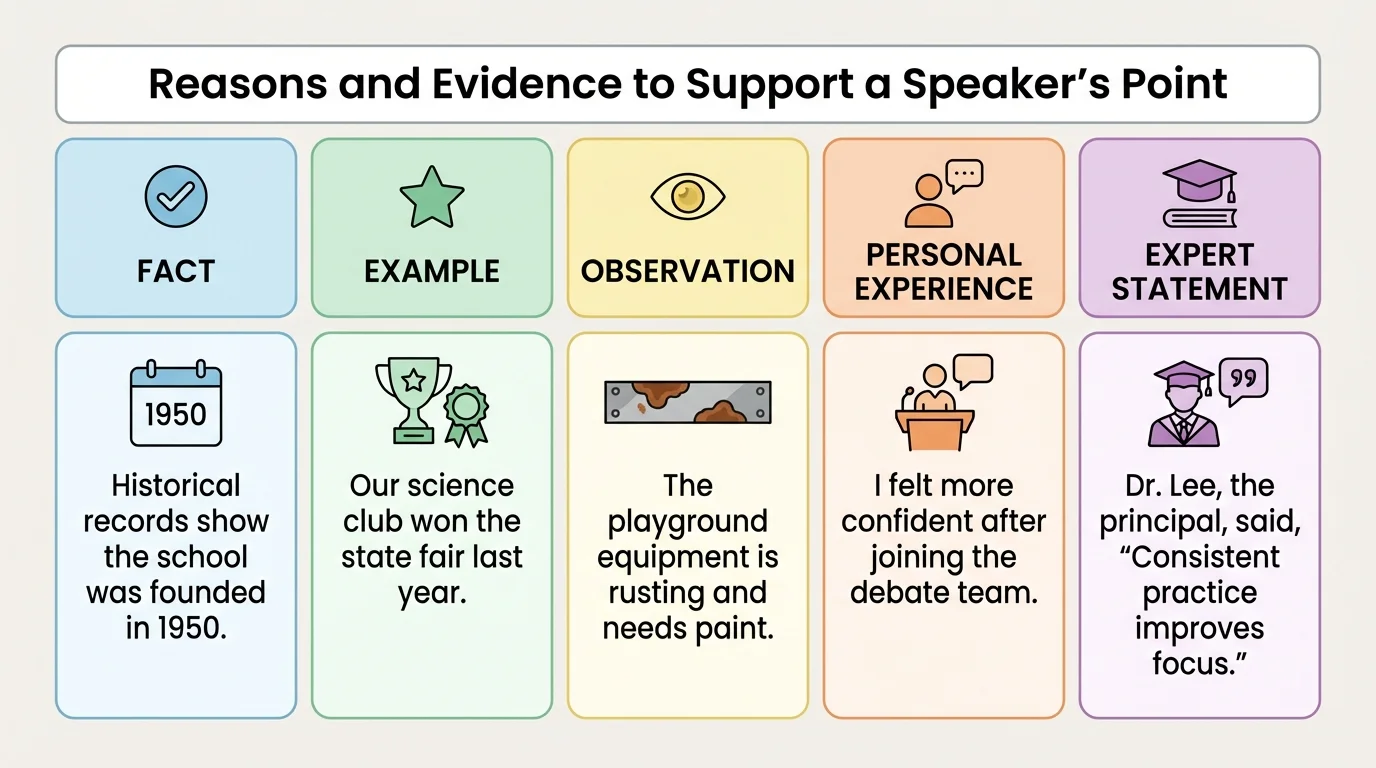
Another type is personal experience. A speaker might say, "When I practiced multiplication facts for a few minutes each day, I got faster." Personal experience can help the audience connect to the point, but it may not prove that the same thing always happens for everyone.
Sometimes a speaker includes information from an expert or trusted source. For grade 4 listeners, this may sound like, "The school nurse explained that washing hands helps stop germs from spreading." This can be strong evidence because it comes from someone with special knowledge.
Good listeners notice not only what type of evidence is used, but also whether the evidence actually supports the point. A funny story may be interesting, but if it does not connect to the point, it is not strong evidence.
| Type of support | What it does | Sample listening clue |
|---|---|---|
| Point | Tells the main idea | "I believe…" |
| Reason | Explains why | "because…" |
| Evidence | Proves or shows support | "for example…" |
Table 1. A simple comparison of point, reason, and evidence.
Not every reason is equally strong, and not every piece of evidence is useful. Strong support has a clear connection to the point. Weak support may be off-topic, too general, or based only on feelings without enough proof.
Suppose a speaker says, "Our school should have more trees." One reason might be "Trees give shade on hot days." That connects well. If the speaker then says, "I like the color green," that may be true, but it is a weak reason because it does not strongly support the need for more trees at school.
Strong evidence is usually relevant, which means it matches the point. It is also specific. "Many students stand in the sun during dismissal" is stronger than "Trees are nice." Strong evidence is also easier to trust when it is based on facts, careful observations, or clear examples.
How support fits together
A speaker's point is like the top of a stool, and the reasons and evidence are like the legs. If the legs are strong, the idea stands up well. If the legs are weak, the idea wobbles. Good listeners test whether each reason really holds up the point and whether the evidence truly supports the reason.
Sometimes speakers repeat the same reason in different words. Repeating a reason does not make it stronger. Also, one example may help, but several pieces of evidence are often better than only one. Careful listeners ask themselves whether the speaker gave enough support or just a little.
It is also important to notice when a speaker mixes opinion with evidence. An opinion is what someone thinks or feels. Opinions matter, but they are not always proof. If someone says, "This is the best lunch ever," that is an opinion. If they say, "More students chose this lunch than any other lunch this month," that sounds more like evidence.
To identify reasons and evidence, you need active listening. Active listening means paying close attention with your mind and body. You look at the speaker, avoid distractions, and think about the meaning of what is being said.
One helpful strategy is to listen for signal words. Speakers often use clues such as "because," "for example," "since," "this shows," "one reason," "according to," and "for instance." These words can point you toward reasons and evidence. If you hear "because," a reason may be coming next. If you hear "for example," evidence may follow.
Another strategy is brief note-taking. You do not need to write every word. You can jot down the point first, then list reasons underneath it, and add evidence next to each reason. This helps organize what you hear so you can remember it later.
As you listen, ask yourself silent questions: What is the speaker trying to prove? Why does the speaker believe it? What proof is being used? If you do this while listening, you will be ready to ask a thoughtful question afterward.
Your brain works harder when you actively sort what you hear into main ideas and details. That is one reason good listeners often remember more from a speech or discussion than people who only half-listen.
You should also pay attention to tone and word choice. Sometimes a speaker sounds very confident, but confidence alone is not evidence. A calm, clear speaker with strong support is more convincing than a loud speaker with weak support.
After listening closely, you can ask questions that connect directly to the speaker's point, reasons, and evidence. This process, shown in [Figure 3], helps you move from listening to meaningful speaking. Thoughtful questions show respect because they prove you were paying attention.
A strong question is specific. Instead of saying, "What?" you might ask, "What evidence shows that students would use the garden during science class?" That question connects to the speaker's reason and asks for clearer support.
You can ask questions to clarify the point. For example: "Is your main idea that every class should help in the garden, or just some classes?" You can ask about reasons: "Why do you think a longer recess would improve focus?" You can ask about evidence: "What example shows that another school's garden was successful?"
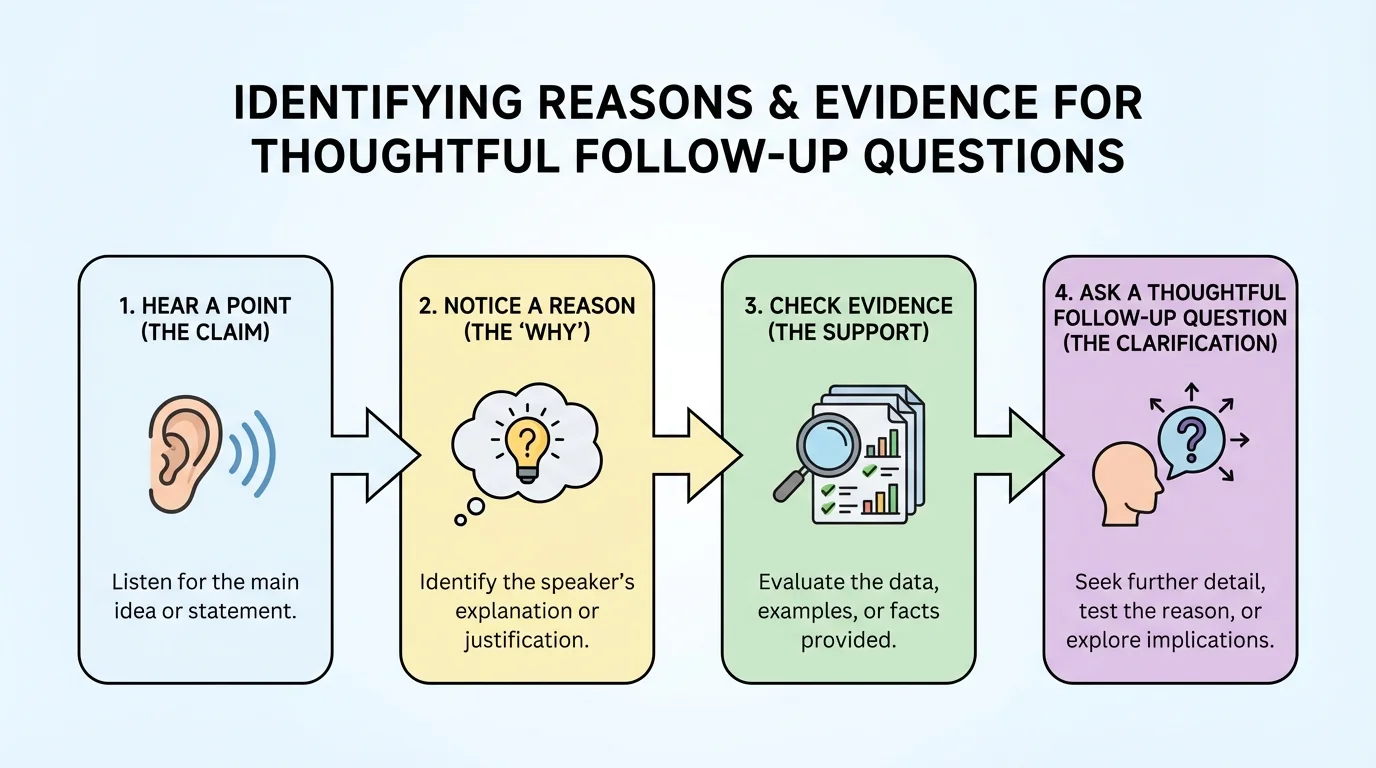
Good questions are polite and connected to the speech. They are not meant to embarrass the speaker. They are meant to help everyone understand the topic better. A thoughtful listener can disagree kindly by asking for more explanation instead of interrupting or arguing.
Later, when you think back to the support chart, it becomes easier to form questions. If you can name the point, then match each reason and each piece of evidence, you can tell exactly where you want more information.
Listening to a short speech and identifying support
A classmate says, "We should have a recycling bin in every classroom because it would reduce waste and teach students better habits. Last week I noticed many paper scraps in our trash can, and our art teacher said we throw away paper that could be recycled."
Step 1: Find the point.
The point is: "We should have a recycling bin in every classroom."
Step 2: Find the reasons.
The reasons are: it would reduce waste, and it would teach students better habits.
Step 3: Find the evidence.
The evidence is: the speaker noticed many paper scraps in the trash, and the art teacher said recyclable paper is being thrown away.
Step 4: Ask a thoughtful question.
A strong question could be: "What plan would help students know which paper should go into the recycling bin?"
Questions like that do more than repeat the speech. They push the conversation forward. As we saw with the types of evidence in [Figure 2], a thoughtful question can also ask what kind of evidence the speaker used and whether more evidence is needed.
This skill appears in many real situations. In class, your teacher may explain why a story character made a choice and support the explanation with details from the text. During a student presentation, a speaker might argue that a class pet would help students learn responsibility. On the playground, someone might try to persuade others to change a game rule and give reasons for fairness.
Advertisements also use reasons and evidence, though sometimes the evidence is weak. A commercial may claim that a snack is "the favorite choice." A smart listener asks, "Favorite according to whom?" If no clear evidence is given, the claim may not be very strong.
Family conversations use this skill too. A parent might say bedtime matters because sleep helps children grow and think clearly during the day. The reasons and evidence may come from experience, from a doctor, or from what the parent notices at home.
Even in sports, players and coaches use support. A coach might say, "Passing more often helps our team score because it moves the defense." Then the coach may use evidence from the last game, such as how several good chances came after quick passes.
One mistake is focusing only on the most exciting detail and missing the main point. A funny story may stand out, but it might not be the speaker's real message. Always ask yourself what idea the speaker wants you to take away.
Another mistake is thinking every detail is evidence. Some details are just extra information. Evidence must support a reason or point. If the detail does not help prove anything, it may not be evidence.
A third mistake is accepting weak support too quickly. Sometimes listeners agree because they like the speaker or because the idea sounds nice. But good listening means checking whether the speaker actually explained and supported the idea well.
You may already know how to find the main idea in a written paragraph. Listening for a speaker's point is similar. Then you go one step further by identifying the reasons and evidence the speaker uses to support that point.
Another mistake is asking questions that do not connect to what was said. If you ask a question just because it popped into your head, it may not show active listening. A thoughtful question grows from the point, the reasons, or the evidence you heard.
Careful listening is a habit. The more you practice hearing a speaker's point, reasons, and evidence, the easier it becomes. Soon you will notice patterns automatically. You will hear a claim and immediately begin thinking, "What reasons support that?" and "What evidence proves it?"
This habit makes you a better classmate and a stronger speaker too. When you give your own ideas, you will remember to include reasons and evidence because you know what listeners need. Strong speaking and strong listening work together.
When someone finishes speaking, pause before you respond. Think about the point, list the reasons in your mind, and check the evidence. Then ask a question or make a comment that matches what you heard. That is how thoughtful listeners become thoughtful speakers.
