Have you ever read something and wondered, "Wait, what is this even about?" Strong writers do not leave readers guessing. When you write an opinion piece, your job is to guide your reader from the very beginning. You need to state the topic, share your opinion, and organize your ideas so each reason fits where it belongs. That way, your writing feels clear, convincing, and easy to follow.
An opinion piece is a kind of writing in which a writer shares a point of view about a topic or a text and supports it with reasons and information. You might write about whether students should have more recess, which animal makes the best class pet, or whether a character in a story made a wise choice. No matter the subject, your writing should have a clear beginning, a logical middle, and an ending that reminds readers of your main point.
Topic is the subject of your writing. Opinion is what you think or believe about that topic. Organizational structure is the way ideas are arranged so readers can follow them. Reason is a cause that supports your opinion, and information includes facts, examples, or details that explain your reasons.
When these parts work together, your writing has a purpose. Your purpose is what you want your reader to understand, believe, or agree with. In opinion writing, the purpose is often to convince the reader that your opinion makes sense.
The beginning of an opinion piece is important because it opens the door for the reader. If the opening is confusing, the rest of the writing becomes harder to understand. A clear introduction tells the reader the subject and the writer's position early, as [Figure 1] demonstrates through the difference between a vague opening and a strong one.
Think of your introduction like the front sign of a store. A clear sign tells people where they are and what they will find inside. In the same way, the introduction tells readers what the writing is about and what the writer thinks.
A weak beginning might say, "I have something important to say." That sentence does not tell the topic. It does not tell the opinion. A stronger beginning might say, "Our school should have a school uniform policy because it can reduce distractions and help students feel part of one community." Now the reader knows both the topic and the opinion.
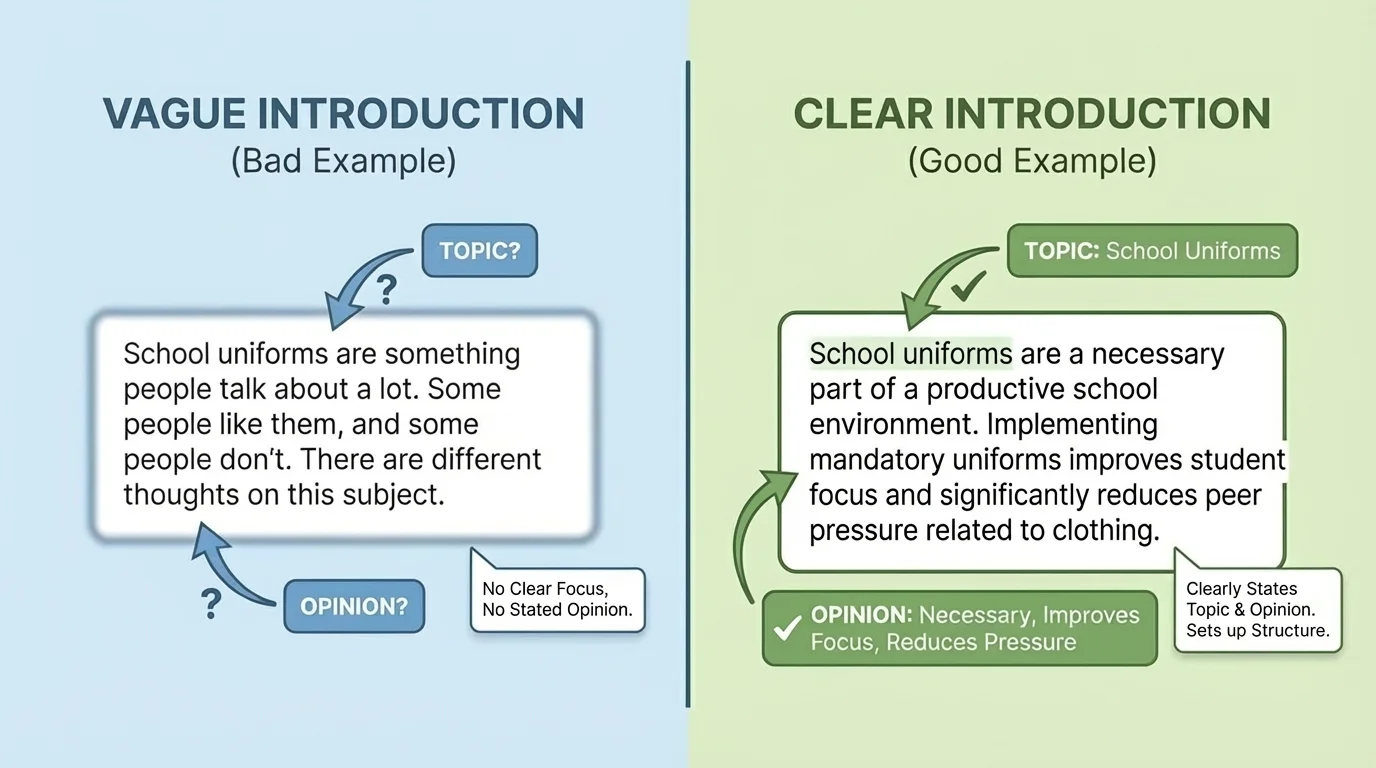
Clear beginnings do not need to be long. In fact, many strong introductions are short. What matters most is that the reader can answer two questions right away: "What is this about?" and "What does the writer think?"
To introduce a topic clearly, name it directly. If you are writing about a school issue, say what the issue is. If you are writing about a book, article, or story, name the text and give just enough background so the reader understands your opinion.
For example, if you are writing about a book, you might begin like this: "In Charlotte's Web, Fern shows kindness to animals from the very start. I think Fern is an important character because her actions help readers understand the value of compassion." The reader learns about the text, the character, and the opinion.
If you are writing about a topic instead of a book, you might say: "Many students would like a longer recess. I believe our school should add more recess time because students need movement, social time, and a short break to help them learn better." This opening is clear because it names the topic and states the opinion in one smooth beginning.
Good introductions include enough information, but not too much. A reader does not need every detail at the start. Save some information for the body paragraphs, where you explain your reasons more fully.
Professional writers often revise their introductions after they finish the rest of the piece. Once they know exactly what their writing says, they can make the opening clearer and stronger.
A topic can also come from a text. When that happens, be careful not to spend the whole introduction retelling the story. Retelling means giving a full summary. In an opinion piece, the story or article is only the starting point. Your opinion is the center.
Your opinion should sound confident and specific. A clear opinion tells exactly what you believe. It should not leave the reader guessing.
Compare these two sentences. "Books are interesting" is too broad. It sounds more like a general thought than a strong opinion. "Students should read mystery books because they build curiosity and make readers pay close attention" is stronger because it states a clear point of view.
Opinion statements often use words like should, best, better, or most important. These words help show the writer's position. Here are some examples:
A strong opinion should also match the rest of the writing. If your opinion says recess should be longer because it helps learning, then your reasons and information should connect to learning, movement, and student focus. If your reasons suddenly change to a different subject, the piece loses power.
Clear opinion versus fuzzy opinion
A clear opinion names the topic and the writer's position in a direct way. A fuzzy opinion sounds uncertain, too broad, or unrelated to the reasons that follow. Readers trust writing more when the opinion is specific and easy to understand.
Sometimes writers hide their opinion until the end of the introduction. That can work, but the opinion should still appear early. Readers should not have to search for it.
Once the topic and opinion are clear, the writer needs a strong organizational structure. This means ideas are arranged in a useful order. One of the best ways to do this is to group related ideas together, as [Figure 2] shows with one opinion connected to separate reason groups.
Imagine your opinion is: "Our school should have a longer recess." You may have three reasons: students need exercise, students need social time, and students come back to class more focused. Each reason belongs in its own group. Details about exercise should stay together. Details about social time should stay together. Details about focus should stay together.
This kind of grouping helps readers follow your thinking. If one paragraph starts with exercise, then jumps to friendship, then back to exercise, the writing feels messy. If all the exercise ideas stay in one place, the writing feels organized.
You can think of your writing like sorting school supplies. Pencils go with pencils, markers go with markers, and paper goes with paper. In writing, related ideas belong together too.
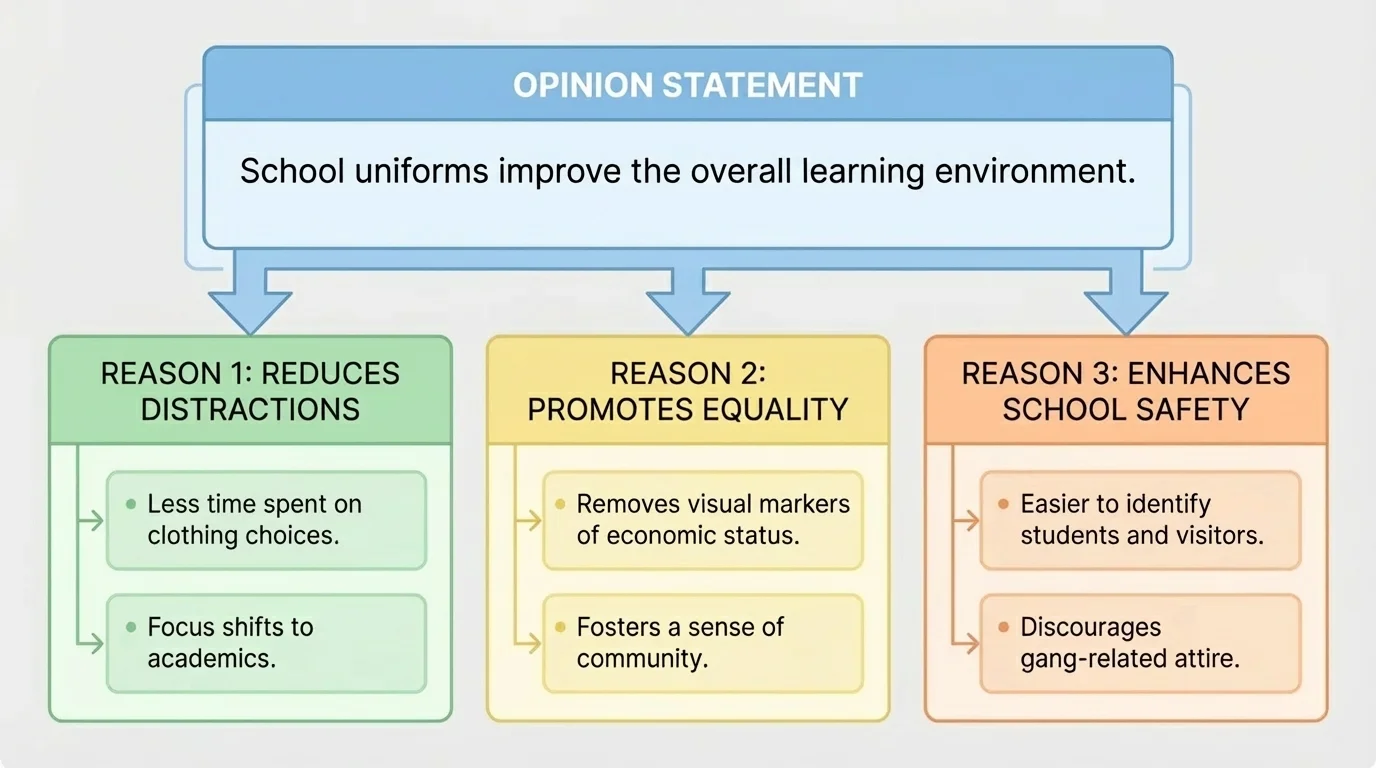
A simple opinion piece often follows this pattern:
This pattern is not the only possible structure, but it works well because readers can easily see how each part supports the writer's purpose. Later, when you build more complex writing, this same skill of grouping related ideas still matters.
This structure makes clear that every reason should have its own space. That helps each reason stand out instead of getting buried in a big mixed paragraph.
A reason tells why your opinion makes sense. But reasons alone are not enough. Strong opinion writing also includes information. Information can be facts, examples, details from a text, or explanations from your own thinking.
Suppose your opinion is that classroom plants are a good idea. One reason might be that plants make the room more inviting. To support that reason, you can add details such as how green spaces often feel calm, how students may enjoy caring for a living thing, or how a brighter classroom can feel more welcoming.
If your opinion is about a text, your support may come from events, characters, or details in the story. For example, if you believe a character is brave, you should explain what the character did that shows bravery. Instead of writing only "She is brave," write about the moment in the text that proves it.
Example: matching reasons and information
Opinion: "The cafeteria should serve more fresh fruit."
Step 1: State one reason.
"Fresh fruit is a healthier choice for students."
Step 2: Add information that explains the reason.
"Fruit contains vitamins and can be a better snack choice than foods with lots of added sugar."
Step 3: Make the connection clear.
"Because students eat lunch at school every day, offering fresh fruit can help them make healthier choices more often."
The reason and the information work together to support the opinion.
Every reason does not need the same number of details, but each one should be developed enough to make sense. A paragraph with only one short sentence usually needs more explanation.
Transitions are words or phrases that help writing flow from one idea to the next. They act like bridges. In opinion writing, transitions help readers understand when you are introducing a reason, adding information, or wrapping up your point.
Here are some common transitions for opinion writing:
| Purpose | Transition words or phrases |
|---|---|
| To add a reason | first, another reason, also, next |
| To explain | for example, for instance, in addition |
| To show cause and effect | because, so, therefore |
| To conclude | in conclusion, finally, for these reasons |
Table 1. Common transition words and phrases used in opinion writing.
Transitions do not do all the work by themselves. They help connect ideas, but the ideas still need to make sense. A piece of writing becomes stronger when transitions and clear organization work together.
For instance, a paragraph may begin, "First, a longer recess helps students get exercise." Then the writer can add, "For example, students can run, climb, and play games that keep their bodies active." The transitions show how the details connect.
Good opinion writing often starts with a plan. Writers may jot down a topic, an opinion, and a few reasons. Then they turn those notes into full paragraphs. This change from short notes to organized writing becomes easier when the writer follows a clear order, as [Figure 3] shows in an outline moving from notes to paragraphs.
Here is a sample plan:
Those notes can become a complete introduction: "Our school should add more recess time because students need exercise, time with friends, and a break that helps them focus in class." Then each reason can grow into its own paragraph with details and examples.
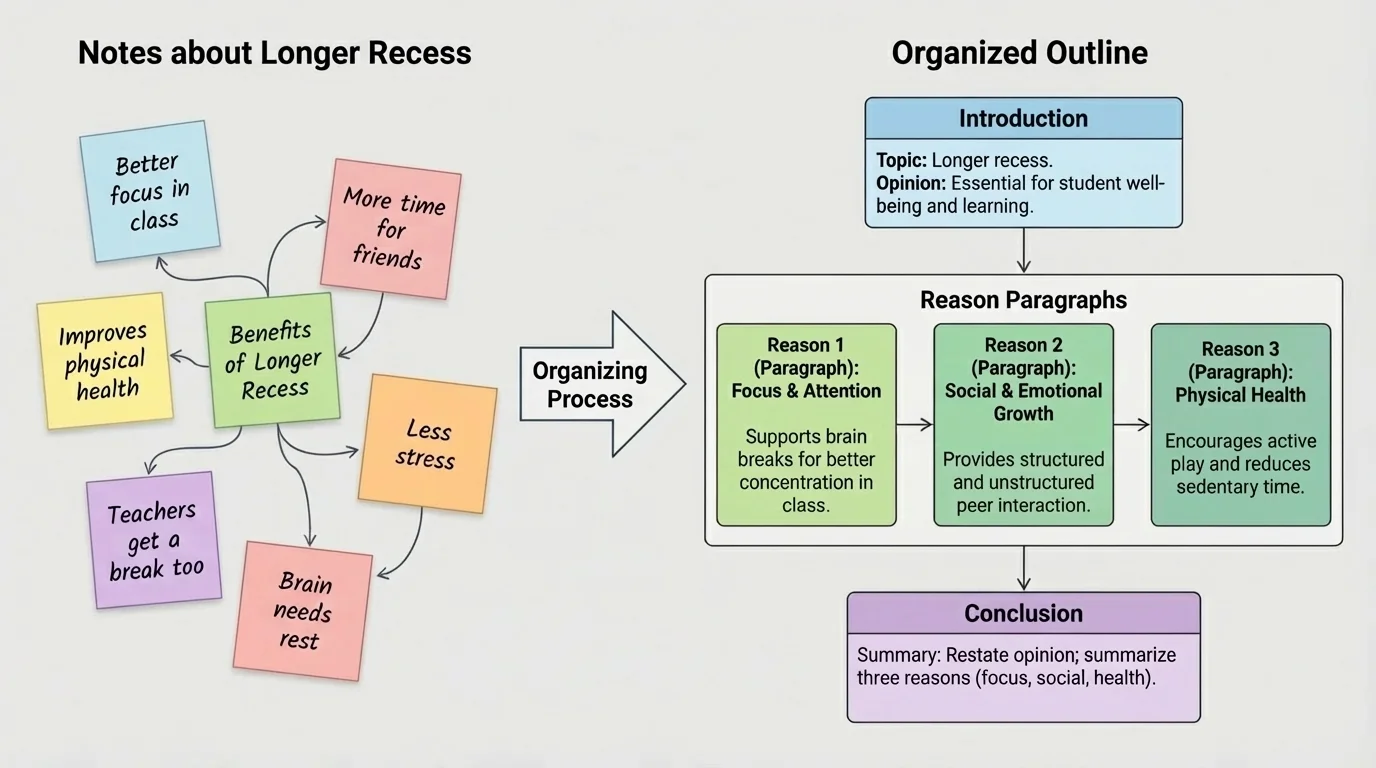
Notice that the introduction does not try to explain every detail. It sets up the main idea. The body paragraphs do the deeper work of supporting the opinion.
Example: turning a plan into organized writing
Topic: class pet
Opinion: "A fish is the best class pet."
Step 1: Write the introduction.
"A fish is the best class pet because it is peaceful to watch, easy to care for, and safe for most classrooms."
Step 2: Group each reason separately.
Paragraph one can explain why a fish is peaceful to watch. Paragraph two can explain why care is simple. Paragraph three can explain why fish are a safe choice.
Step 3: Add details that match each reason.
For the care paragraph, include ideas like feeding schedules, tank cleaning, and quiet behavior.
The piece becomes easier to read because each group of ideas stays together.
Later, this planning pattern can help with other topics too, including opinions about books, school rules, or community problems.
Writers often improve by spotting common problems. One problem is an unclear topic. If the reader cannot tell what the writing is about, the introduction needs to be more direct.
Another problem is a missing opinion. Sometimes a writer gives facts and details but never clearly says what he or she believes. The fix is simple: add a direct opinion statement near the beginning.
A third problem is mixed-up organization. This happens when related ideas are not grouped together. If one paragraph contains several different reasons, the writer can sort the sentences into clearer groups.
Writers can also lose focus by adding details that do not support the opinion. These details may be interesting, but if they do not help the purpose, they should be removed or moved.
From earlier writing work, you may remember that a paragraph usually centers on one main idea. Opinion writing uses that same skill. Each body paragraph should usually focus on one reason that supports the opinion.
Reading your writing aloud can help you notice these problems. If a part sounds confusing or jumps around, it may need better grouping or clearer transitions.
The ending of an opinion piece should connect back to the opinion. A conclusion does not need to repeat the introduction word for word. Instead, it reminds the reader of the main point in a fresh way.
For example, if the opinion is that students should have more recess, a conclusion could say: "For these reasons, a longer recess would make the school day healthier, friendlier, and more productive." This ending restates the opinion while bringing the reasons together.
A weak ending may stop suddenly or add a brand-new reason. A strong ending feels connected to the writing that came before it. It gives the reader a sense that the piece is complete.
"Say what you think, support it well, and make it easy for your reader to follow."
When you write with a clear topic, a direct opinion, and grouped ideas, your writing becomes stronger. Readers can follow your thinking from the first sentence to the last. That is the heart of effective opinion writing.
