Have you ever noticed that many big words are really made of smaller parts that carry meaning? If you know what those parts mean, a long word can stop looking scary and start acting like a puzzle you know how to solve. That is how readers figure out words such as telegraph, photograph, and autograph. Instead of guessing, strong readers look for clues inside the word itself.
When you read, you will meet words you already know and words that are new to you. You do not need to stop every time and look up each unknown word. Often, the word gives you clues. Many English words come from Greek and Latin. These older languages gave us word parts that still carry meaning today.
For example, if you know that root means the main part of a word and that certain roots appear in many words, you can start making smart guesses. If you know that graph has to do with writing or recording, then words like telegraph and autograph become easier to understand. This kind of word study helps with reading science, social studies, stories, and even instructions for games or technology.
English has borrowed thousands of words from Greek and Latin. That is one reason why learning a few word parts can help you understand many different words.
Learning word parts is useful because one clue can help with many words. If you learn one root, you may suddenly understand five or ten more words. That makes you a stronger, faster, and more confident reader. [Figure 1]
Words are built from parts, and those parts work together to create meaning. A prefix comes at the beginning of a word. A suffix comes at the end. An affix is a word part added to a root or base word, so prefixes and suffixes are both kinds of affixes.
The root is like the core of the word. The affixes add more information. In the word rewrite, the prefix re- means again, and the root write tells the action. So rewrite means to write again. In the word careless, the root is care and the suffix -less means without. So careless means without care.
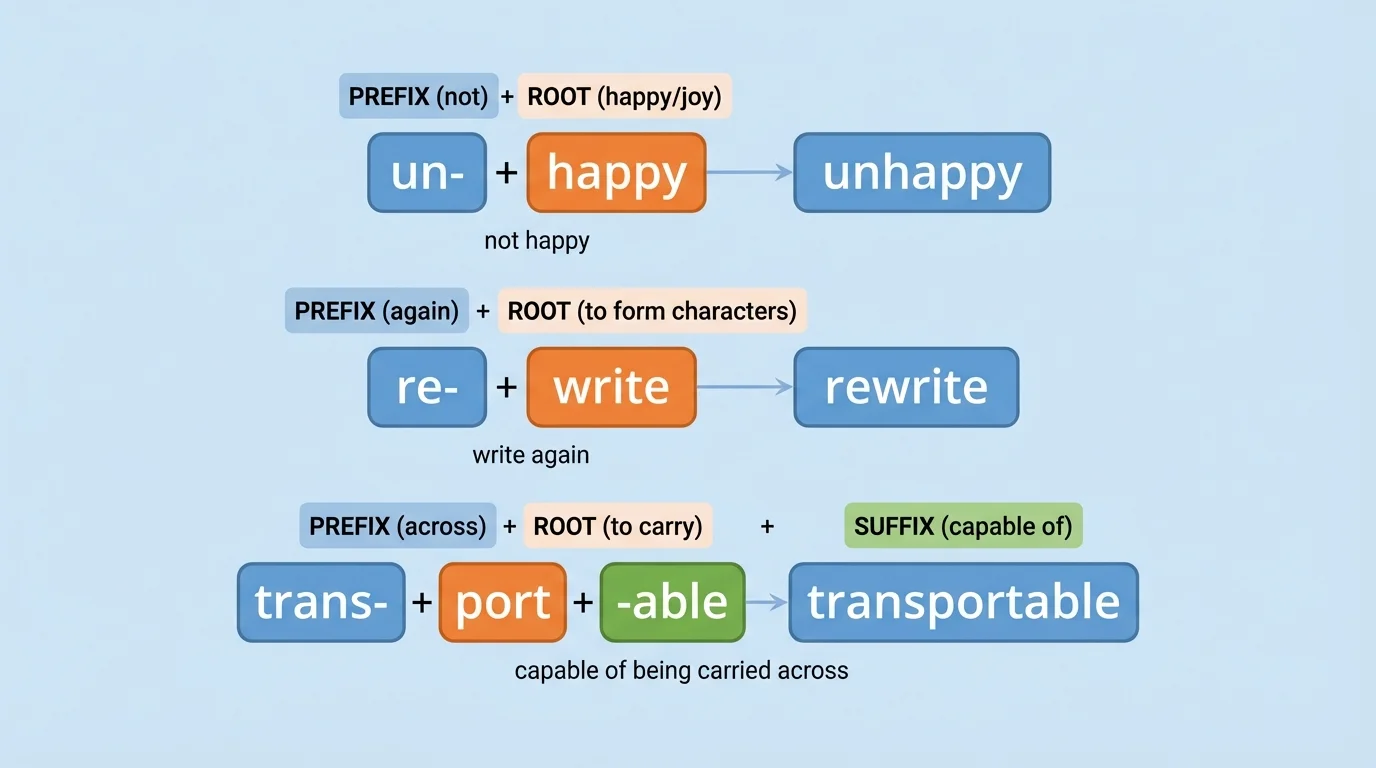
Sometimes a word has only a root or base word. Sometimes it has a root plus one affix. Sometimes it has several parts. In transportation, the root is related to carrying, and the extra parts help shape the full meaning. Big words often become easier when you break them into parts.
Root is the main meaning part of a word. Prefix is a word part added to the beginning of a word. Suffix is a word part added to the end of a word. Affix is a word part added to a root or base word.
Knowing these building blocks helps you decode multisyllable words. A multisyllable word is a word with more than one syllable. Many multisyllable words become much easier when you notice familiar parts inside them.
Some roots show up again and again in school reading. The root chart in [Figure 2] helps you see how one root can connect to several words. When you spot a familiar root, you gain an important clue about the word's meaning.
Here are some common Greek and Latin roots that are helpful in grade 4 reading:
| Root | Meaning | Example Words |
|---|---|---|
| tele | far, distant | telephone, television, telegraph |
| graph | write, record, draw | telegraph, autograph, paragraph |
| photo | light | photograph, photos, photocopy |
| auto | self | autograph, autobiography, automatic |
| bio | life | biology, biography |
| aqua | water | aquarium, aquatic |
| port | carry | transport, portable, import |
| struct | build | structure, construct, instruct |
Table 1. Common Greek and Latin roots, their meanings, and sample words.
Let's look closely at three important examples. In telegraph, tele means far and graph means write. A telegraph is a way to send writing over a distance. In photograph, photo means light and graph means record or draw. A photograph is an image recorded using light. In autograph, auto means self and graph means write. An autograph is a person's own writing, usually a signature.
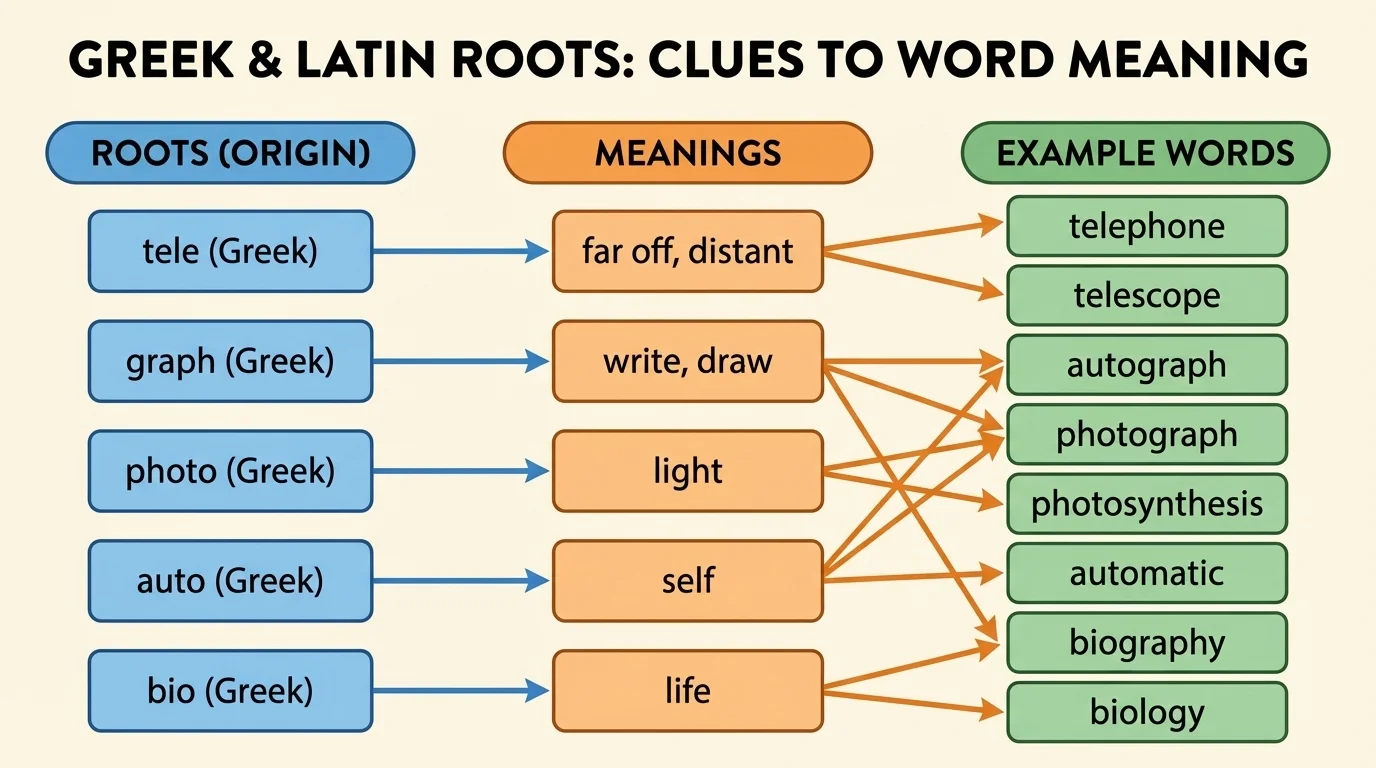
Notice how the root graph appears in all three words. That repeated root gives you a strong clue. Even if you have never seen one of those words before, you can use the root to make a smart guess.
The same idea works with other roots. If you see biology, you might notice bio, which means life. That tells you the word probably has something to do with living things. If you see aquatic, the root aqua suggests something connected to water. If you see portable, the root port helps you think of carrying.
Roots are meaning carriers. A root does not always tell you the whole meaning of a word, but it often points you in the right direction. Readers combine the root's meaning with other word parts and with the sentence around the word.
Later, when you meet a harder word, this same skill still helps. For example, if you remember the pattern from [Figure 2], you can notice that biography combines bio for life with graph for writing. That leads to the idea of writing about someone's life.
Roots are important, but affixes matter too. Prefixes and suffixes can change a word's meaning in powerful ways. A familiar prefix can tell you whether a word means again, not, before, or wrong. A familiar suffix can tell you about a person, a quality, or a condition.
Here are some common prefixes:
| Prefix | Meaning | Example |
|---|---|---|
| un- | not | unhappy = not happy |
| re- | again | replay = play again |
| pre- | before | preview = view before |
| mis- | wrongly, badly | misread = read wrongly |
| dis- | not, opposite of | disagree = not agree |
Table 2. Common prefixes and their meanings.
Here are some common suffixes:
| Suffix | Meaning | Example |
|---|---|---|
| -er | a person or thing that does something | teacher = a person who teaches |
| -ful | full of | hopeful = full of hope |
| -less | without | fearless = without fear |
| -y | having, full of | rainy = having rain |
| -able | can be | washable = can be washed |
Table 3. Common suffixes and their meanings.
Affixes are especially helpful with multisyllable words. If you know pre- means before, then prehistoric suggests a time before written records. If you know -less means without, then wireless suggests something without wires. If you know re- means again, then rebuild means build again.
As we saw with the parts in [Figure 1], readers do not have to know every part of a word perfectly at first. Even one known prefix or suffix can point you toward the correct meaning.
When you meet a word you do not know, do not panic. Use a strategy. Good readers slow down, examine the word, and test a meaning that fits the sentence.
Here is a helpful method, shown in [Figure 3]:
Step 1: Read the whole word carefully.
Step 2: Break it into parts you know, such as a prefix, root, or suffix.
Step 3: Think about what each part means.
Step 4: Put the meanings together into a possible definition.
Step 5: Read the sentence again and check whether your guess makes sense.
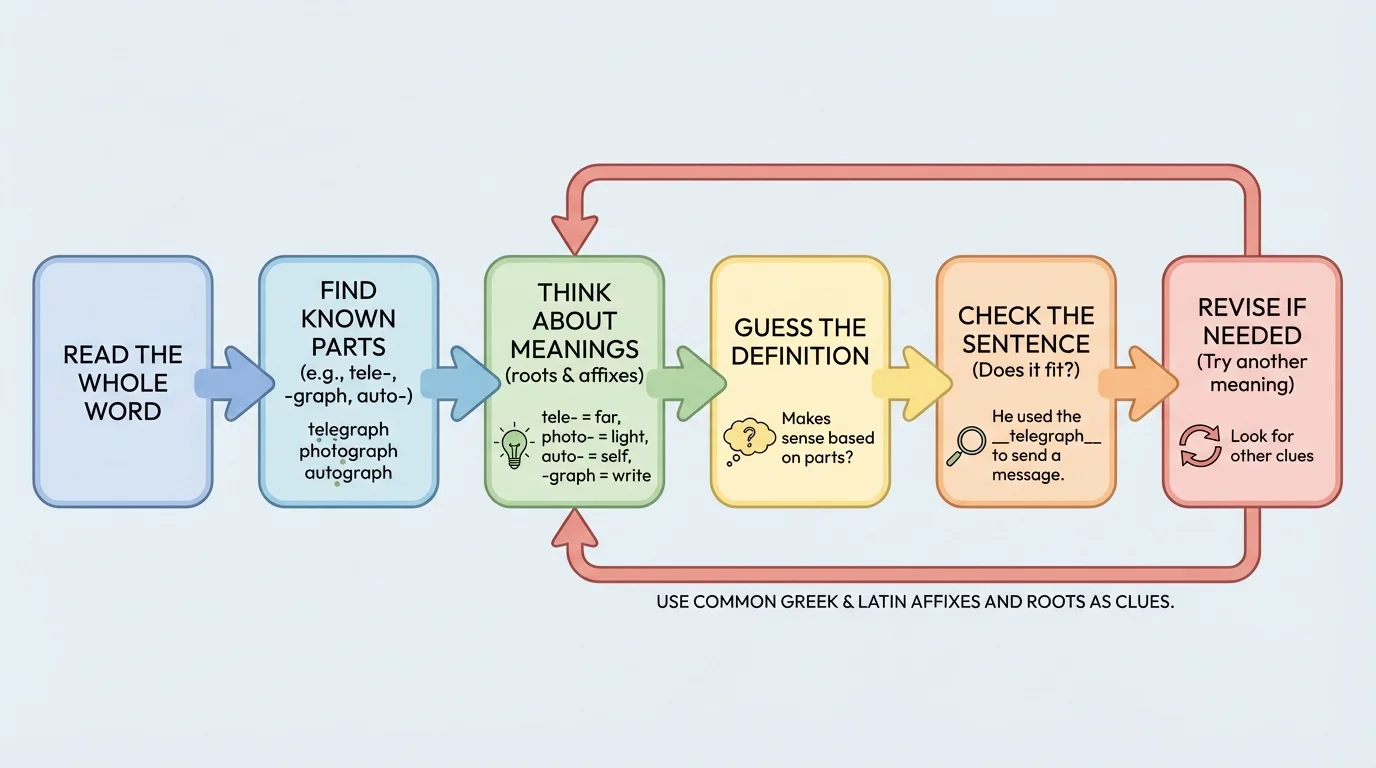
This strategy is useful because word-part clues are powerful, but they work best when you also use context. Context means the other words and sentences around the word. If your guessed meaning does not fit the sentence, you may need to revise it.
Example: figuring out "preview"
Sentence: "We watched a preview of the movie before the full show began."
Step 1: Notice the prefix pre-.
Pre- means before.
Step 2: Look at the rest of the word.
View means to see or watch.
Step 3: Combine the meanings.
Preview means something you see before the main event.
The sentence confirms the meaning because the preview happens before the full movie.
You can use the same process with longer words. If you know one root and one affix, you already have a strong start.
Word parts are clues, not magic answers. Sometimes a root points to a general idea instead of one exact meaning. For example, graph can connect to writing, drawing, or recording. Those ideas are related, but they are not always exactly the same.
Think about paragraph. The root graph still connects to writing, but the whole word does not mean "far writing" or "self writing." It means a section of writing. That is why readers should use root meanings along with the whole word and the sentence context.
Remember that readers use more than one strategy at a time. Sounding out syllables, noticing spelling patterns, looking for roots and affixes, and using context all work together.
Some words also have meanings that changed over time. The root can still help, but it may not tell the complete story. That is normal. The goal is not to guess perfectly every time. The goal is to use clues wisely so that your understanding keeps improving.
Let's apply this skill to words you might meet in books and subjects across school.
Telegraph: tele means far and graph means write. The word suggests sending written messages across a distance.
Photograph: photo means light and graph means record. The word suggests an image recorded with light.
Autograph: auto means self and graph means write. The word suggests someone's own writing or signature.
Biography: bio means life and graph relates to writing. A biography is writing about a person's life. The root pattern from [Figure 2] helps make this word easier to decode.
Transport: port means carry. To transport is to carry from one place to another.
Restructure: the prefix re- means again, and struct means build. To restructure is to build again in a new form.
Example: figuring out "portable"
Sentence: "The speaker is portable, so we can carry it to the park."
Step 1: Find the root.
Port means carry.
Step 2: Notice the suffix.
-able means can be.
Step 3: Combine the parts.
Portable means can be carried.
The context about taking the speaker to the park supports that meaning.
These examples show that morphology, or the study of how words are formed and structured, is a strong reading tool. When you know how words are built, books become more understandable.
A smart reader does not stop after finding one clue. The reader checks the sentence. Suppose you see a word with photo. You might think about light or pictures, but you should still ask, "What is happening in the sentence?" That extra check helps prevent mistakes.
The strategy flow in [Figure 3] reminds us to test our guess. If the meaning does not fit, we go back, look at the parts again, and try a better idea. This is exactly what skilled readers do when reading chapter books, articles, and textbooks.
Context is especially important when a word part has more than one related meaning. Roots and affixes help you get close. The sentence helps you choose the best meaning.
"Big words are often small clues working together."
The more you notice roots and affixes, the more familiar they become. Soon, instead of seeing a long string of letters, you will start seeing meaningful parts. That habit builds reading power across every subject.
